
Evaporating Black Holes and Baths
Guiding question. Holographic black holes in AdS normally live in a box. What exactly must be added to make them evaporate, and what is the radiation system whose entropy will later be computed by the island formula?
The island formula is often advertised as the instruction that, after the Page transition, the entropy of Hawking radiation should be computed by including an unexpected gravitating region in the entanglement wedge of the radiation. That sentence is memorable, but it hides the first essential step: one must define the radiation system.
In ordinary asymptotically flat language, the radiation is collected near future null infinity. In AdS/CFT, however, the usual boundary conditions reflect radiation back into the bulk. A large AdS black hole is therefore not automatically an evaporating object. It is closer to a black hole in a finite box, in equilibrium with its own Hawking radiation.
Modern island calculations avoid this ambiguity by attaching the gravitating black-hole region to an auxiliary system, usually a nongravitating bath, and then asking for the fine-grained entropy of a region in that bath. The bath acts as a reservoir or heat sink. It lets Hawking quanta escape, and, because it is nongravitating, it gives us an ordinary Hilbert-space region whose entropy can be defined without the gravitational factorization subtleties discussed in the previous module.
Schematically, the setup is
The full coupled system can still be closed and unitary, but the black hole subsystem is open: energy and information can flow into the bath. The Page curve is then a statement about
where is the part of the bath chosen as the collected Hawking radiation.
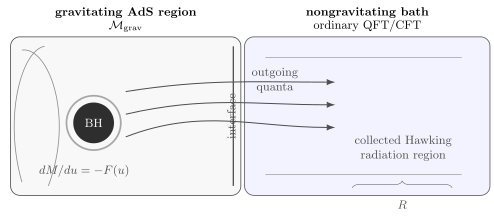
A standard island setup couples a gravitating AdS region to a nongravitating bath through transparent or absorbing boundary conditions. The radiation region lies in the bath, while the black-hole region remains gravitational. This separation is what makes an ordinary fine-grained entropy before the island prescription is applied.
This page sets up the kinematics and bookkeeping. The next page will ask the central dynamical question: when we compute , why should a region behind or near the horizon be included in the entropy functional?
1. Why AdS black holes do not evaporate by default
Section titled “1. Why AdS black holes do not evaporate by default”A black hole in asymptotically flat spacetime can emit Hawking radiation to infinity. In global AdS, the conformal boundary is timelike. With the standard reflecting boundary conditions used in the simplest AdS/CFT dualities, radiation emitted by the black hole reaches the boundary and returns. The black hole may exchange energy with its surroundings, but it does not lose energy irreversibly to infinity.
The timescale for a light ray to cross global AdS is of order the AdS radius . Thus, after a time , outgoing radiation can return to the black hole. A large stable AdS black hole is therefore best thought of as being in a thermal ensemble, dual to a thermal state of the boundary CFT. In that setting there is no ordinary evaporation process and no literal Page curve for radiation escaping to infinity.
There are three common ways to modify the story:
- Reflecting AdS boundary conditions. The black hole remains in an AdS box. This is the natural setting for eternal black holes and thermofield-double states, but not for evaporation.
- Absorbing boundary conditions. Radiation reaching the boundary is absorbed by an external system. In the boundary theory this corresponds to coupling the CFT to additional degrees of freedom that remove energy.
- Transparent coupling to a bath. The gravitating region is glued to a nongravitating system so that matter fields can propagate across the interface. The bath can be at zero temperature, finite temperature, or in a more general state.
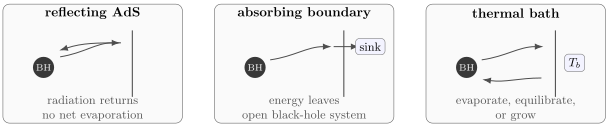
The same AdS black hole has different physical interpretations depending on boundary conditions. Reflecting boundary conditions make AdS a box. Absorbing or transparent boundary conditions allow energy to leave the gravitating region. A thermal bath can also send energy back into the black hole.
The island literature usually works with the second or third option. This is not merely a technical trick. It is the clean way to turn the question “what is the entropy of the Hawking radiation?” into a precise quantum-information question.
2. The gravitating region plus bath as a quantum system
Section titled “2. The gravitating region plus bath as a quantum system”A useful effective description is
Here is the gravitational action in the black-hole region, denotes matter fields that can carry Hawking radiation, is the action of the auxiliary nongravitating system, and imposes the coupling at the interface. In two-dimensional examples, the matter sector is often a CFT, and the bath may be another half-line CFT glued to the gravitating region.
The basic division is
but this equation should be read with care. The bath has an ordinary Hilbert-space factorization. The gravitational region does not have a canonical local tensor-factor decomposition because of constraints and gravitational dressing. That is precisely why the radiation region is placed in a nongravitating bath: the reduced density matrix is then an ordinary object.
If the full gravitating-plus-bath system begins in a pure state and evolves unitarily, then
remains pure. The black hole alone can nevertheless appear to lose information if one ignores the bath. The Page curve is about the redistribution of quantum correlations between the remaining black-hole degrees of freedom and the bath radiation.
In formulas, choose a radiation region and define
where includes the rest of the bath and all gravitating degrees of freedom. The entropy of interest is
This is the entropy that will later be computed by the island formula.
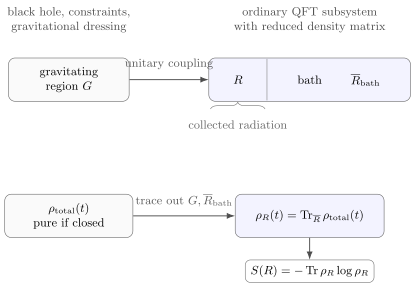
The full gravitating-plus-bath system may evolve unitarily, while the radiation region is only a subsystem. The entropy is computed from the reduced density matrix obtained by tracing out the black hole, the rest of the bath, and any degrees of freedom not included in the collected radiation.
3. What exactly is the radiation region ?
Section titled “3. What exactly is the radiation region RRR?”The symbol does not mean “all Hawking radiation” in an automatic or metaphysical sense. It means a specified nongravitating subsystem whose entropy we decide to measure. Common choices include:
- a half-line in the bath after some retarded time;
- a finite interval in the bath;
- both left and right bath regions in a two-sided setup;
- the complete bath degrees of freedom that have interacted with the black hole up to a time ;
- an auxiliary quantum memory that stores emitted quanta.
The entropy can depend on this choice. For example, if is too small, it may not contain enough radiation to display a Page transition. If contains the entire bath and the full system is pure, then equals the entropy of the complementary gravitating subsystem, modulo the gravitational subtleties that the island formalism handles.
A common choice in two-dimensional models is to introduce null coordinates and in the bath and take to be a region near future null infinity or a late-time interval on the bath. Then can be computed using ordinary CFT formulas.
For a two-dimensional CFT interval with endpoints in flat space, the vacuum entropy has the schematic form
for a spacelike interval, with the appropriate conformal factors included in curved or Weyl-rescaled coordinates. In island calculations this ordinary matter entropy becomes
where is a candidate gravitating region. The bath is where lives; the island is something the entropy functional may add later.
4. Evaporation as energy flux
Section titled “4. Evaporation as energy flux”At the semiclassical level, evaporation is described by an outward energy flux. Let be a retarded time in the bath. If is a parameter measuring the black-hole mass, then
where is the outgoing flux into the bath. In a simple two-dimensional CFT model at temperature , the chiral thermal flux is
and the entropy flux of the outgoing chiral radiation is
These are coarse-grained thermodynamic formulas. They say how much entropy a locally thermal stream appears to carry. They do not by themselves compute the fine-grained von Neumann entropy . The information paradox arises because the semiclassical fine-grained calculation without islands closely tracks this growing thermal entropy, while unitarity requires the entropy of all collected radiation to decrease after the Page time.
The black-hole entropy decreases according to the first law. If the black hole is approximately in local equilibrium, then
The Page time is roughly when the entropy in the radiation has become comparable to the remaining black-hole entropy. The exact coefficient is model-dependent, because it depends on spacetime dimension, greybody factors, the bath state, and which radiation region is chosen. The robust point is the competition:
while
The next page will turn this competition into the formula .
5. Why the bath is usually nongravitating
Section titled “5. Why the bath is usually nongravitating”The bath is often taken to be nongravitating for three related reasons.
First, it gives an ordinary definition of a subregion. In a nongravitating QFT, a spatial region has a standard operator algebra and an ordinary reduced density matrix. In gravity, constraints obstruct naive factorization across spatial regions. One must use dressed operators, edge modes, or algebraic definitions.
Second, the bath gives an operational meaning to collection. One can imagine detectors, memories, or an auxiliary CFT that stores the outgoing Hawking quanta. The entropy is then the entropy of a real subsystem external to the gravitational region.
Third, the bath prevents the computation from being circular. If the radiation remained inside a closed gravitating universe, then defining “the entropy of the radiation region” would itself require the gravitational entropy technology we are trying to test. By placing in a nongravitating bath, we isolate the gravitational subtlety in the possible island .
This does not mean gravitating baths are impossible. They are important in more ambitious models, and they raise deep questions about gravitational subsystems. But the cleanest island formula is first stated for a nongravitating radiation region.
6. One-sided and two-sided evaporating geometries
Section titled “6. One-sided and two-sided evaporating geometries”There are two common geometric templates.
One-sided evaporation
Section titled “One-sided evaporation”A black hole forms from collapse in a gravitating region and then radiates into a bath. This is closest to the physical story of an evaporating black hole. The Penrose diagram has a future singularity, an apparent horizon, and outgoing radiation captured in the bath. The radiation region is usually chosen at late retarded time.
Two-sided evaporation
Section titled “Two-sided evaporation”An eternal two-sided black hole is coupled to one or two baths. One side may be made absorbing, or both sides may exchange radiation with external systems. This setup is technically convenient because the initial state can be a thermofield double and the geometry is highly controlled. It is also natural in JT gravity.
The two-sided setup is not a different paradox. It is a laboratory in which the Page transition, quantum extremal surfaces, and entanglement wedge reconstruction can be computed cleanly.
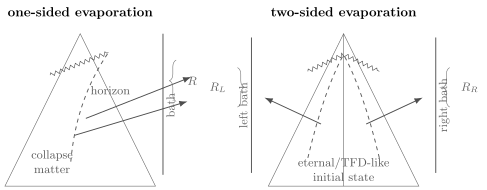
Island calculations use both one-sided and two-sided evaporating setups. In a one-sided geometry, a formed black hole radiates into a bath. In a two-sided geometry, an initially eternal black hole is coupled to external systems, often allowing a controlled description of the Page transition.
7. The semiclassical no-island calculation
Section titled “7. The semiclassical no-island calculation”Before islands enter, the natural semiclassical calculation is simply the matter entropy of the radiation region in the evaporating background:
This calculation treats the background geometry semiclassically and traces over the interior partners of Hawking quanta. It reproduces the Hawking expectation: the entropy of the radiation grows as more quanta are emitted. In a two-dimensional CFT model, this growth can often be computed explicitly from interval entropies in coordinates adapted to the evaporating geometry.
The no-island calculation is not “wrong” in the sense of a bad local QFT calculation. It is the contribution of one saddle or one candidate entropy functional. The modern claim is that after the Page time it is not the dominant fine-grained gravitational entropy saddle. A second candidate appears:
The island formula says to extremize this expression over and then choose the minimal generalized entropy. In this page, however, the important point is just the setup: is in the bath, and , if it appears, is in the gravitating region.
8. The interface and transparent boundary conditions
Section titled “8. The interface and transparent boundary conditions”In many two-dimensional models, the gravitating region and the bath are joined along an interface. A transparent interface allows matter stress tensor to pass through without reflection. Roughly,
with similar matching for the other null component depending on the setup. If the bath is at zero temperature, outgoing Hawking radiation is absorbed and no incoming thermal radiation returns. If the bath is at finite temperature, there is both outgoing and incoming flux, and the black hole can evaporate, equilibrate, or grow depending on the relative temperatures.
For island physics, the important features of the interface are:
- it permits energy and entropy to leave the gravitational region;
- it keeps the bath nongravitating;
- it gives a place where bulk matter fields can be treated continuously across the gluing;
- it lets ordinary CFT entropy formulas be applied to intervals that pass through the interface, after including the correct conformal factors.
The interface is not itself the island. It is the plumbing that makes an evaporating black-hole experiment possible.
9. JT gravity as the standard laboratory
Section titled “9. JT gravity as the standard laboratory”Many explicit calculations use Jackiw–Teitelboim gravity coupled to a large- matter CFT. The JT action has the schematic Lorentzian form
The metric is locally AdS, while the dilaton measures the transverse area inherited from a higher-dimensional near-extremal black hole. The generalized entropy of a pointlike QES in JT gravity is therefore
JT gravity is useful because:
- the gravitational dynamics are simple;
- the matter entropy can often be computed by CFT methods;
- near-extremal black holes have a controlled AdS throat;
- QES locations reduce to points rather than codimension-two surfaces;
- the Page transition can be displayed analytically or semi-analytically.
But JT gravity is a laboratory, not the full problem. It captures the near-horizon, low-energy, nearly AdS sector of certain black holes. It does not by itself solve every issue about higher-dimensional evaporation, asymptotically flat spacetime, or microscopic Hilbert-space factorization.
10. Open-system language versus closed-system unitarity
Section titled “10. Open-system language versus closed-system unitarity”It is useful to separate two perspectives.
From the black hole’s perspective, the bath makes the black hole an open system. The black-hole density matrix evolves non-unitarily because energy and information leave:
From the total system’s perspective, the evolution can still be unitary:
The information paradox is not the statement that open systems have increasing entropy. That would be ordinary quantum mechanics. The paradox is that semiclassical gravity appears to predict that the Hawking radiation itself remains fine-grained mixed even after the black hole disappears, while a unitary microscopic theory would say that the complete radiation should purify.
The bath formalism lets us express this precisely. The Page curve is the expected behavior of when contains the complete emitted radiation. Early on, grows. After the Page time, newly emitted quanta should be correlated with earlier radiation in a way that decreases . The no-island saddle does not see those correlations. The island saddle does.
11. What this page has established
Section titled “11. What this page has established”The ingredients needed for the island formula are now in place:
- a gravitating region containing a black hole;
- a nongravitating bath into which Hawking radiation escapes;
- a radiation subsystem in the bath;
- a fine-grained entropy defined by an ordinary reduced density matrix;
- a semiclassical no-island answer that grows;
- a reason to suspect a competing generalized-entropy saddle after the Page time.
The next page introduces the island formula:
The conceptual leap is that the entropy of a nongravitating radiation region can be computed by including a gravitating region in the generalized entropy functional. The bath makes the left-hand side well-defined; quantum gravity makes the right-hand side surprising.
12. Common pitfalls
Section titled “12. Common pitfalls”Pitfall 1: “AdS black holes evaporate just like flat-space black holes.”
Not with standard reflecting boundary conditions. One must add absorbing boundary conditions, a bath, or some other mechanism that removes energy.
Pitfall 2: “The bath is just a mathematical trick.”
The bath is a controlled way to define and collect radiation. It is a model of detectors, reservoirs, or external CFT degrees of freedom.
Pitfall 3: “The radiation entropy is the thermodynamic entropy flux.”
The Page curve concerns fine-grained von Neumann entropy. Thermodynamic entropy flux is a useful semiclassical guide, but it is not the final quantity.
Pitfall 4: “The island is already present because the bath is attached.”
No. The bath defines . The island is a candidate gravitating region included only in the entropy prescription after generalized entropy extremization.
Pitfall 5: “A nongravitating bath means gravity is unimportant.”
The bath is nongravitating, but the black-hole region is gravitational. The entire puzzle is about how gravitational entropy changes the computation of .
Exercises
Section titled “Exercises”Exercise 1. Why reflecting AdS boundary conditions prevent ordinary evaporation
Section titled “Exercise 1. Why reflecting AdS boundary conditions prevent ordinary evaporation”Explain why a black hole in global AdS with reflecting boundary conditions does not behave like a black hole radiating into empty asymptotically flat space.
Solution
The conformal boundary of global AdS is timelike. With reflecting boundary conditions, massless radiation emitted by the black hole reaches the boundary in a time of order the AdS radius and is reflected back into the bulk. Therefore energy is not irreversibly lost to infinity. A large AdS black hole can equilibrate with its Hawking radiation, and the dual boundary CFT describes a thermal state rather than an evaporating system.
To make the black hole evaporate, one must change the boundary conditions or couple the system to additional degrees of freedom that absorb the outgoing radiation.
Exercise 2. Fine-grained entropy of a subsystem in a closed system
Section titled “Exercise 2. Fine-grained entropy of a subsystem in a closed system”Suppose the total gravitating-plus-bath system is in a pure state , where is the radiation region and denotes everything else. Show that
Why does this identity not imply that the semiclassical Hawking calculation automatically gives the Page curve?
Solution
For a bipartite pure state, use the Schmidt decomposition
The reduced density matrices are
They have the same nonzero eigenvalues, so
This identity is exact quantum mechanics, but it does not say what the eigenvalues are. The semiclassical Hawking calculation approximates the outgoing radiation as entangled with interior partners and gives a growing entropy. The Page curve requires nonperturbative or gravitational fine-grained effects that change the dominant entropy saddle after the Page time.
Exercise 3. Chiral CFT flux and entropy flux
Section titled “Exercise 3. Chiral CFT flux and entropy flux”For a two-dimensional CFT at temperature , the thermal energy density and entropy density on an infinite line are
Argue that a single outgoing chiral stream has energy flux
and entropy flux
Solution
In two dimensions, a thermal state on the full line contains left-moving and right-moving modes. The total energy density is shared equally by the two chiral sectors, and similarly for the entropy density. A single outgoing stream carries one chiral half. Therefore
and
The dot denotes entropy per unit retarded time in the outgoing null direction. These formulas describe coarse-grained thermal fluxes, not directly the fine-grained Page curve.
Exercise 4. Evaporation and black-hole entropy decrease
Section titled “Exercise 4. Evaporation and black-hole entropy decrease”Assume a quasi-static black hole with temperature loses energy into a bath with flux :
Using the first law , derive
Solution
The first law gives
Substituting the energy-loss equation,
Therefore
This is the decrease of coarse-grained black-hole thermodynamic entropy. It is not by itself the fine-grained entropy of the radiation.
Exercise 5. Why a nongravitating bath simplifies the entropy question
Section titled “Exercise 5. Why a nongravitating bath simplifies the entropy question”Explain why defining is conceptually cleaner when is a region in a nongravitating bath rather than a spatial region inside the gravitating black-hole spacetime.
Solution
In an ordinary nongravitating QFT, a spatial region has a well-defined local operator algebra and, after regulating UV divergences, a standard reduced density matrix. One can trace over the complement and compute
In gravity, diffeomorphism constraints and gravitational Gauss-law-like effects obstruct naive Hilbert-space factorization across spatial regions. Local operators must be gravitationally dressed, and the entropy of a gravitating subregion requires additional choices such as edge modes, algebras, or generalized entropy. Placing in a nongravitating bath avoids these complications on the left-hand side of the island formula. The gravitational subtlety is then isolated in the possible island contribution on the right-hand side.
Further reading
Section titled “Further reading”- Geoffrey Penington, Entanglement Wedge Reconstruction and the Information Paradox.
- Ahmed Almheiri, Netta Engelhardt, Donald Marolf, and Henry Maxfield, The Entropy of Bulk Quantum Fields and the Entanglement Wedge of an Evaporating Black Hole.
- Ahmed Almheiri, Raghu Mahajan, Juan Maldacena, and Ying Zhao, The Page Curve of Hawking Radiation from Semiclassical Geometry.
- Ahmed Almheiri, Thomas Hartman, Juan Maldacena, Edgar Shaghoulian, and Amirhossein Tajdini, The Entropy of Hawking Radiation.
- Hong Zhe Chen, Zachary Fisher, Juan Hernandez, Robert C. Myers, and Shan-Ming Ruan, Evaporating Black Holes Coupled to a Thermal Bath.
- Juan Maldacena, Eternal Black Holes in Anti-de Sitter.
- Donald Marolf, The Black Hole Information Problem: Past, Present, and Future.