
Electron Stars, Dirac Hair, and Luttinger Counts
The previous page treated a bulk fermion as a probe. We solved a Dirac equation in a fixed charged black-brane background and asked whether the boundary fermionic Green function has a Fermi momentum. That is the right first calculation, but it deliberately avoids the hardest question:
In an ordinary metal, the answer is morally simple. The density is carried by occupied fermion states, and Luttinger’s theorem relates the total density to the volume enclosed by the Fermi surface. In a holographic finite-density state, the answer is more interesting. Charge can be carried by ordinary bulk matter outside the horizon, or by electric flux emerging from a horizon, or by both.
This distinction is not cosmetic. It separates three broad types of compressible holographic matter:
Electron stars, Dirac hair, and holographic Luttinger counts are the cleanest way to make that statement precise for fermionic charge.
Throughout this page, denotes the number of boundary spatial dimensions. The boundary spacetime dimension is , and the bulk dimension is . We write for the momentum-space volume enclosed by the th boundary Fermi surface. Degeneracy factors, spin labels, and normalization conventions can be absorbed into or written separately; the important point is the separation between horizon charge and Fermi-surface charge.
The problem with probe fermions
Section titled “The problem with probe fermions”A probe spinor teaches us a lot. It can reveal poles in , broad non-Fermi-liquid spectral weight, log-oscillatory regions, and semi-local critical self-energies. But a probe spinor does not determine the background. Its stress tensor and charge current are ignored.
That is consistent only when the fermion density is parametrically small compared with the charge density sourcing the metric and Maxwell field. In that limit one may find Fermi-surface poles, but those poles do not necessarily carry the charge of the state. The charge may still be sitting behind the horizon in the Reissner—Nordström AdS geometry.
The backreaction question is therefore unavoidable:
For bosons, charged matter can condense into a classical scalar field. That is the mechanism of the holographic superconductor. Fermions cannot do that. Pauli exclusion forces them to fill a Fermi sea. A finite density of bulk fermions is therefore not a single classical Dirac wave; it is a many-fermion state, or an approximation to one.
This is why electron stars are conceptually important. They are the fermionic analogue of scalar hair, but with the crucial replacement
Radial Gauss law is the central equation
Section titled “Radial Gauss law is the central equation”Consider a bulk Maxwell field dual to a conserved boundary current. A minimal schematic action is
The function allows for Einstein—Maxwell—dilaton generalizations; set for the simplest Einstein—Maxwell theory. For a static homogeneous ansatz,
the radial electric flux is
Up to convention-dependent signs, the boundary charge density is the asymptotic electric flux:
The Maxwell equation says
Integrating from an interior endpoint to the boundary gives
with
If the interior endpoint is a charged horizon, then is horizon flux and we usually write it as . If the geometry caps off smoothly or the electric field vanishes in the IR, then .
The dictionary is now almost embarrassingly simple:
The word fractionalized is used because horizon charge is carried by the deconfined large- sector. It is present as classical electric flux but is not resolved into a finite set of gauge-invariant quasiparticle Fermi surfaces. The word cohesive is used because charge outside the horizon is carried by gauge-invariant bulk matter: fermions, scalar hair, branes, or other charged fields.
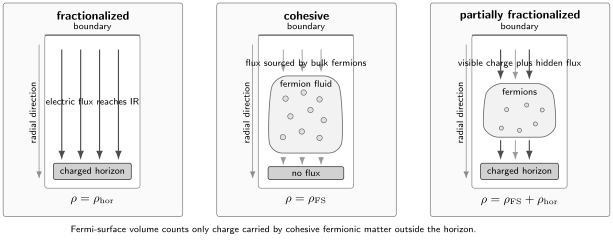
The charge density of a holographic finite-density state is radial electric flux at the boundary. If the flux comes entirely from the horizon, the charge is fully fractionalized. If all flux is sourced by bulk fermion matter outside the horizon, the state is cohesive and obeys an ordinary-looking Luttinger count. Intermediate halo geometries contain both horizon charge and fermion charge; the Luttinger deficit is the horizon flux.
The holographic Luttinger count
Section titled “The holographic Luttinger count”The standard Luttinger theorem says that, in a translationally invariant Fermi liquid, the density is fixed by the Fermi-surface volume, not by microscopic interaction details. For one species in spatial dimensions,
up to degeneracy factors and possible filled-band offsets. With multiple Fermi surfaces,
Holography modifies the theorem by adding a place for charge to hide: the horizon. The clean derivation uses radial Gauss law plus the normal-mode expansion of a bulk charged fermion.
Write the occupied bulk fermion modes schematically as
Here labels radial levels. The boundary interpretation of is “band” or “species” arising from radial quantization. At zero temperature, modes with energy are occupied. The matter current entering the Maxwell equation has the schematic form
where the radial wave functions are normalized appropriately. Integrating over collapses the radial probability density to one:
The remaining integral is exactly the total volume enclosed by the occupied Fermi surfaces:
This is the holographic Luttinger relation. It does not say that the full density is always visible in gauge-invariant fermion spectral functions. It says that the visible Fermi surfaces count the charge outside the horizon. If there is horizon flux, the boundary Fermi surfaces show a deficit.
This is the precise sense in which holography realizes fractionalization. A state can be compressible and charged even when the gauge-invariant fermion spectral function does not account for the full density.
Hard-wall fermions: the cleanest cohesive model
Section titled “Hard-wall fermions: the cleanest cohesive model”The easiest place to see the count is a hard-wall model. Put an IR wall in AdS. The wall makes the radial direction into a box. Normalizable bulk fermion modes are discrete:
in the simplest caricature. Each radial level becomes a boundary band. At finite chemical potential, one fills all states with . For the th band,
where is the area of the unit -sphere.
Because the wall removes the horizon, there is no horizon flux:
Therefore
This is a perfectly ordinary Luttinger count. The bulk Fermi gas maps to a boundary Fermi gas of composite gauge-invariant fermionic operators. In the large- confining regime these objects are weakly interacting, much as mesons become weakly interacting at large .
The hard wall is pedagogically wonderful and physically blunt. It removes the deep IR by hand. The non-Fermi-liquid decay into the horizon, which made the previous page interesting, is gone. The result is a cohesive Fermi liquid, but not yet a dynamically generated one.
Electron stars: Thomas—Fermi gravity in AdS
Section titled “Electron stars: Thomas—Fermi gravity in AdS”The electron star is the dynamical version of the hard-wall idea. Instead of inserting a box by hand, let the bulk fermion density backreact on the metric and Maxwell field. Since a large number of fermion states are occupied, one often replaces the quantum fermion gas by a locally homogeneous charged fluid. This is the AdS version of the Thomas—Fermi approximation, combined with the gravitational logic of the Tolman—Oppenheimer—Volkoff equations.
The local chemical potential is the redshifted electrostatic potential:
The sign of depends on conventions; what matters is the local energy gained by a charge in the electric potential. Fermion matter is present only where the local chemical potential exceeds the rest mass:
This condition defines the star. Where , no local Fermi sea is populated. In the fluid approximation, the local pressure is obtained by filling flat-space fermion states up to :
where is the local density of one-particle states. The local charge density and energy density follow from thermodynamics:
These quantities source Maxwell’s equation and Einstein’s equations. Schematically,
and
The word “star” is literal. A degenerate fermion fluid is held in gravitational and electrostatic balance inside AdS. The AdS boundary conditions provide a natural confining potential, while Pauli pressure prevents collapse.
The star edge
Section titled “The star edge”The edge of the star is where
Outside that region, , so the solution is vacuum Einstein—Maxwell. Depending on coordinates and temperature, it may match onto an exterior RN-like region, a horizon, or the asymptotic AdS boundary.
Near the AdS boundary, the redshift typically drives
so the star does not extend all the way to the boundary. This is important. Boundary charge is not literally sitting at the boundary; it is encoded in a radial distribution of bulk fermion matter.
At zero temperature in the simplest electron star, all the charge is carried by the fermion fluid, and there is no charged horizon. The far IR is not but an emergent Lifshitz geometry,
in a common convention where the IR is . The exponent is determined by the fermion mass, charge, and bulk couplings. The crucial point is that is finite. Hence the zero-temperature entropy density problem of extremal RN-AdS is removed in this approximation; thermal entropy scales as
The electron star therefore gives a controlled example of a cohesive compressible phase with an emergent IR critical geometry.
Why the fluid limit gives many Fermi surfaces
Section titled “Why the fluid limit gives many Fermi surfaces”The fluid approximation treats the occupied bulk fermion states locally in the radial direction. It suppresses the finite spacing between radial levels. From the boundary perspective, this means there are many closely spaced Fermi surfaces, almost a continuum of bands.
This sounds odd if one wants to model an ordinary single-band electron metal, but it is a natural large- artifact. The radial direction geometrizes scale and also produces a tower of normalizable modes. In a strict fluid limit, the tower becomes dense.
A re-quantized WKB treatment partially restores the discrete radial levels. One then finds a large but discrete set of Fermi momenta,
whose total volume satisfies the holographic Luttinger count:
when .
The low-energy fermion spectral peaks in an electron star can be very sharp. In a Lifshitz IR geometry, tunneling from a boundary Fermi-surface mode into the deep IR can be exponentially suppressed. A typical form is
for positive constant and , with conventions and powers depending on the precise scaling coordinates. The physical message is robust: in the electron star, the Fermi-surface modes can decouple very efficiently from the critical IR bath, giving a more Landau-like Fermi liquid than the probe fermions in RN-AdS.
Dirac hair: quantized fermions outside the horizon
Section titled “Dirac hair: quantized fermions outside the horizon”“Dirac hair” is the more microscopic cousin of the electron star. Instead of replacing the fermions by a fluid, one attempts to keep the occupied Dirac wave functions themselves and solve the backreacted Einstein—Maxwell—Dirac problem.
The ideal target is a solution with a finite or moderately large number of occupied radial levels, hence a finite or moderately large number of boundary Fermi surfaces. This is much closer to the condensed-matter image of a metal with a few bands. Schematically, one wants
The difficulty is that fermions are quantum fields. A single classical spinor wave does not represent a filled Fermi sea. A filled shell requires summing many occupied momentum states, and the stress tensor must be homogeneous and isotropic after the sum. In practice, fully quantized backreaction is technically demanding because one must track the radial wave functions, their occupation, and their backreaction self-consistently.
Still, the physical idea is clear. Dirac hair is charged fermionic matter outside the horizon. Therefore it contributes to and to the visible Fermi-surface volume. If no horizon flux remains, the state is cohesive. If a charged horizon remains underneath the fermion hair, the state is partially fractionalized.
Pair production and discharging a horizon
Section titled “Pair production and discharging a horizon”Why should a charged horizon want to grow fermion hair at all? The probe calculation already gave a hint. In RN-AdS, the near-horizon electric field can make the fermionic scaling exponent imaginary:
This is the log-oscillatory regime. It signals that the electric field is strong enough to destabilize the naive background. A useful physical picture is Schwinger pair production near the horizon. Pairs of charged bulk fermions are produced. One sign of charge falls into the horizon, reducing its electric flux, while the other sign remains outside and contributes to a fermion density.
This is the fermionic analogue of scalar condensation near a charged black hole, but Pauli exclusion changes the endpoint. Bosons can pile into a condensate. Fermions populate a Fermi sea. The horizon discharges into an electron star or Dirac hair when electrostatic screening overcomes gravitational clumping.
That last phrase matters. Gravity pulls matter inward; electrostatics pushes like charges outward. A stable electron star is a balance of electric repulsion, gravitational attraction, Pauli pressure, and AdS confinement.
Fractionalized, cohesive, and partially fractionalized phases
Section titled “Fractionalized, cohesive, and partially fractionalized phases”The cleanest classification is by radial electric flux.
Fully fractionalized phase
Section titled “Fully fractionalized phase”In the extremal RN-AdS metal,
The charge is behind the horizon. At the level of classical bulk fields, there is no gauge-invariant Fermi surface whose volume accounts for . Probe fermions may have Fermi-surface poles, but those poles do not automatically carry the total charge.
This is the most holographic-looking metal: its density is a horizon property.
Cohesive phase
Section titled “Cohesive phase”In a hard-wall fermion gas or zero-temperature electron star,
Then
This is the holographic analogue of an ordinary Fermi liquid count. The charge is carried by gauge-invariant fermionic excitations, often called mesino-like modes in large- language.
Partially fractionalized phase
Section titled “Partially fractionalized phase”At finite temperature, or in more general Einstein—Maxwell—dilaton models, one can have both a horizon and a fermion fluid halo:
Then
The boundary theory sees a Luttinger deficit. The missing charge is not missing from Gauss law; it is fractionalized into the horizon sector.
This is one of the most useful conceptual outputs of holography. It gives a geometrical way to talk about “hidden” charge in a compressible state.
The role of temperature
Section titled “The role of temperature”At nonzero temperature, a horizon is usually present. Near a regular horizon,
so
as . Thus the fermion fluid is pushed away from the horizon. Instead of a star that extends to the deep IR, one obtains a halo or electron cloud around a black hole.
The charge is then split:
As temperature increases, the horizon tends to absorb more charge. In simple fluid models, the fermion halo can eventually disappear, leaving a fully fractionalized charged black hole. The details of the transition depend on the model and on whether the fermions are treated as a fluid or quantized shells.
What is measured by a boundary fermion spectral function?
Section titled “What is measured by a boundary fermion spectral function?”A gauge-invariant boundary fermion operator can detect cohesive Fermi surfaces. In the bulk, these correspond to normalizable fermion modes outside the horizon. Their Fermi momenta contribute to
But horizon charge is not generally visible as a small number of gauge-invariant Fermi-surface poles. At large , it belongs to the deconfined sector. This is why holography forces a separation that weak-coupling intuition often merges:
At finite , the distinction can blur. Horizon degrees of freedom are not literally classical; quantum corrections may encode additional oscillatory or fermionic signatures. But in the controlled classical limit, the split between horizon flux and bulk fermion charge is sharp.
Leading transport may not notice the Fermi surface
Section titled “Leading transport may not notice the Fermi surface”There is another important large- warning. The fermion Fermi surfaces can be subleading in , while the conductivity at leading order is computed from classical Maxwell and metric perturbations. Thus a holographic state can have sharp Fermi-surface poles in a fermionic Green function while leading charge transport is dominated by the large- critical bath.
This is shocking only if one imports weak-coupling habits. In an ordinary metal, the same quasiparticles that make the Fermi surface usually dominate transport. In holography, a gauge-invariant fermion spectral function and the leading electric conductivity may probe different sectors of the large- theory.
The practical lesson is severe:
One should compute both observables.
Relation to the throat
Section titled “Relation to the AdS2AdS_2AdS2 throat”The RN-AdS phase has a charged throat. Probe fermions in this throat acquire the semi-local self-energy
When the throat is unstable to fermion production, backreaction can replace the region with an electron-star Lifshitz region. This changes the IR scaling data. A rough map is
The first has horizon charge and semi-local criticality. The second has cohesive fermion charge and a finite- IR geometry. This is a genuine change of the ground state, not a small correction to the probe Green function.
A compact dictionary
Section titled “A compact dictionary”Here is the most useful dictionary for this page:
| Bulk object | Boundary interpretation |
|---|---|
| Radial electric flux at boundary | Total charge density |
| Electric flux through horizon | Fractionalized charge density |
| Charged bulk fermion matter outside horizon | Cohesive charge density |
| Normalizable bulk fermion shell | Boundary Fermi surface or band |
| Electron star fluid | Many closely spaced Fermi surfaces, fluid limit |
| Dirac hair | Resolved fermion shells outside horizon |
| No horizon flux | Ordinary-looking Luttinger count |
| Nonzero horizon flux | Luttinger deficit |
The table is simple. The hard part is solving the actual bulk equations.
Model status and limitations
Section titled “Model status and limitations”Electron stars are not literal stars made of electrons in a material. They are large- holographic saddle points describing fermionic charge in the bulk. The word “electron” is historical and mnemonic.
Several caveats are essential:
The fluid limit is not a single-band metal. It usually produces many closely spaced Fermi surfaces. This is natural in a large- radial quantization problem, but not a direct model of a one-band metal.
Dirac hair is more microscopic but harder. Keeping quantized fermion wave functions is closer to the desired boundary interpretation, but the fully backreacted problem is technically difficult.
The boundary fermion is usually composite. The fermionic operator detected by the bulk spinor is gauge-invariant. It may be analogous to a mesino-like bound state rather than a microscopic electron.
The Luttinger deficit is a classical large- statement. It cleanly measures horizon flux in the bulk saddle. At finite , quantum corrections may expose more structure.
Horizon charge is not a cheat. It is a legitimate contribution to the boundary charge density, measured by the asymptotic Maxwell flux. It is simply not carried by cohesive gauge-invariant fermion poles.
Worked example: interpreting a charge split
Section titled “Worked example: interpreting a charge split”Suppose a dimensional boundary theory has total charge density and a single visible circular Fermi surface with charge and Fermi momentum . Then
The cohesive charge detected by this Fermi surface is
The horizon charge is therefore
If , the state is cohesive and obeys the ordinary count. If , the visible Fermi surface accounts for only part of the density. If , the visible Fermi surface is absent or contributes no net charge at leading order.
Of course, real holographic examples usually contain multiple Fermi surfaces and possible degeneracy factors. The logic is unchanged.
Common pitfalls
Section titled “Common pitfalls”Calling every finite-density horizon a Fermi liquid. RN-AdS is compressible, but its charge is behind the horizon. It is not a Fermi liquid merely because it has a finite density.
Forgetting the horizon term in Luttinger’s theorem. In holography, the robust count is , not automatically .
Taking the electron-star fluid limit too literally. The continuum of radial levels is a useful approximation, but it produces many boundary Fermi surfaces.
Confusing probe poles with charge accounting. A probe fermion pole identifies a possible Fermi momentum. It does not by itself prove that the pole carries the full density.
Assuming transport is quasiparticle transport. Leading large- conductivity can be governed by classical horizon or bulk gauge-field dynamics, while fermion-loop contributions are subleading.
Treating fractionalization as metaphor only. In the bulk saddle, fractionalized charge has a precise diagnostic: radial electric flux through the horizon.
Exercises
Section titled “Exercises”Exercise 1: Gauss law and the Luttinger deficit
Section titled “Exercise 1: Gauss law and the Luttinger deficit”Let
Assume
Show that if the boundary charge is and the horizon charge is , then the matter charge outside the horizon is .
Solution
Integrate the radial Maxwell equation from the horizon to the boundary:
The left-hand side is
Therefore
This is the charge that can be carried by cohesive matter outside the horizon.
Exercise 2: When does a local fermion fluid exist?
Section titled “Exercise 2: When does a local fermion fluid exist?”The local chemical potential is
In the Thomas—Fermi approximation, explain why the fermion fluid is present only where .
Solution
In a local inertial frame, the fermions behave approximately like a flat-space degenerate Fermi gas. A fermion of rest mass costs at least energy . The local electrochemical potential available to populate fermion states is .
If
then even the lowest positive-energy fermion state is too expensive, so no local Fermi sea forms. If
states are filled up to the local Fermi energy. The local Fermi momentum satisfies, schematically,
Thus the star edge is determined by
Exercise 3: Luttinger count in boundary dimensions
Section titled “Exercise 3: Luttinger count in 2+12+12+1 boundary dimensions”A dimensional boundary theory has two circular Fermi surfaces with charges and Fermi momenta . Write the cohesive charge density and the horizon charge density.
Solution
For a circular Fermi surface in two spatial dimensions,
The cohesive charge is
If the total density is , then
If , the visible Fermi surfaces account for all charge. If , the state is partially fractionalized.
Exercise 4: Entropy scaling of a Lifshitz electron star
Section titled “Exercise 4: Entropy scaling of a Lifshitz electron star”Assume the zero-temperature electron-star IR geometry has finite dynamical exponent and spatial dimension . Use scaling to derive the low-temperature entropy density.
Solution
Under Lifshitz scaling,
Temperature has dimension of inverse time, so
Entropy density has dimension inverse spatial volume, so
The only scaling form compatible with these transformations is
This vanishes as for finite positive , unlike the finite zero-temperature entropy density of the extremal RN-AdS horizon.
Exercise 5: Classify three charge distributions
Section titled “Exercise 5: Classify three charge distributions”Classify the following holographic states as cohesive, fractionalized, or partially fractionalized.
- and .
- and no bulk charged matter is present.
- and a fermion halo carries the remaining charge.
Solution
-
This state is cohesive. All charge is carried outside the horizon by visible bulk matter, and the ordinary-looking Luttinger count holds.
-
This state is fully fractionalized. All charge is horizon flux. At leading classical order, no gauge-invariant Fermi-surface volume accounts for the density.
-
This state is partially fractionalized. The fermion halo contributes cohesive charge, while the horizon flux contributes fractionalized charge. The visible Fermi surfaces count only .
Further reading
Section titled “Further reading”For the broad review perspective, see Hartnoll, Lucas and Sachdev, Holographic Quantum Matter, especially the discussion of bulk fermion quantum effects, the holographic Luttinger relation, and electron stars. For a condensed-matter-facing account, see Zaanen, Liu, Sun and Schalm, Holographic Duality in Condensed Matter Physics, chapter 11. For textbook background on finite-density holography, electron stars, and the cohesive/fractionalized distinction, see Ammon and Erdmenger, Gauge/Gravity Duality, section 15.5. The original research literature includes work by Sachdev on holographic Luttinger counts, Hartnoll and Tavanfar on electron stars, Iqbal and Liu on Luttinger’s theorem in holography, and Cubrovic, Liu, Schalm, Sun and Zaanen on spectral probes interpolating between electron stars and AdS Dirac hair.