
Holographic Fermions and Spectral Functions
The most direct experimental signature of a metal is not the DC resistivity. It is the single-particle spectral function. In angle-resolved photoemission, one tries to see whether low-energy electron spectral weight is concentrated near a Fermi surface, broadened into an incoherent continuum, gapped, or split into several bands. Holography gives a clean theoretical analogue of this diagnostic: solve a bulk Dirac equation in a charged black-brane geometry and read off the retarded Green function of a fermionic boundary operator.
That sentence hides several subtleties. A holographic fermion is usually not the microscopic electron of a material. It is a gauge-invariant fermionic operator in a large- quantum field theory. Its spectral function is nevertheless extremely useful because it asks the right universal question:
The answer is yes. A probe bulk spinor in a charged black brane can show sharp Fermi-surface poles, marginal-Fermi-liquid-like behavior, broad non-Fermi-liquid spectral weight, algebraic pseudogaps, and log-periodic oscillations. The best way to understand all of these is to combine three ideas from earlier pages:
- finite density is radial electric flux,
- the extremal charged horizon contains an throat,
- retarded correlators are computed by infalling boundary conditions at the future horizon.
Throughout this page, is the number of boundary spatial dimensions. The boundary spacetime dimension is , and the bulk dimension is . We use a radial coordinate for which the asymptotic AdS boundary is at .
The boundary observable
Section titled “The boundary observable”For a fermionic operator , the retarded Green function is defined with an anticommutator:
After Fourier transform, is a matrix in spinor indices. The spectral function is
up to harmless convention choices. It is the holographic analogue of the photoemission intensity, modulo matrix elements and the fact that need not be the physical electron.
A Fermi surface is diagnosed by a low-frequency singularity at nonzero momentum. Operationally, one looks for
This criterion is more robust than the existence of a long-lived quasiparticle. A Fermi liquid has such a zero together with a narrow pole of the form
A non-Fermi liquid can still have a Fermi momentum , but the pole may be strongly broadened, the residue may vanish, or the low-energy self-energy may dominate over the bare dispersion.
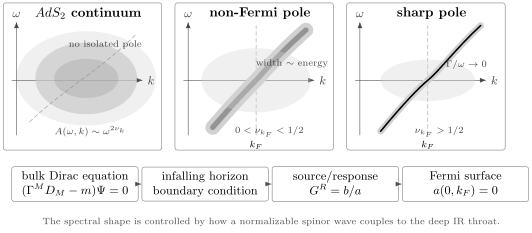
A holographic fermion spectral function is obtained by solving a charged bulk Dirac equation with infalling horizon boundary conditions. A Fermi momentum appears when the infalling bulk solution is normalizable at , equivalently when the boundary source coefficient vanishes. The width of the spectral peak is controlled by leakage into the deep IR throat.
The bulk Dirac problem
Section titled “The bulk Dirac problem”The minimal bottom-up bulk action for a charged spinor is
with
Here is the bulk spinor mass, is its bulk charge, is the Maxwell field dual to the boundary current, and is the spin connection. The curved gamma matrices obey
The simplest finite-density backgrounds are diagonal and translationally invariant:
with . We take momentum in the direction,
A useful field redefinition removes the spin-connection term for diagonal metrics:
where . The Dirac equation becomes a radial first-order equation.
After choosing a gamma-matrix basis adapted to the radial direction, the spinor splits into two independent two-component sectors, labelled by . A representative form is
The precise signs depend on the gamma-matrix basis, but the structure is universal. The spinor experiences an effective local frequency
and a local momentum
Thus the chemical potential does not just shift the boundary frequency. It creates a radial electrostatic environment in which a charged bulk fermion can form quasi-bound states.
Source and response for spinors
Section titled “Source and response for spinors”Spinors differ from scalars because the Dirac equation is first order. One does not freely specify all components at the boundary. Half of the spinor components are sources; the conjugate half are responses.
In asymptotically ,
For the rescaled spinor , the near-boundary expansion takes the schematic form
For in standard quantization, is the source and is the response. The dimension of the dual fermionic operator is
When , an alternative quantization is also allowed, in which the roles of source and response are exchanged and
For most holographic-fermion applications one chooses standard quantization and writes
with possible normalization factors depending on convention. In matrix notation,
The retarded prescription is imposed in the interior. At a nonextremal horizon ,
which is the spinor version of the infalling boundary condition. The computation is now well-posed: start with the infalling solution at the horizon, integrate to the boundary, and read off and .
Fermi surfaces as normalizable zero modes
Section titled “Fermi surfaces as normalizable zero modes”At fixed , the infalling boundary condition determines a unique solution up to overall normalization. Near the boundary this solution has coefficients and . Poles of the retarded Green function occur when the source coefficient vanishes:
A holographic Fermi surface is therefore a normalizable, zero-frequency, finite-momentum bulk spinor mode:
This statement is simple and important. The bulk problem looks like finding a bound state at zero energy. The boundary interpretation is a pole in the fermionic Green function at a Fermi momentum.
There is no guarantee that such a exists. It depends on the background geometry and on the spinor data , plus possible nonminimal couplings. A large charge-to-mass ratio tends to favor Fermi-surface-like poles because the electrostatic potential can trap the charged spinor. A large mass or small charge tends to suppress such quasi-bound states, leaving the deep IR continuum more visible.
A practical flow equation
Section titled “A practical flow equation”For numerical work, it is convenient to avoid tracking both spinor components separately. Write
The Dirac equation becomes a first-order nonlinear flow equation for :
where, up to gamma-matrix conventions,
The horizon condition is usually a simple constant, for example for in a common basis. Then
This flow-equation method is the workhorse for plotting holographic fermion spectral functions. It is also a good sanity check: the result must be insensitive to small changes in the radial cutoff and to the overall normalization of the infalling solution.
The charged black brane and the throat
Section titled “The charged black brane and the AdS2AdS_2AdS2 throat”For the Reissner—Nordström AdS black brane, the zero-temperature near-horizon geometry is
This region controls the low-frequency fermion response. The spatial momentum is a parameter from the point of view of ; it contributes to an effective mass in the Dirac equation. The IR scaling dimension is
where, schematically,
with
The constants and depend on the near-horizon electric field and on the normalization of the Maxwell field. Nonminimal spinor couplings can modify and .
The retarded Green function of the IR problem has the universal small-frequency form
with a complex phase fixed by infalling boundary conditions. This is the origin of semi-local quantum criticality in the fermion spectral function: time scales, but space mostly enters as a label through .
At finite temperature, the result is thermally rounded:
where is a known ratio of Gamma functions in the pure region. The important point is the scaling form, not the precise normalization.
Matching: from the IR throat to the UV boundary
Section titled “Matching: from the IR throat to the UV boundary”The full Green function is obtained by matching an inner solution to an outer solution in the asymptotic AdS region. At small , the result has the form
The coefficients and are determined by the UV-to-IR geometry. They are analytic in near . The nonanalytic physics is isolated in .
If a Fermi surface exists, then
Expanding near gives the canonical holographic-fermion form
where
Since
the exponent determines the character of the spectral peak.
Three regimes of holographic Fermi surfaces
Section titled “Three regimes of holographic Fermi surfaces”Fermi-liquid-like poles:
Section titled “Fermi-liquid-like poles: νkF>1/2\nu_{k_F}>1/2νkF>1/2”When , the analytic term dominates the denominator at low frequency. The pole has approximately linear dispersion,
and the width scales as
Therefore
The excitation becomes sharp at low energy. It is Fermi-liquid-like in the sense of having a long-lived pole, but it is not automatically an ordinary Landau quasiparticle. The exponent need not be , and the operator is a large- gauge-invariant fermion rather than a microscopic electron.
At , the analytic term and the IR self-energy compete. In many conventions the self-energy becomes
This resembles marginal Fermi liquid phenomenology: the decay rate is of the same order as the energy, up to logarithms. The spectral peak is neither a stable quasiparticle nor a fully featureless continuum.
Non-Fermi-liquid poles:
Section titled “Non-Fermi-liquid poles: 0<νkF<1/20<\nu_{k_F}<1/20<νkF<1/2”When , the nonanalytic IR term dominates:
The dispersion is nonlinear,
and the width is of the same order as the energy. There is still a low-energy singularity at , but it is not a Landau quasiparticle.
The punchline is compact:
Algebraic pseudogaps and no Fermi surface
Section titled “Algebraic pseudogaps and no Fermi surface”Not every holographic fermion has a Fermi momentum. If the bulk spinor does not form a quasi-bound state, then the continuum can dominate directly:
at small and fixed , up to phases and matrix factors. This is sometimes called an algebraic pseudogap. The spectral weight vanishes as a power rather than being exponentially gapped.
This behavior is one of the cleanest fingerprints of local quantum criticality. It says that low-frequency fermionic spectral weight is controlled by an IR scaling dimension that depends on momentum. Unlike a Fermi liquid, there is no special shell of low-energy excitations around ; the whole momentum dependence enters through .
Log-oscillatory regions and IR instabilities
Section titled “Log-oscillatory regions and IR instabilities”The exponent can become imaginary:
Then
which is periodic in . This is the log-oscillatory region.
The mathematical reason is an analogue of violating a stability bound. The physical interpretation is that the charged near-horizon electric field is strong enough to produce an instability in the probe fermion sector. The simple RN-AdS background should then not be trusted as the final ground state. One expects the bulk charge to reorganize, for example into fermionic matter outside the horizon. This is the doorway to electron stars, Dirac hair, and Luttinger-count questions, which are the subject of the next page.
Schrödinger potential intuition
Section titled “Schrödinger potential intuition”Squaring the Dirac equation gives a second-order radial equation that can be viewed as a Schrödinger problem,
where is a tortoise-like radial coordinate. The precise potential is basis-dependent, but the intuition is robust.
The geometry has three regions:
- the UV AdS boundary, where source and response are defined,
- an intermediate domain wall controlled by finite density,
- the IR horizon or throat, which absorbs probability.
For suitable , the effective potential develops a well in the intermediate region. A quasi-bound state in this well is the bulk origin of the boundary Fermi-surface pole. Because the inner barrier is not perfectly reflecting, the state can tunnel into the horizon. That tunneling is the imaginary part of the boundary self-energy.
This explains why holographic Fermi surfaces can look familiar and unfamiliar at the same time. The spectral function may have a peak dispersing through , but the decay channel is not phonons, impurities, or particle-hole excitations of a Fermi liquid. It is the strongly coupled IR sector represented by the horizon.
Semi-holographic interpretation
Section titled “Semi-holographic interpretation”The matched Green function has a useful boundary interpretation. Near a Fermi momentum, it is as if an emergent fermion is coupled to a locally critical large- bath:
The bath correlator is
Integrating out the bath gives
This is exactly the structure produced by the bulk matching calculation. The large- nature of the IR sector suppresses many corrections that would ordinarily complicate an interacting electron problem. This is why the simple self-energy form is controlled in holography, even though the same expression would be much more phenomenological in a microscopic condensed-matter model.
Nonminimal couplings and model dependence
Section titled “Nonminimal couplings and model dependence”The minimal Dirac action is not the only possible fermion model. Bottom-up holography often adds Pauli or dipole couplings such as
Such terms can shift Fermi momenta, change the IR exponent, create zeros of the Green function, or open gap-like features. This is useful for model-building, but it reduces universality. Unless the coupling is fixed by a top-down truncation or symmetry, one should treat it as phenomenological.
The same warning applies to the choice of background. RN-AdS, electron stars, probe brane systems, Q-lattices, and hyperscaling-violating geometries can all give different fermion spectral functions. Holography is not a single prediction for ARPES; it is a controlled framework for producing and organizing strongly coupled spectral functions.
What is trustworthy?
Section titled “What is trustworthy?”The most trustworthy statements are structural:
- Retarded fermion correlators come from infalling solutions of a bulk Dirac equation.
- The Fermi momentum is a normalizable zero mode of the radial Dirac problem.
- In an throat, the IR Green function scales as .
- The matched Green function naturally has a semi-holographic self-energy.
- Imaginary signals an IR instability or at least a breakdown of the naive probe background.
Less universal are the numerical values of , the number of Fermi surfaces, the existence of zeros, and the detailed resemblance to a particular material.
Common pitfalls
Section titled “Common pitfalls”Mistaking every pole for a Landau quasiparticle. A pole with width comparable to its energy is not a long-lived quasiparticle. The exponent matters.
Forgetting the large- limit. Probe fermion spectral functions are leading large- observables. They do not automatically include the full quantum dynamics of a finite-density electron fluid.
Reading as the full charge density. The probe calculation can find Fermi momenta, but it does not by itself prove a Luttinger theorem. Horizon charge may carry part of the density.
Ignoring instabilities. Log-oscillatory behavior is not merely exotic scaling. It often signals that the RN-AdS background is not the correct ground state.
Overfitting materials. Holographic fermions can resemble features of cuprate or heavy-fermion spectra, but resemblance is not identification. The operator dictionary and model status must be stated honestly.
Exercises
Section titled “Exercises”Exercise 1: Spinor dimension from the near-boundary Dirac equation
Section titled “Exercise 1: Spinor dimension from the near-boundary Dirac equation”In asymptotic , the rescaled spinor behaves as
Use the usual factor relating the full spinor to the rescaled spinor to argue that the two possible operator dimensions are
Solution
Near the boundary,
For
one has
Thus
For a spinor operator, the coefficient multiplying the non-normalizable falloff is the source for an operator whose scaling dimension is
in standard quantization. When alternative quantization is allowed, the other choice gives
Exercise 2: Why a Fermi surface is a normalizable zero mode
Section titled “Exercise 2: Why a Fermi surface is a normalizable zero mode”Suppose the infalling bulk spinor solution has boundary coefficients and , with
Show that gives a pole in at , . Explain why this is the holographic Fermi-surface condition.
Solution
If
while is finite and nonzero, then
has a pole at . The vanishing of means that the source term is absent. The bulk solution is therefore normalizable with infalling interior boundary conditions.
A pole of the retarded Green function at zero frequency and finite momentum is precisely the operational definition of a Fermi surface, even when there is no long-lived Landau quasiparticle.
Exercise 3: Width of a holographic Fermi-surface pole
Section titled “Exercise 3: Width of a holographic Fermi-surface pole”Near , assume
where is real and positive. For , show that the excitation is sharp at low energy.
Solution
For , the analytic term dominates over at sufficiently small , because
The leading dispersion is therefore
The imaginary part of gives the width,
Hence
as . The pole becomes sharp. It is Fermi-liquid-like, although it is only an ordinary Fermi-liquid pole when the detailed exponent and residue structure match the Landau case.
Exercise 4: Non-Fermi-liquid dispersion
Section titled “Exercise 4: Non-Fermi-liquid dispersion”For , the nonanalytic self-energy dominates. Estimate the dispersion relation of the spectral peak.
Solution
When ,
at small . The denominator is approximately
The peak occurs when this nearly vanishes:
Thus
Because the phase of is complex, the width is generally of the same order as the energy. The excitation is not a long-lived quasiparticle.
Exercise 5: Log oscillations from imaginary
Section titled “Exercise 5: Log oscillations from imaginary νk\nu_kνk”Let
Show that the IR Green function is periodic in . What does this suggest physically?
Solution
The IR Green function scales as
If ,
This is periodic under
The oscillation in logarithmic frequency indicates that the IR scaling dimension has become complex. In the description, this is analogous to violating an IR stability bound. Physically it warns that the probe fermion sector or the RN-AdS background is unstable and that backreaction or a new ground state must be considered.
Further reading
Section titled “Further reading”The standard research papers on holographic fermions include the early work by Henningson and Sfetsos, Mueck and Viswanathan, Iqbal and Liu, Lee, Liu, McGreevy and Vegh, Cubrovic, Zaanen and Schalm, and Faulkner, Liu, McGreevy and Vegh. For broad treatments, see Hartnoll, Lucas and Sachdev, Holographic Quantum Matter, especially the sections on fermions in compressible phases; and Zaanen, Liu, Sun and Schalm, Holographic Duality in Condensed Matter Physics, chapter 9. The next page continues from the probe calculation to backreacted fermion charge, electron stars, Dirac hair, and Luttinger counts.