
Experimental Connections and Epistemic Limits
Holography is not a microscope that tells us the Hamiltonian of a cuprate, a heavy-fermion metal, or a graphene device. It is closer to a controlled thought laboratory: it produces strongly coupled quantum fluids, compressible metals, ordered phases, and nonequilibrium states in which calculations can be done from first principles at large . The experimental question is therefore not
For known laboratory materials, the honest answer is almost always no. The better question is
This page is about that translation problem. We will use holography as a source of mechanisms, constraints, and calculable response functions, while keeping a hard line between evidence and analogy. The practical rule is simple: a single exponent is a clue; a constrained pattern among many observables is evidence.
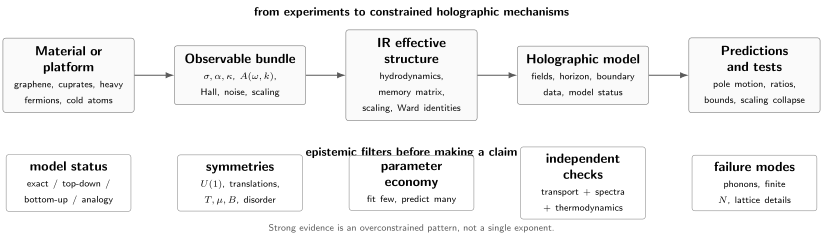
A disciplined pipeline from experiment to holography and back. Raw observables are first converted into dimensionless diagnostics and checked against Ward identities, Kramers—Kronig relations, sum rules, and ordinary hydrodynamic constraints. Holographic models then supply mechanisms and predictions. Failed predictions should revise the model, not the data.
The theme is especially important for holographic quantum matter because the same experimental symptom can have several causes. A linear-in- resistivity can come from quantum critical scattering, electron-phonon physics, disorder, critical bosons, semi-holographic baths, or a crossover masquerading as scaling. A large Lorenz ratio can indicate hydrodynamic heat-charge separation, phonon contamination, bad thermal-contact subtraction, or a genuine violation of quasiparticle expectations. A broad ARPES spectrum can mean no quasiparticles, strong inelastic scattering above a coherence scale, matrix-element effects, or unresolved inhomogeneity.
So the right standard is not whether holography can reproduce a plot. It usually can. The right standard is whether the model explains why several plots must be related.
What would count as contact with experiment?
Section titled “What would count as contact with experiment?”There are several levels of contact, and they should not be mixed.
At the weakest level, holography gives phenomenological analogies. For example, a charged black brane with momentum relaxation can produce a broad optical conductivity, a large scattering rate, or a linear resistivity. This is useful, but not decisive. Many non-holographic mechanisms can do the same.
A stronger level is a bottom-up effective model whose fields and couplings encode the symmetries, conserved quantities, and relevant deformations of an experimental system. Linear axions, Q-lattices, Einstein—Maxwell—dilaton geometries, probe branes, and holographic superconductors live mostly here. These models can be excellent laboratories for hydrodynamic and scaling mechanisms, but their microscopic UV completion is often unknown.
Stronger still are top-down models, where the bulk theory is a consistent truncation of string theory or supergravity. They provide microscopic control of the large- dual theory, but their boundary theory is usually not a realistic material.
The strongest possible case would be an exact duality to a specific microscopic many-body system. This is not what we have for cuprates, pnictides, graphene devices, or heavy-fermion compounds.
This gives an evidence ladder:
Most AdS/CMT contact with experiment sits in the middle: holography proposes a strongly coupled effective structure, and experiment tests whether that structure is visible in response functions.
The observables holography is best at organizing
Section titled “The observables holography is best at organizing”Holography is strongest when the observable is controlled by conservation laws, scaling, analyticity, or horizon regularity. It is weakest when the observable is dominated by material-specific chemistry, disorder distributions, phonon bottlenecks, crystal-field splittings, or multiband details that have not been included in the bulk model.
Transport matrices
Section titled “Transport matrices”The central experimental object is often the thermoelectric response matrix. In a homogeneous isotropic system at zero magnetic field, write
Here is the electric current and is the heat current. The open-circuit thermal conductivity is
This distinction matters. In a finite-density fluid, heat and charge currents can both overlap with momentum. A clean system then has singular DC transport even if it equilibrates rapidly. With weak momentum relaxation,
where is an incoherent conductivity, is the charge density, in a relativistic fluid, and is the momentum relaxation rate. The Drude-like pole in this expression is hydrodynamic, not necessarily quasiparticle-like. That one sentence saves a lot of confusion.
At nonzero magnetic field, the response becomes tensor-valued:
and similarly for and . Magnetization currents must be subtracted before comparing transport coefficients with holographic DC formulae. Otherwise one may compare a bulk transport current with a laboratory current containing circulating equilibrium pieces.
Lorenz ratio and Wiedemann—Franz diagnostics
Section titled “Lorenz ratio and Wiedemann—Franz diagnostics”For ordinary quasiparticles that carry charge and heat together, the Wiedemann—Franz law gives
The law is not sacred. It assumes the appropriate quasiparticle regime and usually elastic scattering. In a hydrodynamic fluid, charge and heat are independent conserved densities. They need not diffuse in the same way. A large or temperature-dependent Lorenz ratio can therefore be a sharp clue that transport is collective rather than quasiparticle-like.
Holography adds a useful mental model. In an incoherent metal, heat and charge can be carried by different diffusive modes. In a coherent metal, both can be dragged by momentum, producing strong differences between and . In scaling theories with anomalous charge-density scaling, the temperature dependence of is a probe of the charge anomalous dimension ; in common conventions one expects schematically
up to the important caveat that transport also depends on how translations are broken. This is not a universal formula for all materials. It is a diagnostic: if the Lorenz ratio scales nontrivially in a clean quantum-critical regime, the charge sector is doing something nontrivial.
Optical conductivity and spectral weight
Section titled “Optical conductivity and spectral weight”Optical conductivity is a natural bridge between holography and experiment because it is a retarded current-current correlator:
The real part obeys sum-rule constraints. The imaginary part is tied to the real part by Kramers—Kronig relations. A proposed holographic fit must respect both.
In a quantum critical regime, the strongest claim is not simply that
for some window. The stronger claim is a scaling collapse,
or, at finite magnetic field,
with appropriate modifications when charge density has anomalous scaling or when momentum relaxation is dangerously irrelevant. A power law over one decade is suggestive. A collapse of complex conductivity, thermodynamics, Hall response, and spectral functions using the same exponents is a different beast.
Single-particle spectra
Section titled “Single-particle spectra”Angle-resolved photoemission measures a single-electron spectral function, roughly
Holography can produce sharp Fermi-surface-like peaks, non-Fermi-liquid self-energies, broad incoherent continua, algebraic pseudogaps, and log-oscillatory instabilities. But there is an immediate interpretational hazard: in many holographic models the probe fermion is not literally the electron. It is a charged fermionic operator of a large- theory. The comparison with ARPES is therefore most meaningful at the level of structures: pole motion, linewidth scaling, spectral-weight redistribution, particle-hole asymmetry, and the coexistence of coherent and incoherent sectors.
A useful near-Fermi-surface form is
The exponent is controlled by the IR geometry. If an experiment suggests a self-energy with non-Fermi-liquid scaling, holography offers a controlled example. But the next question is not “can we fit ?” The next question is whether the same IR sector also controls optical, thermal, and magnetic response.
Collective spectra
Section titled “Collective spectra”Neutron scattering, Raman scattering, resonant x-ray scattering, and electron energy-loss spectroscopy probe collective response functions. A standard relation for neutron scattering is
where is the imaginary part of the relevant retarded susceptibility. Holography is particularly natural for collective correlators because bulk fields directly compute operator response functions. Local criticality, for example, predicts strong frequency-temperature scaling with weak momentum dependence:
This kind of structure is much more constraining than a transport exponent. It asks an experiment to measure both and dependence over a broad regime.
Planckian dissipation: useful, dangerous, unavoidable
Section titled “Planckian dissipation: useful, dangerous, unavoidable”A recurring holographic timescale is
Strongly coupled black-brane systems often equilibrate on this timescale. In phenomenology one often writes
with of order one. This is called Planckian dissipation.
The concept is useful because it puts numbers on rapid relaxation. If a metal has a scattering rate far larger than what a quasiparticle picture can comfortably support, is the natural clock to compare with. It is also dangerous because is not unique. One can define a transport lifetime, a single-particle lifetime, a momentum relaxation time, an equilibration time, a Lyapunov time, a phonon lifetime, or a hydrodynamic diffusion time. They need not be equal.
The clean holographic statement is usually about local equilibration or quasinormal-mode damping, not automatically the measured DC transport relaxation rate. DC resistivity depends on momentum relaxation:
in a coherent finite-density metal. If is controlled by disorder, Umklapp, phonons, or irrelevant operators, then Planckian local equilibration alone does not determine .
So the rule is:
Graphene: the cleanest hydrodynamic cousin
Section titled “Graphene: the cleanest hydrodynamic cousin”Graphene near charge neutrality is not a holographic CFT, but it is one of the cleanest experimental arenas for relativistic-like quantum critical transport. The low-energy electronic degrees of freedom are Dirac fermions. In ultra-clean samples, electron-electron collisions can be faster than momentum relaxation and electron-phonon cooling. That produces a window in which the electron-hole plasma behaves as a fluid.
At charge neutrality, the net charge density is small but the entropy density is not. Heat current and charge current decouple in a way that resembles the hydrodynamic logic of neutral quantum critical matter. This is why the Wiedemann—Franz law can fail dramatically. In the simplest hydrodynamic picture,
while
At , charge transport is controlled by , while heat transport is tied to entropy flow and momentum. This naturally permits a very large Lorenz ratio.
Graphene also gives real-space hydrodynamic tests: viscous backflow, negative nonlocal resistance, Gurzhi-like flow, current vortices, and imaging of current profiles. These are stronger than fitting because they test the spatial structure of hydrodynamic equations.
The holographic lesson is not that graphene is secretly a black brane. It is that hydrodynamics can be the correct language for an electronic system once local equilibration is fast. Graphene is a reality check for the basic premise that electron fluids can be measured as fluids.
Cuprates: the main temptation and the main trap
Section titled “Cuprates: the main temptation and the main trap”Cuprate strange metals are the emotional center of much AdS/CMT. Their normal state near optimal doping shows several features that make holographers perk up: broad spectra, approximately linear-in- resistivity, anomalous optical conductivity, strong scattering, nontrivial Hall response, and nearby superconducting, density-wave, nematic, and pseudogap phenomena.
The temptation is to identify the strange metal with a compressible holographic quantum critical phase. The trap is that cuprates are not clean large- CFTs. They are doped Mott systems with lattice-scale correlations, phonons, disorder, multiple competing orders, and a superconducting instability that often hides the low-temperature normal state unless large magnetic fields are used.
A careful holographic comparison should therefore ask for patterns such as:
all described by a compatible effective theory. Here
and denotes thermal diffusivity. No single one of these observables settles the question.
Several holographic mechanisms are relevant as candidate phenomenology:
-
Semi-local criticality. An throat gives frequency scaling with weak momentum scaling. This is suggestive for local quantum critical response and broad incoherent spectra.
-
Hyperscaling-violating EMD geometries. These encode compressible critical phases with exponents , , and sometimes . They organize entropy, charge response, and transport scaling.
-
Momentum relaxation. Q-lattices, axions, massive gravity, and explicit lattices model the fact that real crystals have Umklapp and disorder. The most trustworthy statements here are hydrodynamic or memory-matrix statements, not the microscopic identity of a lattice deformation.
-
Holographic superconductivity. Charged-hair instabilities give a strong-coupling route from an incoherent metal to an ordered condensate. The mean-field large- criticality is a caveat, but the pair-susceptibility mechanism is useful.
-
Competing order. Stripes, helices, nematic-like phases, and density waves arise naturally as finite-momentum instabilities. This is qualitatively attractive for cuprates, where competing orders are everywhere.
The best possible experimental program would compare scaling collapse in optical conductivity, Hall response, thermodynamics, ARPES linewidths, neutron or Raman collective response, and thermal transport in the same doping and field regime. The benchmark is not whether a bottom-up model can reproduce linear resistivity. The benchmark is whether it can survive this many-body interrogation.
Pnictides and iron-based superconductors
Section titled “Pnictides and iron-based superconductors”Iron-based superconductors add multiband structure and orbital physics. Many families show spin-density-wave and nematic tendencies near superconductivity, and strange-metal-like transport often appears near optimal doping or pressure. This makes them attractive for theories of metallic quantum criticality.
From the holographic perspective, the most relevant features are:
The challenge is that holographic models are often single-current, single-density effective theories, while pnictides can have multiple pockets, orbital-selective coherence, and complicated impurity structure. A bottom-up holographic model can still be useful if it targets a universal hydrodynamic sector. But the model must not pretend that band details are absent when the measured observable is dominated by them.
Good tests include magnetotransport scaling, Hall angle scaling, violation or restoration of Kohler’s rule, optical spectral-weight redistribution, and the relation between nematic susceptibility and transport anisotropy.
Heavy fermions and local quantum criticality
Section titled “Heavy fermions and local quantum criticality”Heavy-fermion metals are natural laboratories for quantum criticality because magnetic order can often be tuned by pressure, field, or composition. They also bring a distinctive microscopic ingredient: local moments coupled to itinerant electrons through Kondo physics.
A schematic Kondo-lattice problem contains
The competition between Kondo screening and magnetic ordering can produce heavy Fermi liquids, antiferromagnets, and non-Fermi-liquid critical regimes. Some experiments have suggested local quantum critical behavior: frequency-temperature scaling with weak momentum dependence in magnetic response. This is conceptually close to semi-local holographic criticality, where the IR is controlled by an sector.
But the microscopic meanings are different. In a heavy-fermion compound, local criticality involves Kondo breakdown, local moments, and Fermi-volume reconstruction. In a minimal RN-AdS metal, local criticality arises from a charged horizon and a large- continuum. The resemblance is useful, not an identification.
A serious comparison should ask:
in the same tuning regime. If the critical magnetic spectrum is local but the transport is controlled by a separate cold Fermi surface, a one-sector holographic model is too simple. Semi-holographic models, in which a visible fermion couples to a locally critical bath, are often a better phenomenological template.
Weyl semimetals and anomaly-driven transport
Section titled “Weyl semimetals and anomaly-driven transport”Weyl semimetals are different from strange metals. Here holography is useful less because quasiparticles are absent, and more because anomaly and hydrodynamic constraints are sharp. In dimensions a chiral anomaly has the schematic form
In hydrodynamics this anomaly can generate longitudinal magnetoconductivity when electric and magnetic fields are parallel. A simple structure is
in the appropriate weak-field, weak-relaxation regime. Holographic Chern—Simons terms give controlled strongly coupled versions of anomaly inflow, chiral magnetic and vortical response, and relaxation.
The experimental caveat is fierce: current jetting, disorder, orbital magnetoresistance, and sample geometry can mimic or obscure anomaly-induced signals. The most reliable comparisons use symmetry, angular dependence, thermal response, and relaxation-rate scaling rather than a single negative magnetoresistance plot.
Cold atoms and engineered fluids
Section titled “Cold atoms and engineered fluids”Cold atoms are valuable because the experimentalist can tune interactions, trap geometry, dimensionality, and quenches with unusual precision. They are not usually finite-density electronic strange metals, but they are excellent tests of nonequilibrium and hydrodynamic principles.
For example, two-dimensional superfluids can test vortex dynamics. Holographic simulations of superfluid turbulence suggest a dissipative vortex-annihilation law of the schematic form
where is the number of vortices and is an effective dimensionless dissipation parameter. The exponent and coefficient are not universal truths; they depend on the dynamical regime. But the proposal is experimentally attractive because vortex counting is directly accessible.
Unitary Fermi gases are another important comparison class. They are strongly interacting, hydrodynamic, and experimentally clean. They are not holographic metals, but they test the same conceptual language: viscosity, entropy, diffusion, expansion flows, and the separation between microscopic scattering and hydrodynamic response.
A practical checklist for holographic claims
Section titled “A practical checklist for holographic claims”When reading or writing a holographic interpretation of experimental data, ask the following questions.
1. Which conservation laws control the observable?
Section titled “1. Which conservation laws control the observable?”If the measurement is transport, identify the conserved quantities. Is momentum long-lived? Is charge exactly conserved? Is heat current mixed with momentum? Are there slow imbalance modes, valley modes, spin modes, phonons, or approximate symmetries?
A holographic conductivity formula is not meaningful until this has been answered.
2. Is the measured quantity a transport coefficient or a thermodynamic current?
Section titled “2. Is the measured quantity a transport coefficient or a thermodynamic current?”Thermal Hall, Nernst, and magnetotransport measurements can contain magnetization currents. The transport current is what appears in Kubo formulae. The distinction is not decorative.
3. Is the comparison dimensionless?
Section titled “3. Is the comparison dimensionless?”Prefer dimensionless combinations such as
where is a relevant velocity, such as , sound speed, or butterfly velocity depending on the question. Dimensionful fits can hide arbitrary choices of units and scales.
4. Are the same parameters reused?
Section titled “4. Are the same parameters reused?”A strong model does not get a new relaxation rate for every plot. If is extracted from optical conductivity, it should also constrain DC transport. If and are inferred from entropy, they should constrain scaling of charge and heat response. If a QNM controls ringdown, it should appear as a pole in the retarded correlator.
5. What would falsify the model?
Section titled “5. What would falsify the model?”A model that can explain every outcome explains none. Before comparing to data, state what would count as failure: wrong Hall sign, wrong scaling collapse, violation of a sum rule, missing pole, incompatible thermodynamics, or inconsistent dependence on disorder.
6. What is the model status?
Section titled “6. What is the model status?”Label the claim:
There is no shame in analogy. There is only shame in selling analogy as derivation.
Common pitfalls
Section titled “Common pitfalls”Pitfall 1: Linear resistivity proves holography. It does not. Linear resistivity is a target, not a fingerprint. It becomes interesting when it is tied to optical conductivity, Hall response, thermal transport, entropy, and scaling functions.
Pitfall 2: Planckian means no quasiparticles. Not by itself. One must specify which lifetime is Planckian and why that lifetime controls the measured observable.
Pitfall 3: The result is a universal law of matter. It is a robust result for a broad class of classical two-derivative holographic theories. Higher-derivative terms, finite coupling, anisotropy, explicit translation breaking, and nonrelativistic systems can modify the interpretation.
Pitfall 4: A bottom-up bulk field is a microscopic electron. Usually it is not. A bulk fermion computes a fermionic operator in a large- theory. ARPES analogies are useful, but they are not automatic identifications.
Pitfall 5: Disorder can be added later. Often it cannot. In transport, disorder, Umklapp, phonons, and lattice effects may determine the measured DC response. They are not small details if the observable is momentum relaxation.
Pitfall 6: Experiments measure the same as the formula. Holographic formulae often distinguish and , and may or may not include phonon heat transport. Real thermal conductivity can be phonon dominated.
A useful standard: constrained response functions
Section titled “A useful standard: constrained response functions”The most compelling experimental role for holography is to generate constrained response functions. A response function is constrained when it must satisfy many independent conditions at once:
For example, a finite-density hydrodynamic metal with weak momentum relaxation predicts not merely a DC conductivity but a whole correlated structure:
all controlled by , , , , and . This is why hydrodynamic holography is more testable than arbitrary fitting. It reduces freedom.
Similarly, a scaling IR geometry predicts relations among entropy, spectral weight, diffusion, and response:
with related scaling of correlators. If the entropy suggests one pair while the optical conductivity demands another and the Hall response a third, the model has failed or the scaling assumptions are incomplete.
This is the right kind of failure. It teaches.
Mini-case study: hydrodynamic Lorenz ratio
Section titled “Mini-case study: hydrodynamic Lorenz ratio”Suppose an experiment reports
near charge neutrality. A quasiparticle interpretation would be strained if the enhancement is large and robust. A hydrodynamic interpretation says: charge and heat are not carried by the same long-lived objects. In a relativistic fluid,
At , electric current can relax through electron-hole friction even when momentum is conserved, while heat current overlaps strongly with momentum and can be large if momentum relaxation is weak. Thus
can be parametrically enhanced.
What would strengthen the claim? Real-space viscous flow, negative nonlocal resistance, current-profile imaging, independent estimates of momentum relaxation, and consistency with hydrodynamic boundary conditions. What would weaken it? Large phonon heat current, uncontrolled contact heating, or a sample geometry where ballistic transport rather than hydrodynamics dominates.
This is the model of reasoning one should apply to less clean materials.
Exercises
Section titled “Exercises”Exercise 1: Why a clean finite-density metal has infinite DC conductivity
Section titled “Exercise 1: Why a clean finite-density metal has infinite DC conductivity”Use the overlap between current and conserved momentum to explain why a translation-invariant finite-density system has a delta function in .
Solution
At finite density, the electric current usually has overlap with momentum. In a relativistic fluid,
while the momentum density is
Thus the current contains a component proportional to the conserved momentum:
If translations are exact, cannot decay. An applied electric field accelerates the momentum, and the current keeps growing rather than reaching a steady finite value. In frequency space this produces
Using
we obtain a delta function in . A finite DC conductivity requires momentum relaxation, zero density, or an incoherent current that does not overlap with momentum.
Exercise 2: Hydrodynamic violation of Wiedemann—Franz
Section titled “Exercise 2: Hydrodynamic violation of Wiedemann—Franz”Consider a charge-neutral relativistic fluid with and weak momentum relaxation rate . Suppose
Show why the Lorenz ratio can be large even though the system is not a gas of heat-carrying quasiparticles.
Solution
The Lorenz ratio is
Substituting the given hydrodynamic conductivities gives
If momentum relaxation is weak, is small, and therefore can be much larger than the Sommerfeld value .
The physical reason is that, at charge neutrality, electric current is not the same as momentum flow. Electrons and holes moving oppositely can carry charge while carrying little net momentum. Heat current, however, overlaps with the collective motion of the fluid and is sensitive to momentum relaxation. Thus heat and charge transport separate, violating the quasiparticle intuition behind Wiedemann—Franz.
Exercise 3: Scaling collapse of optical conductivity
Section titled “Exercise 3: Scaling collapse of optical conductivity”Assume a quantum critical regime with dynamical exponent and conductivity scaling
How would you test this experimentally using optical conductivity data at several temperatures?
Solution
For each temperature, rescale the horizontal axis and vertical axis:
If the scaling form is correct, all curves should collapse onto a single complex scaling function
Both real and imaginary parts should collapse:
and
A strong test also checks Kramers—Kronig consistency, sum rules, and whether the same exponent is compatible with thermodynamics and DC transport. A collapse over a narrow frequency window is only weak evidence; a collapse over multiple observables is much stronger.
Exercise 4: Evidence ladder for a holographic claim
Section titled “Exercise 4: Evidence ladder for a holographic claim”A paper claims that a cuprate strange metal is described by an near-horizon region because its optical conductivity has an approximate power law . Classify the claim on the evidence ladder and list two additional tests that would make it stronger.
Solution
By itself, this is a weak phenomenological analogy. A single power law can be produced by many mechanisms and does not identify a unique IR theory.
Two stronger tests would be:
- A frequency-temperature scaling collapse of the complex optical conductivity,
with Kramers—Kronig and sum-rule consistency.
- Independent evidence for semi-local criticality from collective response, such as
with weak momentum dependence but strong scaling.
Other useful tests include Hall response, thermal diffusivity, ARPES linewidth scaling, entropy scaling, and whether the same IR parameters control all of them. The key point is that is a structure, not an exponent.
Exercise 5: Separating local equilibration from momentum relaxation
Section titled “Exercise 5: Separating local equilibration from momentum relaxation”A material has a local equilibration time
but its momentum relaxation rate obeys
In a coherent finite-density hydrodynamic metal, what is the expected leading temperature dependence of the DC resistivity, assuming is approximately temperature independent?
Solution
In a coherent finite-density hydrodynamic metal,
when the momentum-drag contribution dominates. Therefore
If is approximately temperature independent and
then
The local equilibration time being Planckian is not enough to force linear resistivity. DC resistivity in a coherent metal is controlled by momentum relaxation.
Further reading
Section titled “Further reading”For the experimental-facing discussion of holographic quantum matter, see Hartnoll, Lucas, and Sachdev, Holographic Quantum Matter, especially section 8 on connections to experiments and the earlier sections on hydrodynamics, memory matrices, compressible phases, and symmetry breaking. For the condensed-matter narrative and the comparison with cuprates and heavy fermions, see Zaanen, Liu, Sun, and Schalm, Holographic Duality in Condensed Matter Physics, especially chapters 3, 7, 8, 12, and 14.
For graphene hydrodynamics, see Crossno et al., “Observation of the Dirac fluid and the breakdown of the Wiedemann—Franz law in graphene,” Science 351, 1058—1061 (2016); Bandurin et al., “Negative local resistance caused by viscous electron backflow in graphene,” Science 351, 1055—1058 (2016); and Gallagher et al., “Quantum-critical conductivity of the Dirac fluid in graphene,” Science 364, 158—162 (2019).
For strange-metal phenomenology and Planckian transport, see Hartnoll and Mackenzie, “Colloquium: Planckian dissipation in metals,” Reviews of Modern Physics 94, 041002 (2022), and Phillips, Hussey, and Abbamonte, “Stranger than metals,” Science 377, eabh4273 (2022). For the holographic view of cuprate strange metals, also see Zaanen, “Planckian dissipation, minimal viscosity and the transport in cuprate strange metals,” SciPost Physics 6, 061 (2019).
For heavy-fermion quantum criticality, see Gegenwart, Si, and Steglich, “Quantum criticality in heavy-fermion metals,” Nature Physics 4, 186—197 (2008), and Schröder et al., “Onset of antiferromagnetism in heavy-fermion metals,” Nature 407, 351—355 (2000). For anomaly-induced transport in Weyl semimetals, see Landsteiner, “Notes on anomaly induced transport,” Acta Physica Polonica B 47, 2617 (2016), and the holographic anomaly literature cited in the magnetic-fields page.