
What Is the Island?
Guiding question. When the island formula says that part of the black-hole interior belongs to the radiation, what exactly does that mean?
The island formula is compact enough to be misleading. It says that the entropy of a nongravitating radiation region is computed by allowing a gravitating region to join the entropy region:
The equation is correct in the semiclassical regimes where the island prescription has been derived or checked, but the words around it require care. An island is not a physical island floating through spacetime. It is not a new local channel through which Hawking quanta carry classical messages. It is not a region that an exterior observer can simply look into using ordinary local detectors.
The most precise short statement is:
Equivalently, after the Page transition, certain bulk observables in are reconstructible from the degrees of freedom of , within an appropriate code subspace. The island is therefore simultaneously an entropy saddle, an entanglement-wedge region, and a quantum-error-correcting reconstruction statement.
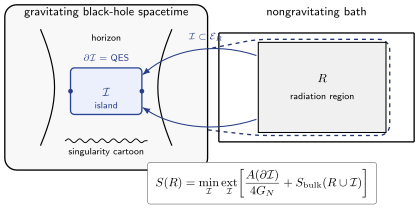
The island is a gravitating region included in the generalized entropy calculation for the nongravitating radiation region . In entanglement-wedge language, the statement is : the radiation wedge contains both the bath region and the island region in the black-hole spacetime.
This page is a conceptual checkpoint. The previous pages explained how islands are computed. Here we ask what the result means.
1. Three equivalent levels of meaning
Section titled “1. Three equivalent levels of meaning”There are three useful levels of interpretation. Confusion often comes from mixing them.
Level 1: the entropy-saddle statement
Section titled “Level 1: the entropy-saddle statement”At the most conservative level, the island is part of the saddle-point prescription for a fine-grained entropy. The generalized entropy functional has multiple candidate saddles. One is the empty-island saddle,
Another is a nonempty-island saddle,
with chosen by the QES condition
The answer is the smallest extremized value. Before the Page time the empty saddle typically dominates. After the Page time the island saddle can dominate. This is the minimal statement required to obtain the Page curve.
Level 2: the entanglement-wedge statement
Section titled “Level 2: the entanglement-wedge statement”The island is not merely a trick for drawing a curve. In holographic language, the dominant QES determines the entanglement wedge of . If a nonempty island dominates, then the radiation entanglement wedge contains the island:
where is the bulk or bath region associated with on a suitable Cauchy slice. This is the sense in which part of the black-hole interior is assigned to the Hawking radiation.
This assignment is fine-grained and nonlocal. It concerns the algebra of operators reconstructible from , not the causal future of in the semiclassical geometry.
Level 3: the reconstruction statement
Section titled “Level 3: the reconstruction statement”The strongest useful interpretation is operator reconstruction. For an operator in the island algebra, there should be an operator acting on the radiation degrees of freedom such that, for states in the relevant code subspace,
where is the holographic encoding map from the effective bulk description to the fundamental description. This is the same logic as entanglement wedge reconstruction: a bulk operator can have a boundary representative supported on the boundary region whose wedge contains it.
The phrase “the island is in the radiation” means this kind of reconstructability. It does not mean that local experiments performed on a few outgoing Hawking quanta will reveal the interior.
2. What the island is not
Section titled “2. What the island is not”A good way to understand islands is to rule out several tempting but wrong pictures.
Not a local signal channel
Section titled “Not a local signal channel”The island formula does not introduce a causal path from the black-hole interior to the bath. A point in can remain behind the event horizon in the semiclassical spacetime. Local signals from that point still cannot reach the exterior in the classical geometry.
What changes is not the local light cone, but the fine-grained encoding map. The radiation may contain a nonlocal, highly scrambled representation of an interior algebra.
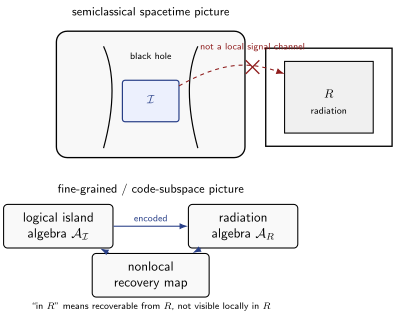
The statement is not a statement about ordinary causal propagation from to . It is a statement about fine-grained reconstruction: operators in the island algebra can have nonlocal representatives on the radiation Hilbert space, within a suitable code subspace.
Not a literal transfer of spacetime points
Section titled “Not a literal transfer of spacetime points”The island is not pulled out of the black hole into the bath. It remains part of the gravitating spacetime in the semiclassical description. The formula instead says that when computing the entropy of , the correct generalized entropy saddle includes .
This is similar in spirit to ordinary subregion duality. A bulk point inside the entanglement wedge of a boundary region is not literally transported to . Rather, its operator algebra is encoded in the degrees of freedom of .
Not visible in the coarse-grained Hawking flux
Section titled “Not visible in the coarse-grained Hawking flux”The local Hawking flux can remain approximately thermal. The island effect appears in the fine-grained entropy, mutual information, and reconstructability of the radiation. This distinction is crucial:
The Page curve is a statement about the von Neumann entropy of the exact radiation state, not about a simple thermometer placed in the bath.
Not a proof that every information problem is finished
Section titled “Not a proof that every information problem is finished”The island formula gives a controlled semiclassical calculation of the radiation entropy in important models. It also gives a compelling reconstruction interpretation. But by itself it does not answer every microscopic question about black-hole evaporation, factorization, realistic asymptotically flat evaporation, or the full algebra of interior observables in a UV-complete theory.
The modern lesson is powerful but specific: semiclassical gravity, when used with the correct fine-grained entropy prescription, knows about the Page curve.
3. The Hawking-pair bookkeeping changes
Section titled “3. The Hawking-pair bookkeeping changes”The old Hawking argument says that each late outgoing mode is entangled with an interior partner . If is added to the radiation while is traced out, the entropy of the radiation increases. Repeating this logic gives a monotonically increasing Hawking curve.
After the Page transition, the island formula reorganizes this bookkeeping. The interior partner can lie in the island. Then the matter entropy appearing in the island saddle is not , but
If contains both members of many Hawking pairs, those pairs no longer contribute positively to the entropy in the same way. The local pair-creation picture is not necessarily invalidated. What changes is which degrees of freedom are included in the fine-grained entropy region.
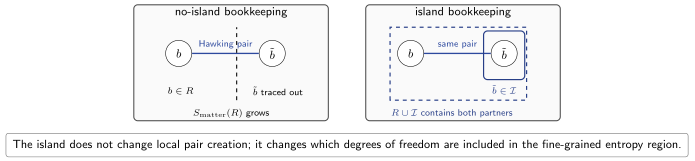
In the no-island bookkeeping, the outgoing mode is included in while its interior partner is traced out, so many such pairs make grow. In the island bookkeeping, may lie in , so the entropy functional sees rather than alone.
This is the cleanest way to understand why islands evade the small-corrections problem. They are not small perturbative corrections to each Hawking pair. They are a nonperturbative change in the dominant entropy saddle.
4. What happens at the Page time?
Section titled “4. What happens at the Page time?”The Page transition is a transition in which generalized entropy saddle dominates. Schematically,
The no-island branch grows like the Hawking entropy. The island branch is roughly controlled by the remaining black-hole entropy, plus subleading matter terms. At the Page time the two branches cross.
This does not mean that an infalling observer experiences a violent event at . The Page time is defined by the entropy of the collected radiation. It is not a local curvature singularity, shockwave, or membrane that suddenly appears at the horizon.
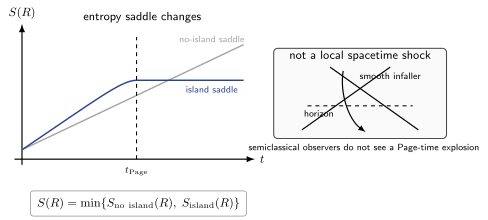
The Page transition is a switch in the dominant generalized-entropy saddle. It is sharp in the semiclassical saddle approximation, but it is not a local explosion at the horizon. Semiclassical observers should not interpret the Page time as a spacetime shock.
In an exact finite-dimensional quantum system, entropies are smooth functions of time unless the dynamics has a genuine nonanalyticity. The sharp “kink” in a Page curve is usually the large- or semiclassical limit of a smooth crossover. This is the same kind of idealization familiar from RT/HRT phase transitions in holographic entanglement entropy.
5. Does the radiation really contain the interior?
Section titled “5. Does the radiation really contain the interior?”The honest answer is: yes, in the reconstructability sense; no, in the naive local sense.
Suppose is the radiation after the Page time. If the island lies in , then an operator in the island can be represented on within a suitable code subspace. This is the same kind of statement as
But the reconstruction can be enormously complicated. In many black-hole settings, decoding the relevant information may require operations whose complexity is exponential in the black-hole entropy. Thus there is a large gap between two statements:
This gap is essential. It helps explain how the Page curve can be unitary while semiclassical physics remains an excellent local approximation for ordinary observers.
6. The algebraic version
Section titled “6. The algebraic version”The cleanest modern formulation is algebraic. Instead of asking whether a naive tensor factor “inside the island” is literally part of the radiation Hilbert space, ask whether the operator algebra associated with the island is reconstructible from .
For a code subspace , island reconstruction means that for a suitable algebra and its commutant, the encoding permits representatives on the radiation system:
for all , up to controlled errors.
This wording avoids a common trap. Gravitational regions do not factorize as simply as nongravitational quantum systems, because of constraints, edge modes, dressing, and the area operator. The island should therefore be understood as an entanglement-wedge algebra, not as a naive independent tensor factor secretly stored in the bath.
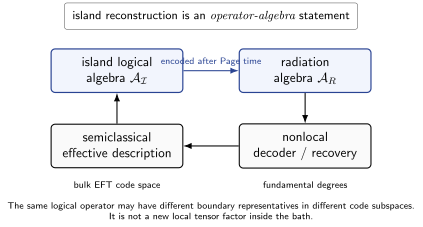
Island reconstruction is best understood as an operator-algebra statement. The island algebra has radiation representatives inside an appropriate code subspace, but the reconstruction is generally nonlocal, code-subspace dependent, and sensitive to the distinction between effective semiclassical variables and fundamental degrees of freedom.
This algebraic viewpoint also clarifies why islands do not violate no-cloning. Before the Page transition, the interior algebra may be reconstructible from the black-hole degrees of freedom. After the Page transition, relevant interior operators may also have representatives on the radiation, but these are not independent copies acting on independent physical code spaces. They are different representatives of the same logical operators, valid under specific conditions.
7. What an observer can and cannot do
Section titled “7. What an observer can and cannot do”Imagine two observers. One falls into the black hole and describes local effective field theory near the horizon. Another remains outside, collects the Hawking radiation, and attempts a decoding operation.
The island formula does not say that the outside observer can send a local signal into the island or receive an ordinary radio message from it. Nor does it say that the infalling observer sees the island boundary as a wall. The two descriptions are related by a highly nonlocal encoding, and operational comparisons are constrained by causality, computational complexity, and the finite lifetime of the black hole.
A useful rule of thumb is:
but
This is why islands are compatible with the practical thermality of Hawking radiation and with ordinary semiclassical experience near a large horizon.
8. Common misleading phrases
Section titled “8. Common misleading phrases”| Misleading phrase | Better statement |
|---|---|
| “The island is inside the radiation.” | The island algebra is reconstructible from the radiation degrees of freedom. |
| “The interior escaped into the bath.” | The dominant generalized-entropy saddle for includes a gravitating region . |
| “Hawking radiation is not thermal after Page time.” | The local coarse-grained flux may remain approximately thermal, while the fine-grained entropy follows the Page curve. |
| “The Page time creates a firewall.” | The Page transition is a saddle transition in entropy calculations, not by itself a local horizon event. |
| “Islands solve every black-hole information question.” | Islands explain the fine-grained entropy in controlled semiclassical settings, while microscopic reconstruction, factorization, and realistic evaporation remain active topics. |
9. What the island formula teaches
Section titled “9. What the island formula teaches”The island story changes the black-hole information problem in a precise way.
Hawking’s original entropy calculation effectively used
The modern fine-grained prescription uses
This is not a small correction to the old answer. It is a different saddle prescription. At early times the difference is invisible because the empty-island saddle dominates. At late times the difference is order because the dominant saddle changes.
Conceptually, this means that the semiclassical bulk description has more redundancy than a naive local QFT picture suggests. A region behind the horizon can be encoded in the radiation without becoming locally accessible in the radiation. That is the same deep moral as holographic quantum error correction, now applied to an evaporating black hole.
10. Exercises
Section titled “10. Exercises”Exercise 1. A two-qubit model of island bookkeeping
Section titled “Exercise 1. A two-qubit model of island bookkeeping”Let and be two qubits in a Bell state,
Compute and . Explain why this toy model captures the bookkeeping difference between and .
Solution
The reduced density matrix of is maximally mixed:
so
The two-qubit state is pure, so
The lesson is simple but important. If the entropy region contains only the outgoing mode , the pair contributes entropy. If the entropy region contains both and its partner , that pair need not contribute. In the island formula, the late-time entropy functional contains , so interior partners can be included in the entropy region.
Exercise 2. Reconstruction is not causality
Section titled “Exercise 2. Reconstruction is not causality”Suppose is reconstructible from , so there exists with
for all states in a code subspace. Does this imply that a local signal can propagate from to through the semiclassical geometry?
Solution
No. Reconstruction is an equality of operator actions within an encoded code subspace. It says that the same logical operation can be represented using radiation degrees of freedom. It does not say that there is a causal curve from the island to the radiation region, nor that a local detector in can directly receive a signal from .
This distinction is already present in ordinary AdS/CFT subregion duality. A bulk operator in the entanglement wedge of a boundary region can be represented on that boundary region, but the bulk point is not physically transported to the boundary. The equality is an encoding statement, not a local propagation statement.
Exercise 3. A saddle-transition model
Section titled “Exercise 3. A saddle-transition model”Consider the toy generalized entropies
where , , and varies slowly. Interpret as the no-island branch and as the island branch. Estimate the Page time.
Solution
The entropy is
The transition occurs when
If is small compared with , then
with a correction of order . This captures the basic island logic: the Hawking branch grows until it meets a second branch controlled by the black-hole entropy or generalized entropy of a QES.
Exercise 4. Code-subspace dependence
Section titled “Exercise 4. Code-subspace dependence”Why is it reasonable that island reconstruction can depend on a code subspace? Why would a single reconstruction valid for every possible black-hole microstate be too strong?
Solution
Bulk effective field theory is itself a code-subspace description. It describes small fluctuations around a class of semiclassical backgrounds. The same bulk operator can have different boundary representatives in different code subspaces, just as in quantum error correction a logical operator can have different physical representatives depending on the chosen code.
A reconstruction valid for every possible black-hole microstate would try to describe too large a Hilbert space using one semiclassical interior. That would run into entropy bounds and typical-state firewall-style tensions. The island formula and entanglement wedge reconstruction are most precise when the code subspace is specified and its size is compatible with the relevant generalized entropy bounds.
11. Further reading
Section titled “11. Further reading”- Geoffrey Penington, “Entanglement Wedge Reconstruction and the Information Paradox”.
- Ahmed Almheiri, Netta Engelhardt, Donald Marolf, and Henry Maxfield, “The Entropy of Bulk Quantum Fields and the Entanglement Wedge of an Evaporating Black Hole”.
- Ahmed Almheiri, Thomas Hartman, Juan Maldacena, Edgar Shaghoulian, and Amirhossein Tajdini, “The Entropy of Hawking Radiation”.
- Geoff Penington, Stephen H. Shenker, Douglas Stanford, and Zhenbin Yang, “Replica Wormholes and the Black Hole Interior”.
- Chris Akers, Netta Engelhardt, Geoff Penington, and Mykhaylo Usatyuk, “Quantum Maximin Surfaces”, for a more structural view of QESs.
- Chris Akers, Netta Engelhardt, Geoff Penington, and Shreya Vardhan, “The Black Hole Interior from Quantum Error Correction”, for a modern perspective on interior reconstruction and non-isometric codes.