
Large N Factorization and Fock Space
Bulk effective field theory needs a Hilbert space before it needs an action. The Hilbert space of a weakly coupled bulk theory is approximately a Fock space: one-particle states, two-particle states, three-particle states, and so on, with weak interactions mixing them.
Where is this Fock space in the CFT?
The answer is large- factorization. In the strict limit, suitably normalized single-trace operators behave like generalized free fields. Their products create multiparticle states. At finite but large , connected correlators are small but nonzero, and the Fock space becomes weakly interacting.
The slogan is:
This page explains the statement in Hilbert-space language.
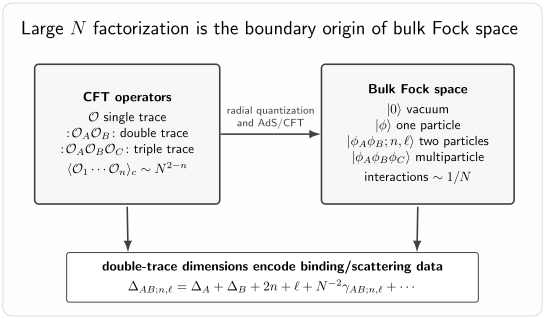
In radial quantization, operators create states. At large , single-trace primaries create one-particle bulk states, while normal-ordered products create multiparticle states. Connected correlators suppressed by powers of become weak bulk interactions.
Why this matters
Section titled “Why this matters”A classical-looking bulk is not only about equations of motion. It is about the organization of quantum states.
In a free scalar field theory in AdS, a quantum state can contain any number of particles:
The same structure must be visible in the CFT. Since a CFT Hilbert space is generated by local operators acting on the vacuum, the bulk Fock-space question becomes:
The answer is controlled by the large- expansion.
Normalizing single-trace operators
Section titled “Normalizing single-trace operators”In a matrix large- gauge theory, a typical gauge-invariant single-trace operator has the schematic form
Its two-point function often scales like a positive power of . For holographic purposes it is convenient to define a normalized operator with two-point function of order one:
For adjoint matrix theories, this usually means rescaling a trace operator by a suitable power of . With this normalization, connected correlators of single-trace operators satisfy
Thus
This is the same scaling as a weakly coupled bulk theory with interaction strength
Factorization
Section titled “Factorization”Large- factorization says that products of separated single-trace operators factorize at leading order:
for unnormalized operators, or more usefully, for normalized operators with vanishing one-point functions,
This is the Wick-like behavior of a generalized free field.
The word “generalized” matters. A generalized free field has the correlator factorization of a free field, but its two-point function can have an arbitrary scaling dimension allowed by conformal symmetry:
It is not necessarily a free local field in the boundary spacetime. Rather, it is the boundary shadow of a free bulk field in AdS.
Radial quantization: operators create states
Section titled “Radial quantization: operators create states”In a CFT, radial quantization maps local operators to states on the cylinder:
A primary operator of dimension creates an energy eigenstate on :
In global AdS, a scalar particle of mass has normal-mode energies
where
The state-operator map then matches beautifully:
and
Multi-trace operators as multiparticle states
Section titled “Multi-trace operators as multiparticle states”A two-particle state is created by a double-trace operator. Schematically,
Here is a radial excitation number and is the relative angular momentum. At , its dimension is
This is precisely the energy of two noninteracting AdS particles:
At finite large , interactions shift the dimension:
The anomalous dimension is the CFT version of a bulk binding energy or scattering phase shift.
Similarly, triple-trace operators create three-particle states, and so on:
Fock space at
Section titled “Fock space at N=∞N=\inftyN=∞”At strict , the connected correlators beyond two points vanish:
The CFT operator algebra generated by the low-dimension single-trace operators becomes generalized free. This is the boundary signature of a free bulk theory.
One can think of the CFT Hilbert space, restricted to the low-energy sector, as approximately
where is the one-particle space generated by light single-trace primaries and their descendants, and denotes the Fock-space construction.
In words:
Interactions at finite large
Section titled “Interactions at finite large NNN”At finite large , connected correlators are small but nonzero. This is the boundary imprint of bulk interactions.
After canonical normalization, a bulk scalar action has the schematic form
The cubic term gives
The exchange of two cubic vertices or one quartic vertex gives
In Hilbert-space language, interactions mix Fock sectors. For example, a one-particle state can mix weakly with two-particle states if the quantum numbers allow it:
The Fock-space picture is therefore approximate, not exact.
The role of the large gap
Section titled “The role of the large gap”Large- factorization builds a Fock space, but it does not by itself make that Fock space local in a weakly curved bulk. To get local bulk EFT, one also needs a gap to additional single-trace states.
Without a large gap, there may be infinitely many light fields, including higher-spin fields. The bulk can still exist, but it may be stringy or higher-spin at the AdS scale.
The best low-energy bulk picture requires both:
A useful combined statement is:
Multi-trace mixing and the need to diagonalize
Section titled “Multi-trace mixing and the need to diagonalize”The phrase “double-trace operator” hides a technical point. Operators with the same quantum numbers can mix. For example, a single-trace operator and a double-trace operator may share the same spin and approximate dimension.
The true energy eigenstates are obtained by diagonalizing the dilatation operator:
At large , mixing is often perturbatively small. But near degeneracies can enhance it. Bulk language calls the same effect particle mixing, decay, or resonance physics.
Thus, the dictionary is sharpest after one specifies a basis of properly normalized, approximately diagonal operators.
Finite : where Fock space breaks
Section titled “Finite NNN: where Fock space breaks”A Fock space has infinitely many independent multiparticle states. A finite- holographic CFT does not. At sufficiently high energies, finite- constraints become important.
Several effects signal the breakdown of the naive Fock picture:
- trace relations: for finite-size matrices, traces are not all independent;
- stringy exclusion effects: not every large quantum number state has a naive independent bulk-particle interpretation;
- black-hole formation: sufficiently energetic states are better described as black holes than as a dilute gas of particles;
- entropy bounds: the number of independent bulk states in a region is constrained by gravitational entropy;
- nonperturbative effects: corrections can scale like , invisible in ordinary perturbation theory.
The Fock-space picture is therefore a low-energy and perturbative description:
with more refined thresholds depending on dimension, charges, angular momenta, and the operator sector.
Gravitational dressing and locality
Section titled “Gravitational dressing and locality”There is another subtlety. In a theory with gravity, a strictly local gauge-invariant bulk operator does not exist in the same way as a local operator in a nongravitational QFT. A bulk field must be gravitationally dressed to the boundary or to some reference structure.
In the large- limit, this dressing is weak, and one can use approximate local bulk fields. But at finite , exact gauge-invariant bulk observables are relational and nonlocal.
The CFT sees this through the fact that a bulk local operator is represented by a complicated, generally nonlocal boundary operator. In perturbation theory, this can be constructed order by order. Nonperturbatively, the notion of a local bulk operator is limited by gravitational constraints.
A simple dictionary of states
Section titled “A simple dictionary of states”Here is the state dictionary in its most useful first-pass form.
| CFT object | Bulk interpretation |
|---|---|
| vacuum $ | 0\rangle$ on the cylinder |
| light single-trace primary | one-particle state |
| descendants of | excited one-particle AdS modes |
| double-trace primary | two-particle state with radial excitation and angular momentum |
| multi-trace operator | multiparticle bulk state |
| connected three-point function | cubic bulk interaction |
| double-trace anomalous dimension | binding energy/scattering data |
| high-energy dense spectrum | black-hole/stringy regime |
This table is a map, not a substitute for diagonalizing the CFT.
Dictionary checkpoint
Section titled “Dictionary checkpoint”The central translation of this page is:
This is the Hilbert-space backbone of perturbative AdS quantum gravity.
Common confusions
Section titled “Common confusions”“Multi-trace means composite, so it cannot be fundamental.”
Section titled ““Multi-trace means composite, so it cannot be fundamental.””Correct, but irrelevant. A two-particle state is also composite. Multi-trace operators are not fundamental bulk fields; they create multiparticle states built from the one-particle fields dual to single-trace operators.
“A product of two primaries is automatically a primary.”
Section titled ““A product of two primaries is automatically a primary.””No. A product of two primaries contains descendants and traces. The double-trace primary is a particular linear combination chosen to transform as a conformal primary.
“Factorization means the theory is free.”
Section titled ““Factorization means the theory is free.””At , the low-energy single-trace sector behaves like a generalized free theory. But the full finite- theory is not free. The corrections encode bulk interactions.
“Every large- CFT has an Einstein Fock space.”
Section titled ““Every large-NNN CFT has an Einstein Fock space.””No. Large gives weak interactions, but the particle content may include infinitely many light higher-spin or stringy fields. A local Einstein-like Fock space also requires a sparse low-energy spectrum and a large gap.
“The Fock space is exact at finite .”
Section titled ““The Fock space is exact at finite NNN.””No. It is an approximation valid in a perturbative low-energy regime. Finite- trace identities, black-hole states, and gravitational constraints all limit the naive Fock construction.
Exercises
Section titled “Exercises”Exercise 1
Section titled “Exercise 1”Let be a normalized single-trace operator with
Assume large- counting
What are the scalings of the connected three- and four-point functions? What bulk interactions do they correspond to?
Solution
For ,
This is the scaling of a cubic bulk interaction among canonically normalized fields.
For ,
This is the scaling of tree-level four-point bulk processes: either a quartic contact diagram or an exchange diagram built from two cubic vertices. Bulk loops are further suppressed by additional powers of .
Exercise 2
Section titled “Exercise 2”At , two scalar single-trace primaries and have dimensions and . What is the leading dimension of the double-trace primary ?
Solution
At , the two bulk particles do not interact. The corresponding double-trace primary has dimension
Here is the radial excitation number and is the relative spin/angular momentum. At finite large , interactions produce anomalous dimensions:
Exercise 3
Section titled “Exercise 3”Explain why a large gap is needed in addition to large- factorization if one wants a local Einstein-like bulk EFT.
Solution
Large- factorization makes connected correlators small and therefore gives weak interactions. But it does not guarantee that only a few light fields exist. A theory may have infinitely many light single-trace operators, including higher-spin operators, even at large .
A local Einstein-like EFT requires a finite or controlled number of light fields and a derivative expansion. This requires a gap
to additional single-trace states, especially higher-spin or stringy states. The large gap suppresses higher-derivative corrections by powers of and allows low-energy physics to be local on length scales much smaller than but larger than the cutoff scale.
Exercise 4
Section titled “Exercise 4”Suppose a double-trace operator has dimension
What is the bulk interpretation of ?
Solution
In global AdS, dimensions are energies in units of . The leading term is the energy of two noninteracting particles. The correction
is therefore the leading interaction energy. Depending on the kinematic regime, it can be interpreted as a binding energy, a perturbative energy shift, or scattering data for the two bulk particles.
Further reading
Section titled “Further reading”- G. ‘t Hooft, A Planar Diagram Theory for Strong Interactions.
- E. Witten, Baryons and Branes in Anti de Sitter Space, for finite- and stringy-exclusion-type lessons in holography.
- A. L. Fitzpatrick, E. Katz, D. Poland, and D. Simmons-Duffin, Effective Conformal Theory and the Flat-Space Limit of AdS.
- A. L. Fitzpatrick and J. Kaplan, Scattering States in AdS/CFT.
- I. Heemskerk, J. Penedones, J. Polchinski, and J. Sully, Holography from Conformal Field Theory.
- A. Hamilton, D. Kabat, G. Lifschytz, and D. A. Lowe, Local Bulk Operators in AdS/CFT.