
Complementarity, AMPS, and Firewalls
The Page curve says that after the Page time the fine-grained entropy of the Hawking radiation must decrease if evaporation is unitary. The Hayden–Preskill protocol says that an old black hole should behave like an information mirror: newly thrown-in information can become recoverable from the old radiation plus a small amount of late radiation after roughly a scrambling time.
Those statements sharpen the information paradox. They do not merely say that information must come out. They say that late Hawking modes must be correlated with the early radiation. But local effective field theory near a smooth horizon says something else: a late outgoing Hawking mode is entangled with an interior partner in the local vacuum.
This is the firewall problem. The tension is not the slogan that “black holes are hot.” It is a precise quantum-information conflict among three ideas:
- evaporation is unitary, so the radiation follows a Page curve;
- semiclassical effective field theory is valid near the horizon for low-energy observers;
- an infalling observer sees no drama at the horizon of a large black hole.
The AMPS argument says that, in a naive tensor-factor description, these three statements cannot all be true.
Guiding question
Section titled “Guiding question”Why does the Page curve create a problem for the smoothness of the horizon?
Let
- be the early Hawking radiation already far away,
- be a late outgoing Hawking wavepacket just outside the horizon,
- be the interior partner mode that would purify in the local near-horizon vacuum.
Before the Page time, it is consistent for a newly emitted mode to increase the entropy of the radiation. After the Page time, unitary evaporation requires the opposite:
Equivalently,
Negative conditional entropy is a quantum statement: it means that is strongly correlated, in the relevant purification sense, with the early radiation .
But the equivalence principle plus local effective field theory near a smooth horizon says that is also entangled with its interior partner in an approximately vacuum state:
A quantum system cannot be fully purified twice by two independent systems. That is the firewall paradox in one sentence.
Black hole complementarity
Section titled “Black hole complementarity”Black hole complementarity was proposed as a way to reconcile exterior unitarity with the infalling observer’s smooth experience.
The idea is not that there are literally two independent copies of the information. Instead, the exterior and infalling descriptions are regarded as two effective descriptions that cannot be operationally compared by a single low-energy observer.
For a distant observer, the black hole is replaced by a stretched horizon, a timelike membrane located a microscopic proper distance outside the event horizon. The membrane has a huge number of degrees of freedom, absorbs infalling information, scrambles it, and eventually re-emits it in Hawking radiation. For an infalling observer crossing a large black hole horizon, the local geometry is approximately Rindler and nothing dramatic need happen at the crossing.
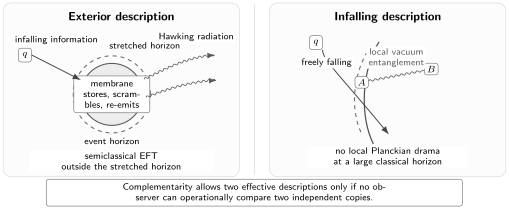
Black hole complementarity describes the same physics using two effective pictures. The exterior observer attributes absorption, scrambling, and re-emission to a stretched horizon. The infalling observer uses a local freely falling frame and sees the horizon as smooth. The proposal is consistent only if these descriptions are not two independent tensor factors that one observer can compare.
The stretched horizon is natural already from the near-horizon redshift. Near a nonextremal horizon, the metric locally takes the Rindler form
where is proper distance from the horizon and is the surface gravity. The Hawking temperature measured at infinity is
A static observer at proper distance measures a blue-shifted local temperature
Thus at the local temperature is Planckian. It is then plausible, from the exterior viewpoint, that ordinary low-energy effective field theory should be replaced by microscopic horizon degrees of freedom. Complementarity packages those degrees of freedom into the stretched horizon.
Why complementarity seemed to avoid cloning
Section titled “Why complementarity seemed to avoid cloning”Suppose Alice falls into the black hole carrying a qubit . A distant observer Bob may later recover the information in Hawking radiation. Does that mean there are two copies, one inside and one outside?
Complementarity answers: not operationally. If Bob waits long enough to collect and decode the Hawking radiation, there may be no time for him to jump in and compare the exterior copy with Alice’s interior copy. For a young black hole, the relevant waiting time is of order the Page time, much longer than the time Alice has before hitting the singularity. The causal structure prevents a direct no-cloning experiment.
This was the attractive feature of complementarity: it kept
and
without requiring a single semiclassical spacetime description to contain both copies at once.
But the old-black-hole regime is more dangerous. After the Page time, the early radiation is already available. Hayden–Preskill reasoning suggests that a late message can become recoverable from plus a small amount of additional radiation after roughly a scrambling time, not after another Page time. AMPS used this old-black-hole setting to turn the complementarity story into a sharper test.
The AMPS setup
Section titled “The AMPS setup”Consider an old black hole, already past the Page time. Let be a late outgoing mode outside the horizon. In ordinary local quantum field theory near a smooth horizon, the state of the exterior mode and its interior partner is approximately the Unruh vacuum.
For a single frequency mode, the local vacuum has the schematic two-mode squeezed form
Tracing over gives a thermal density matrix for :
Thus is mixed because it is entangled with . This entanglement is exactly what makes the horizon locally smooth. If the short-distance entanglement across the horizon is removed, the infalling state is no longer the vacuum and typically contains high-energy excitations in the freely falling frame.
On the other hand, after the Page time unitary evaporation says that adding the new mode to the radiation should reduce the radiation entropy:
This means is not merely a fresh thermal quantum independent of . It must carry correlations with .
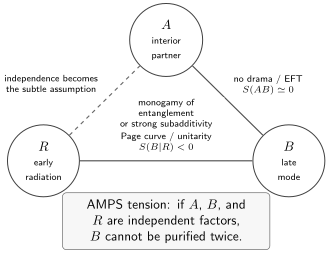
The AMPS tension. After the Page time, unitarity requires the late outgoing mode to be correlated with the early radiation . Local effective field theory plus no drama requires to be entangled with an interior partner in an approximately vacuum state. If , , and are independent Hilbert-space factors, monogamy of entanglement forbids both requirements from being simultaneously exact.
The problem is not that has some small correlation with while also having some small correlation with . Quantum systems can share partial correlations. The problem is that the two conditions are both strong in the idealized limit:
- no drama wants to be nearly pure;
- the Page curve wants to help purify the early radiation.
This is the entanglement version of trying to spend the same qubit twice.
The entropy inequality behind AMPS
Section titled “The entropy inequality behind AMPS”The AMPS contradiction can be stated with strong subadditivity. For three systems , , and ,
This inequality is an exact theorem of quantum mechanics for ordinary tensor-factor Hilbert spaces.
Now impose the two semiclassical assumptions that make the horizon smooth and local.
First, no drama says that and are approximately in the local vacuum, so
Second, local effective field theory says that the near-horizon pair is produced locally and is not secretly the same set of degrees of freedom as the distant early radiation . Thus adding the nearly pure pair to should not change the entropy of very much:
Strong subadditivity then gives
In words: if is born as part of a smooth local vacuum pair, then adding to the radiation should increase the radiation entropy by approximately .
But after the Page time, unitary evaporation requires
The same late quantum is being asked to both increase and decrease the entropy of the radiation. That is the sharp AMPS conflict.
A slightly more robust way to phrase the same point uses conditional entropy. After the Page time,
No drama plus locality gives approximately
The signs disagree.
What is a firewall?
Section titled “What is a firewall?”The most direct escape is to give up no drama. Then the near-horizon state is not the local vacuum. The mode is not entangled with a smooth interior partner in the usual way; instead it can be correlated with without violating monogamy. The cost is that an infalling observer encounters order-one deviations from the vacuum at the horizon.
This is called a firewall.
The word is vivid, but it should not be overinterpreted. It does not necessarily mean a classical wall of ordinary matter sitting at . The essential claim is more precise: the short-distance entanglement structure required for a smooth horizon is absent or drastically modified for old black holes. In local QFT, changing the vacuum entanglement across a Rindler horizon tends to produce large stress-energy in the infalling frame. That is why the proposal is often described as the observer “burning up” at the horizon.
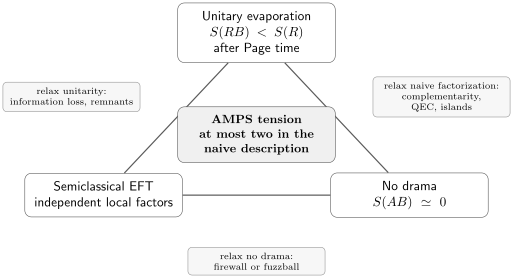
The AMPS trilemma in its naive tensor-factor form. After the Page time, unitary evaporation, independent near-horizon effective field theory, and no drama are hard to maintain simultaneously. Different proposed resolutions relax different corners of the triangle.
The firewall conclusion is conservative in one narrow sense: it keeps ordinary unitary quantum mechanics and keeps a fairly ordinary exterior effective field theory, while sacrificing smoothness of the horizon. It is radical in another sense: it violates the equivalence-principle expectation that a sufficiently large black hole horizon should be locally uneventful.
Small corrections are not enough
Section titled “Small corrections are not enough”One tempting response is to say that Hawking’s calculation is only approximate. Perhaps tiny quantum-gravity corrections to each emitted pair encode enough information to restore unitarity.
The problem is that the Page curve requires an order-one change in the fine-grained entropy flow after the Page time. In the semiclassical pair-production picture, each newly emitted pair increases the entanglement between the radiation and the remaining black hole by roughly the entropy of the outgoing mode. If every pair is corrected only slightly, the entanglement growth changes only slightly.
A schematic pair state is
where is the Hawking pair state. Small corrections cannot reverse the sign of the entropy production for many emissions. To obtain a Page curve, the entanglement structure must change by order one in the relevant fine-grained sense.
This is why AMPS is not merely a complaint about a missing tiny correction in Hawking’s calculation. It asks where the order-one change enters.
The Harlow–Hayden obstruction
Section titled “The Harlow–Hayden obstruction”AMPS is often presented as an in-principle experiment. An exterior observer Bob collects the early radiation , distills from it the subsystem that purifies the late mode , and then jumps into the black hole to compare with the interior partner .
Harlow and Hayden pointed out that the dangerous step may be computationally infeasible. Distilling the purifier from a highly scrambled radiation state can require a quantum computation whose complexity is exponential in the black hole entropy:
For a large semiclassical black hole, the evaporation time is only polynomial in in Planck units. Thus the decoding operation needed to make the AMPS contradiction operational may take far longer than the black hole lifetime.
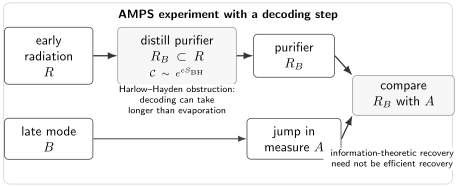
The Harlow–Hayden obstruction. To perform the AMPS experiment operationally, Bob must distill from the early radiation a purifier of the late mode , then enter the black hole and compare it with the interior partner . For generic scrambled states this decoding can be exponentially complex in , even though the information is present in principle.
This distinction is important:
The Harlow–Hayden point does not by itself remove the logical tension in the Hilbert-space description. It says that the thought experiment that would expose the contradiction may be impossible for any observer obeying the physical time constraints. This fits naturally with the spirit of complementarity: perhaps no observer can operationally access both descriptions at once.
There are also caveats. Complexity arguments depend on assumptions about generic scrambling, available quantum computers, and the structure of the decoding problem. Specially engineered systems or protocols may evade generic estimates. So decoding complexity is best viewed as an operational obstruction, not as a complete microscopic resolution of black hole information.
Modern holographic perspective
Section titled “Modern holographic perspective”The island and entanglement-wedge story changes the interpretation of the AMPS variables.
In the naive AMPS setup, , , and are treated as independent tensor factors. But in quantum gravity, especially after the Page time, the interior partner of a late Hawking mode may be encoded in the radiation’s entanglement wedge. In that case the purifier in and the interior partner are not two independent systems. They are two reconstructions of the same logical degrees of freedom in different descriptions.
This is exactly the kind of structure familiar from quantum error correction. A logical bulk operator can have multiple boundary reconstructions. The existence of two reconstructions does not imply two independent copies, because the reconstructions act on a constrained code subspace.
In island language, after the Page transition the fine-grained entropy of the radiation is computed not by the no-island saddle but by an island saddle:
The island can include the region that semiclassically looked like part of the black hole interior. Thus the radiation’s entanglement wedge can contain degrees of freedom that the naive Hawking calculation traced over. The lesson is not that a local signal travels from the interior into the radiation. It is that the correct fine-grained gravitational entropy calculation uses a different entanglement wedge after the Page time.
This modern viewpoint softens the firewall conclusion, but it also explains why AMPS was so powerful. AMPS exposed that the naive Hilbert-space factorization
cannot be trusted as an exact description of the old black hole. The same lesson reappears in entanglement wedge reconstruction, operator-algebra quantum error correction, and the island formula.
What AMPS does and does not prove
Section titled “What AMPS does and does not prove”AMPS is a clean contradiction among assumptions. It is not a theorem that every old black hole in quantum gravity literally has a material wall at the horizon.
What it shows:
- A Page curve plus ordinary local pair creation is inconsistent with a naive independent tensor-factor description.
- The smooth-horizon condition is really a statement about entanglement across the horizon.
- Small perturbative corrections to Hawking pairs cannot by themselves generate the Page curve.
- Any resolution must modify at least one of unitarity, no drama, locality/factorization, or operational accessibility.
What it does not show:
- It does not prove that semiclassical effective field theory fails everywhere outside the horizon.
- It does not by itself identify the microscopic degrees of freedom of the black hole.
- It does not settle whether realistic observers encounter high-energy excitations.
- It does not remove the need for a UV-complete account of the interior.
The value of the firewall paradox is that it forces a precise question:
In what Hilbert space, and in what algebra of observables, are the early radiation, late Hawking mode, and interior partner independent?
The modern answer is subtle. In fixed-background QFT they are independent enough for the AMPS contradiction. In quantum gravity, the algebraic and code-subspace structure can be different.
Common pitfalls
Section titled “Common pitfalls”Pitfall 1: “The firewall is just high temperature Hawking radiation.”
Section titled “Pitfall 1: “The firewall is just high temperature Hawking radiation.””No. Hawking radiation at infinity is cold for a large black hole. The firewall is about the state seen by an infalling observer near the horizon. It is a claim that the local vacuum entanglement across the horizon is absent or modified.
Pitfall 2: “AMPS assumes a single Hawking quantum is exactly maximally entangled with the early radiation.”
Section titled “Pitfall 2: “AMPS assumes a single Hawking quantum is exactly maximally entangled with the early radiation.””The cleanest cartoon says that. The more robust statement is entropic: after the Page time, adding late radiation must reduce the radiation entropy on average. That requires correlations with the early radiation incompatible with ordinary independent pair creation.
Pitfall 3: “Harlow–Hayden proves there is no paradox.”
Section titled “Pitfall 3: “Harlow–Hayden proves there is no paradox.””It gives a powerful operational obstruction to performing the AMPS experiment. It does not, by itself, derive the microscopic interior or the Page curve.
Pitfall 4: “Islands simply say the interior is literally in the radiation.”
Section titled “Pitfall 4: “Islands simply say the interior is literally in the radiation.””The better statement is that the interior island belongs to the entanglement wedge of the radiation for the purpose of computing fine-grained entropy and reconstructing logical operators. This is a nonlocal encoding statement, not a local signal-propagation statement.
Exercises
Section titled “Exercises”Exercise 1. Local temperature near the horizon
Section titled “Exercise 1. Local temperature near the horizon”Starting from the near-horizon Rindler metric
show that the local temperature measured by a static observer at proper distance is approximately
Solution
The Hawking temperature measured with respect to the asymptotic Killing time is
A static observer at fixed has proper time
Energies measured locally are blue-shifted relative to Killing energies by
The same Tolman redshift applies to the temperature:
Thus the local temperature becomes Planckian when is of order the Planck length.
Exercise 2. Entropy sign after the Page time
Section titled “Exercise 2. Entropy sign after the Page time”Explain why unitary evaporation after the Page time implies
for a typical late Hawking subsystem .
Solution
The Page curve is the fine-grained entropy of the collected radiation. Before the Page time, the radiation subsystem is smaller than the remaining black hole subsystem, so typical newly emitted radiation increases the entropy of the radiation.
After the Page time, the radiation subsystem is larger than the remaining black hole subsystem. If the total state is pure, then
As evaporation proceeds, the remaining black hole loses Hilbert-space dimension and entropy. Therefore the fine-grained entropy of the radiation must decrease. If is the radiation before the emission and is the newly collected late subsystem, this decrease is expressed as
Equivalently, the conditional entropy is negative:
Exercise 3. The strong-subadditivity contradiction
Section titled “Exercise 3. The strong-subadditivity contradiction”Use strong subadditivity,
together with the no-drama assumptions
to derive the AMPS conflict with the Page-curve condition.
Solution
Insert the no-drama/locality assumptions into strong subadditivity:
Using
we find
Since is a nontrivial outgoing mode,
Therefore the no-drama semiclassical picture predicts
But after the Page time, unitary evaporation requires
The two inequalities are incompatible. This is the entropic core of the AMPS paradox.
Exercise 4. Why small corrections do not reverse the Page curve
Section titled “Exercise 4. Why small corrections do not reverse the Page curve”Suppose each Hawking pair is corrected by a small parameter . Give a qualitative entropy argument for why such corrections cannot make the radiation entropy decrease after the Page time.
Solution
In the leading Hawking process, each outgoing mode is entangled with an interior partner . This increases the entanglement between the radiation and the remaining black hole by an amount of order per emission.
If the pair state is changed only by a small trace-distance amount , continuity of entropy implies that the entropy change per emitted pair is modified only by a small amount, schematically of order times the size of the local Hilbert space, plus logarithmic corrections. For , this cannot turn a positive entropy increase of order into a negative entropy change of comparable magnitude.
The Page curve after the Page time requires an order-one change in the entropy flow. Therefore the state of the radiation cannot be fixed by tiny independent corrections to each Hawking pair while keeping the semiclassical pair structure intact.
Exercise 5. Complementarity and no-cloning
Section titled “Exercise 5. Complementarity and no-cloning”Explain why black hole complementarity does not simply violate the quantum no-cloning theorem.
Solution
The no-cloning theorem forbids producing two independent copies of an unknown quantum state that can be accessed in the same Hilbert-space description.
Complementarity does not claim that there are two independent copies. It claims that the exterior stretched-horizon description and the infalling smooth-horizon description are different effective descriptions of the same underlying quantum system. The exterior observer says the information is absorbed, scrambled, and later re-emitted. The infalling observer uses a local description in which the horizon is smooth.
The proposal is viable only if no single observer can operationally compare an interior copy with an exterior copy. If such a comparison were possible, complementarity would become ordinary cloning and would fail.
Exercise 6. Decoding complexity versus information-theoretic recovery
Section titled “Exercise 6. Decoding complexity versus information-theoretic recovery”What is the difference between saying that the purifier of a late Hawking mode exists in the early radiation and saying that Bob can efficiently distill ?
Solution
The statement that exists is information-theoretic. It means that, in principle, the correlations in the early radiation contain a subsystem or logical reconstruction that purifies .
Efficient distillation is a stronger operational statement. Bob must implement a quantum decoding map on the radiation that extracts in the available physical time. For generic scrambled states, Harlow and Hayden argued that this decoding may require complexity exponential in the black hole entropy:
A large black hole evaporates in a time polynomial in , so such a decoding would not be physically executable before the black hole disappears. Thus the purifier can exist in principle while remaining operationally inaccessible.
Exercise 7. Islands and the independence assumption
Section titled “Exercise 7. Islands and the independence assumption”In one paragraph, explain how the island formula changes the AMPS independence assumption.
Solution
The AMPS argument treats the early radiation , the outgoing late mode , and the interior partner as independent tensor factors. The island formula says that after the Page transition, part of the black hole interior can lie in the entanglement wedge of the radiation. Then the interior partner may be reconstructible from as a logical operator. The purifier in and the interior mode are not two independent systems; they can be two reconstructions of the same encoded degree of freedom. This modifies the naive factorization assumption without requiring a local signal to travel from the interior to the radiation.
Further reading
Section titled “Further reading”- L. Susskind, L. Thorlacius, and J. Uglum, “The Stretched Horizon and Black Hole Complementarity,” Physical Review D 48 (1993), 3743. arXiv:hep-th/9306069.
- A. Almheiri, D. Marolf, J. Polchinski, and J. Sully, “Black Holes: Complementarity or Firewalls?” Journal of High Energy Physics 02 (2013), 062. arXiv:1207.3123.
- D. Harlow and P. Hayden, “Quantum Computation vs. Firewalls,” Journal of High Energy Physics 06 (2013), 085. arXiv:1301.4504.
- S. D. Mathur, “The Information Paradox: A Pedagogical Introduction,” Classical and Quantum Gravity 26 (2009), 224001. arXiv:0909.1038.
- A. Almheiri, T. Hartman, J. Maldacena, E. Shaghoulian, and A. Tajdini, “The Entropy of Hawking Radiation,” Reviews of Modern Physics 93 (2021), 035002. arXiv:2006.06872.
- D. Harlow, “Jerusalem Lectures on Black Holes and Quantum Information,” Reviews of Modern Physics 88 (2016), 015002. arXiv:1409.1231.
The Foundations module has now reached the point where the paradox is sharp. The next module begins the holographic entropy technology needed to move beyond slogans: the Ryu–Takayanagi formula, its covariant and quantum corrections, and eventually the quantum extremal surfaces that make the island formula possible.