
Holographic Superconductors and Superfluids
The finite-density pages built a normal state: a charged black brane, often with an throat, radial electric flux, and no quasiparticles. The fermion pages then asked how gauge-invariant fermionic probes and backreacted fermion charge see that state. We now ask the most basic ordered-state question:
The answer is yes, and the mechanism is beautifully economical. Add a charged scalar field to the charged black-brane background. At high temperature the scalar vanishes and the solution is the Reissner—Nordström AdS black brane. At low temperature the electric field near the horizon lowers the scalar’s effective mass enough to trigger an instability. The endpoint is a hairy black brane:
The boundary interpretation is spontaneous breaking of a global symmetry:
This page explains that statement carefully. The central lesson is not that holography literally derives the cuprate superconductors. The lesson is sharper and more useful: holography gives a controlled strong-coupling model in which a non-quasiparticle finite-density state undergoes a symmetry-breaking transition with many macroscopic signatures of superconductivity.
There is one terminological nuisance. A bulk gauge field is dual to a global current in the boundary theory. Therefore the minimal model is, strictly speaking, a holographic superfluid. It is called a holographic superconductor because its optical conductivity, condensate, gap-like response, vortices, Josephson physics, and mean-field order-parameter behavior closely resemble those of superconductors. To obtain an honest electromagnetic superconductor, one must weakly gauge the boundary .
Throughout this page is the number of boundary spatial dimensions, so the boundary spacetime dimension is . Bulk indices are , boundary indices are , and the radial coordinate is denoted by when the boundary is at .
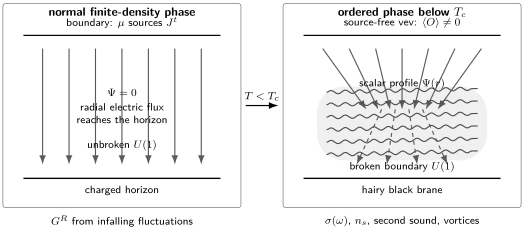
The minimal holographic superconductor. At high temperature, the normal finite-density state is a charged black brane with and radial electric flux ending on the horizon. Below , a charged scalar condenses. The bulk develops scalar hair, and the boundary theory has a source-free order parameter .
The boundary problem: order without quasiparticles
Section titled “The boundary problem: order without quasiparticles”In ordinary weak-coupling BCS theory, superconductivity starts with a Fermi liquid. The Fermi surface is sharp, the Cooper instability is logarithmic, and the elementary electron-like quasiparticles are reorganized into Bogoliubov quasiparticles. That is not the holographic starting point.
The normal state in the simplest holographic construction is a strongly coupled charged plasma. It may have broad spectral functions, an throat, incoherent charge dynamics, and no electron quasiparticles. Yet it can still have a charged scalar operator in the boundary theory. If is interpreted as a pair operator, then the question is whether its susceptibility becomes unstable:
A pole at zero frequency and zero momentum means that the normal state is no longer stable. The system can lower its free energy by developing
This is the holographic version of the order-parameter problem. The computation is classical in the bulk, but it captures a strongly coupled large- quantum field theory. The large- limit is why the transition has mean-field critical exponents even when the normal state is strongly interacting.
The useful mental picture is:
versus
Both produce a broken phase. The microscopic mechanisms are different.
The minimal bulk action
Section titled “The minimal bulk action”The canonical bottom-up model is Einstein—Maxwell theory coupled to a charged complex scalar:
where
The ingredients are exactly the ones the dictionary demands:
The operator is charged under the boundary global symmetry. If the boundary theory is meant to model an electronic superconductor, is often interpreted as a charge-two pair operator. In bottom-up models the charge is a tunable parameter; in top-down embeddings it is fixed by the consistent truncation.
The action is sometimes called the Abelian Higgs model in AdS. That phrase is helpful but slightly dangerous. In the bulk, the local gauge symmetry is a redundancy. The scalar profile does not literally break the bulk gauge symmetry in a gauge-invariant sense. On the boundary, however, the normalizable scalar profile is the order parameter for spontaneous breaking of the global .
Normal phase: the charged black brane
Section titled “Normal phase: the charged black brane”With
the equations reduce to Einstein—Maxwell theory. The finite-density normal state is a planar Reissner—Nordström AdS black brane. In a common coordinate convention,
with the boundary at and the horizon at . The gauge potential has the form
The boundary data are
The first is the chemical potential, the second is the charge density. The regularity condition is the finite-temperature version of choosing a smooth gauge at the Euclidean horizon.
This normal state carries its charge partly or entirely as electric flux through the horizon. That is why it is a fractionalized compressible state in the language of the previous pages. The superconducting instability is then a way of moving some of that charge into explicit charged matter outside the horizon.
Why a charged horizon wants scalar hair
Section titled “Why a charged horizon wants scalar hair”The scalar equation in a fixed charged background is
To see the instability, choose a static homogeneous mode and a gauge in which is real. The time component of the covariant derivative contributes
Since outside the horizon, the electric potential lowers the scalar’s effective mass:
This is the simplest intuition behind holographic superconductivity. A charged scalar sitting in a strong electric field can become effectively tachyonic in the infrared even if it is perfectly stable near the AdS boundary.
The precise stability criterion is local to the IR region. Extremal RN-AdS has an near-horizon throat. A neutral scalar in is stable only if it satisfies the Breitenlohner—Freedman bound,
For a charged scalar, the horizon electric field shifts the IR scaling exponent. Schematically,
where is the radius, is the transverse length scale of the throat, and measures the near-horizon electric field in dimensionless units. When becomes imaginary, the IR fixed point is unstable.
For the superconducting instability, the dominant mode is usually homogeneous:
The instability is then not a density wave or stripe. It is a uniform charged condensate.
This mechanism is robust. The scalar can be above the UV AdS BF bound, so the theory is stable in the ultraviolet, while below the effective IR BF bound near the charged horizon, so the finite-density state is unstable in the infrared.
Source, response, and spontaneous symmetry breaking
Section titled “Source, response, and spontaneous symmetry breaking”Near the boundary of , the scalar behaves as
where
In standard quantization,
and
Spontaneous symmetry breaking means that the source vanishes but the response does not:
In the mass window where both falloffs are normalizable, one may instead use alternative quantization, in which is the source and is the vev. The frequently studied choice
has
so both quantizations are often discussed. The two corresponding operators are commonly denoted and .
The order parameter is not the value of at the horizon. It is the normalizable coefficient in the near-boundary expansion. Horizon hair is the bulk avatar; a source-free normalizable mode is the boundary definition.
The transition as an eigenvalue problem
Section titled “The transition as an eigenvalue problem”At the critical temperature, the scalar is infinitesimal. Therefore one can find by solving a linear problem: place on the normal RN-AdS background and ask whether there is a static normalizable mode.
In in the probe limit, a particularly transparent setup uses the neutral planar Schwarzschild-AdS metric,
with
The matter ansatz is
where the scalar phase has been removed by a gauge choice. The equations become
and
At , the scalar is small and the Maxwell equation is solved by the normal-state profile
The scalar equation is then linear. Regularity at the horizon and source-free behavior at the boundary are two boundary conditions. They are compatible only for special values of the dimensionless ratio
The largest such temperature is . Below it, a nonlinear scalar profile develops.
This is why holographic superconductivity is often found by a shooting method. Start at the horizon with regular data, integrate outward, and tune the horizon data so that the source term vanishes at the boundary.
Mean-field behavior from a classical bulk
Section titled “Mean-field behavior from a classical bulk”Close to the transition, the scalar amplitude is small. One may expand in a parameter proportional to the condensate:
The Maxwell field changes at order because the scalar current is quadratic in . Solving order by order gives the Landau-Ginzburg result
The free-energy difference behaves as
Thus the transition is second order and mean-field in the classical gravity limit.
This is not a contradiction with the strongly coupled normal state. The large- limit suppresses order-parameter fluctuations, just as the thermodynamic limit suppresses fluctuations in an ordinary mean-field saddle. Holographic order parameters at leading large are classical fields.
Backreaction and the hairy black brane
Section titled “Backreaction and the hairy black brane”The probe limit is pedagogically useful, but the fully backreacted solution is physically richer. In the full Einstein—Maxwell—scalar problem, the metric, gauge field, and scalar all change below . A common homogeneous ansatz in is
The normal phase has . The ordered phase has and a different geometry.
The scalar carries charge outside the horizon. Gauss’s law says that the boundary charge density is the sum of charge carried by bulk matter and charge hidden behind the horizon:
In the ordered phase, is nonzero because the scalar condensate itself is charged. At very low temperature, in many models the scalar hair can carry essentially all the charge, and the extremal RN horizon is replaced in the deep IR by a domain wall or Lifshitz-like geometry. This is one way the ordered phase cures the residual entropy of the extremal RN throat.
The important warning is that the phrase “the black hole grows hair” is not just colorful language. It is the gravitational statement that the no-hair intuition from asymptotically flat black holes is evaded in AdS with charged matter and boundary conditions appropriate to a finite-density state.
Conductivity in the ordered phase
Section titled “Conductivity in the ordered phase”The optical conductivity is computed by perturbing the gauge field:
In the probe limit this fluctuation decouples from the metric and obeys
At the horizon, impose the infalling condition. Near the boundary,
in . The electric field is
up to the convention for , and the current is proportional to . Thus
in a common normalization.
The scalar condensate acts like a radial mass term for . Physically, charge is now partly locked into the condensate. The consequences are the familiar superconducting ones:
and
By the Kramers—Kronig relation, a pole in the imaginary part implies a delta function in the real part:
Here is the superfluid density or phase stiffness.
There is an important subtlety. In a clean finite-density translationally invariant system, the normal state already has a delta function in because current overlaps with conserved momentum. The superconducting delta function is a different contribution. In practice, to isolate the superfluid response one either studies a probe limit where the momentum delta function is absent from the sector being probed, breaks translations, or computes gauge-invariant phase stiffness and hydrodynamic response.
The optical gap in the minimal holographic superconductor is often not a hard BCS gap. In many cases the low-frequency spectral weight is strongly suppressed but remains algebraic. This is a clue that the ordered state is built from a strongly coupled bath rather than from weakly coupled electron quasiparticles.
The Goldstone mode and superfluid hydrodynamics
Section titled “The Goldstone mode and superfluid hydrodynamics”A broken global symmetry produces a Goldstone mode. Write the order parameter as
The phase is hydrodynamic. In the presence of a background gauge source , the gauge-invariant superfluid velocity is
The ideal constitutive relations of a relativistic superfluid contain both a normal component and a superfluid component. Schematically,
with a Josephson relation tying the phase to the chemical potential:
up to convention-dependent signs and dissipative corrections. The new hydrodynamic variable produces a new sound mode: second sound.
In holography, second sound appears as a quasinormal mode of the coupled gauge-scalar-metric fluctuation system. Its frequency has the small-momentum form
The speed and attenuation are computable from the bulk equations. This is one of the cleanest aspects of holographic superfluidity: the long-distance dynamics is fixed by symmetry and conservation laws, while the strongly coupled microscopic coefficients are obtained from the horizon problem.
Superfluid versus superconductor
Section titled “Superfluid versus superconductor”The minimal holographic model breaks a global boundary . Therefore its Goldstone mode is physical and gapless. That is a superfluid.
In an ordinary superconductor, the electromagnetic field is dynamical. The Goldstone mode is eaten by the photon, producing a massive photon and the Meissner effect. In field-theory language, the boundary is gauged.
Holographically, one can weakly gauge the boundary current by adding a dynamical boundary gauge field coupled to :
For small , the superfluid calculation remains a good approximation to the matter response, while electromagnetic phenomena such as screening and the Meissner effect become meaningful.
This is why both names are used. The gravitational solution is a dual of a superfluid unless the boundary is gauged. The response functions often look superconducting, so the conventional name “holographic superconductor” is entrenched.
Vortices and magnetic fields
Section titled “Vortices and magnetic fields”A superfluid vortex is a configuration in which the phase winds around a point or line:
In the bulk, the dual object is a vortex-like configuration of the charged scalar and gauge field. The scalar magnitude vanishes at the core, and flux threads the vortex. In the boundary, the vortex is a topological defect of the condensate; in the bulk, it looks much like an Abrikosov flux tube extending into the radial direction.
Magnetic fields suppress the condensate. With a weakly gauged boundary , one can discuss critical magnetic fields and vortex lattices. In bottom-up holography, these are found by solving inhomogeneous bulk equations. Near an upper critical field, the scalar is small and the problem reduces to Landau-level physics in the boundary spatial directions, coupled to the radial holographic equation.
The conceptual payoff is simple: the holographic superfluid is not merely a homogeneous condensate. It supports the full topological and hydrodynamic apparatus expected of a broken phase.
Pair susceptibility and the origin of
Section titled “Pair susceptibility and the origin of TcT_cTc”The order parameter susceptibility in the normal state is the cleanest diagnostic of the pairing mechanism. It is computed by studying linear scalar fluctuations in the uncondensed background:
The retarded correlator has the general holographic structure
At , this ratio develops a pole at . Near the transition, one obtains an Ornstein—Zernike form,
This is ordinary mean-field critical dynamics. The unusual part is not the final pole. The unusual part is the normal-state spectral function from which the pole emerges. In an -controlled strange metal, the IR scalar Green function has semi-local scaling,
at zero temperature, with a finite-temperature generalization controlled by . Thus the order-parameter susceptibility can reveal the underlying strange-metal bath even when the low-temperature ordered state looks conventional.
This is a recurring pattern in holographic quantum matter: hydrodynamic and broken-symmetry observables look familiar, while high-frequency or quantum-critical susceptibilities expose the non-quasiparticle origin.
Alternative order parameters
Section titled “Alternative order parameters”The minimal scalar model describes an -wave order parameter. Other holographic ordered phases are possible.
A common -wave model uses an Yang—Mills field in the bulk. One component of the gauge field supplies the chemical potential, while another spatial component condenses:
The boundary order parameter is then vectorial. It breaks the generated by and also breaks spatial rotations.
A -wave order parameter would naturally be represented by a charged spin-two field. Such models are more delicate because consistent interacting theories of charged higher-spin fields in curved spacetime are constrained. Bottom-up -wave constructions exist, but their regime of control requires more care than the scalar or Yang—Mills examples.
The moral is not that every order parameter has a unique simple bulk action. The moral is that symmetry determines the rough bulk field content:
Control then depends on whether that field content comes from a consistent top-down truncation or a trustworthy effective bottom-up model.
Low-dimensional caveat: large hides phase fluctuations
Section titled “Low-dimensional caveat: large NNN hides phase fluctuations”In ordinary low-dimensional systems, continuous symmetries cannot always be broken in the naive way. In dimensions at zero temperature and in dimensions at nonzero temperature, phase fluctuations destroy true long-range order for a global continuous symmetry. Correlators may show algebraic order rather than a constant expectation value.
The leading classical holographic solution ignores this effect because the order parameter scales like a large- saddle. There are degrees of freedom but only Goldstone fluctuations. Therefore the Coleman—Mermin—Wagner physics is subleading in .
This is not a minor technicality. It is a reminder that classical holographic condensates are mean-field objects. They correctly organize the symmetry breaking at leading large , but fluctuation-sensitive questions require quantum bulk corrections.
What the model explains, and what it does not
Section titled “What the model explains, and what it does not”The minimal holographic superconductor is valuable because it computes a strongly coupled transition from a non-quasiparticle finite-density state into a broken phase. It naturally produces:
It does not, by itself, identify the microscopic electron-pairing glue of a real material. It also does not automatically include lattice momentum relaxation, disorder, Coulomb interactions, phonons, finite- phase fluctuations, or a realistic band structure. These ingredients can be added in various models, but each addition changes the status of the claim.
The right epistemic label for the minimal Einstein—Maxwell—scalar model is usually bottom-up holographic effective model. It is trustworthy as a controlled large- strong-coupling calculation of a class of theories. It is not a literal dual of a known superconductor.
Common pitfalls
Section titled “Common pitfalls”Pitfall 1: Confusing bulk Higgsing with boundary superconductivity. The bulk scalar profile is a gauge-dependent field configuration. The boundary statement is the gauge-invariant source-free vev of a charged operator, together with the response functions of the global current.
Pitfall 2: Forgetting the normal-state momentum delta function. In a clean finite-density system, translation invariance already gives a delta function in the electrical conductivity. The superfluid delta function is conceptually distinct.
Pitfall 3: Treating the optical gap as automatically BCS. A depletion of low-frequency spectral weight is not proof of weak-coupling Cooper pairing. Holographic superconductors can show gap-like optical behavior while arising from non-quasiparticle normal states.
Pitfall 4: Calling every model a superconductor. Without a dynamical boundary electromagnetic field, the broken phase is a superfluid. The term “holographic superconductor” is conventional, but the distinction matters for the Meissner effect and Coulomb physics.
Pitfall 5: Ignoring model status. A top-down truncation, a phenomenological scalar action, and a toy higher-spin model do not have the same reliability. The physics may be similar, but the standards of evidence are different.
Exercises
Section titled “Exercises”Exercise 1: Effective mass and the IR instability
Section titled “Exercise 1: Effective mass and the IR instability”A charged scalar in a static background has the covariant derivative . Show that the gauge potential lowers the effective mass in a region where . Explain how this can produce an instability even if the scalar is stable near the AdS boundary.
Solution
The scalar equation is
For a static homogeneous scalar,
The time-derivative contribution to the wave equation is
so the radial equation can be written with an effective mass
Outside a black brane horizon,
therefore
The electric potential lowers the effective mass. A scalar can satisfy the UV AdS BF bound, so it is stable near the boundary, but violate the effective IR BF bound in the near-horizon region. Then the normal charged black brane is unstable to scalar hair.
Exercise 2: Source-free condensation
Section titled “Exercise 2: Source-free condensation”For a scalar in with ,
In standard quantization, which coefficient is the source and which is the vev? What boundary condition gives spontaneous symmetry breaking?
Solution
For , the operator dimensions are
In standard quantization, the leading coefficient is the source:
and the subleading coefficient is proportional to the expectation value:
Spontaneous symmetry breaking requires no explicit source but a nonzero response:
In alternative quantization, available in this mass range, the roles are reversed.
Exercise 3: Why the transition is mean-field
Section titled “Exercise 3: Why the transition is mean-field”Explain why the condensate scales as
in the classical holographic superconductor, even though the normal state is strongly coupled.
Solution
Near , the scalar amplitude is small. One can expand the bulk fields in powers of a small parameter :
The gauge field backreacts on the scalar amplitude at order . The solvability condition at the next order gives
Since the boundary condensate is linear in the scalar amplitude,
The reason this is mean-field is that the bulk is classical at leading large . The normal state can be strongly coupled, but the order-parameter fluctuations are suppressed by the large- saddle.
Exercise 4: Delta function from the imaginary conductivity
Section titled “Exercise 4: Delta function from the imaginary conductivity”Suppose the low-frequency conductivity has
Use the Kramers—Kronig relation to explain why contains a delta function.
Solution
The causal conductivity is analytic in the upper half complex frequency plane, so its real and imaginary parts are related by Kramers—Kronig. A delta function in the real part produces a pole in the imaginary part:
Thus a pole in signals dissipationless transport with spectral weight concentrated at zero frequency. In the broken phase, is interpreted as the superfluid density or phase stiffness.
Exercise 5: Superfluid or superconductor?
Section titled “Exercise 5: Superfluid or superconductor?”Why is the minimal holographic superconductor more precisely a superfluid? What must be changed to make it a true superconductor?
Solution
A bulk gauge field is dual to a global current in the boundary theory. Therefore the boundary symmetry in the minimal Einstein—Maxwell—scalar model is global. When , the boundary theory spontaneously breaks a global symmetry and has a Goldstone mode. That is a superfluid.
A true superconductor has a dynamical electromagnetic field. This means the boundary must be gauged by adding a boundary Maxwell term and coupling its gauge field to . Then the Goldstone mode is eaten by the photon, producing electromagnetic screening and the Meissner effect.
Exercise 6: Horizon charge versus condensate charge
Section titled “Exercise 6: Horizon charge versus condensate charge”In the normal RN-AdS phase, the charge density is carried by electric flux through the horizon. In a fully backreacted superconducting phase, explain how Gauss’s law partitions the charge.
Solution
The radial Maxwell equation is a bulk Gauss law. In the absence of charged matter outside the horizon, the radial electric flux is constant, and all boundary charge can be viewed as horizon charge.
When a charged scalar condenses, it contributes a bulk current outside the horizon. Integrating Gauss’s law radially gives
The scalar hair carries . The remaining flux entering the horizon is . At sufficiently low temperature in many models, the condensate can carry most or all of the charge, and the extremal RN horizon is replaced by a different IR geometry.
Further reading
Section titled “Further reading”For the original minimal model and optical conductivity, see Hartnoll, Herzog and Horowitz, Holographic Superconductors. For the charged-horizon instability and the scalar-hair viewpoint, see Gubser’s original work and the discussions in Hartnoll, Lucas and Sachdev, Holographic Quantum Matter, section 6. For a condensed-matter-facing account of scalar hair, phenomenology, pair susceptibility, Josephson junctions, optical conductivity, and zero-temperature geometries, see Zaanen, Liu, Sun and Schalm, Holographic Duality in Condensed Matter Physics, chapter 10. For a textbook treatment of holographic superfluids, conductivities, and the distinction between global and gauged boundary symmetries, see Ammon and Erdmenger, Gauge/Gravity Duality, section 15.3. For a compact applied overview with BF-bound intuition, see Natsuume, AdS/CFT Duality User Guide, section 14.3.