
QFT Data and Generating Functionals
AdS/CFT begins with an equality of quantum theories, but the first formula one actually uses is an equality of generating functionals. Before we talk about bulk fields, boundary values, or on-shell gravitational actions, we need the field-theory side of that statement.
The basic idea is simple. Couple a source to a local operator , compute the partition functional , and then differentiate with respect to . The derivatives give correlation functions of . The logarithm gives connected correlation functions.
This is the language in which the GKP/Witten prescription is written:
The equation says that the same object can be computed in two radically different ways. The CFT computes it as a quantum field theory with sources. The bulk computes it as a gravitational or string-theoretic partition function with prescribed boundary data.
This page develops the field-theory half of that statement.
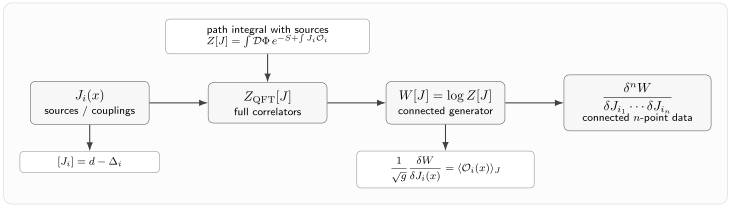
A source couples to an operator . The partition functional generates full correlators, while generates connected correlators. This is the field-theory structure that the bulk on-shell action reproduces in AdS/CFT.
Why this matters for holography
Section titled “Why this matters for holography”The gravitational side of AdS/CFT does not usually hand us boundary correlators directly. It hands us a bulk variational problem.
For a scalar field in AdS, one solves the bulk equation of motion subject to a near-boundary condition. The boundary coefficient is interpreted as a source for a CFT operator . The renormalized on-shell bulk action is then a functional of that source:
In Euclidean signature and in the classical gravity approximation, the bulk partition function has the schematic saddle-point form
Thus the CFT generating functional is related to the on-shell action by
All later computations of holographic one-point functions, two-point functions, Ward identities, transport coefficients, and response functions are refinements of this sentence.
The important point for now is not the bulk formula. The important point is what means in an ordinary QFT.
QFT data as a response problem
Section titled “QFT data as a response problem”A quantum field theory is not just a Lagrangian. A Lagrangian is one way of presenting the theory. The physical data include:
- the Hilbert space and its states;
- local operators and their correlation functions;
- conserved currents and stress tensors;
- the response to external fields;
- the behavior under changes of scale;
- the partition function on different spacetime manifolds and backgrounds.
In a conformal field theory, especially in flat space, much of the local data can be organized into the spectrum of local operators and their operator product coefficients. For holography, however, the most useful package is the generating functional with sources.
Think of as a response machine. We perturb the theory by external fields , and the derivatives of tell us how the theory responds.
The source can be a purely formal book-keeping device, introduced only so that we can differentiate and then set it to zero. But it can also be a real physical coupling. For example:
is a deformation of the theory by the operator . If is constant, it is an ordinary coupling. If varies in spacetime, it is a local external field.
This dual role is essential in AdS/CFT. The same boundary datum can be used either to compute correlators around an undeformed CFT or to define a genuinely deformed theory.
Euclidean generating functional
Section titled “Euclidean generating functional”Let be a Euclidean -dimensional spacetime with metric . Let denote all dynamical fields of the QFT, and let be a set of local operators. We couple sources to these operators by defining
Throughout this course, when no confusion is likely, we abbreviate the source coupling as
The expectation value in the presence of sources is
The connected generating functional is
Some authors define in Euclidean signature. This course uses unless stated otherwise. With this convention, the classical Euclidean gravity saddle gives .
Functional derivatives
Section titled “Functional derivatives”The defining operation is differentiation with respect to the source. We use the covariant convention
Then
In flat space, where , this reduces to the familiar expression
The second derivative gives the connected two-point function in the presence of sources:
provided the operators themselves do not have explicit source dependence. More generally, source-dependent definitions of composite operators can generate contact terms. Such terms are not mistakes; they are part of the local scheme dependence of QFT.
At zero source, the connected two-point function is therefore
The general connected -point function is
This formula is the field-theory ancestor of the holographic rule “differentiate the on-shell action with respect to boundary data.”
Why gives connected correlators
Section titled “Why logZ\log ZlogZ gives connected correlators”It is useful to see explicitly why generates connected correlators.
For one operator , define
where denotes expectation values in the theory without sources. Expanding the exponential gives full correlators:
Taking the logarithm reorganizes this expansion into cumulants:
The logarithm removes disconnected pieces because disconnected vacuum diagrams exponentiate. This is why tree-level bulk Witten diagrams compute connected CFT correlators, while disconnected pieces are generated by exponentiating the connected functional.
Normalized and unnormalized functionals
Section titled “Normalized and unnormalized functionals”One often removes the vacuum normalization by defining
This normalization ensures
It does not change connected correlators with at least one source derivative. It only removes source-independent vacuum terms.
In holography, source-independent constants in the on-shell action often correspond to vacuum energies, Casimir terms, or scheme-dependent local counterterms. They can matter for thermodynamics, but they do not affect ordinary connected correlators at separated points.
Sources, couplings, and dimensions
Section titled “Sources, couplings, and dimensions”If has scaling dimension in a -dimensional CFT, the source has engineering dimension
because the source deformation
must be dimensionless.
This simple relation is one of the first pieces of the holographic dictionary. Later we will see that for a scalar field in ,
Thus the bulk mass determines the scaling dimension of the boundary operator, and the boundary behavior of the bulk field determines the source.
The sign of gives the usual classification of deformations:
| Operator dimension | Source dimension | Deformation |
|---|---|---|
| relevant | ||
| classically marginal | ||
| irrelevant |
Relevant deformations grow in the infrared. Irrelevant deformations require UV care. Marginal deformations can remain marginal, become marginally relevant, or become marginally irrelevant depending on quantum effects.
In the bulk, these distinctions are reflected in the near-boundary falloffs of fields and in the difficulty of defining boundary conditions for the corresponding modes.
The source is not the expectation value
Section titled “The source is not the expectation value”One repeated confusion in AdS/CFT is to identify the source with the expectation value. They are different pieces of the response problem.
The source is what we control. It appears in the definition of the theory:
The expectation value is what the theory returns:
The relation between them is dynamical. In a linear response regime,
where
In holography, the same distinction appears as the difference between the leading boundary coefficient of a bulk field and the subleading response coefficient. The precise identification requires holographic renormalization.
Several sources at once
Section titled “Several sources at once”Real theories have many operators. A compact way to write the sourced generating functional is
Mixed derivatives generate mixed correlators:
If the operators carry indices, the sources carry the corresponding dual indices. For example:
couples a background gauge field to a conserved current , while the metric couples to the stress tensor.
The sources should be viewed as coordinates on a space of theories or backgrounds. A local QFT is probed by turning on these coordinates and asking how the generating functional changes.
Background fields and Ward identities
Section titled “Background fields and Ward identities”The most important sources in holography are not always scalar. A conserved current and the stress tensor have special sources.
A global symmetry current couples to a background gauge field :
The one-point function is
If the symmetry is non-anomalous and no charged sources are turned on, background gauge invariance implies
Varying this relation gives
so
This is a Ward identity. In AdS/CFT, the corresponding bulk statement is gauge invariance of the bulk gauge field.
The stress tensor is similar but even more important. It is sourced by the background metric:
With the Euclidean convention used here,
or equivalently
Diffeomorphism invariance implies stress-tensor conservation. In the absence of additional sources and anomalies,
For a CFT in flat space, scale invariance further implies the trace relation
up to conformal anomalies in even dimensions and contact terms. With scalar sources present, the trace Ward identity is modified schematically to
This equation will reappear in holographic renormalization, where Ward identities follow from bulk constraints near the AdS boundary.
Euclidean, Lorentzian, and real-time correlators
Section titled “Euclidean, Lorentzian, and real-time correlators”The Euclidean generating functional computes Euclidean correlation functions. In a Lorentzian QFT one often writes a formal source functional
This object naturally generates time-ordered correlators, with convention-dependent factors of .
Retarded correlators are different. They describe causal response:
At finite temperature or in real-time nonequilibrium problems, the clean formulation uses a Schwinger–Keldysh contour. In holography, retarded functions are computed by imposing incoming-wave boundary conditions at black-hole horizons. That subject belongs to the real-time unit of the course.
For now, the lesson is simply this: do not blindly convert Euclidean formulas into retarded Lorentzian formulas. The words “generating functional” are used in both settings, but the boundary conditions and analytic continuation matter.
Effective action and one-particle-irreducible data
Section titled “Effective action and one-particle-irreducible data”The connected functional is not the only useful functional. Define the classical expectation value
When the relation between and can be inverted, the Legendre transform defines the effective action
Then
The effective action generates one-particle-irreducible correlators. It is central in ordinary QFT, spontaneous symmetry breaking, and Wilsonian effective field theory.
In standard AdS/CFT computations, however, the first object is usually , because the bulk partition function naturally computes the source-dependent generating functional. Legendre transforms become important for alternate quantization, mixed boundary conditions, and multi-trace deformations.
Contact terms and scheme dependence
Section titled “Contact terms and scheme dependence”Correlation functions at separated points are usually the cleanest observables. At coincident points, local ambiguities appear.
For example, adding a local counterterm depending on the source,
changes the two-point function by
This is a contact term. It affects coincident-point correlators and momentum-space polynomials, but not separated-point singularities or nonlocal response.
Holographic renormalization is full of such terms. Counterterms are necessary to remove divergences, but finite local counterterms remain a choice of renormalization scheme. A trustworthy holographic computation must distinguish universal nonlocal data from scheme-dependent local data.
Large- preview
Section titled “Large-NNN preview”In holographic CFTs, the generating functional typically has a large- expansion. For a gauge theory with matrix degrees of freedom, the number of degrees of freedom scales like , and one often finds
The leading term is classical from the bulk viewpoint. The subleading terms are bulk quantum corrections. This is the field-theory origin of the statement that large suppresses bulk loops.
Operator normalization matters. Depending on whether a single-trace operator is written as , , or with a convention that gives an order-one two-point function, powers of move between the operator and the source. The invariant statement is not a particular normalization, but the hierarchy of connected correlators and the existence of a controlled expansion.
The next pages develop this point carefully.
The holographic translation
Section titled “The holographic translation”At this stage, the basic field-theory structure is:
The holographic claim is that for special large- QFTs, the same functional can be computed from a higher-dimensional bulk theory:
In the classical limit,
So the field-theory operation
becomes the bulk operation “vary the renormalized on-shell action with respect to the boundary value of the dual field.”
This is the technical bridge from QFT to gravity.
Dictionary checkpoint
Section titled “Dictionary checkpoint”The lesson of this page can be compressed into the following dictionary.
| QFT concept | Later bulk interpretation |
|---|---|
| source | boundary value of a bulk field |
| operator | bulk field species |
| bulk partition function with boundary data | |
| minus the renormalized on-shell action at leading classical order | |
| one-point function / response coefficient | |
| connected -point function | |
| background gauge field | boundary value of a bulk gauge field |
| background metric | boundary value of the bulk metric |
| Ward identities | bulk gauge and diffeomorphism constraints |
| local counterterms | holographic counterterms and scheme dependence |
The table is only a preview. Each line becomes precise only after we specify the AdS asymptotics, boundary conditions, and renormalization prescription.
Common confusions
Section titled “Common confusions”“ and generate the same correlators.”
Section titled ““Z[J]Z[J]Z[J] and W[J]W[J]W[J] generate the same correlators.””generates full correlators. generates connected correlators. The distinction matters because classical bulk diagrams compute connected correlators, and disconnected correlators arise by exponentiating them.
“The source is the same thing as the expectation value.”
Section titled ““The source is the same thing as the expectation value.””No. The source is what we choose. The expectation value is the response of the theory. In holography, these become different coefficients in the near-boundary expansion of a bulk field.
“Contact terms are errors.”
Section titled ““Contact terms are errors.””Contact terms are often physical or scheme-dependent local contributions. They are especially important in Ward identities, anomalies, and stress-tensor correlators. They should be tracked, not automatically discarded.
“A source must be infinitesimal.”
Section titled ““A source must be infinitesimal.””A source can be infinitesimal if we are computing linear response, but the generating functional is defined for finite sources when the theory is well-defined. Finite sources correspond to deformations or nontrivial background fields.
“Euclidean correlators are automatically retarded correlators.”
Section titled ““Euclidean correlators are automatically retarded correlators.””No. Euclidean correlators, time-ordered Lorentzian correlators, and retarded correlators are related but distinct. Analytic continuation and boundary conditions matter, especially at finite temperature.
Exercises
Section titled “Exercises”Exercise 1: Derive the connected two-point function
Section titled “Exercise 1: Derive the connected two-point function”Starting from
show that
in flat space, assuming has no explicit source dependence.
Solution
First,
Since differentiating the source term brings down ,
Therefore
Differentiate again:
The derivative acts both on the numerator and on . The numerator gives
while the derivative of gives
Thus
This is the connected two-point function.
Exercise 2: Gaussian generating functional
Section titled “Exercise 2: Gaussian generating functional”Consider a Euclidean Gaussian theory with action
and source coupling . Let . Show that
and compute the connected two-point function.
Solution
Write the exponent as
Complete the square:
where condensed notation is used:
The shift leaves the Gaussian measure formally unchanged, so
Therefore
Taking two derivatives gives
Thus the connected two-point function of the free field is the Green function .
Exercise 3: Source dimensions
Section titled “Exercise 3: Source dimensions”In a -dimensional CFT, an operator has scaling dimension . The theory is deformed by
Find the dimension of . Classify the deformation for , , and .
Solution
The action is dimensionless in units where . Since has dimension and has dimension , the source must have dimension
If , then , and the deformation is relevant. If , then , and the deformation is classically marginal. If , then , and the deformation is irrelevant.
In holography, this classification is reflected in the near-boundary behavior of the bulk field dual to .
Exercise 4: Ward identity from a background gauge field
Section titled “Exercise 4: Ward identity from a background gauge field”Let be invariant under the background gauge transformation
Assume
Show that
when there are no anomalies and no charged sources.
Solution
Gauge invariance gives
Integrating by parts and ignoring boundary terms,
Because is arbitrary,
This is the current-conservation Ward identity. In holography, the corresponding statement comes from gauge invariance and the radial constraint equations of the bulk gauge field.
Exercise 5: The sign of the holographic one-point function
Section titled “Exercise 5: The sign of the holographic one-point function”Suppose the Euclidean CFT convention is
Suppose also that the classical bulk saddle gives
What is in terms of ?
Solution
From the CFT convention,
The saddle approximation gives
Therefore
Some references absorb this minus sign by using a different source convention or by defining the Euclidean generating functional as . The physics is unchanged, but the convention must be tracked.
Further reading
Section titled “Further reading”For the generating-functional language in ordinary QFT, see standard QFT texts such as Peskin and Schroeder, Weinberg, Zinn-Justin, and Coleman. For its role in AdS/CFT, the essential starting points are:
- S. S. Gubser, I. R. Klebanov, and A. M. Polyakov, Gauge Theory Correlators from Non-Critical String Theory.
- E. Witten, Anti de Sitter Space and Holography.
- O. Aharony, S. S. Gubser, J. Maldacena, H. Ooguri, and Y. Oz, Large Field Theories, String Theory and Gravity.
- K. Skenderis, Lecture Notes on Holographic Renormalization.