
Hawking Radiation and Information Loss
The previous page explained why a black hole has entropy
and temperature
This page explains why that temperature is not merely a thermodynamic bookkeeping device. Quantum fields on a collapsing black hole spacetime produce an outgoing flux at future null infinity. For a Schwarzschild black hole in units ,
The shock is not just that black holes radiate. The shock is that the same semiclassical calculation appears to turn an initially pure quantum state into a final mixed density matrix. That is Hawking’s original information-loss paradox.
Guiding question
Section titled “Guiding question”How can a calculation performed in a low-curvature region outside a large black hole imply a breakdown of unitary quantum mechanics?
The answer has two parts. First, the near-horizon redshift converts short-distance vacuum fluctuations into a thermal flux at infinity. Second, the outgoing Hawking modes are entangled with partner modes that fall behind the horizon. If the black hole evaporates completely and nothing remains to purify the radiation, the final radiation state is mixed.
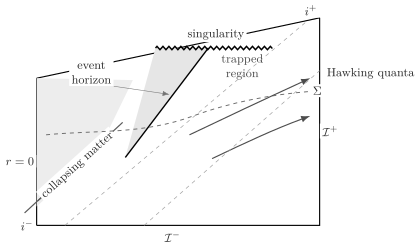
A schematic collapse geometry. Hawking quanta are detected at , while their partner modes lie behind the horizon. The paradox is sharpest when semiclassical evolution is trusted until the black hole disappears and no remnant, baby universe, or final interior region is left to purify the radiation.
The semiclassical setup
Section titled “The semiclassical setup”Hawking’s calculation uses quantum field theory on a classical curved spacetime. The metric is treated as a background, while matter fields are quantized. Backreaction is first ignored and then included adiabatically by allowing the black hole mass to decrease slowly.
The relevant approximation is excellent for a macroscopic black hole because the curvature near the horizon is small. For a four-dimensional Schwarzschild black hole,
so for the horizon region is locally gentle. This is precisely why the result is disturbing: the argument does not seem to require Planckian curvature at the horizon.
A quantum field may be expanded in two different complete bases of modes. Near past null infinity one has an “in” expansion
while near future null infinity one has an “out” expansion
The two bases are related by a Bogoliubov transformation,
or equivalently
If , the in-vacuum is not the out-vacuum. The expected number of out-particles in the in-vacuum is
Thus particle creation is not caused by a local machine sitting at the horizon. It is a statement about the mismatch between positive-frequency modes in the asymptotic past and positive-frequency modes in the asymptotic future.
The exponential redshift
Section titled “The exponential redshift”The thermal character of Hawking radiation comes from the universal near-horizon relation between past and future null coordinates. Let
where is the tortoise coordinate. For Schwarzschild,
Outgoing rays that barely escape from the forming black hole experience an enormous redshift. Near the last ray that escapes before horizon formation, the relation between the retarded time at and an advanced coordinate at has the form
where labels the would-be horizon and depends on collapse details. Equivalently,
This exponential is the heart of the calculation. A late-time outgoing mode behaves near like
When traced backward through the collapsing geometry, it becomes roughly
Because this function is not purely positive-frequency with respect to , it has both positive- and negative-frequency components on . Analytic continuation gives the ratio
Using the Bogoliubov normalization condition then yields the Planck distribution
with
For a rotating or charged black hole, the same logic gives a thermal distribution with chemical potentials. For a Kerr-Newman black hole, schematically,
for bosonic modes, where is a greybody factor. The greybody factor encodes scattering through the gravitational potential outside the horizon. It modifies the spectrum seen at infinity but not the local Hawking temperature.
The Unruh state
Section titled “The Unruh state”Different quantum states of a field on a black hole background describe different physical situations.
The Boulware state is empty at infinity but singular on the horizon. It is not the state formed by regular gravitational collapse.
The Hartle-Hawking state describes a black hole in thermal equilibrium with a bath of incoming and outgoing radiation. It is natural for an eternal black hole in a reflecting box, or in Euclidean thermal methods.
The Unruh state describes collapse. It has no incoming thermal bath from , is regular on the future horizon, and contains outgoing Hawking radiation at .
The information paradox concerns the Unruh state and its backreacted version: a black hole forms from collapse, radiates, loses mass, and eventually disappears if no stable remnant remains.
Pair entanglement near the horizon
Section titled “Pair entanglement near the horizon”The pair-production picture is a mnemonic, but a useful one. Locally near a smooth horizon, the state looks like the Minkowski vacuum written in Rindler-like modes. For each frequency, the state has the form of a two-mode squeezed state,
Here denotes the outgoing exterior mode and denotes its interior partner. Tracing over the interior partner gives
This is a thermal density matrix.
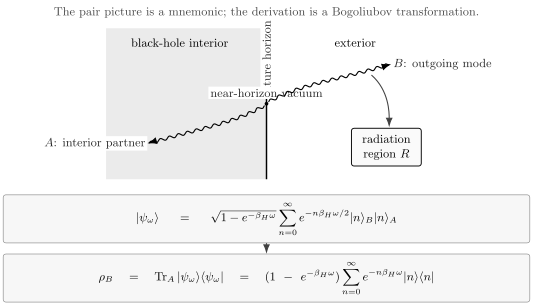
The outgoing mode is entangled with an interior partner . The exterior observer who has access only to sees a thermal density matrix. The information problem arises when this pair entanglement is repeatedly produced during evaporation while the black hole’s remaining entropy decreases.
For a single bosonic oscillator with
the occupation probability is
and the mean occupation number is
The entropy of the outgoing mode is
The global two-mode state is pure, but the outside mode alone is mixed. This is the local origin of the paradox.
Hawking flux and evaporation
Section titled “Hawking flux and evaporation”The thermal spectrum implies an energy flux. In four dimensions, the exact luminosity is not the Stefan-Boltzmann formula for a perfect black body because greybody factors and spin dependence matter. Parametrically, however, one may estimate
For Schwarzschild,
so
Thus
and the evaporation time scales as
in units . Restoring constants,
up to a numerical coefficient and species-dependent factors.
Two lessons matter for information. First, the evaporation time is enormous for a macroscopic black hole, so the process is adiabatic for most of its life. Second, the Bekenstein-Hawking entropy decreases as
If the black hole is a finite quantum system with roughly internal states, then as decreases it has fewer states available to purify the radiation.
From thermal radiation to information loss
Section titled “From thermal radiation to information loss”Thermal radiation alone is not a paradox. A hot piece of coal emits radiation that looks approximately thermal in low-point observables, but the exact radiation state is pure if the coal and radiation are treated as a closed quantum system. The detailed correlations in the radiation encode the initial state.
The black hole problem is stronger. In Hawking’s semiclassical calculation, the outgoing mode is purified by an interior partner, not by earlier radiation. After many emissions, the radiation state is entangled with modes behind the horizon. Schematically,
where are outgoing modes and are interior partners. The radiation density matrix is obtained by tracing over the interior:
Its entropy grows roughly by one bit per emitted pair in this simplified model:
If the black hole eventually disappears, there is no interior system left to trace over. The semiclassical story then seems to imply
where is mixed. Such a map is not unitary evolution of a closed quantum system.
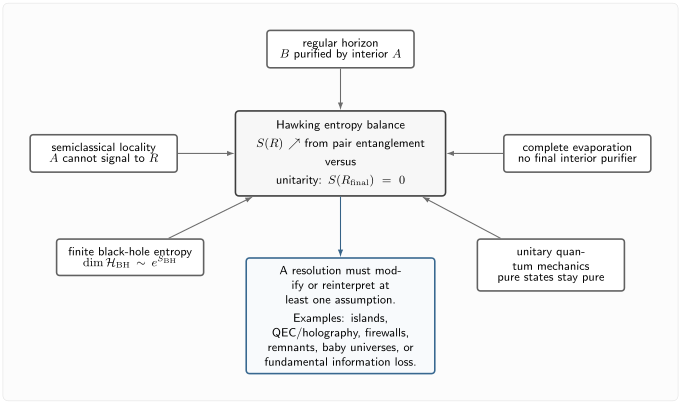
The paradox is not one assumption but a conflict among several plausible assumptions: regular horizons, local semiclassical effective field theory, complete evaporation without remnants, finite black hole entropy, and unitary quantum mechanics. Different proposed resolutions modify different parts of this diagram.
A sharper entropy version
Section titled “A sharper entropy version”Let be the radiation after emission steps, and let be the next outgoing Hawking mode. In the leading semiclassical picture, is strongly entangled with a new interior partner and approximately uncorrelated with . Hence
The radiation entropy increases monotonically.
This is not merely an artifact of using an exactly thermal approximation. Mathur’s small-corrections theorem makes the point precise in a simplified setting. If each Hawking pair differs from the leading entangled pair state by a correction of norm at most , then the radiation entropy still increases by approximately the leading amount:
The exact numerical bound depends on the setup, but the lesson is robust: small corrections to each pair cannot by themselves produce the Page curve. To make the radiation entropy turn over, the late outgoing radiation must be correlated with the early radiation at order one in the appropriate fine-grained sense.
This is one of the clearest ways to state the paradox. The problem is not that Hawking’s spectrum is exactly thermal. The problem is that local semiclassical evolution near a smooth horizon makes the purifier of each outgoing quantum lie behind the horizon, while unitarity after the Page time requires the purifier to lie in the previously emitted radiation.
The assumptions behind the paradox
Section titled “The assumptions behind the paradox”The information-loss argument is powerful because every assumption sounds reasonable in its own domain.
1. Semiclassical gravity is valid outside and near the horizon of a large black hole.
The curvature at the horizon is small for . Effective field theory should therefore work locally, at least for ordinary low-energy observers.
2. The horizon is regular.
An infalling observer should see no violent Planck-scale structure at the horizon of a large black hole. In local inertial coordinates, the state should resemble the vacuum.
3. Locality holds in the semiclassical geometry.
The outgoing Hawking mode just outside the horizon cannot be strongly influenced by distant early radiation without a nonlocal effect from the bulk viewpoint.
4. The black hole evaporates completely.
If no stable remnant, baby universe, or final singular interior remains, then the final state accessible at infinity is the radiation state.
5. Quantum mechanics is unitary.
A closed quantum system should evolve by
In particular, a pure state should remain pure.
The paradox says that these assumptions cannot all be true.
Why obvious fixes are not enough
Section titled “Why obvious fixes are not enough”Several tempting replies miss the core issue.
“The radiation is only approximately thermal.”
Approximate thermality of low-point observables is not the problem. Ordinary systems can emit approximately thermal radiation while preserving information in subtle correlations. The issue is that the leading semiclassical geometry assigns the purifier of the outgoing radiation to the interior, and small local corrections do not change the entropy balance enough.
“The information comes out at the final Planckian stage.”
By the time the black hole reaches Planck size, it must purify a radiation system whose entropy can be of order the initial . A Planckian object has too few ordinary states to do this unless one postulates a remnant with an enormous internal degeneracy. Such remnants raise serious problems, including uncontrolled pair production and a tension with the finite entropy suggested by .
“Backreaction changes the geometry.”
Backreaction certainly matters for the mass loss. But for most of the lifetime of a large black hole, the change is slow. Adiabatic mass loss does not by itself create the order-one correlations required after the Page time.
“Greybody factors make the spectrum nonthermal.”
Greybody factors change the frequency and angular distribution of the flux at infinity. They do not remove the near-horizon entanglement structure responsible for the entropy growth.
“Quantum gravity becomes important near the singularity.”
It probably does. But in the semiclassical picture, the outgoing Hawking quanta are produced in a region of low curvature long before they can know what happens at the singularity. A resolution that relies only on the singularity must explain how it influences exterior radiation without violating the semiclassical assumptions.
Trans-Planckian issue and robustness
Section titled “Trans-Planckian issue and robustness”Tracing a late Hawking quantum backward in time gives an exponentially blueshifted precursor near . This is the trans-Planckian problem. It warns us that Hawking’s derivation assumes ordinary quantum field theory at arbitrarily short wavelengths.
However, the existence of this issue does not automatically invalidate Hawking radiation. Many derivations show that the thermal factor is robust under broad modifications of short-distance dispersion, provided the horizon is regular and the state is locally vacuum-like. The deeper information problem is therefore not simply “Hawking used arbitrarily high frequencies.” It is the combination of a regular horizon, local effective field theory, and complete evaporation.
In modern language, the paradox is an infrared consequence of ultraviolet assumptions. It is detected in the fine-grained entropy of radiation collected far away, but it is forced by the local entanglement structure near the horizon.
The density matrix language
Section titled “The density matrix language”It is useful to distinguish three density matrices.
First, the global density matrix on a complete Cauchy slice before complete evaporation is pure:
Second, the exterior radiation density matrix is mixed because interior partners are not included:
Third, if the black hole evaporates completely in the semiclassical picture, the final density matrix is identified with itself. That is the pure-to-mixed step.
This distinction matters. There is no contradiction in saying that a subregion density matrix is mixed. Every entangled pure state has mixed reduced density matrices. The contradiction appears only when the mixed reduced density matrix becomes the final state of the whole universe.
Relation to the generalized second law
Section titled “Relation to the generalized second law”The generalized second law says that
should not decrease in ordinary semiclassical processes. Hawking evaporation is consistent with this statement: the area term decreases while entropy appears outside the black hole.
But the information paradox is about the fine-grained entropy of the collected radiation. Hawking’s calculation predicts that this entropy increases monotonically. Unitary evaporation predicts that it eventually decreases, because after the Page time the remaining black hole has too few states to purify the radiation.
Thus the generalized second law and the Page curve are not the same statement. The generalized second law is a semiclassical entropy law for horizons. The Page curve is a fine-grained unitarity diagnostic for the radiation.
What the original paradox teaches
Section titled “What the original paradox teaches”The original information-loss argument is not obsolete. Modern islands, quantum extremal surfaces, and replica wormholes are best understood as precise responses to it.
Hawking taught us that a smooth semiclassical horizon naturally produces entangled radiation. Page taught us that a finite unitary black hole must eventually produce radiation whose entropy decreases. Holographic entropy and islands teach us that the semiclassical calculation of radiation entropy was missing a new saddle for the entropy functional, not necessarily a large local violation of effective field theory at the horizon.
That last sentence is subtle. The island formula does not say Hawking radiation was never emitted. It says that the fine-grained entropy of a radiation region is not computed by the naive no-island saddle after the Page time. The Hawking calculation remains correct for many local observables while failing for the nonlocal entropy question that diagnoses unitarity.
Common pitfalls
Section titled “Common pitfalls”Pitfall 1: “Hawking radiation comes from particles popping out of the horizon.”
The particle-pair picture is a mnemonic. The actual calculation is a Bogoliubov transformation between in-modes and out-modes in a time-dependent curved geometry. The horizon and its exponential redshift are essential, but the radiation is not produced by a little local furnace exactly on the horizon.
Pitfall 2: “A thermal spectrum automatically means information loss.”
No. Approximate thermality of a spectrum is compatible with unitarity. The paradox concerns fine-grained entropy and purification, not just the one-particle spectrum.
Pitfall 3: “The paradox only appears at the final Planckian stage.”
The entropy problem appears already at the Page time, when the black hole can still be macroscopic. The tension is not confined to the final burst.
Pitfall 4: “Greybody factors solve the problem.”
Greybody factors make the spectrum at infinity non-perfectly-blackbody. They do not change the fact that the outgoing modes are purified by interior partners in the leading semiclassical state.
Pitfall 5: “The global state is mixed at all intermediate times.”
On a complete Cauchy slice before the end of evaporation, the global state in semiclassical QFT can be pure. The mixed state appears after tracing over inaccessible interior modes. The paradox arises when the interior disappears and the mixed reduced density matrix is interpreted as the final state.
Exercises
Section titled “Exercises”Exercise 1. Thermal density matrix from a two-mode squeezed state
Section titled “Exercise 1. Thermal density matrix from a two-mode squeezed state”Consider
Compute and show that it is thermal when .
Solution
The density matrix is
Tracing over gives
Since ,
If , this is
with
This is precisely the thermal density matrix of a harmonic oscillator mode of frequency .
Exercise 2. Occupation number
Section titled “Exercise 2. Occupation number”Using the density matrix from Exercise 1, compute
Solution
We have
Using
and differentiating with respect to ,
so
Therefore
For ,
which is the Bose-Einstein distribution.
Exercise 3. Exponential redshift and temperature
Section titled “Exercise 3. Exponential redshift and temperature”Suppose outgoing rays satisfy
Explain why this exponential relation leads to a thermal factor involving .
Solution
An outgoing positive-frequency mode at future null infinity behaves as
Using
this becomes
As a function of the past null coordinate , this has a branch point at . Defining positive- and negative-frequency parts requires analytic continuation around this branch point. The continuation across the cut produces a relative factor
between Bogoliubov coefficients, so
Together with the normalization relation between and , this gives
Thus the inverse temperature is
Exercise 4. Evaporation time scaling
Section titled “Exercise 4. Evaporation time scaling”Use the estimates
to show that in units .
Solution
The power scales as
Since power is energy loss per unit time,
Thus
Integrating from to gives
so
up to numerical constants and species-dependent factors.
Exercise 5. Why a mixed reduced state is not yet a paradox
Section titled “Exercise 5. Why a mixed reduced state is not yet a paradox”Explain why the mixedness of at an intermediate time does not itself violate unitarity. Where exactly does the paradox enter?
Solution
In ordinary quantum mechanics, a subsystem of a pure entangled state has a mixed reduced density matrix. Thus there is no violation of unitarity if, on a complete Cauchy slice, the global state is pure but the exterior radiation state is mixed after tracing over interior degrees of freedom.
The paradox enters when the black hole is assumed to evaporate completely. If there is no remnant, baby universe, or remaining interior Hilbert space, the radiation becomes the entire final system. Hawking’s semiclassical calculation then appears to identify the final state with the mixed reduced density matrix . A closed system evolving from a pure state to a mixed state cannot be described by unitary evolution.
Exercise 6. Small corrections and entropy growth
Section titled “Exercise 6. Small corrections and entropy growth”In the simplified pair model, suppose each emission step produces a state that differs only slightly from a maximally entangled Hawking pair. Why is this insufficient to make the radiation entropy decrease after the Page time?
Solution
If each outgoing mode is still almost purified by a new interior partner, then it is not strongly purified by the previously emitted radiation. The new mode therefore adds approximately its own entropy to the radiation system. Entropy inequalities make this intuition precise: small corrections to each pair can change the entropy increase only by a small amount per step.
To obtain a Page curve, the late outgoing radiation must be correlated with the early radiation strongly enough that adding a new emitted mode can reduce the radiation entropy. That requires an order-one change in the fine-grained entanglement structure relative to the naive Hawking pair state. It does not necessarily require an order-one change in every local low-energy observable, but it does require more than perturbatively small independent corrections to each pair.
Further reading
Section titled “Further reading”- S. W. Hawking, “Particle Creation by Black Holes,” Communications in Mathematical Physics 43 (1975), 199–220. Project Euclid.
- S. W. Hawking, “Breakdown of Predictability in Gravitational Collapse,” Physical Review D 14 (1976), 2460–2473. DOI: 10.1103/PhysRevD.14.2460.
- W. G. Unruh, “Notes on Black-Hole Evaporation,” Physical Review D 14 (1976), 870–892. DOI: 10.1103/PhysRevD.14.870.
- N. D. Birrell and P. C. W. Davies, Quantum Fields in Curved Space, Cambridge University Press, 1982.
- R. M. Wald, Quantum Field Theory in Curved Spacetime and Black Hole Thermodynamics, University of Chicago Press, 1994.
- J. Preskill, “Do Black Holes Destroy Information?” arXiv:hep-th/9209058.
- S. D. Mathur, “The Information Paradox: A Pedagogical Introduction,” arXiv:0909.1038.
The next page turns the information-loss argument into a quantitative diagnostic: the Page curve. We will distinguish coarse-grained thermodynamic entropy from fine-grained von Neumann entropy, prove the basic Page-theorem estimate, and see why unitary evaporation requires the radiation entropy to rise and then fall.