
Lessons for Higher-Dimensional Holography
is the cleanest holographic laboratory, but it is also the most exceptional one. It has no local bulk graviton polarizations, two-dimensional CFTs have infinite-dimensional conformal symmetry, BTZ black holes are locally , and the Cardy formula gives a universal handle on high-energy entropy.
Those facts make the subject powerful. They also make it dangerous. A reader who learns only can easily walk away with intuitions that are false in for .
This page collects the reusable lessons and separates them from the accidents of low dimensionality.
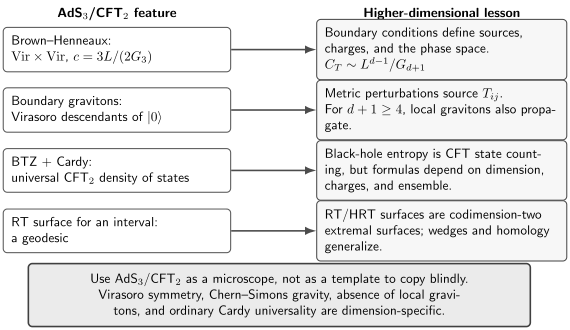
gives universal lessons about asymptotic symmetries, stress tensors, black-hole entropy, and boundary reconstruction, but several mechanisms are special to three bulk dimensions and two boundary dimensions.
The main message
Section titled “The main message”The safe summary is:
It teaches general lessons about boundary charges, stress tensors, black holes, thermodynamics, modular invariance, entanglement, and the organization of quantum gravity states. But it also enjoys special simplifications:
None of these statements generalizes literally to higher-dimensional AdS/CFT.
Lesson 1: boundary symmetries are physical
Section titled “Lesson 1: boundary symmetries are physical”The most robust lesson from Brown–Henneaux is not the numerical formula by itself. It is the conceptual fact that asymptotic symmetries with finite nonzero charges act physically.
In any dimension, gauge redundancies that do not vanish at the boundary can become global symmetries of the boundary theory. The gravitational version is:
For with , the conformal group of flat Lorentzian boundary space is finite-dimensional:
For , the Brown–Henneaux asymptotic symmetry algebra is much larger:
The general lesson is boundary charges matter. The special low-dimensional lesson is that the charge algebra expands to Virasoro.
Lesson 2: the central charge is a measure of gravitational strength
Section titled “Lesson 2: the central charge is a measure of gravitational strength”In ,
This is the cleanest possible example of a universal holographic scaling:
In higher-dimensional CFTs, there is usually no single central charge with all the same properties as in two dimensions. Instead one encounters quantities such as:
- , the coefficient of the stress-tensor two-point function;
- and anomaly coefficients in four-dimensional CFTs;
- sphere free energies such as in three-dimensional CFTs;
- thermal entropy coefficients at strong coupling.
For Einstein gravity duals, these quantities all scale schematically as
So the higher-dimensional version of Brown–Henneaux is not another Virasoro central charge. It is the statement that the normalization of stress-tensor correlators is controlled by the inverse bulk Newton coupling.
Lesson 3: the stress tensor is the universal gravitational operator
Section titled “Lesson 3: the stress tensor is the universal gravitational operator”makes this point especially vivid. The boundary stress tensor is not merely one operator among many; its modes generate the asymptotic symmetry algebra. Boundary gravitons are Virasoro descendants.
In higher dimensions, the stress tensor remains the operator dual to the metric:
Metric fluctuations compute stress-tensor correlators, and the boundary stress tensor measures energy, pressure, momentum flow, and response to background geometry.
What changes is the representation theory. In , the stress tensor organizes states into Virasoro modules. In , conformal descendants are generated by translations, and the conformal group is finite. The stress tensor is still universal, but it no longer controls the entire theory in the same way.
Lesson 4: black-hole entropy is CFT state counting
Section titled “Lesson 4: black-hole entropy is CFT state counting”The BTZ/Cardy match is one of the most beautiful results in holography:
This teaches a general holographic lesson:
The special feature is the universality of the Cardy formula. In two-dimensional unitary modular-invariant CFTs, high-energy asymptotics are strongly constrained by modular invariance. In higher-dimensional CFTs, there is no equally universal formula that determines all large AdS black-hole entropies from only one central charge.
Higher-dimensional black-hole entropy is still CFT state counting, but the CFT input is less universal. One often needs much more dynamical information: the spectrum, OPE coefficients, supersymmetric indices, localization results, or strong-coupling dynamics.
Lesson 5: topology and quotients can be unusually powerful in three dimensions
Section titled “Lesson 5: topology and quotients can be unusually powerful in three dimensions”BTZ black holes are locally . Their nontrivial physics comes from global identifications, causal structure, horizons, and boundary conditions. In three-dimensional Einstein gravity, local curvature does not distinguish global from BTZ; both solve the same constant-curvature equations locally.
This is not true for ordinary higher-dimensional AdS black holes. For example, the AdS-Schwarzschild metric in has nontrivial Weyl curvature. It is not locally pure AdS.
Thus:
The general lesson is that global structure matters. The special low-dimensional feature is that global structure can carry essentially all of the black-hole geometry.
Lesson 6: entanglement is geometric, but the geometry changes
Section titled “Lesson 6: entanglement is geometric, but the geometry changes”For a static interval in , holographic entanglement entropy is computed by a bulk geodesic:
In higher-dimensional holography, the Ryu–Takayanagi surface is not a curve but a codimension-two extremal surface:
The reusable lesson is that entanglement entropy probes bulk geometry in a quasi-local way. The special feature of is that geodesics are much easier to classify than higher-dimensional minimal surfaces.
This matters technically. Many calculations reduce to geodesic lengths, quotient geometry, or Virasoro symmetry. Higher-dimensional entanglement calculations usually require solving nonlinear minimal-surface equations.
Lesson 7: local bulk EFT needs more than symmetry
Section titled “Lesson 7: local bulk EFT needs more than symmetry”In , pure gravity is unusually constrained because there are no local bulk gravitons. In higher dimensions, a weakly curved bulk effective field theory requires a stronger CFT condition.
A rough criterion is:
Large suppresses bulk loops. A large gap suppresses stringy or higher-spin states, leaving a small number of low-energy bulk fields. Without the gap, the bulk may still exist, but it need not be well approximated by local Einstein gravity.
This criterion is not visible from Brown–Henneaux alone. A two-dimensional CFT may have large central charge and modular invariance without being dual to weakly coupled Einstein gravity. Similarly, in , large alone is not enough.
Lesson 8: pure gravity is much more plausible in three dimensions, but still subtle
Section titled “Lesson 8: pure gravity is much more plausible in three dimensions, but still subtle”Because 3D Einstein gravity has no local graviton waves, one might hope that pure gravity is a complete quantum theory with only boundary gravitons and BTZ black holes. This is an attractive idea, but it is subtle.
A consistent dual CFT must have:
- a modular-invariant partition function;
- a nonnegative integer spectrum of states;
- crossing-symmetric correlation functions;
- a sensible high-energy density of states;
- appropriate stress-tensor and operator dynamics.
The gravitational path integral over saddles does not automatically guarantee all of these properties. This is why pure quantum gravity is an instructive testing ground rather than a solved model.
In higher dimensions, pure Einstein gravity as a complete quantum theory is even less plausible. It is normally an effective field theory arising from string theory, M-theory, or some other UV completion.
Comparison table
Section titled “Comparison table”| Topic | Higher-dimensional AdS/CFT | |
|---|---|---|
| conformal symmetry | VirasoroVirasoro | finite for |
| bulk gravitons | no local Einstein-gravity gravitons | local graviton polarizations |
| universal central data | , anomaly coefficients, sphere free energies | |
| black holes | BTZ locally AdS | black holes have local curvature structure |
| entropy control | Cardy formula often universal | state counting less universal |
| entanglement surfaces | geodesics | codimension-two extremal surfaces |
| pure gravity | conceivable but subtle | generally only an EFT |
| bulk locality criterion | special due to no local graviton modes | large plus large gap is essential |
A useful hierarchy of lessons
Section titled “A useful hierarchy of lessons”It is helpful to classify lessons into three categories.
Robust lessons
Section titled “Robust lessons”These survive in all standard AdS/CFT examples:
Modified lessons
Section titled “Modified lessons”These survive but change form:
Special low-dimensional lessons
Section titled “Special low-dimensional lessons”These should not be exported blindly:
How this guides the rest of holography
Section titled “How this guides the rest of holography”The unit gives a compact version of the whole course:
- Brown–Henneaux teaches that asymptotic boundary conditions determine physical charges.
- BTZ teaches that black holes are states or ensembles in the boundary theory.
- Cardy teaches that black-hole entropy is microscopic state counting.
- Boundary gravitons teach that gauge redundancies can become physical at boundaries.
- Entanglement geodesics teach that quantum information can reconstruct geometry.
In higher dimensions, each of these statements remains important, but the machinery becomes less symmetric and more dynamical. One must use large- factorization, sparse spectra, Witten diagrams, holographic renormalization, fluid/gravity, extremal surfaces, and quantum error correction rather than relying only on Virasoro representation theory.
Dictionary checkpoint
Section titled “Dictionary checkpoint”| AdS/CFT insight | Higher-dimensional translation |
|---|---|
| Brown–Henneaux central charge | stress-tensor normalization |
| Virasoro descendants | stress-tensor descendants and graviton excitations, but not a complete organizing principle |
| boundary gravitons | boundary-charge excitations; plus local bulk gravitons for |
| BTZ as quotient | black holes as CFT thermal states, usually not locally AdS |
| Cardy entropy | black-hole entropy as CFT state counting, generally less universal |
| geodesic RT surfaces | codimension-two extremal surfaces |
| pure 3D gravity | effective gravitational sector, usually UV-completed by string/M-theory |
| modular invariance of CFT | crossing, OPE consistency, causality, large-gap constraints |
The safest export is not a formula but a principle:
Common confusions
Section titled “Common confusions”“Large central charge means a classical gravity dual.”
Section titled ““Large central charge means a classical gravity dual.””Not by itself. Large central charge or large indicates many degrees of freedom and suppresses some quantum effects. A weakly curved local Einstein gravity dual also requires a sparse enough spectrum of low-dimension single-trace operators, or equivalently a large gap to stringy and higher-spin states.
“The Cardy formula proves all black-hole entropy formulas.”
Section titled ““The Cardy formula proves all black-hole entropy formulas.””No. It is extraordinarily powerful in two-dimensional CFT because of modular invariance. Higher-dimensional black-hole entropy is still CFT state counting, but the counting is not generally fixed by symmetry alone.
“BTZ black holes are typical black holes.”
Section titled ““BTZ black holes are typical black holes.””BTZ black holes are typical in the sense that they have horizons, temperature, entropy, and thermodynamics. They are atypical in being locally and in being highly constrained by symmetry.
“Boundary gravitons are the same as higher-dimensional gravitons.”
Section titled ““Boundary gravitons are the same as higher-dimensional gravitons.””No. Boundary gravitons are asymptotic-symmetry descendants in a theory with no local Einstein-gravity propagating modes. Higher-dimensional gravitons are local bulk field excitations dual to stress-tensor insertions, though boundary charges still play an important role.
“AdS/CFT is simpler, so it must be less deep.”
Section titled ““AdS3_33/CFT2_22 is simpler, so it must be less deep.””It is simpler in local gravitational dynamics, but deeper in symmetry. Many modern ideas about black holes, entanglement, modular invariance, quantum gravity partition functions, and boundary dynamics are sharpest in three bulk dimensions.
Exercises
Section titled “Exercises”Exercise 1: Why Brown–Henneaux has no literal higher-dimensional analogue
Section titled “Exercise 1: Why Brown–Henneaux has no literal higher-dimensional analogue”Explain why the Brown–Henneaux result gives two Virasoro algebras in , while standard with gives only the finite-dimensional conformal group under ordinary boundary conditions.
Solution
The boundary of is two-dimensional. Local conformal transformations in two dimensions are infinite-dimensional: holomorphic and antiholomorphic reparametrizations produce two copies of the Witt algebra, which become Virasoro algebras after the central extension of the charge algebra.
For , the conformal Killing equation on flat space has only a finite-dimensional solution space. The conformal group is , generated by translations, rotations, dilatations, and special conformal transformations. Therefore the standard asymptotic symmetry group is finite-dimensional rather than Virasoro.
Exercise 2: Central charge versus
Section titled “Exercise 2: Central charge versus CTC_TCT”In , the stress-tensor two-point function normalization is controlled by . What is the higher-dimensional analogue?
Solution
In higher-dimensional CFTs, the stress-tensor two-point function has the schematic form
where is fixed by conformal symmetry and conservation. The coefficient measures the normalization of stress-tensor fluctuations. In a holographic Einstein-gravity dual,
Thus plays one role analogous to the Brown–Henneaux central charge, though it does not generate an infinite-dimensional Virasoro algebra.
Exercise 3: Why BTZ is special
Section titled “Exercise 3: Why BTZ is special”Use the fact that three-dimensional vacuum Einstein gravity has
to explain why BTZ black holes can be locally . Why is this not true for higher-dimensional AdS-Schwarzschild black holes?
Solution
In three dimensions, the Riemann tensor is determined algebraically by the Ricci tensor. Vacuum Einstein equations with negative cosmological constant force the full curvature tensor to take the constant-curvature form. Therefore any local vacuum solution is locally ; BTZ differs from global by global identifications and causal structure.
In dimensions greater than three, the Weyl tensor contains independent local curvature data. Vacuum Einstein equations fix the Ricci tensor but not the full Riemann tensor. Higher-dimensional AdS-Schwarzschild black holes have nonzero Weyl curvature and are not locally pure AdS.
Exercise 4: Why a large gap matters
Section titled “Exercise 4: Why a large gap matters”Why is large not enough to guarantee a local higher-dimensional Einstein gravity dual?
Solution
Large suppresses connected correlators and bulk loop effects, but it does not by itself remove an infinite tower of light single-trace operators. If many higher-spin or stringy states remain light in AdS units, the bulk theory is not well described by local Einstein gravity plus a small number of fields. A large gap in the single-trace spectrum is needed to separate low-energy gravitational physics from stringy or higher-spin physics.
Thus a rough condition for local bulk EFT is
Exercise 5: Exporting Cardy carefully
Section titled “Exercise 5: Exporting Cardy carefully”The Cardy formula explains BTZ entropy using the asymptotic density of states of a modular-invariant . Why should one not expect an equally universal formula for every large AdS black hole in higher dimensions?
Solution
The Cardy formula uses the special modular properties of two-dimensional CFT on the torus. Modular transformations relate low-temperature and high-temperature regimes and thereby constrain the high-energy density of states in a universal way.
Higher-dimensional CFTs do not have an equally powerful universal modular constraint that fixes the full high-energy density of states from a single number like . Higher-dimensional black-hole entropy is still boundary state counting, but the relevant counting depends on more detailed CFT dynamics.
Further reading
Section titled “Further reading”- J. D. Brown and M. Henneaux, Central Charges in the Canonical Realization of Asymptotic Symmetries: An Example from Three-Dimensional Gravity.
- P. Kraus, Lectures on Black Holes and the AdS/CFT Correspondence.
- E. Witten, Three-Dimensional Gravity Revisited.
- I. Heemskerk, J. Penedones, J. Polchinski, and J. Sully, Holography from Conformal Field Theory.
- A. Hamilton, D. Kabat, G. Lifschytz, and D. Lowe, Local Bulk Operators in AdS/CFT: A Boundary View of Horizons and Locality.