
AdS2 Throats and IR Criticality
At finite charge density, the simplest homogeneous holographic saddle is a charged AdS black brane. At nonzero temperature it has a regular horizon and ordinary thermal entropy. At zero temperature, however, the horizon does not disappear. In the minimal Einstein–Maxwell model, its near-horizon region becomes
This geometry is the basic infrared laboratory of finite-density holography. It says that the low-energy boundary dynamics is governed by an emergent scale invariance in time, while the spatial directions remain spectators. The resulting behavior is often called local quantum criticality or semi-local criticality.
The word “local” is easy to misread. The bulk theory is still local in spacetime. The point is that the IR scaling acts as
so frequency scales but momentum does not.
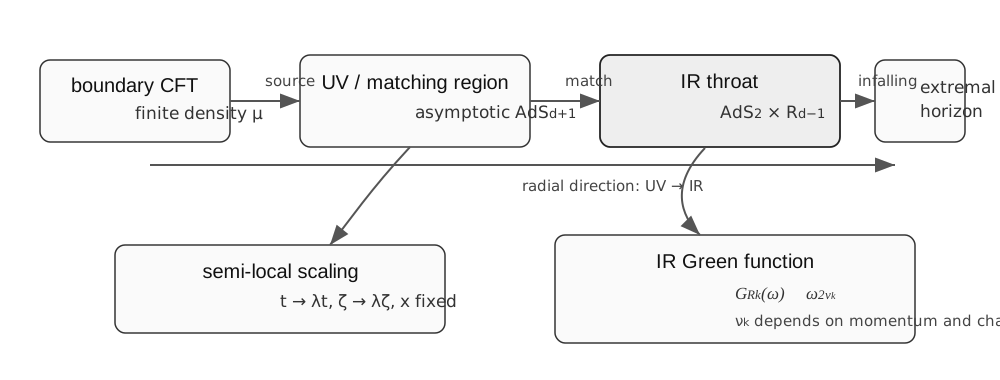
An extremal charged black brane interpolates between a UV region and an IR throat . The radial direction is an RG scale, while the near-horizon electric field remembers the finite charge density.
Why this matters
Section titled “Why this matters”Finite-density quantum field theory is hard because the ground state can reorganize itself. Weakly coupled Fermi liquids have quasiparticles. Strongly coupled finite-density systems may not. Holography gives a different diagnostic:
Look at the deep interior of the charged black brane.
For the minimal charged black brane, the deep interior is an AdS throat. This has three major consequences.
First, low-frequency response functions inherit power laws from AdS. Second, spatial momentum labels different IR operators rather than scaling in the usual relativistic way. Third, extremal RN-AdS has a finite entropy density at , which is powerful but suspicious: it often indicates that the simplest saddle is not the final microscopic ground state.
So AdS is both a tool and a warning. It gives universal IR control in a simple finite-density phase, but it also points toward instabilities and more refined phases.
Setup: the extremal charged black brane
Section titled “Setup: the extremal charged black brane”Use the planar metric convention
The boundary is at . The horizon is at . For a non-extremal black brane, has a simple zero at the horizon:
At extremality, the temperature vanishes and the zero becomes double:
where is the extremal horizon position. This double zero is the geometric origin of the AdS throat.
Deriving the AdS throat
Section titled “Deriving the AdS2_22 throat”Near the extremal horizon define
Then
The part is AdS. Introducing a coordinate proportional to , the metric becomes
with
Therefore
The spatial factor is not an accident. It is the horizon plane of the black brane.
The near-horizon electric field
Section titled “The near-horizon electric field”The gauge potential can be chosen to vanish at the horizon,
which is the regular gauge in Euclidean signature. But the electric field does not vanish:
in the AdS region. This matters because charged fields in AdS feel the background electric field. Their effective IR scaling dimensions are shifted by their charge.
Boundary interpretation:
If charge is instead carried by explicit bulk matter outside the horizon, the IR geometry and transport can change. This is one reason why RN-AdS is not the only possible finite-density ground state.
The IR scaling symmetry
Section titled “The IR scaling symmetry”The AdS metric
is invariant under
In the full throat geometry,
the spatial coordinates do not scale. Momentum is therefore not assigned an ordinary scaling dimension. Instead, each value of labels a different operator in the emergent IR CFT.
This is the semi-local scaling structure:
Momentum-dependent IR dimensions
Section titled “Momentum-dependent IR dimensions”Consider a neutral scalar field of mass and Fourier mode
In the AdS region, spatial momentum contributes to an effective AdS mass:
The dots can include spin-dependent terms, curvature couplings, or mixing with other fields. The AdS scaling exponent is
The two possible IR dimensions are
For a charged field, the background electric field shifts this expression schematically to
This formula is the small hinge on which much of holographic finite-density physics turns. The exponent depends on , even though itself does not scale.
IR Green functions
Section titled “IR Green functions”A CFT operator of dimension
has a zero-temperature retarded Green function with power-law behavior
up to a complex coefficient fixed by the infalling AdS boundary condition.
At low but nonzero temperature, the throat becomes an AdS black hole. The scaling form is
where the function is determined by the AdS wave equation.
The full boundary Green function is obtained by matching this IR solution to the outer AdS region. A common schematic form is
The functions and are UV matching data. The nonanalytic frequency dependence comes from the AdS throat.
Semi-local versus ordinary criticality
Section titled “Semi-local versus ordinary criticality”At an ordinary relativistic fixed point,
and correlators scale in terms of combinations involving both and .
In an AdS throat,
Therefore the IR exponent can depend continuously on momentum:
This is not a standard CFT scaling form. It is an emergent CFT scaling form for a continuum of momentum-labeled sectors.
Fermions and non-Fermi-liquid behavior
Section titled “Fermions and non-Fermi-liquid behavior”A famous application involves a charged bulk spinor. After matching the AdS throat to the UV region, the boundary fermion Green function can take the schematic form
The Fermi momentum is determined by the UV problem. The exponent is determined by the IR AdS throat. Depending on its value, the excitation can resemble a Fermi liquid quasiparticle, a non-Fermi liquid, or a marginal Fermi liquid.
The lesson for this course is the mechanism:
The zero-temperature entropy puzzle
Section titled “The zero-temperature entropy puzzle”Extremal RN-AdS has finite horizon area at zero temperature. Hence
is nonzero. For an ordinary isolated quantum system, a finite ground-state entropy density is unusual. In holography it is often treated as a clue that the minimal Einstein–Maxwell saddle is incomplete in the deep IR.
Possible resolutions include:
- charged scalar condensation, leading to holographic superconductors;
- charged fermion fluids, leading to electron-star-like geometries;
- lattice or translation-breaking effects;
- hyperscaling-violating or Lifshitz IR geometries;
- stringy or finite- corrections that lift the degeneracy.
RN-AdS is therefore best read as a controlled, universal starting point, not as a universal endpoint.
Dictionary checkpoint
Section titled “Dictionary checkpoint”| Bulk statement | Boundary statement |
|---|---|
| extremal charged horizon | zero-temperature finite-density state |
| throat | emergent IR CFT sectors |
| radial coordinate in AdS | low-energy scale |
| near-horizon electric field | finite charge density |
| exponent | momentum-dependent IR critical exponent |
| infalling AdS condition | retarded IR response |
| finite extremal area | finite entropy density, often signaling degeneracy or instability |
Common confusions
Section titled “Common confusions”“AdS means the boundary theory literally becomes one-dimensional.”
Section titled ““AdS2_22 means the boundary theory literally becomes one-dimensional.””No. The UV theory still lives in spacetime dimensions. The statement is that the low-frequency dynamics is controlled by an emergent CFT-like sector, with momentum acting as a label.
“Momentum disappears in the IR.”
Section titled ““Momentum disappears in the IR.””No. Momentum enters the effective AdS mass and therefore the exponent . What disappears is ordinary spatial scaling.
“Extremal RN-AdS is automatically the true ground state.”
Section titled ““Extremal RN-AdS is automatically the true ground state.””No. It is the simplest homogeneous saddle of Einstein–Maxwell theory. Many models become unstable at low temperature or flow to a different IR geometry.
“The finite entropy is harmless.”
Section titled ““The finite entropy is harmless.””It may be a useful large- saddle artifact, but it is also a warning. In many microscopic theories one expects additional effects to resolve or replace the extremal horizon degeneracy.
Exercises
Section titled “Exercises”Exercise 1: The double zero and AdS
Section titled “Exercise 1: The double zero and AdS2_22”Suppose near an extremal horizon ,
Show that the part of
is locally AdS near the horizon.
Solution
Set . To leading order,
Define and . Then
which is AdS. For extremal planar RN-AdS, , so .
Exercise 2: Momentum as an IR mass
Section titled “Exercise 2: Momentum as an IR mass”For
show that a scalar Fourier mode with spatial momentum behaves in AdS like a scalar of mass
Solution
The scalar wave equation contains the term . Since , this contribution is . Therefore the AdS radial equation contains the effective mass
The IR scaling exponent is then
Exercise 3: Semi-local scaling
Section titled “Exercise 3: Semi-local scaling”Why is
not the usual scaling form of a relativistic CFT?
Solution
In a relativistic CFT, time and space scale together, so correlators scale in combinations involving both and . In the AdS throat only time and the AdS radial coordinate scale. Momentum remains a label, and the exponent itself may depend on . This is the semi-local feature.
Further reading
Section titled “Further reading”- T. Faulkner, H. Liu, J. McGreevy, and D. Vegh, Emergent quantum criticality, Fermi surfaces, and AdS.
- S. A. Hartnoll, Lectures on holographic methods for condensed matter physics.
- S. A. Hartnoll, J. Polchinski, E. Silverstein, and D. Tong, Towards strange metallic holography.
- N. Iqbal, H. Liu, and M. Mezei, Semi-local quantum liquids.
- J. McGreevy, Holographic duality with a view toward many-body physics.