
Bit Threads and Entropy Inequalities
The RT formula says that the entropy of a boundary region is an area:
where is the minimal bulk surface homologous to on a static time slice. This is an astonishingly compact formula, but it hides an equally important dual viewpoint. Instead of minimizing an area, one can maximize a flow.
The bit-thread formulation replaces the minimal surface by a divergenceless vector field in the bulk, constrained by a local norm bound. The entropy is the largest possible flux through :
The integral curves of are called bit threads. The bound says that at most one Planck-thickness thread can pass through a Planck area. The condition says that threads cannot begin or end in the classical bulk. They must connect boundary regions, or end on horizons/internal boundaries when the homology problem is formulated relative to them.
This page explains why the max-flow picture is equivalent to RT, how it makes entropy inequalities transparent, and why it is conceptually useful for black hole information. The key lesson is this:
The thread picture is not a literal microscopic model of Bell pairs in the CFT. It is a dual convex-optimization description of the same leading large- entropy computed by RT. Still, it is often the cleanest way to see why holographic entanglement has special information-theoretic properties.
Guiding question
Section titled “Guiding question”Why do holographic entropies obey more inequalities than generic quantum entropies?
Every density matrix obeys general inequalities such as subadditivity and strong subadditivity. But classical holographic entropies obey an additional inequality, monogamy of mutual information,
where
Generic quantum states do not satisfy this inequality. Holographic states do, at leading classical order, because their entropies come from a common bulk geometry. Bit threads make this geometric common origin visible: the same local capacity bound controls all possible boundary entropies.
From minimal cuts to maximal flows
Section titled “From minimal cuts to maximal flows”Let be a static bulk time slice with boundary containing the CFT spatial slice. Let be a boundary region. A flow is a vector field on satisfying
The flux through is
where is the outward-pointing unit normal to the boundary region inside the bulk slice.
Now take any bulk surface homologous to . Since is divergenceless, Gauss’s law gives
The norm bound implies
Since this holds for every homologous surface , it holds in particular for the minimal surface :
Thus every allowed flow gives a lower bound on the RT entropy. The nontrivial part of the max-flow/min-cut theorem is that there exists an optimal flow saturating this bound:
Therefore the RT formula is equivalent to
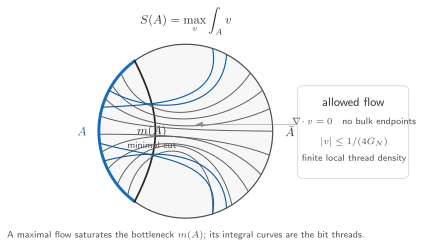
Bit threads are integral curves of a divergenceless, norm-bounded bulk flow. The maximal flux out of is limited by every homologous cut and is saturated at the minimal cut . The RT surface is therefore a bottleneck for information flow rather than merely a geometric object to be minimized.
The proof is a continuum version of a theorem familiar from graph theory. In a network with edge capacities, the maximum amount of flow from a source to a sink equals the minimum capacity of a cut separating them. RT is the Riemannian version of the same statement, with surface area playing the role of cut capacity.
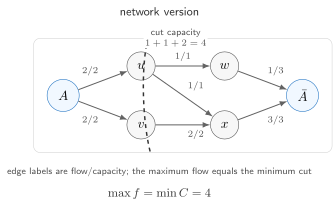
The graph version of the theorem: the maximum allowed flow from to equals the minimum cut capacity. In holography the graph is replaced by a Riemannian bulk slice, the edge capacities by area density, and the cut by a codimension-one surface on the slice, equivalently the codimension-two RT surface in spacetime.
This duality between a minimization problem and a maximization problem is useful because different questions become simple on different sides. Minimal surfaces make phase transitions and geometric nesting visible. Bit threads make flux conservation, bottlenecks, and entropy inequalities visible.
What do bit threads mean?
Section titled “What do bit threads mean?”A thread configuration can be visualized as a collection of curves in the bulk. Each thread connects two boundary points, or more generally two allowed endpoints. The density of curves is the norm , and the local density bound is
This suggests the following interpretation:
But this interpretation requires care.
A bit thread is not a literal identifiable Bell pair in the CFT. The optimal flow is highly nonunique, and different optimal flows can represent the same entropy. The flow is also a classical large- object: it computes the leading geometric term in the entropy, not the full microscopic entanglement spectrum. A thread should therefore be understood as an information-flow line in a dual variational problem, not as a microscopic string carrying a named qubit.
The picture is still powerful. If a large number of threads connect to , then the geometry has enough capacity to support large correlations between and . If a narrow neck separates from the rest, no thread configuration can carry more flux than that neck allows. This is precisely the holographic principle in local form.
Homology and conservation of threads
Section titled “Homology and conservation of threads”The RT formula includes a homology constraint: the surface must be homologous to . In the flow language this constraint is encoded by conservation.
If and bound a bulk region , then
up to orientations and possible internal boundaries. Since ,
Thus the same flux that leaves must cross any homologous cut. A nonhomologous surface would not necessarily intercept all the threads leaving ; it would not define the same flux problem.
For mixed states or geometries with horizons, one often formulates homology relative to additional internal boundaries. In the thread language this changes the allowed endpoints or boundary conditions. The core principle is unchanged: the entropy is a capacity between and everything that purifies or complements it in the chosen gravitational problem.
Mutual information as thread connectivity
Section titled “Mutual information as thread connectivity”For two disjoint boundary regions and , the mutual information is
In a thread picture, counts the maximum total number of threads leaving , and counts the maximum total number leaving . The entropy counts threads leaving the union . Threads connecting directly to contribute to and to , but not to , because they stay inside the union.
This gives the intuition
provided one chooses a thread configuration that is optimal for the relevant regions. More precisely, in suitable locking configurations, the maximum number of threads that can be arranged between and is .
This factor of two is easy to understand: one — thread is counted once in and once in , but it is not counted in .
The mutual information phase transition in RT now has a flow interpretation. When the entanglement wedge of is disconnected, there is no advantage to sending threads directly between and , and vanishes at leading order. When the connected surface dominates, a bottleneck opens that allows a positive bundle of threads between and .
Entropy inequalities from cuts
Section titled “Entropy inequalities from cuts”Some entropy inequalities are true for all quantum systems. Two basic examples are subadditivity,
and strong subadditivity,
Strong subadditivity is equivalent to positivity of conditional mutual information,
In the RT language, these inequalities can be proven by cutting and recombining minimal surfaces. For example, surfaces for and can be cut into pieces and reassembled into candidate surfaces for and . Since the true RT surfaces for and have no larger area than these candidates, the inequality follows.
In the thread language, the same statement is a consequence of compatible flows. One can choose flows whose fluxes simultaneously lock nested regions. The norm bound prevents overcounting: the same local bit of bulk capacity cannot be used twice in incompatible ways. This is the geometric reason strong subadditivity is natural in holography.
For static classical holographic entropy, there is an even stronger inequality that is not true for general quantum states.
Monogamy of mutual information
Section titled “Monogamy of mutual information”For three disjoint regions , define tripartite information
Equivalently,
The holographic monogamy inequality is
or
This says that in classical holographic states, the correlations of with and are monogamous in a strong sense. If is highly correlated with , then the same geometric capacity cannot be independently reused to correlate with unless the larger region supplies enough capacity.
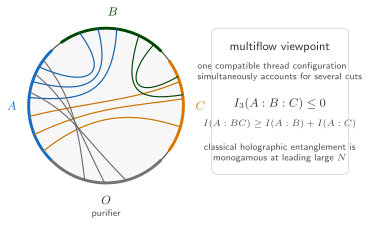
A multiflow decomposes a compatible thread configuration into bundles connecting boundary regions. This gives an intuitive proof of monogamy of mutual information: at leading classical order, the same local bulk capacity cannot simultaneously support independent — and — correlations beyond the capacity available between and .
One clean way to formulate this is through multiflows. Partition the boundary into regions . A multiflow consists of antisymmetric pairwise flows , with carrying threads from to . The combined flow obeys a local norm bound,
or an equivalent convex constraint depending on the precise formulation. A max multiflow theorem states that, for appropriate classical RT setups, one can choose a multiflow that simultaneously maximizes the outward flux for all individual boundary regions.
This simultaneous locking is stronger than optimizing one region at a time. It is exactly what makes monogamy manifest. In such a configuration, entropy is accounted for by pairwise thread bundles and certain constrained multipartite structures, not by arbitrary quantum correlations.
This is why is a diagnostic of classical holographic entanglement. It is not a universal law of quantum information. It is a geometric property of entropies generated by RT surfaces.
The holographic entropy cone
Section titled “The holographic entropy cone”For named boundary regions, collect all nonempty subsystem entropies into a vector
The set of all entropy vectors allowed by general quantum mechanics is called the quantum entropy cone. Its complete structure is unknown for sufficiently many parties. The set generated by classical holographic RT geometries is smaller and more rigid. It is called the holographic entropy cone.
For two, three, and four boundary regions, the holographic cone is characterized by the usual quantum inequalities together with monogamy of mutual information. For five or more regions, new independent holographic entropy inequalities appear. These inequalities can be studied using minimal surfaces, graph models, contraction maps, or bit-thread/multiflow methods.
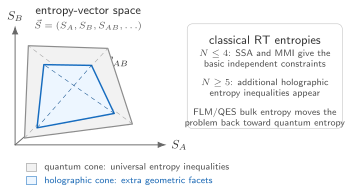
The holographic entropy cone is the set of entropy vectors realized by classical RT geometries. It is more constrained than the general quantum entropy cone. For a small number of regions, strong subadditivity and monogamy of mutual information are enough; for larger numbers of regions, genuinely new holographic inequalities appear.
The entropy cone is not just a classification device. It tells us what kinds of multipartite entanglement can be represented by smooth classical geometry. A state whose entropy vector violates MMI cannot be described by a single classical RT geometry at leading order, although it might arise after including bulk quantum entropy, finite- effects, or non-geometric phases.
Why MMI is not a theorem of all quantum states
Section titled “Why MMI is not a theorem of all quantum states”It is useful to see why is special. Consider a classically correlated distribution in which three bits are always equal:
The Shannon entropies are
Thus
A quantum GHZ state has a closely related entropy pattern for suitable choices of subsystems. Such correlations are not forbidden in quantum mechanics. They are simply not the leading entropy pattern of a classical holographic geometry.
This observation is a useful warning. Holographic entanglement is not generic entanglement. Classical bulk geometry imposes severe constraints on the entropy vector. Bit threads make those constraints intuitive because all entropies must be supported by one and the same local bulk capacity.
Bit threads and tensor networks
Section titled “Bit threads and tensor networks”Tensor-network models make the max-flow/min-cut analogy almost literal. In a graph network with bond dimensions , the entropy of a boundary region in a random tensor network is often controlled by a minimal cut,
The dual flow problem sends as many units of information as possible from to its complement subject to edge-capacity constraints. This is the discrete ancestor of the continuum bit-thread picture.
This analogy is useful but imperfect. Smooth Einstein gravity contains local dynamics, gravitons, gauge constraints, and a continuum geometry. A tensor network captures the combinatorial skeleton of entanglement wedges and minimal cuts, but not the full content of the bulk effective field theory.
Still, tensor networks explain why bit threads are natural in holography. The RT surface is a continuum minimal cut. Bit threads are the continuum version of saturating the corresponding network capacity.
Quantum corrections: what changes beyond classical RT?
Section titled “Quantum corrections: what changes beyond classical RT?”The bit-thread formulation described above is equivalent to the classical RT formula. Once we include FLM or QES corrections, the entropy becomes
The extra bulk entropy term is an ordinary quantum von Neumann entropy. It obeys strong subadditivity, but it does not generally obey holographic monogamy. Therefore the leading classical inequality
can receive quantum corrections that spoil it at subleading order.
There are quantum generalizations of bit threads in which sources, sinks, or modified constraints encode the bulk entropy contribution. The conceptual message is simple: classical bit threads describe geometric area capacity, while quantum bit threads must also account for entanglement already present in the bulk state.
This distinction is essential for black hole information. Islands and QESs are governed by generalized entropy, not by area alone. Classical bit-thread intuition remains useful, but it must be upgraded when the dominant entropy competition involves bulk matter entropy.
Covariant bit threads
Section titled “Covariant bit threads”The discussion so far assumes a static time-reflection-symmetric slice, where RT applies. HRT surfaces in time-dependent spacetimes are extremal rather than minimal on a fixed Riemannian slice, so the naive Riemannian max-flow/min-cut theorem does not immediately apply.
There are covariant flow reformulations of HRT. They are more subtle because the relevant norm constraints become nonlocal in time or are formulated using timelike/achronal structures rather than simple Riemannian flows. The clean intuition survives:
but the mathematical implementation is more delicate.
For the purposes of black hole information, the static bit-thread picture is already valuable because it teaches the right lesson: entropy is not merely an area assigned to a surface; it is a capacity of the bulk geometry. In evaporating black holes, the island transition can be viewed as a dramatic change in the dominant generalized-entropy bottleneck.
Common pitfalls
Section titled “Common pitfalls”Pitfall 1: “Bit threads are actual microscopic strings in the bulk.”
They are not. They are integral curves of a variational flow. Their nonuniqueness is a feature, not a bug.
Pitfall 2: “Each thread is one Bell pair.”
This is a useful cartoon only in special tensor-network-like limits. A general holographic CFT state does not come with a canonical Bell-pair decomposition matching an arbitrary flow.
Pitfall 3: “MMI is a universal quantum entropy inequality.”
It is not. MMI is a leading-order property of classical holographic entropies. Generic quantum states can violate it.
Pitfall 4: “If the RT surface is minimal, the corresponding flow is unique.”
Usually it is highly nonunique. Many different thread configurations can saturate the same minimal cut.
Pitfall 5: “Quantum corrections preserve all classical holographic inequalities.”
They preserve universal quantum inequalities such as strong subadditivity, but classical holographic inequalities such as MMI can fail once bulk entropy is included.
Summary
Section titled “Summary”The bit-thread formulation rewrites the static RT formula as
This is the continuum max-flow/min-cut theorem applied to holography. Minimal surfaces are bottlenecks; bit threads are maximally packed flows through those bottlenecks.
The formulation clarifies several important facts:
- the homology constraint is flux conservation;
- mutual information measures how many thread bundles can connect two regions;
- strong subadditivity follows from compatible flows or cut-and-paste geometry;
- monogamy of mutual information is a special classical holographic constraint;
- the holographic entropy cone is smaller than the general quantum entropy cone;
- quantum corrections require a generalized, bulk-sensitive thread picture.
The next pages move from entropy formulae to bulk reconstruction. Bit threads are a perfect transition point: they already suggest that the boundary knows about bulk connectivity, bottlenecks, and entanglement wedges, not merely about the area of isolated surfaces.
Exercises
Section titled “Exercises”Exercise 1: The easy half of max-flow/min-cut
Section titled “Exercise 1: The easy half of max-flow/min-cut”Let be a flow satisfying and . Let be any bulk surface homologous to . Show that
Conclude that
Solution
Since is homologous to , there is a bulk region with boundary , up to orientations. Gauss’s law gives
so
Then
This holds for every homologous , so it holds for the minimal one. Maximizing over gives the desired inequality.
The hard half of max-flow/min-cut is the existence of a flow saturating the minimal cut.
Exercise 2: Mutual information and internal threads
Section titled “Exercise 2: Mutual information and internal threads”Suppose a thread configuration is simultaneously optimal for , , and . Let be the number of threads from to the complement of , the number from to the complement of , and the number from to . Show that
Solution
In this configuration,
because threads leaving either go to or to the outside of . Similarly,
For the union , threads internal to do not contribute to the flux out of the union, so
Therefore
This is the origin of the statement that mutual information counts twice the number of internal — threads in a locking configuration.
Exercise 3: MMI violation in a nonholographic entropy vector
Section titled “Exercise 3: MMI violation in a nonholographic entropy vector”Consider three classical bits with probability distribution
Compute using Shannon entropies. Does this entropy vector obey holographic monogamy?
Solution
Each single bit is random, so
Each pair is also determined by one random bit, so
The full triple is again determined by one random bit, so
Thus
This violates the holographic inequality . The example shows that monogamy of mutual information is not a universal entropy inequality. It is a special property of classical holographic entropy vectors.
Exercise 4: Cut-and-paste proof of subadditivity
Section titled “Exercise 4: Cut-and-paste proof of subadditivity”Using RT surfaces, give a geometric proof of
for disjoint regions and .
Solution
Let and be the minimal surfaces homologous to and . Their union is a candidate, not necessarily minimal, surface homologous to after the obvious recombination of homology regions. Therefore
Dividing by gives
This proves subadditivity at the classical RT level. The same logic can be refined to prove strong subadditivity by cutting and recombining the surfaces for and .
Exercise 5: Why quantum corrections can spoil MMI
Section titled “Exercise 5: Why quantum corrections can spoil MMI”Assume the entropy has the FLM form
where is the bulk entanglement wedge region. Explain why the area terms may obey while the full entropy need not obey at subleading order.
Solution
The leading area terms are classical RT entropies, and therefore their tripartite information satisfies
The bulk terms are ordinary quantum entropies of bulk effective field theory regions. Ordinary quantum entropies obey universal inequalities such as strong subadditivity, but they do not generally obey monogamy of mutual information. Therefore the bulk contribution
can be positive. The full tripartite information is schematically
Since is subleading in or , it cannot usually overwhelm a generic order- negative area contribution. But near phase transitions, in special configurations, or when the leading area contribution vanishes, the subleading term can determine the sign. Thus classical holographic inequalities need not survive unchanged once quantum corrections are included.
Further reading
Section titled “Further reading”- Michael Freedman and Matthew Headrick, “Bit threads and holographic entanglement”.
- Matthew Headrick and Tadashi Takayanagi, “A holographic proof of the strong subadditivity of entanglement entropy”.
- Patrick Hayden, Matthew Headrick, and Alexander Maloney, “Holographic Mutual Information is Monogamous”.
- Shawn X. Cui, Patrick Hayden, Temple He, Matthew Headrick, Bogdan Stoica, and Michael Walter, “Bit Threads and Holographic Monogamy”.
- Ning Bao, Sepehr Nezami, Hirosi Ooguri, Bogdan Stoica, James Sully, and Michael Walter, “The Holographic Entropy Cone”.
- Matthew Headrick, “General properties of holographic entanglement entropy”.
- Matthew Headrick and Veronika E. Hubeny, “Covariant bit threads”.
- Cesar A. Agón and Juan F. Pedraza, “Quantum bit threads and holographic entanglement”.