
Python's Lunch and Decoding Complexity
Guiding question. If the Page curve and the island formula say that the radiation contains the information, why does the information still look impossible to extract by any reasonable observer?
The previous pages explained two complementary facts. First, after the Page time, the fine-grained entropy of the radiation is computed by a saddle with an island. In entanglement-wedge language,
so operators in the island can be reconstructed from the radiation algebra. Second, holographic complexity gives a natural language for the growth and computational difficulty of black-hole interiors. The present page combines these facts. The moral is simple but powerful:
The island formula is an information-theoretic statement. It does not say that the decoding map is easy.
The phrase Python’s lunch refers to a geometric obstruction to decoding: a pattern of quantum extremal surfaces, including nonminimal ones, which acts like a bottleneck in the reconstruction map. The proposal is that the computational cost of reconstructing degrees of freedom behind the bottleneck is exponentially large in a generalized-entropy barrier.
Schematically,
where is a locally minimal surface, is a nonminimal extremal surface deeper in the geometry, and the coefficient depends on the computational model. In simple postselection tensor-network models, Grover-type amplification naturally gives .
The slogan is therefore:
This distinction is not a technical afterthought. It is one of the cleanest ways to reconcile the Page curve, entanglement wedge reconstruction, and the practical invisibility of information in Hawking radiation.
1. Information-theoretic versus computational reconstruction
Section titled “1. Information-theoretic versus computational reconstruction”Let be a radiation system after the Page time. The island formula says that the entropy of is computed by
When the island saddle dominates, a bulk operator with belongs to the entanglement wedge of . In the idealized code-subspace limit, there exists a boundary or radiation operator such that
for all states in the relevant code subspace, where is the encoding map from the effective bulk code to the microscopic system.
This is an existence statement. It says that the logical operator can be represented on . It does not give a low-depth circuit for finding , and it does not say that a laboratory with access to the Hawking radiation can efficiently distill the interior qubit.
The distinction is analogous to ordinary error correction. A code may correct an erasure in principle, but the optimal decoder can still be computationally expensive. In black-hole physics the gap is dramatic: the decoding operation may require a number of elementary quantum gates exponential in the black-hole entropy.
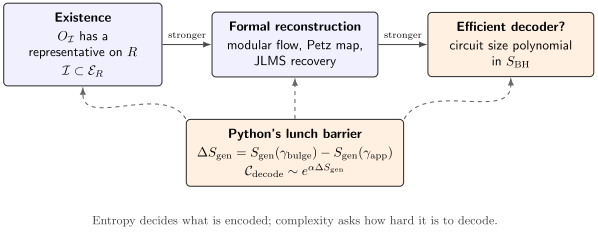
Entanglement wedge reconstruction is an information-theoretic statement: a radiation operator exists. A constructive map such as a Petz-type recovery map is already stronger. Efficient decoding is stronger still, requiring circuit size polynomial in the entropy rather than exponential in an entropy barrier.
It is helpful to separate three claims.
Existence. There is some operator on that reconstructs the island operator in a code subspace.
Constructivity. There is a formal reconstruction formula, for example one involving modular flow or a recovery map.
Efficiency. The reconstruction can be implemented by a circuit with feasible gate count, usually taken to mean polynomial in or in the number of microscopic degrees of freedom.
The island formula gives the first claim. JLMS and recovery-map technology make the second claim more precise. The Python’s lunch proposal addresses the third claim.
2. The Harlow–Hayden problem
Section titled “2. The Harlow–Hayden problem”The computational version of the firewall paradox was sharpened by Harlow and Hayden. Consider an old black hole. A late Hawking mode is entangled, according to semiclassical effective field theory, with an interior partner . But after the Page time, unitarity says that is also correlated with the early radiation . An AMPS-style observer wants to distill from the qubit that purifies , then compare it with near the horizon.
The decoding task is roughly:
For a generic old black hole, the map from the infalling matter to the radiation is highly scrambled. Harlow and Hayden argued that the decoding operation needed to isolate has complexity exponential in the black-hole entropy,
or at least so large that it cannot be completed before the black hole evaporates. In four asymptotically flat dimensions, the evaporation time is only polynomial in the entropy,
whereas is absurdly larger for a semiclassical black hole.
This does not by itself solve the information paradox. The Page curve still needs a microscopic explanation, and the radiation Hilbert space still contains the information. But it changes the operational status of the AMPS experiment: the observer who wants to manufacture a contradiction may need a decoding operation of prohibitive complexity.
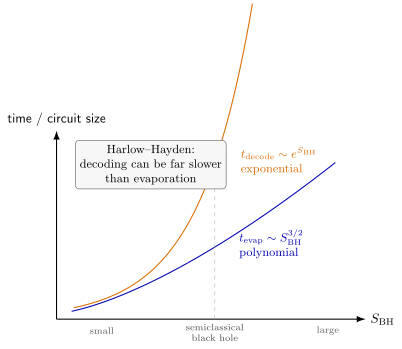
The physical lifetime of a semiclassical evaporating black hole is polynomial in , while a generic Harlow–Hayden decoding operation is expected to require exponential resources. The Python’s lunch proposal geometrizes this gap using a generalized-entropy barrier.
The key lesson is not merely that black holes are complicated. It is that information-theoretic recovery and operational recovery are different questions.
3. What is a Python’s lunch?
Section titled “3. What is a Python’s lunch?”The Python’s lunch is a pattern in the generalized-entropy landscape of extremal surfaces. Fix a boundary or radiation region , and consider candidate quantum extremal surfaces homologous to . Their generalized entropy is
In simple cases there is only one relevant locally minimal QES. But in more intricate geometries, the generalized-entropy profile can contain multiple extrema: local minima and nonminimal extrema between them. A schematic Python’s lunch configuration contains:
- an outer locally minimal surface , often called the appetizer;
- a nonminimal extremal surface with larger generalized entropy;
- a deeper surface, often a globally minimal surface or throat, .
The region behind may lie in the entanglement wedge according to the globally minimal surface, but reconstructing it from the accessible boundary system requires passing through the bulge. This passage is easy in the forward gravitational path integral but hard in the inverse decoding problem.
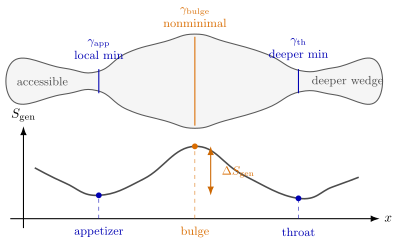
A Python’s lunch is diagnosed by nonminimal quantum extremal surfaces. The generalized-entropy barrier controls, conjecturally, the exponential part of the decoding complexity for reconstructing degrees of freedom beyond the appetizer.
The word “lunch” is meant to evoke a snake after eating: a narrow throat, a bulge, and another narrow region. The metaphor is whimsical, but the physics is not. Nonminimal QESs are invisible to the leading entropy formula because the entropy uses the minimum over extremal surfaces. Complexity, however, can be sensitive to saddles that do not dominate the entropy.
This is the central conceptual point:
4. Why a nonminimal QES can create computational hardness
Section titled “4. Why a nonminimal QES can create computational hardness”The cleanest intuition comes from tensor networks. A standard holographic tensor network built from isometries is easy to invert on its image. But a network with projections is different. Inverting a projection is not a deterministic quantum operation. If a map contains a projection onto a subspace of dimension inside a larger intermediate space of dimension , the probability of successfully reversing it by blind postselection is roughly
A brute-force strategy then costs attempts. With amplitude amplification, the cost can be reduced to
The Python’s lunch proposal translates this tensor-network estimate into gravity by replacing ordinary entropies with generalized entropies of QESs:
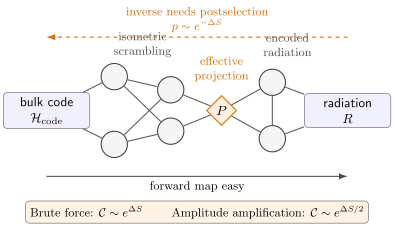
In tensor-network models, a Python’s lunch appears when reconstructing the interior requires undoing an effective projection. If the projection succeeds with probability , brute-force inversion costs attempts, while Grover-type amplification suggests scaling.
This is why the proposal is geometric but also computational. The generalized-entropy landscape tells us not only which region is encoded, but also how difficult the decoding map might be.
5. The formula and its interpretation
Section titled “5. The formula and its interpretation”The most useful form of the Python’s lunch estimate is schematic:
with . The coefficient depends on what is counted as an elementary operation and whether amplitude amplification or other quantum algorithms are allowed. The robust claim is exponential sensitivity to the generalized-entropy barrier, not the precise prefactor in the exponent.
Several points are worth emphasizing.
First, the barrier is not the total black-hole entropy in all situations. It is the difference between two generalized entropies associated with a reconstruction bottleneck. In many black-hole applications this difference is of order , reproducing Harlow–Hayden-type hardness.
Second, the bulge is not selected by the entropy formula. The von Neumann entropy of is controlled by the globally minimal QES. The nonminimal QES enters a different observable: the complexity of reconstructing beyond a bottleneck.
Third, the formula is a conjectural bridge between semiclassical geometry and boundary computational complexity. It is strongly motivated by tensor networks and by black-hole decoding arguments, but it is not a theorem with the same status as, say, the leading RT formula in classical holography.
Fourth, an exponentially hard decoder can coexist with exact unitarity. There is no contradiction between
and
6. Islands, radiation, and the decoding barrier
Section titled “6. Islands, radiation, and the decoding barrier”After the Page time, the radiation region has an entanglement wedge containing an island . This means that island operators have radiation reconstructions. But those reconstructions are highly nonlocal in the radiation and, generically, computationally complex.
The useful picture is therefore:
The Page curve diagnoses the first arrow. The Python’s lunch diagnoses the second.
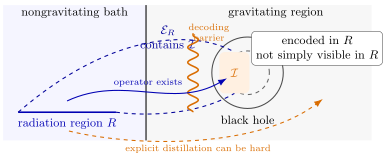
The island is included in the entanglement wedge of the radiation, so a reconstruction exists. But the decoding map can be obstructed by a Python’s lunch barrier: the island is encoded in , not locally visible in a simple radiation observable.
This distinction repairs a common misleading interpretation of islands. One sometimes hears: “after the Page time, the interior is in the radiation.” That phrase is acceptable only if “in” means encoded in the radiation algebra. It does not mean:
- the interior sends a local signal into the radiation;
- a simple detector on can measure the interior mode;
- the semiclassical observer near the horizon sees the Page transition occur as a local event;
- the island formula supplies an efficient decoding circuit.
The Python’s lunch makes this last point geometrically sharp.
7. Relation to AMPS and the decoding experiment
Section titled “7. Relation to AMPS and the decoding experiment”Recall the AMPS trilemma. The late Hawking mode should be entangled with an interior partner if the horizon is smooth. But after the Page time, unitarity suggests that is purified by early radiation . The contradiction arises if and a distillable mode can be treated as independent systems that an observer can compare.
Complexity modifies the operational story. Even if the purification is encoded in , the decoding map
may require exponential resources. An observer who jumps into the black hole after collecting the radiation may not be able to complete before losing causal access to the experiment.
The island/QEC perspective adds a more structural statement. The interior partner and the radiation reconstruction need not be independent tensor factors. They can be different reconstructions of logical information in a gravitational code. Complexity then protects semiclassical effective field theory by making the dangerous comparison operationally inaccessible in generic situations.
This does not make every firewall question disappear. It does show that a sharp contradiction requires more than information-theoretic purification; it requires an efficient, physically realizable decoding protocol.
8. Nonminimal QESs in unexpected places
Section titled “8. Nonminimal QESs in unexpected places”The original Python’s lunch discussion was motivated by decoding Hawking radiation. Later work emphasized that nonminimal QESs may appear much more broadly. In particular, one can ask about the reconstruction of black-hole interiors even in single-sided, non-evaporating systems with no explicit radiation bath.
The key lesson is that the difficulty of interior reconstruction may be a generic feature of semiclassical black holes rather than an artifact of an evaporating setup. If a code subspace includes excitations of interior outgoing modes, the maximally mixed state on that code subspace can have additional QESs. These nonminimal surfaces then suggest a Python’s lunch obstruction to reconstructing the interior from the microscopic boundary theory.
This gives a geometric interpretation of an old intuition: the black-hole interior is not merely far away in the bulk; it is computationally protected. The protection is not absolute, because quantum mechanics still encodes the information. But the relevant decoder can be exponentially complex.
9. Complexity, state dependence, and non-isometric codes
Section titled “9. Complexity, state dependence, and non-isometric codes”The previous page discussed state dependence. The Python’s lunch offers a way to refine that discussion.
In ordinary subspace QEC, the encoding map is approximately isometric:
For simple entanglement wedge reconstruction, this is a good model. But black-hole interior reconstruction after the Page time can involve maps that are effectively non-isometric from the semiclassical bulk description to the microscopic boundary variables. The semiclassical description may include many states that are not independently represented as orthogonal microscopic states.
In such situations, the reconstruction map can behave like an inverse to a many-to-one or postselected process. That is exactly where complexity barriers appear. One can say, cautiously, that the Python’s lunch geometrizes a controlled kind of state or code dependence: the interior reconstruction exists in a suitable effective description, but the microscopic inverse map may require extraordinary computational resources.
The right lesson is not “the interior is fake.” The right lesson is:
10. What the Python’s lunch does not say
Section titled “10. What the Python’s lunch does not say”Because the name is memorable, it is easy to overuse. Here are the main caveats.
It is not the island formula. The island formula computes entropy. The Python’s lunch estimates decoding complexity.
It is not simply the ER bridge volume. CV and CA complexity concern global state complexity or interior growth. The Python’s lunch concerns the complexity of reconstructing a particular entanglement-wedge region from a specified boundary or radiation subsystem.
It is not a proof that every interior reconstruction is impossible. The claim is about exponential scaling in certain semiclassical regimes. Special states, special observables, or extra side information can reduce the difficulty.
It is not a new causal barrier. It does not prevent signals allowed by the spacetime geometry, nor does it make nontraversable wormholes traversable. It is a computational obstruction in the boundary/radiation decoding task.
It is not yet a fully rigorous theorem of AdS/CFT. The conjecture is supported by tensor-network models and geometric evidence, and recent work has found both new examples and subtleties. The safest phrasing is that nonminimal QESs are strong indicators of exponential reconstruction complexity.
11. A compact dictionary
Section titled “11. A compact dictionary”The following dictionary summarizes the objects that appear in this page.
| Concept | Entropy/reconstruction meaning | Complexity meaning |
|---|---|---|
| Minimal QES | Determines or | Does not by itself determine decoding cost |
| Nonminimal QES | Usually invisible to the entropy minimum | Can signal a reconstruction bottleneck |
| Bulge | Larger extremal surface | Entropy barrier in the decoder |
| Appetizer | Locally minimal surface before the bulge | Beginning of the hard-to-invert region |
| Island | Part of after Page time | Encoded in , often hard to distill |
| Harlow–Hayden task | Distill purifier of a late Hawking mode | Expected hardness |
| Postselection tensor network | Toy model of non-isometric encoding | Success probability |
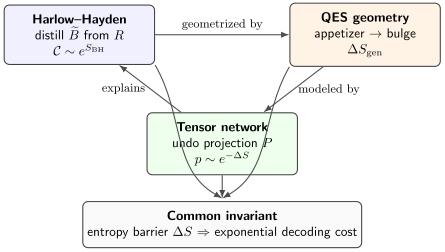
The Python’s lunch dictionary links three languages: Harlow–Hayden decoding hardness, nonminimal-QES geometry, and postselection tensor-network models. The common invariant is an entropy barrier that makes the inverse reconstruction exponentially difficult.
12. Summary
Section titled “12. Summary”The Page curve says that black-hole evaporation is compatible with unitarity. The island formula explains how the fine-grained entropy of radiation can turn over in semiclassical gravity. Entanglement wedge reconstruction says that the radiation can encode the island. The Python’s lunch adds the missing computational qualifier:
This is why black hole information is not merely a question about where the information is. It is also a question about what operations can reveal it.
The Python’s lunch proposal is therefore a bridge between three themes:
- QES geometry: nonminimal surfaces can matter even when they do not dominate entropy;
- quantum information: reconstruction exists as a code-theoretic statement;
- computational complexity: decoding can be protected by an entropy barrier.
That bridge will be important in the final frontier pages, especially factorization puzzles, baby universes, and the problem of defining black-hole interiors beyond semiclassical approximations.
Exercises
Section titled “Exercises”Exercise 1. Polynomial lifetime versus exponential decoding
Section titled “Exercise 1. Polynomial lifetime versus exponential decoding”For a four-dimensional Schwarzschild black hole in Planck units, use
Express as a function of . Compare it with a decoding time .
Solution
Since , we have . Therefore
This is polynomial in the black-hole entropy. By contrast,
is exponential. For a semiclassical black hole, , so is parametrically larger than any power of . This is the basic timescale separation behind the Harlow–Hayden obstruction.
Exercise 2. Postselection cost
Section titled “Exercise 2. Postselection cost”Suppose a tensor-network model has an effective projection with success probability
Estimate the cost of brute-force inversion and the cost after ideal amplitude amplification.
Solution
A brute-force strategy repeats the attempted inversion until the projection succeeds. The expected number of attempts is
Amplitude amplification is the quantum analogue of Grover search. It reduces the scaling from to , giving
This is the origin of the common schematic estimate
with an order-one coefficient depending on the computational model.
Exercise 3. Entropy barriers from Hilbert-space dimensions
Section titled “Exercise 3. Entropy barriers from Hilbert-space dimensions”Let an intermediate tensor-network leg have dimension , while the successful postselected subspace has dimension . Define
Show that the postselection probability is naturally written as .
Solution
If the successful subspace is a typical subspace of dimension inside a larger space of dimension , then the probability that a random state lands in the successful subspace is approximately
Using the definitions of the entropies,
Therefore
The gravitational conjecture replaces and by generalized entropies of the corresponding QESs.
Exercise 4. Why islands do not imply easy decoding
Section titled “Exercise 4. Why islands do not imply easy decoding”Explain why the statement does not imply that a simple measurement on can detect a local field operator in the island.
Solution
The inclusion means that, in the appropriate code subspace, island operators have representations in the radiation algebra. It is an existence statement about logical operators. It does not specify that the representing operator is simple, local, or efficiently constructible.
A local field operator in the island is typically encoded in in a highly scrambled, nonlocal way. The decoding map may require a circuit whose complexity is exponential in an entropy barrier. Thus the information can be present in while being inaccessible to simple measurements or feasible decoding protocols.
Exercise 5. Reading a generalized-entropy profile
Section titled “Exercise 5. Reading a generalized-entropy profile”Consider a schematic generalized-entropy profile with a local minimum at , a local maximum at , and a global minimum at . Which surface controls the von Neumann entropy? Which quantity controls the Python’s lunch decoding estimate?
Solution
The von Neumann entropy is computed by the globally minimal quantum extremal surface after extremizing. Therefore controls if it is the global minimum among the allowed extrema.
The Python’s lunch estimate is sensitive to the barrier between a locally accessible reconstruction region and the deeper region. The relevant entropy difference is typically
The bulge does not dominate the entropy, but it can dominate the decoding complexity.
Further reading
Section titled “Further reading”- Daniel Harlow and Patrick Hayden, Quantum Computation vs. Firewalls.
- Adam R. Brown, Hrant Gharibyan, Geoff Penington, and Leonard Susskind, The Python’s Lunch: geometric obstructions to decoding Hawking radiation.
- Netta Engelhardt, Geoff Penington, and Arvin Shahbazi-Moghaddam, Finding Pythons in Unexpected Places.
- Gurbir Arora, Matthew Headrick, Albion Lawrence, Martin Sasieta, and Connor Wolfe, Geometric Surprises in the Python’s Lunch Conjecture.
- Ahmed Almheiri, Thomas Hartman, Juan Maldacena, Edgar Shaghoulian, and Amirhossein Tajdini, The entropy of Hawking radiation.
- Patrick Hayden and John Preskill, Black holes as mirrors: quantum information in random subsystems.