
AdS2 Throats and Local Criticality
The charged black brane from the previous page has a special zero-temperature limit. At nonzero temperature its horizon is ordinary: the Euclidean time circle caps off smoothly, perturbations fall through the future horizon, and the state is a finite-density thermal fluid. At zero temperature something sharper happens. The horizon becomes extremal, the blackening factor develops a double zero, and the near-horizon region stretches into a long throat with geometry
This throat is the first genuinely strange finite-density IR geometry in holographic quantum matter. Its scaling symmetry acts on time and the radial coordinate, but not on the boundary spatial coordinates:
In boundary language, the IR theory has critical temporal correlations but no ordinary spatial scaling. Equivalently, it has an infinite dynamical exponent,
This is called local or semi-local quantum criticality. It is local not because the theory has no spatial structure whatsoever, but because the deep IR scaling symmetry does not rescale space. Momentum becomes a label on a family of -dimensional critical problems. The result is one of the signature formulas of holographic finite-density physics:
The exponent depends on momentum. That is the odd little jewel of the throat: criticality in time, momentum-dependent scaling dimensions, and a finite density of low-energy spectral weight without quasiparticles.
Throughout this page, denotes the number of boundary spatial dimensions, is the boundary spacetime dimension, and the bulk dimension is . The boundary is at , the horizon is at , and we set .
The extremal charged black brane
Section titled “The extremal charged black brane”The planar Reissner—Nordström AdS black brane can be written as
with
The gauge potential may be chosen regular at the horizon,
The temperature is
Thus extremality occurs when
At this value,
The horizon is not merely a simple zero of . It is a double zero. Expanding near gives
This one line is the seed of the whole page. A simple zero gives Rindler space and a finite-temperature horizon. A double zero gives an throat and an emergent low-energy scaling region.
Deriving the throat
Section titled “Deriving the AdS2×RdsAdS_2\times\mathbb R^{d_s}AdS2×Rds throat”Let
Near the extremal horizon, , and
Substituting this into the metric, the time-radial part becomes
Define
and
Then
This is in Poincare coordinates. Equivalently, with
the throat metric is
The horizon is at
while the boundary of the throat, where it glues onto the asymptotic region, is at
The spatial directions are spectators. They do not form part of the scaling geometry; they sit as a flat of fixed proper size
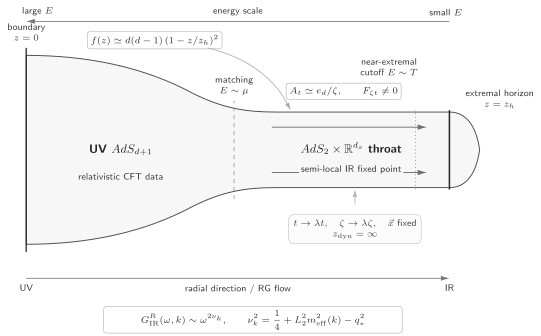
The extremal charged black brane develops an throat. The UV region is asymptotically and encodes the microscopic CFT deformed by a chemical potential. The deep IR is controlled by the near-horizon region, where and the radial coordinate scale but the boundary spatial coordinates do not. At small nonzero temperature the throat is cut off at an energy scale .
The radial direction is the holographic version of scale. Moving from the boundary toward the horizon means flowing from the UV to the IR. The charged black brane therefore says:
This is a geometric RG flow. The chemical potential introduces a scale. Above that scale the system remembers the original relativistic CFT. Below that scale the extremal horizon controls the IR.
The electric field in the throat
Section titled “The electric field in the throat”The gauge potential also has a simple near-horizon limit. Since
near we find
Using the coordinate , this becomes
The constant depends on the normalization of the bulk Maxwell field and on the convention used for , but the structure
is universal for the RN-AdS throat. The corresponding electric field is nonzero in the region:
This field is compatible with the scaling symmetry. Under
the one-form
is invariant.
The electric field is physically important. It is the near-horizon remnant of the finite charge density. It also lowers the effective mass of charged fields and can drive IR instabilities, including the holographic superconductor instability.
Why the throat is infinitely long
Section titled “Why the throat is infinitely long”For a nonextremal black brane, the near-horizon geometry is Rindler-like. The proper radial distance from a point outside the horizon to the horizon is finite. For an extremal horizon, the double zero changes the story.
At fixed time, the radial proper distance near the extremal horizon is
Therefore the distance from to is
As , this diverges. The extremal horizon is down an infinitely long throat.
This logarithmic length is why the region can dominate low-energy physics. A perturbation sent from the boundary must propagate through a long scaling region before reaching the horizon. The throat is not a small correction to the UV geometry; it is the IR fixed point.
At small but nonzero temperature, the throat is cut off. The near-horizon region is better described by an black hole,
with
The throat length is then roughly
So the low-temperature limit is a long-throat limit. This is a useful mental picture: finite temperature caps off the throat, while makes it infinitely long.
The IR scaling symmetry
Section titled “The IR scaling symmetry”The metric
is invariant under
The full near-horizon geometry is
so the spatial coordinates do not participate in the scaling:
This is unlike a relativistic CFT, where
It is also unlike a Lifshitz fixed point with finite dynamical exponent , where
The throat is the limiting case
Energy scales, but momentum does not scale. Frequency is an IR scaling variable; momentum is an external label.
This is the cleanest way to understand local criticality:
That one sentence prevents a lot of confusion.
Probe fields and momentum-dependent IR dimensions
Section titled “Probe fields and momentum-dependent IR dimensions”Consider a neutral scalar bulk field of mass dual to a boundary operator . In the throat, Fourier decompose
Because the spatial metric in the throat is fixed,
the momentum term acts like an additional contribution to the mass in :
The scalar wave equation near the boundary has two independent asymptotic behaviors,
where
for a neutral scalar.
The corresponding IR operator dimension is
This is the central fact: each momentum gives a different scaling dimension in the emergent -dimensional theory.
For a charged scalar, the near-horizon electric field shifts the effective exponent. Schematically,
where
is the dimensionless coupling of the charged field to the electric field. The precise normalization depends on the Maxwell convention. The sign is robust: the electric field lowers for charged fields.
For spinors the formula is modified by spin connection and gamma-matrix factors, but the physical structure is the same:
Later, in the holographic fermion page, this will control whether a boundary fermionic excitation is Fermi-liquid-like, non-Fermi-liquid-like, marginal, or deeply incoherent.
IR Green’s functions
Section titled “IR Green’s functions”In a -dimensional scale-invariant theory, an operator of dimension has a time-domain two-point function
Fourier transforming gives, up to contact terms and phase conventions,
Thus
for real positive and real , with depending on conventions and on the normalization of the IR field.
At nonzero temperature, scaling gives the finite-temperature form
where is an black-hole response function. Its explicit expression is a ratio of Gamma functions, but the scaling form is usually the key point. The only low-energy scale in the IR throat is .
The spectral density behaves as
at zero temperature when the IR throat controls the response. This is low-energy continuum spectral weight, not a quasiparticle pole.
Matching the throat to the UV
Section titled “Matching the throat to the UV”The Green’s function is not automatically the full boundary Green’s function. The full geometry has two regions:
- the UV and matching region, where the spacetime is not ;
- the IR throat, where scaling controls low-frequency dynamics.
A standard matched-asymptotic calculation gives a structure of the form
Here
is the response, while and are determined by solving the zero-frequency wave equation through the UV geometry. They are analytic in at small frequency.
Generically, if , expanding at small gives
So the throat contributes the leading nonanalytic frequency dependence.
A special case occurs when
Then the denominator of is small at , and the same response becomes a self-energy for a sharp or semi-sharp excitation. This is the origin of the famous holographic fermion formula
We will not develop that story here, but this page contains its IR engine.
What local criticality means physically
Section titled “What local criticality means physically”The throat gives a controlled large- model of a finite-density state with no ordinary quasiparticle description. The most important physical features are these.
First, the IR theory has a continuum of low-energy excitations. The horizon absorbs perturbations, and the region produces branch cuts rather than isolated stable quasiparticle poles.
Second, time and space behave asymmetrically. Time correlations are power-law critical. Spatial correlations are not governed by a scale transformation. Instead, spatial dependence enters through momentum-dependent exponents .
Third, the charge is fractionalized in the pure RN-AdS solution. The electric flux continues into the horizon, so the boundary charge is carried by the deconfined large- sector rather than by visible gauge-invariant charged particles outside the horizon.
Fourth, the extremal entropy density is nonzero:
This makes the RN-AdS throat powerful but also suspicious. A finite ground-state entropy density is not expected in a generic stable ordinary material. In many holographic models the RN-AdS throat is not the final ground state; it is an intermediate scaling regime or the parent state that becomes unstable to another phase.
BF bounds and IR instabilities
Section titled “BF bounds and IR instabilities”Anti-de Sitter space can tolerate a negative mass squared, but only down to the Breitenlohner—Freedman bound. In , a neutral scalar is stable if
For , this becomes
In the notation above, this is simply
If
then
and the IR scaling dimension is complex:
The response behaves schematically as
which is log-periodic in frequency. For bosonic modes, a complex IR scaling dimension is usually an instability of the throat. The system wants to condense the unstable mode and replace the RN-AdS interior with a new geometry.
This is the mechanism behind several important ordered phases.
Charged scalar instability
Section titled “Charged scalar instability”A charged scalar has
The electric field can make negative even if the scalar is perfectly stable in the UV region. This means:
That is exactly what a phase transition should look like holographically. The UV theory is well-defined. The finite-density state is not the true IR endpoint.
For a homogeneous superfluid or superconductor instability, the first unstable mode is often at
For spatially modulated phases, an instability may first appear at
Then the ordered phase breaks translations.
Neutral scalar instability
Section titled “Neutral scalar instability”Even a neutral scalar can violate the BF bound if its UV mass lies in the window where it is stable in but unstable in the smaller throat. This is possible because the stability bounds are different in the two geometries.
For example, in the UV BF bound is
For an extremal RN-AdS throat,
so the BF bound is
Thus a scalar with
is allowed in the UV theory but unstable in the throat.
This is a beautiful and useful distinction. A negative mass squared is not automatically bad; what matters is the geometry that controls the IR.
Local criticality versus ordinary quantum criticality
Section titled “Local criticality versus ordinary quantum criticality”It is worth comparing the throat with an ordinary relativistic quantum critical point.
| Feature | Relativistic CFT | throat |
|---|---|---|
| scaling | , | , |
| dynamical exponent | ||
| operator dimension | fixed by operator | depends on in the IR |
| low-energy correlator | scales in | |
| spatial correlations | scale invariant | finite spatial scale set by in simple RN-AdS |
| entropy at | usually zero density of entropy | finite in classical RN-AdS |
The throat is therefore not just another CFT. It is a semi-local critical sector attached to every point in momentum space.
This makes it both powerful and peculiar. It gives simple analytic control over frequency dependence, but it does not by itself produce all the spatial structure of a real metal. Spatial coherence, Fermi surfaces, lattices, density waves, and disorder require additional ingredients or deformations.
The residual entropy problem
Section titled “The residual entropy problem”The extremal RN-AdS black brane has
At the level of classical gravity this is not a contradiction. The entropy is an area density in Planck units, and the large- limit makes it order . But as a model of quantum matter it raises a sharp question: what microscopic degrees of freedom account for a macroscopic ground-state entropy?
There are several common responses.
One response is that the RN-AdS throat is an intermediate scaling regime. Before reaching the true limit, another instability may intervene: superconductivity, electron-star formation, scalar condensation, a spatially modulated phase, or a dilaton-driven scaling geometry.
Another response is that the large- limit can hide low-temperature splittings. Effects that are subleading in may lift the degeneracy at parametrically low scales.
A third response is to replace the RN-AdS throat by a more general IR geometry, such as an Einstein—Maxwell—dilaton solution with Lifshitz or hyperscaling-violating scaling. That is the next page.
The practical lesson is simple:
Common pitfalls
Section titled “Common pitfalls”Pitfall 1: thinking means a literal spatially zero-dimensional boundary theory. The full boundary theory still lives in spatial dimensions. The throat means the deep IR scaling problem is -dimensional for each momentum .
Pitfall 2: confusing local criticality with momentum independence. The exponent depends on momentum. The critical scaling is local in the sense that does not scale.
Pitfall 3: treating the residual entropy as harmless. It is harmless as a controlled classical saddle. It is not harmless as a claim about generic stable matter. Always ask what resolves or replaces the extremal entropy.
Pitfall 4: using the UV BF bound to decide IR stability. A field can be stable near the boundary and unstable in the throat. The IR geometry has its own stability bound.
Pitfall 5: forgetting the electric field. The RN-AdS throat is not just neutral . It is supported by a near-horizon electric field, and charged probes feel that field.
Pitfall 6: expecting quasiparticles. The generic response is a branch cut, not a pole. Quasiparticle-like poles can appear after matching to the UV, but they are special and can decay into the IR bath.
Exercises
Section titled “Exercises”Exercise 1: The double zero produces
Section titled “Exercise 1: The double zero produces AdS2AdS_2AdS2”At extremality,
Starting from
show that the near-horizon metric is
Solution
Let
Near the horizon,
Also in the overall prefactor. The time-radial metric becomes
Define
Then
Finally set
Since
we obtain
The spatial part is constant at the horizon:
Thus the near-horizon geometry is .
Exercise 2: The near-horizon gauge potential
Section titled “Exercise 2: The near-horizon gauge potential”Use
and
to show that
near the extremal horizon. Find .
Solution
Let
For small ,
Therefore
From the definition of ,
Thus
Hence
The normalization of can change if the Maxwell field is rescaled, but the form is the invariant near-horizon statement.
Exercise 3: Momentum as an effective mass in
Section titled “Exercise 3: Momentum as an effective mass in AdS2AdS_2AdS2”Consider a neutral scalar of mass in the throat metric
For a mode , show that the spatial momentum contributes an effective mass
Solution
The scalar equation is
The Laplacian contains a spatial term
In the throat,
For a Fourier mode,
Thus the spatial derivative term contributes
In the radial equation this appears in the same place as , so the effective mass is
Since ,
Exercise 4: The scaling exponent
Section titled “Exercise 4: The AdS2AdS_2AdS2 scaling exponent”For a neutral scalar in with effective mass , show that the near-boundary behavior is
with
Solution
Near the boundary, the frequency term is subleading for determining the indicial exponents. The scalar equation reduces to the standard mass equation. Try a power-law solution
For , the relation between mass and scaling exponent is
Here , so
Solving gives
Thus
and the two independent behaviors are
The IR operator dimension in standard quantization is
Exercise 5: From -dimensional scaling to
Section titled “Exercise 5: From 0+10+10+1-dimensional scaling to G(ω)∼ω2νG(\omega)\sim\omega^{2\nu}G(ω)∼ω2ν”In a scale-invariant -dimensional theory, an operator of dimension has
Use dimensional analysis to show that the frequency-space retarded function scales as
Then set .
Solution
Under a time rescaling
the correlator transforms as
The Fourier transform is schematically
The measure contributes one power of time, so the frequency-space object has scaling dimension
Therefore
For the throat,
so
Exercise 6: The BF instability window in RN-AdS
Section titled “Exercise 6: The AdS2AdS_2AdS2 BF instability window in RN-AdS4_44”In RN-AdS, the UV geometry is with radius , while the extremal throat has
For a neutral scalar at , find the mass window in which the scalar is stable in the UV region but unstable in the throat.
Solution
The BF bound is
The BF bound is
Using
the bound becomes
or
Stable in the UV but unstable in the IR means
and
Therefore the window is
A scalar in this window is allowed in the UV theory but condenses in the extremal near-horizon region.
Exercise 7: Momentum can stabilize an IR instability
Section titled “Exercise 7: Momentum can stabilize an IR instability”For a charged scalar, suppose
with . Find the maximum momentum for which the mode is unstable.
Solution
The mode is unstable when
Using the given expression,
Thus
The critical momentum is
Modes with are unstable, while sufficiently large momentum increases the effective mass and stabilizes the mode.
Exercise 8: Matching and the leading nonanalytic term
Section titled “Exercise 8: Matching and the leading nonanalytic term”Suppose the full boundary Green’s function has the low-frequency matching form
where and
Show that the leading nonanalytic term in is proportional to .
Solution
Factor out from the denominator:
For small ,
Therefore
Since
the leading nonanalytic term is
where
Further reading
Section titled “Further reading”For the throat of extremal Einstein—Maxwell theory, charged horizons, and semi-local critical response, see Hartnoll, Lucas, and Sachdev, Holographic Quantum Matter, especially the sections on compressible quantum matter. For a condensed-matter-facing treatment of the RN strange metal, local quantum criticality, and momentum-dependent exponents, see Zaanen, Liu, Sun, and Schalm, Holographic Duality in Condensed Matter Physics, chapters 8 and 9. For textbook derivations of the extremal near-horizon geometry and the BF-bound instability mechanism, see Ammon and Erdmenger, Gauge/Gravity Duality, section 15.2, and Natsuume, AdS/CFT Duality User Guide, section 14.3.