
Other AdS Backgrounds
The canonical duality
is not the only AdS/CFT correspondence. It is the cleanest classroom example because it has maximal supersymmetry, a simple compact space, and a transparent D3-brane origin. But the logic of holography is much broader.
This page is a map of other AdS backgrounds. The aim is not to classify all known solutions. The aim is to teach you how to read a top-down holographic background:
The AdS factor fixes the spacetime conformal symmetry. The compact internal space encodes global symmetries, R-symmetries, Kaluza–Klein towers, flux quantization, and the microscopic brane construction.
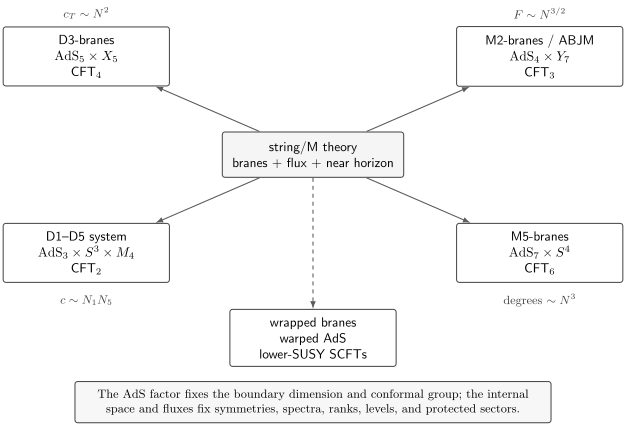
A non-exhaustive map of major top-down AdS/CFT families. The noncompact factor fixes the boundary spacetime dimension , while the internal space and flux data determine supersymmetry, global symmetries, operator spectra, and the scaling of degrees of freedom.
How to read an AdS background
Section titled “How to read an AdS background”A top-down AdS solution usually has the schematic form
where for type II string theory and for M-theory. The dual field theory lives in spacetime dimensions.
The first pass through any background should ask the following questions.
1. What is the AdS factor?
Section titled “1. What is the AdS factor?”The AdS factor determines the conformal group:
matching the global conformal group of a Lorentzian CFT.
So:
| Bulk factor | Boundary theory |
|---|---|
| CFT | |
| CFT | |
| CFT | |
| CFT |
There is no known ordinary AdS/CFT example with a simple weakly coupled Lagrangian as canonical as SYM, but string theory does contain important AdS solutions dual to five-dimensional SCFTs. The lesson is that the boundary CFT need not have a conventional Lagrangian description.
2. What is the internal space?
Section titled “2. What is the internal space?”The compact factor is not decoration. Its isometries become global symmetries of the CFT. Its Kaluza–Klein modes become towers of CFT operators. Its cycles support wrapped branes, baryon-like operators, defects, and fluxes.
For example,
in SYM. Replacing by a different compact Einstein or Sasaki–Einstein space changes the internal symmetry and the dual field theory.
3. What flux supports the geometry?
Section titled “3. What flux supports the geometry?”AdS backgrounds are usually supported by form-field flux. Flux quantization supplies the integer data that become ranks, levels, or charges in the CFT.
For D3-branes,
and becomes the rank of the gauge group. For M2- and M5-brane backgrounds, flux through or determines the number of branes and the scaling of degrees of freedom.
4. What is the separation of scales?
Section titled “4. What is the separation of scales?”A background may be a perfectly valid string or M-theory solution but not have a simple Einstein gravity regime. To use low-energy supergravity, one needs the curvature radius to be large in microscopic units and the effective Newton constant to be small.
The universal question is:
The first condition suppresses quantum loops. The second suppresses stringy or Kaluza–Klein/string-scale corrections to the desired lower-dimensional EFT.
A compact table of examples
Section titled “A compact table of examples”| Branes / construction | Bulk background | Boundary theory | Characteristic scaling |
|---|---|---|---|
| D3-branes | type IIB on | SYM | |
| D3-branes at conifold | type IIB on | quiver SCFT | |
| M2-branes | M-theory on | CFT on M2-branes | |
| ABJM | M-theory on or IIA on | Chern–Simons matter | in the M-theory regime |
| M5-branes | M-theory on | 6d theory | degrees of freedom |
| D1-D5 system | type IIB on | 2d CFT | |
| wrapped branes | warped | lower-dimensional SCFTs | depends on flux and topology |
This table is only a guide. The correct dictionary of any particular background depends on supersymmetry, fluxes, cycles, brane charges, and boundary conditions.
AdS/CFT: M2-branes and ABJM
Section titled “AdS4_44/CFT3_33: M2-branes and ABJM”The near-horizon geometry of many coincident M2-branes is
The dual theory is a three-dimensional superconformal field theory living on the M2-brane worldvolume. Unlike D3-branes, M2-branes do not lead to an ordinary Yang–Mills theory in the UV with a dimensionless coupling. The interacting fixed point is intrinsically three-dimensional and strongly coupled.
A major breakthrough was ABJM theory: a three-dimensional Chern–Simons matter theory with gauge group
where is the Chern–Simons level. Its holographic dual depends on the regime:
for fixed and large , while a type IIA description on
emerges in an appropriate ‘t Hooft limit with
large but with also large enough to reduce the M-theory circle.
The most striking scaling is the number of degrees of freedom. Instead of , M2-brane theories exhibit
at large , matching the gravitational scaling of the AdS background.
AdS/CFT: M5-branes and the theory
Section titled “AdS7_77/CFT6_66: M5-branes and the (2,0)(2,0)(2,0) theory”The near-horizon geometry of coincident M5-branes is
The dual is the six-dimensional superconformal field theory. This theory is one of the most mysterious and important examples in quantum field theory. It has no known standard Lagrangian description in six dimensions, yet it is a well-defined object in string/M-theory and is central to many constructions in lower-dimensional supersymmetric field theory.
The characteristic large- scaling is
This scaling is not what one would expect from a simple matrix gauge theory. Holography makes the scaling visible through the seven-dimensional Newton constant:
The AdS/CFT example teaches a crucial lesson: holographic CFTs need not have elementary field variables that resemble a conventional gauge theory.
AdS/CFT beyond : conifolds and Sasaki–Einstein spaces
Section titled “AdS5_55/CFT4_44 beyond S5S^5S5: conifolds and Sasaki–Einstein spaces”The simplest AdS/CFT example uses , but type IIB string theory has many AdS solutions of the form
where is a suitable compact five-dimensional space. Supersymmetric examples often involve Sasaki–Einstein manifolds.
The classic example is the conifold:
The dual is the Klebanov–Witten superconformal quiver gauge theory with gauge group
bifundamental matter fields, and a superpotential constrained by global symmetry. The internal isometry
matches global symmetries of the boundary SCFT.
This example is important because it shows how reducing supersymmetry and changing the internal space produce less symmetric but still controlled AdS/CFT duals.
Orbifolds and quiver gauge theories
Section titled “Orbifolds and quiver gauge theories”Orbifolding is another way to generate new AdS backgrounds. Starting with
one can quotient the internal sphere by a discrete group :
On the field-theory side, this often produces quiver gauge theories. Nodes correspond to gauge-group factors, arrows correspond to matter fields, and the amount of preserved supersymmetry depends on how acts on the internal space.
The lesson is structural:
Quiver diagrams are often the field-theory shadow of branes probing singular geometry.
AdS/CFT from D1-D5
Section titled “AdS3_33/CFT2_22 from D1-D5”The AdS/CFT unit emphasized pure three-dimensional gravity and Brown–Henneaux symmetry. String theory also gives top-down AdS examples. The most famous is the D1-D5 system, whose near-horizon geometry is roughly
The dual is a two-dimensional CFT associated with the D1-D5 brane system. Its central charge scales as
up to conventions and precise charge definitions. This family is especially important for black-hole microstate counting, stringy AdS physics, symmetric-product CFTs, and the study of tensionless-string regimes.
The D1-D5 system is a reminder that not every AdS/CFT example is pure Einstein gravity. A full top-down model includes an internal space, fluxes, Kaluza–Klein modes, branes, and stringy sectors.
Wrapped branes and lower supersymmetry
Section titled “Wrapped branes and lower supersymmetry”Many AdS backgrounds arise by wrapping branes on curved internal cycles. The field theory then appears as the infrared fixed point of a higher-dimensional brane theory compactified with a topological twist.
Schematically,
in the infrared. The bulk dual is often a warped product rather than a direct product:
The warp factor and internal fluxes encode the compactification data. These examples are more complicated than , but they are essential for understanding the range of top-down holography.
Consistent truncations
Section titled “Consistent truncations”A common simplification is to reduce the higher-dimensional theory on the internal space and keep only a finite set of lower-dimensional fields. A truncation is called consistent if every solution of the lower-dimensional equations uplifts to a solution of the full ten- or eleven-dimensional equations.
For example, many calculations in AdS/CFT use a five-dimensional action of the form
This does not mean the internal disappeared. It means one is focusing on a consistent subsector, usually the modes invariant under some symmetry or organized by a supergravity multiplet.
A consistent truncation is powerful, but it can also hide important physics. Kaluza–Klein modes, wrapped branes, baryon vertices, and stringy excitations may be invisible in the truncated action.
Top-down versus bottom-up
Section titled “Top-down versus bottom-up”A top-down AdS background comes from a known solution of string or M-theory. It carries a microscopic dictionary: flux integers, branes, compact cycles, global symmetries, supersymmetry, and operator spectra.
A bottom-up model begins with a lower-dimensional gravitational action chosen to model desired field-theory features. It may not be known whether the model embeds into string theory.
Both approaches are useful:
| Approach | Strength | Main risk |
|---|---|---|
| top-down | UV complete, constrained, microscopic dictionary | often technically complicated |
| bottom-up | flexible, efficient, phenomenologically targeted | may violate hidden quantum-gravity consistency conditions |
A mature holographic argument usually knows which kind of model it is using.
A warning about internal spaces and gaps
Section titled “A warning about internal spaces and gaps”Suppose the bulk is
The Kaluza–Klein masses on are often of order
where is the size of the internal space. In many maximally supersymmetric examples, , so the Kaluza–Klein scale is not much heavier than the AdS scale.
This means pure -dimensional Einstein gravity is often not the full low-energy theory. It may be a consistent truncation, but the full tower of protected KK modes can have dimensions of order one.
The large gap needed for locality below the AdS scale usually refers to stringy and higher-spin states, not necessarily all KK modes. One must distinguish:
Conflating these scales is a common source of bad holographic reasoning.
How backgrounds encode observables
Section titled “How backgrounds encode observables”Given an AdS background, many CFT observables can be read from geometric data.
Central charge or stress-tensor normalization
Section titled “Central charge or stress-tensor normalization”The effective Newton constant determines the stress-tensor normalization:
The lower-dimensional Newton constant comes from reducing over the internal space:
up to warp factors and convention-dependent constants.
Global symmetries
Section titled “Global symmetries”Isometries of give global symmetries of the CFT. Gauge fields in AdS arise from metric components with one leg along AdS and one leg along an internal Killing direction.
Operator dimensions
Section titled “Operator dimensions”Kaluza–Klein modes on produce bulk masses. These masses determine operator dimensions through relations such as
for scalar operators.
Extended operators
Section titled “Extended operators”Wrapped branes on cycles in produce extended or heavy operators: baryon vertices, Wilson surfaces, domain walls, defects, and line operators. The topology of matters directly for the operator spectrum.
Dictionary checkpoint
Section titled “Dictionary checkpoint”The basic translation for other AdS backgrounds is:
| Bulk datum | Boundary meaning |
|---|---|
| conformal symmetry of CFT | |
| internal isometry of | global or R-symmetry |
| flux integer | rank, charge, or level data |
| stress-tensor normalization / degrees of freedom | |
| KK modes on | towers of single-trace operators |
| cycles in | wrapped-brane operators and defects |
| singularities/orbifolds | quiver structure and reduced supersymmetry |
| warping | nontrivial compactification and RG data |
The slogan is: the AdS factor tells you the CFT dimension, but the internal space tells you which CFT.
Common confusions
Section titled “Common confusions”“AdS means the bulk is five-dimensional.”
Section titled ““AdS5_55 means the bulk is five-dimensional.””Not in string theory. The noncompact part may be five-dimensional, but the full background is usually ten-dimensional, such as . The five-dimensional description is often a truncation.
“Changing the internal space is a small detail.”
Section titled ““Changing the internal space is a small detail.””It is a huge detail. It changes supersymmetry, global symmetries, KK spectra, wrapped-brane sectors, and the microscopic CFT.
“A lower-dimensional CFT must be simpler.”
Section titled ““A lower-dimensional CFT must be simpler.””No. CFT and CFT examples can be more mysterious than SYM. The 6d theory is a prime example: it is central to modern quantum field theory but has no ordinary six-dimensional Lagrangian.
“Top-down backgrounds are only examples; bottom-up models are the real physics.”
Section titled ““Top-down backgrounds are only examples; bottom-up models are the real physics.””That is too glib. Top-down examples teach consistency conditions that bottom-up models can easily miss. Bottom-up models are powerful precisely when used with awareness of those constraints.
“All internal modes should be ignored in a low-energy AdS calculation.”
Section titled ““All internal modes should be ignored in a low-energy AdS calculation.””Not always. If the internal radius is comparable to the AdS radius, KK modes can have dimensions of order one. A lower-dimensional truncation may still be consistent, but it does not represent the entire operator spectrum.
Exercises
Section titled “Exercises”Exercise 1: Boundary dimension
Section titled “Exercise 1: Boundary dimension”What is the boundary dimension of a CFT dual to ?
Solution
The CFT dimension is one less than the AdS dimension. Thus is dual to a six-dimensional CFT. In the canonical M-theory example, this is the 6d theory on M5-branes.
Exercise 2: Internal symmetries
Section titled “Exercise 2: Internal symmetries”Why does the in lead to an global symmetry in the boundary theory?
Solution
The isometry group of is . In Kaluza–Klein reduction, isometries of the internal space give gauge fields in AdS. Bulk gauge fields are dual to conserved currents in the boundary CFT, so the internal isometry becomes an global symmetry. In SYM this is the R-symmetry group, often written as .
Exercise 3: Central-charge scaling
Section titled “Exercise 3: Central-charge scaling”Suppose a top-down AdS background gives
What should be the large- scaling of thermal entropy density at temperature in the planar black-brane regime?
Solution
For a CFT with a classical Einstein black-brane dual,
Therefore
The same power controls the stress-tensor normalization and the leading classical gravitational action.
Exercise 4: KK modes and operator dimensions
Section titled “Exercise 4: KK modes and operator dimensions”A scalar KK mode on an internal space has effective AdS mass . What determines the dimension of the dual scalar operator?
Solution
For a scalar in , the dimension obeys
Thus solving the KK spectrum on the internal space gives effective AdS masses, and these masses determine the scaling dimensions of the corresponding single-trace operators.
Further reading
Section titled “Further reading”- J. Maldacena, The Large Limit of Superconformal Field Theories and Supergravity.
- O. Aharony, S. S. Gubser, J. Maldacena, H. Ooguri, and Y. Oz, Large Field Theories, String Theory and Gravity.
- O. Aharony, O. Bergman, D. L. Jafferis, and J. Maldacena, Superconformal Chern–Simons-Matter Theories, M2-Branes and Their Gravity Duals.
- I. R. Klebanov and E. Witten, Superconformal Field Theory on Threebranes at a Calabi–Yau Singularity.
- N. Seiberg and E. Witten, The D1/D5 System and Singular CFT.
- D. Gaiotto and J. Maldacena, The Gravity Duals of Superconformal Field Theories.