
Stringy and Quantum Corrections
The classical gravity limit is the most calculable corner of AdS/CFT, but it is not the full duality. The exact boundary CFT contains every correction: finite coupling, finite , stringy towers, Kaluza–Klein modes, quantum loops, instantons, and nonperturbative spectral effects. Classical Einstein gravity is the result of taking a very special limit in which most of this structure is invisible.
This page organizes those corrections. The purpose is practical: when you read a holographic calculation, you should be able to identify which approximation is being made, which CFT data are being discarded, and what sort of correction would restore them.
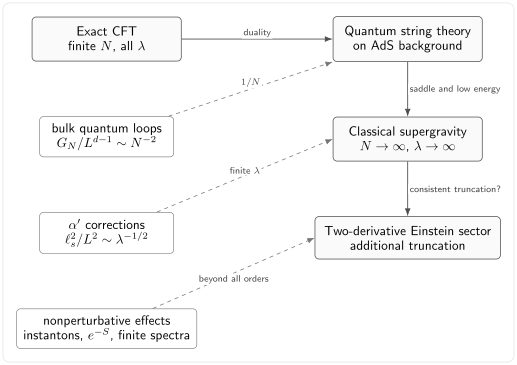
Correction hierarchy in AdS/CFT. The exact CFT is dual to quantum string theory, not merely to two-derivative Einstein gravity. The classical supergravity limit suppresses both bulk loops and stringy higher-derivative effects.
The hierarchy of descriptions
Section titled “The hierarchy of descriptions”For the canonical example,
the exact duality relates the full CFT to the full quantum string theory. The commonly used classical-gravity limit is obtained only after several approximations:
Each arrow discards something. Classical string theory discards string loops. Supergravity discards massive string excitations. A five-dimensional Einstein truncation discards many Kaluza–Klein and matter fields. A bottom-up model may discard even more.
The most important parameters are
Thus
The first ratio controls string-scale curvature corrections. The second controls quantum gravity loops in AdS units.
Three expansions, not one
Section titled “Three expansions, not one”There is no single “holographic correction.” There are several different expansions.
The expansion
Section titled “The 1/N1/N1/N expansion”Large suppresses connected correlators and bulk loops. In the bulk effective theory, loop corrections are controlled by powers of Newton’s constant in AdS units:
For with gauge group, , so bulk loop effects are typically of order for closed-string observables.
CFT meaning: the large- factorization approximation is no longer exact. Multi-trace mixing, anomalous dimensions, loop corrections to Witten diagrams, and finite-dimensional trace identities begin to matter.
The expansion
Section titled “The 1/λ1/\lambda1/λ expansion”Large makes the AdS radius large compared with the string length:
Finite restores stringy corrections. In the CFT, this means that the dimensions of stringy single-trace operators are not infinitely heavy. The rough scale is
When is large, this tower is heavy and can be integrated out. When is not large, the tower is not decoupled, and a low-derivative bulk gravity action is not enough.
Nonperturbative corrections
Section titled “Nonperturbative corrections”Even the combined expansions in and miss effects that are invisible order by order. Examples include D-instanton effects, brane nucleation effects, finite-spectrum discreteness, and effects of order in black-hole physics.
These effects are often negligible for local correlators at finite time, but they can be decisive for fine-grained questions such as black-hole information.
The effective action viewpoint
Section titled “The effective action viewpoint”A low-energy bulk action is an expansion in local operators:
Here schematically denotes curvature invariants and terms involving matter fields and derivatives. The coefficients encode heavy physics that has been integrated out.
In string theory, the expansion is more structured. In type IIB on , maximal supersymmetry forbids many low-order corrections, and the leading famous correction to the ten-dimensional effective action is an -type interaction. Since
many leading finite-coupling corrections in strongly coupled SYM appear at order .
The phrase “ correction” is schematic. The actual supersymmetric completion contains a particular contraction of Weyl tensors and additional terms required by type IIB supersymmetry. In many high-level computations, using only the schematic term is not enough.
Example: thermal free energy of SYM
Section titled “Example: thermal free energy of N=4\mathcal N=4N=4 SYM”At infinite coupling and large , the entropy density of strongly coupled SYM is
The free-field result is larger by a factor of , so
The leading stringy correction shifts this ratio upward as the coupling is decreased. In a conventional normalization,
The precise coefficient depends on the observable and normalization, but the lesson is robust: finite- physics is encoded by higher-derivative string corrections to the black-brane geometry and action.
This is an unusually clean example because the leading correction is known from the type IIB effective action. In less supersymmetric or bottom-up settings, the higher-derivative coefficients are usually not known from first principles.
Example: shear viscosity corrections
Section titled “Example: shear viscosity corrections”For two-derivative Einstein gravity duals,
Finite-coupling corrections modify the bulk graviton dynamics. For strongly coupled SYM, the leading type IIB correction gives a positive correction of order :
In more general higher-derivative theories, can move away from in either direction unless the coefficients are constrained by causality, positivity, or a consistent UV completion. This is why arbitrary higher-derivative gravity models should be treated carefully.
Bulk loops and one-loop determinants
Section titled “Bulk loops and one-loop determinants”Bulk quantum loops are the gravitational counterpart of corrections. A tree-level Witten diagram computes the leading connected CFT correlator at large . A one-loop Witten diagram computes a subleading term.
Schematically, for normalized single-trace operators,
In the bulk, the one-loop term includes sums over fields propagating in AdS. In the boundary CFT, the same term contains subleading corrections to OPE coefficients and anomalous dimensions of multi-trace operators.
For entanglement entropy, the leading RT term is the classical area. The first quantum correction is the bulk entanglement entropy across the RT surface:
This is a paradigmatic example of a correction that is conceptually essential.
Kaluza–Klein towers and internal spaces
Section titled “Kaluza–Klein towers and internal spaces”A common beginner mistake is to say: “The bulk is five-dimensional gravity.” In the canonical example, the bulk is ten-dimensional type IIB string theory on
Compactifying on gives infinitely many Kaluza–Klein fields in . Their masses are of order , not the string scale. Therefore they are not decoupled by taking .
Some sectors admit consistent truncations: if the truncated fields are set to zero, the remaining lower-dimensional equations imply the full higher-dimensional equations. But a consistent truncation is not the same as a low-energy decoupling of all omitted fields. It is a special dynamical closure property.
CFT meaning: Kaluza–Klein modes are dual to towers of protected or light single-trace operators, often organized by internal-space symmetries such as for .
Protected versus unprotected quantities
Section titled “Protected versus unprotected quantities”Supersymmetry can protect some observables. For example, certain BPS operator dimensions and protected correlation functions are fixed or constrained across coupling. Other quantities, such as generic anomalous dimensions, transport coefficients, and thermal free energies, receive corrections.
The rough distinction is:
while
This is why AdS/CFT can make exact statements about some quantities but only asymptotic strong-coupling statements about others.
Higher-derivative gravity and consistency
Section titled “Higher-derivative gravity and consistency”Suppose one writes a five-dimensional action
This is a legitimate effective-field-theory deformation only when is small and the omitted terms are controlled. If one treats the higher-derivative theory as exact, extra ghostlike degrees of freedom or causality problems may appear.
In a UV-complete string construction, higher-derivative terms come with an infinite tower of massive states and correlated coefficients. Those correlations are what prevent many pathologies. This is one reason that bottom-up higher-derivative models should be used as controlled EFTs, not arbitrary fundamental theories.
Boundary consistency imposes constraints. Causality, positivity of energy flux, Regge behavior, and crossing symmetry all restrict possible bulk interactions. A local-looking bulk action with arbitrary coefficients need not correspond to a consistent CFT.
Corrections to black-hole physics
Section titled “Corrections to black-hole physics”Classical black holes capture the thermodynamic leading term
Stringy and quantum corrections modify this in several ways:
- Higher-derivative terms modify the entropy functional. The correct entropy is then Wald entropy, or a generalized entropy functional including additional corrections, not simply area divided by .
- Quantum fields contribute bulk entanglement entropy.
- One-loop determinants correct the black-hole partition function.
- Nonperturbative effects affect late-time correlators and fine-grained information.
Thus the corrected entropy has the schematic form
The leading area term is large, of order . The corrections may be smaller in powers of , but they encode important physics.
Corrections to the mass-dimension relation
Section titled “Corrections to the mass-dimension relation”At the supergravity level, a bulk field mass determines the boundary scaling dimension through
This relation remains true for a field in AdS with a given effective mass, but stringy and quantum corrections can shift the mass, mix fields, or invalidate the truncation to a single field.
For example, an unprotected single-trace operator can have
On the bulk side, this corresponds to corrections to the spectrum of string states and quantum corrections to bulk masses.
Corrections to Witten diagrams
Section titled “Corrections to Witten diagrams”Tree-level Witten diagrams are the leading large- approximation. Corrections come in layers:
Here:
- comes from two-derivative supergravity interactions;
- comes from higher-derivative stringy terms;
- comes from bulk loops;
- comes from instantons, branes, or finite-spectrum effects.
In Mellin-space language, stringy corrections often show up as higher-degree polynomial contact terms or Regge behavior softened by the full string amplitude. In position space, they correct anomalous dimensions and OPE coefficients of double-trace and higher multi-trace operators.
Practical recipe for using corrections
Section titled “Practical recipe for using corrections”When doing a corrected holographic computation, follow this checklist.
1. Identify the expansion parameter
Section titled “1. Identify the expansion parameter”Ask whether the correction is controlled by , , a small flavor ratio , a small higher-derivative coupling, or a small deformation of the state.
2. Decide whether the correction is top-down or bottom-up
Section titled “2. Decide whether the correction is top-down or bottom-up”A top-down correction has coefficients fixed by string/M-theory. A bottom-up correction is a phenomenological parameter. Both can be useful, but they carry different evidentiary weight.
3. Include all terms required at the same order
Section titled “3. Include all terms required at the same order”It is often inconsistent to keep one higher-derivative term while dropping others of the same order, unless symmetries or a consistent truncation justify it.
4. Correct the variational problem
Section titled “4. Correct the variational problem”Higher derivatives and quantum terms can change boundary terms, counterterms, canonical momenta, and entropy functionals. Do not simply plug a corrected metric into an uncorrected formula.
5. Translate back to CFT data
Section titled “5. Translate back to CFT data”The final answer should say what changed in the CFT: a scaling dimension, OPE coefficient, transport coefficient, thermal free energy, central charge, spectral density, or entropy.
Dictionary checkpoint
Section titled “Dictionary checkpoint”| Correction | Bulk description | Boundary meaning |
|---|---|---|
| finite | corrections, massive string modes | stringy single-trace operators become less heavy |
| finite | bulk loops, quantum gravity | connected correlators and mixing beyond factorization |
| Kaluza–Klein modes | fields from compact internal space | towers of operators charged under internal symmetries |
| higher-derivative terms | local EFT corrections | anomalous dimensions/OPE data of heavy-integrated sectors |
| instantons/branes | nonperturbative string effects | effects invisible in perturbative or expansions |
| one-loop entanglement | bulk entropy across RT/QES surfaces | subleading corrections to boundary entropy |
| finite spectral discreteness | late-time nonperturbative effects | exact CFT unitarity and recurrences |
The main principle is simple: every correction on the bulk side is a statement about CFT data. If one cannot say what CFT data are being changed, the bulk correction has not been fully interpreted.
Common confusions
Section titled “Common confusions”“Finite and finite are the same kind of correction.”
Section titled ““Finite NNN and finite λ\lambdaλ are the same kind of correction.””They are different. Finite controls quantum bulk loops. Finite controls string-scale corrections and the mass of stringy states. A theory can have large but moderate , or large but not parametrically large .
“If is small, gravity is classical.”
Section titled ““If gsg_sgs is small, gravity is classical.””Small suppresses string loops, but classical Einstein gravity also requires small curvature in string units, . That means large in the canonical example.
“A five-dimensional Einstein action is the full dual of SYM.”
Section titled ““A five-dimensional Einstein action is the full dual of N=4\mathcal N=4N=4 SYM.””No. It is a truncation of type IIB string theory on , valid for certain observables in a certain limit. The full dual contains the internal space, Kaluza–Klein towers, massive strings, branes, and quantum effects.
“Higher-derivative terms can be chosen arbitrarily.”
Section titled ““Higher-derivative terms can be chosen arbitrarily.””Not if the model is meant to have a consistent CFT dual. Causality, positivity, crossing symmetry, and UV completion constrain the coefficients.
“Protected quantities prove that all strong-coupling results are exact.”
Section titled ““Protected quantities prove that all strong-coupling results are exact.””Protection is special. Many quantities used in holographic thermal physics and transport are unprotected and do receive finite-coupling or finite- corrections.
Exercises
Section titled “Exercises”Exercise 1: Identify the correction
Section titled “Exercise 1: Identify the correction”In AdS/CFT, suppose an observable receives a correction proportional to at leading large . Is this a finite- correction or a finite-coupling correction?
Solution
It is a finite-coupling correction. In the canonical type IIB example, the leading famous higher-derivative correction is of order
Since the correction is taken at leading large , it is not a bulk loop correction. It is a stringy correction.
Exercise 2: Why does a large gap help bulk locality?
Section titled “Exercise 2: Why does a large gap help bulk locality?”Explain why sending to infinity helps produce a local bulk effective field theory.
Solution
A local low-energy EFT is valid when heavy states can be integrated out. In AdS/CFT, massive string states correspond to single-trace operators with large scaling dimensions. If
then these operators are heavy compared with the AdS scale. Their effects on low-energy correlators can be expanded in local higher-derivative interactions suppressed by powers of the gap. If the gap is not large, infinitely many stringy states participate, and a local two-derivative bulk action is not a good approximation.
Exercise 3: Order of a one-loop Witten diagram
Section titled “Exercise 3: Order of a one-loop Witten diagram”For normalized single-trace operators in a large- CFT, suppose a connected four-point function has the expansion
Which term is tree level and which term is one loop in the bulk?
Solution
The leading connected term is computed by tree-level Witten diagrams. The next term is computed by one-loop Witten diagrams and related subleading effects. This follows from the identification of with the bulk interaction/loop expansion.
Exercise 4: Why area is not always enough
Section titled “Exercise 4: Why area is not always enough”Why is the Bekenstein–Hawking formula not the complete entropy formula once higher-derivative and quantum corrections are included?
Solution
The formula is the entropy of a stationary horizon in two-derivative Einstein gravity. Higher-derivative interactions change the gravitational entropy functional, often to a Wald-like entropy plus additional terms. Quantum bulk fields also contribute entanglement entropy. Therefore the corrected entropy is schematically
The area term remains the leading contribution in many large- limits, but it is not the full answer.
Further reading
Section titled “Further reading”- O. Aharony, S. S. Gubser, J. Maldacena, H. Ooguri, and Y. Oz, Large Field Theories, String Theory and Gravity.
- S. S. Gubser, I. R. Klebanov, and A. A. Tseytlin, Coupling Constant Dependence in the Thermodynamics of Supersymmetric Yang–Mills Theory.
- T. Faulkner, A. Lewkowycz, and J. Maldacena, Quantum Corrections to Holographic Entanglement Entropy.
- I. Heemskerk, J. Penedones, J. Polchinski, and J. Sully, Holography from Conformal Field Theory.
- A. Buchel, J. T. Liu, and A. O. Starinets, Coupling Constant Dependence of the Shear Viscosity in Supersymmetric Yang–Mills Theory.
- M. B. Green, M. Gutperle, and P. Vanhove, One Loop in Eleven Dimensions.