
Spatially Modulated Phases and Competing Orders
The previous page described the simplest ordered phase: a charged scalar condenses at zero momentum, producing a homogeneous holographic superfluid. Real strongly correlated matter is rarely that polite. Charge density waves, spin density waves, pair density waves, stripes, nematicity, loop-current order, smectics, crystals, and superconductivity often appear close together and compete for the same low-energy degrees of freedom.
Holography has a crisp way to organize this zoo. A homogeneous charged black brane can become unstable not only to scalar hair, but also to a finite-momentum normalizable mode:
The important word is spontaneous. We are not imposing a lattice or a striped chemical potential from the boundary. The sources remain homogeneous. The vevs choose a wavevector, a phase, and a pattern.
Typical boundary profiles look like
possibly accompanied by modulated currents such as
The phase is not a decorative constant. It is the Goldstone coordinate of the broken translation symmetry. Shifting slides the entire pattern.
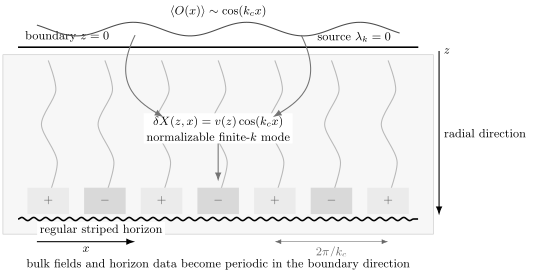
A finite-momentum instability of a homogeneous charged brane. The boundary sources remain homogeneous, but the normalizable data develop spatial dependence. The preferred wavevector is found from the linearized instability near and, below , from the nonlinear free energy .
Throughout this page denotes the number of boundary spatial dimensions, so the boundary spacetime dimension is . The radial coordinate is , with the boundary at . A wavevector along is denoted by or .
What it means to break translations
Section titled “What it means to break translations”Consider a scalar operator and its Fourier components . Under a translation ,
Therefore a nonzero expectation value
chooses a phase. In position space,
A continuous translation by arbitrary no longer leaves the state invariant. Only translations by integer multiples of the period survive:
This is the continuum version of a density wave. On a microscopic lattice, the story is slightly richer because only discrete translations were present to begin with. Then one must distinguish commensurate and incommensurate order. Most bottom-up holographic models begin in a continuum, so the finite- state spontaneously breaks a continuous translation symmetry.
Different patterns break different symmetries:
| Pattern | Boundary profile | Symmetry breaking |
|---|---|---|
| Stripe or smectic | one translation, usually rotations | |
| Crystal | periodic in two or more directions | translations to a lattice subgroup |
| Helix | translation and rotation separately, but not a combined operation | |
| Nematic | no density wave, anisotropic tensor vev | rotations, but not translations |
| Pair-density wave | and translations |
The distinction between explicit and spontaneous translation breaking is the first thing to check in any holographic model. For a bulk field dual to an operator of dimension ,
The modulation is explicit if the source contains the wavevector. It is spontaneous if the source is homogeneous or zero while the normalizable coefficient is modulated:
That source-vev distinction is not bookkeeping. It determines the hydrodynamics. A spontaneously broken density wave has a sliding Goldstone mode; an explicitly imposed lattice generally does not.
The finite-momentum instability
Section titled “The finite-momentum instability”The normal state is usually a charged black brane. At low temperature its deep interior is often controlled by an region, or by a related semi-local scaling geometry. Linear perturbations about this background can be decomposed by boundary momentum:
For a single uncoupled fluctuation, the near-horizon equation often reduces to an scalar problem with an effective mass . More generally several fields mix, and the IR problem is a matrix eigenvalue problem:
Let be the eigenvalues of . The corresponding IR scaling exponents are
The Breitenlohner—Freedman stability condition is
A finite-momentum instability occurs when the most dangerous eigenvalue violates the bound first at nonzero momentum:
Equivalently, becomes imaginary. The normal state is then unstable to a condensate with wavevector . At finite temperature the sharp criterion is replaced by a static normalizable zero mode of the full black-brane fluctuation problem:
The highest temperature at which such a mode exists is . Near the order parameter is small, so the linear problem determines the onset. Below one must solve the nonlinear equations and minimize the free energy over possible wavevectors.
This mechanism is the strong-coupling cousin of familiar finite-wavevector instabilities in metals. In a weakly coupled Fermi liquid, density waves are often tied to nesting, hot spots, or soft particle-hole excitations. In holography, the immediate cause is instead the finite- spectrum of a charged horizon. The analogy is useful; the microscopic interpretation is different.
Why throats are fertile ground
Section titled “Why AdS2AdS_2AdS2 throats are fertile ground”Semi-local criticality has a peculiar property: the low-energy scaling is in time, while momentum remains a label. Operators can have -dependent IR dimensions,
rather than dimensions that depend only on representation data at . This makes it possible for a mode at nonzero to become unstable while the homogeneous mode remains stable.
That is why charged horizons are so good at producing modulated order. The IR geometry has a dense set of low-energy channels indexed by momentum. Couplings among scalars, gauge fields, metric perturbations, and topological terms can bend the function so that its minimum occurs at .
A schematic example is
If , then a band of momenta around is unstable. The nonlinear solution chooses a specific periodic pattern from this band.
Topological terms and current stripes
Section titled “Topological terms and current stripes”One common way to generate finite- instabilities is to include parity-odd couplings. In four bulk dimensions, a neutral pseudoscalar can couple to the gauge field through
The Reissner—Nordström AdS solution with can be stable at but unstable at finite . The reason is that the term mixes scalar and gauge perturbations in a way that is odd in momentum. A typical fluctuation sector contains fields of the form
The boundary interpretation is a striped state with a density modulation and a transverse current modulation:
Such states often break parity and time reversal , because they contain spontaneous current patterns. They are therefore closer to loop-current or flux-like orders than to a simple charge-density wave.
In five bulk dimensions another canonical mechanism uses a Chern—Simons term,
The Chern—Simons coupling can drive a helical instability. The resulting state has a spatially rotating current rather than a simple sinusoidal density wave.
Helical order: spatial dependence without PDEs
Section titled “Helical order: spatial dependence without PDEs”A helical phase in three boundary spatial dimensions can be described using Bianchi VII one-forms,
A helical current profile is
This profile breaks translations in and rotations in the - plane separately, but preserves a combined operation: translate in and rotate in the transverse plane. That residual symmetry is a technical gift. A bulk ansatz such as
and
is spatially modulated from the boundary viewpoint but depends only on the radial coordinate . The equations are ordinary differential equations rather than partial differential equations.
That makes helical phases excellent laboratories. They are not generic crystals, but they let us study finite-momentum order, anisotropic transport, and symmetry breaking in a controlled computational setting.
Stripes and fully inhomogeneous black branes
Section titled “Stripes and fully inhomogeneous black branes”A unidirectional stripe is less symmetric than a helix. The bulk fields genuinely depend on both the radial coordinate and one boundary coordinate:
A typical ansatz contains
as well as metric components such as
The boundary conditions are the whole story:
but
are allowed to become periodic functions. The equations are nonlinear elliptic PDEs, usually solved with spectral methods and a DeTurck gauge-fixing procedure.
At the onset of the transition, the critical wavevector is found by the linear zero-mode problem. Away from , the preferred wavevector can drift. The physical value is obtained by minimizing the grand potential:
The preferred branch satisfies
This step is essential. A linear instability tells us that the homogeneous phase is not the endpoint; it does not by itself tell us which nonlinear pattern wins.
Crystals and triangular lattices
Section titled “Crystals and triangular lattices”A crystal requires modulation in at least two independent spatial directions:
For a triangular lattice in two spatial dimensions, one may take three wavevectors separated by with
The corresponding bulk problem depends on and is much harder than stripes. The reward is conceptual: a holographic crystal is the closest gravitational analogue of an ordinary solid. It has phonons, elastic moduli, and a spatially periodic stress tensor.
There is no universal rule that the most symmetric lattice wins. In many bottom-up models simple stripes are competitive or preferred; with different boundary conditions or interactions, rectangular or triangular patterns can appear. The free energy comparison is model-dependent. This is one of the places where holography is still more a toolkit than a classification theorem.
Pair-density waves and modulated superconductivity
Section titled “Pair-density waves and modulated superconductivity”A pair-density wave is a superconducting or superfluid order parameter at nonzero momentum:
If , then
This breaks both the boundary symmetry and translations. It can coexist with a uniform condensate,
or exist without one. In ordinary condensed matter, pair-density waves naturally induce charge order at twice the wavevector:
In holography, modulated superconductivity can arise when a charged scalar is itself driven unstable at finite momentum, or when a homogeneous superconducting condensate coexists with a finite- neutral or current order. The details depend on the bulk couplings. The qualitative lesson is robust: once the IR geometry contains multiple nearly unstable channels, homogeneous superfluidity is only one possible way to reorganize charge outside the horizon.
Competing orders as coupled bulk hair
Section titled “Competing orders as coupled bulk hair”The phrase competing orders means that more than one order parameter wants to condense, and the condensates affect each other’s stability. Holographically, this is literal: several bulk fields can want to grow hair on the same charged black brane.
Let denote a homogeneous charged scalar and a finite-momentum density-wave order. A simple Landau free energy is
The signs of and determine which instabilities are present. The mixed quartic coupling determines whether the orders help or suppress one another:
This effective description is only the boundary shadow. In the bulk, the mechanisms are more concrete:
- Both condensates may draw charge away from the horizon.
- One condensate may remove the throat that made the other instability possible.
- A modulated order can anisotropically gap spectral weight and change the transport channel seen by the superfluid.
- A superfluid condensate can screen electric flux and thereby shift the finite- BF bound.
Thus the nonlinear geometry decides the phase diagram. Near a multicritical point, several branches must be compared:
A very common mistake is to identify the first instability on cooling with the final low-temperature ground state. That need not be correct. The first instability tells us which phase appears continuously from the normal state. A lower-temperature first-order transition to another ordered phase can still occur.
Goldstone modes: phonons and phasons
Section titled “Goldstone modes: phonons and phasons”For a unidirectional density wave,
all values of describe the same free energy. The coordinate is the phase of the density wave. A slowly varying phase field
is the phason. In a true crystal it is the longitudinal phonon. For a stripe or smectic there are also subtleties associated with rotations and transverse fluctuations, but the central idea is the same: broken translations produce gapless sliding modes.
This has a sharp transport consequence. Spontaneously breaking translations does not automatically make the DC conductivity finite. In a perfectly clean system the density wave can slide. A uniform electric field can accelerate the sliding mode, producing an infinite conductivity.
One quick field-theory way to see this is to let the density wave slide with velocity :
The current
satisfies the continuity equation
The spatial average is
If there is no pinning or damping mechanism for , the sliding mode carries current forever. In frequency space, this appears as a pole
and therefore a delta function in .
This statement often surprises people because the state visibly lacks continuous spatial homogeneity. But it is not explicit disorder. The conserved momentum of the full system has not disappeared; it has been reorganized into collective motion of the pattern.
Pinning, phase relaxation, and finite conductivity
Section titled “Pinning, phase relaxation, and finite conductivity”Real density waves are rarely perfectly free to slide. A small explicit lattice, disorder, commensurability, or impurities can pin the phase. Then the phason acquires a small frequency :
If dislocations or other defects relax the phase, one introduces a phase relaxation rate . A useful schematic form of the pinned density-wave conductivity is
Here is momentum relaxation, is the incoherent conductivity, and is a spectral weight. The precise coefficients depend on the hydrodynamic frame and on the model, but the pole structure is robust: pinning moves the sliding pole away from .
In holography, pinned density waves are studied by adding a small explicit lattice or disorder to a spontaneously modulated background. The quasinormal modes then reveal the pseudo-Goldstone pole. This is one of the cleanest ways to connect holographic order to measured optical conductivity.
Relation to explicit lattices
Section titled “Relation to explicit lattices”The previous page in the transport section already discussed explicit translation breaking: linear axions, Q-lattices, helical lattices, massive gravity, and disorder. Those models answer the question:
The present page asks a different question:
The distinction is visible in the near-boundary data:
The distinction is also visible in low-energy dynamics:
Holographic models often combine both. One first finds a spontaneous density wave, then adds a weak explicit lattice to pin it. That is the setting closest to many experimental charge-density-wave materials.
Numerical gravity and the endpoint problem
Section titled “Numerical gravity and the endpoint problem”Finite-momentum order is technically hard because it usually destroys the cohomogeneity-one structure of homogeneous black branes. The steps are:
- Find a static normalizable zero mode at and .
- Construct nonlinear periodic black branes below .
- Holographically renormalize the on-shell action.
- Compute .
- Minimize over and compare with competing phases.
- Compute fluctuations around the ordered geometry to obtain phonons, conductivities, and spectral functions.
For stripes the PDEs depend on . For crystals they depend on . At zero temperature the problem is harder still, because the IR endpoint may be a new inhomogeneous scaling geometry rather than a smooth finite-temperature horizon.
This is why helical phases and other homogeneous tricks are valuable. They let us learn lessons about finite- order using ODEs. But one should not confuse technical convenience with genericity.
Control and caveats
Section titled “Control and caveats”Finite-momentum holographic order is powerful, but it is easy to over-interpret. A source-free striped solution is a controlled large- saddle of a particular quantum field theory or effective bottom-up model. It is not automatically a microscopic theory of cuprate stripes, heavy-fermion order, or charge order in any named material.
The most trustworthy claims are structural:
The less universal claims are quantitative details such as the preferred lattice geometry, the value of , and the relative free energies of stripe, helix, and crystal branches. Those depend on the bulk action and on boundary conditions.
Large also suppresses fluctuations. A finite-temperature transition into a modulated order can look mean-field-like even in spatial dimensions where ordinary condensed matter would have strong thermal fluctuations. In low dimensions, true long-range order may be destroyed or replaced by quasi-long-range order once effects are included. The classical bulk calculation is best read as the saddle-point answer.
Finally, a continuum holographic density wave is not automatically commensurate with any microscopic lattice. Commensurability, lock-in transitions, and impurity pinning require extra ingredients: an explicit periodic source, disorder, or a top-down construction whose microscopic theory contains the relevant lattice-scale information. This is not a defect of the formalism; it is a reminder of what the model has and has not been asked to encode.
Common pitfalls
Section titled “Common pitfalls”Pitfall 1: “A density wave automatically gives finite DC conductivity.”
Not if the density wave is spontaneous and clean. The sliding mode gives an infinite conductivity unless it is pinned or phase-relaxed.
Pitfall 2: “The critical wavevector from the linear instability is the final wavevector.”
It is the onset wavevector near . Deeper in the ordered phase, the preferred is determined by minimizing the nonlinear free energy.
Pitfall 3: “Spatial modulation means the boundary source is modulated.”
Not for spontaneous order. The source must remain homogeneous or vanish in the modulated channel.
Pitfall 4: “Helical models are just ordinary lattices.”
A helical state can be spontaneous or explicit depending on boundary data. Its special feature is a combined translation-rotation symmetry that keeps the bulk ODE-like.
Pitfall 5: “Finite- order proves Fermi-surface physics.”
No. Finite- instabilities in holography are often enabled by semi-local critical spectral weight. They are analogous to Fermi-surface instabilities, not identical to them.
What to remember
Section titled “What to remember”The conceptual spine is short:
The dictionary is equally short:
The physics is rich because the broken symmetry has a Goldstone mode. A spontaneous density wave is not merely a mechanism for momentum relaxation. It is an ordered phase with sliding collective motion, possible pinning, elastic response, and competition with superconductivity.
Exercises
Section titled “Exercises”Exercise 1: source or vev?
Section titled “Exercise 1: source or vev?”A scalar field dual to an operator of dimension has the near-boundary expansion
Suppose
Is the -modulation explicit or spontaneous?
Solution
It is spontaneous. The source has no Fourier component at :
The modulated coefficient is the response:
Therefore the boundary Hamiltonian is translation invariant, while the state is not.
Exercise 2: finite-momentum BF window
Section titled “Exercise 2: finite-momentum BF window”Assume the lowest IR eigenvalue near its minimum is
For which momenta is the BF bound violated?
Solution
The BF bound is violated when
Using the given form,
so
Thus the unstable band is
Exercise 3: the sliding current
Section titled “Exercise 3: the sliding current”Let
and define . Show that, for constant ,
satisfies charge conservation. What is the spatially averaged current?
Solution
First,
For with constant ,
Therefore
The spatial average of the oscillatory part vanishes, so
A sliding density wave can therefore carry a uniform current.
Exercise 4: helical residual symmetry
Section titled “Exercise 4: helical residual symmetry”Consider
Show that a translation can be undone by a rotation in the - plane.
Solution
After translation,
This is obtained from the original vector by a rotation through angle :
Thus translation and transverse rotation are broken separately, but a combined operation remains a symmetry.
Exercise 5: coexistence from a two-order Landau theory
Section titled “Exercise 5: coexistence from a two-order Landau theory”Take
with and . Find the coexistence solution with and .
Solution
The stationarity equations are
and
Solving the two linear equations for and gives
A stable coexistence phase requires
and both numerators positive. If is too large and positive, coexistence is disfavored and the system tends to choose one order or the other.
Further reading
Section titled “Further reading”For the broad review treatment, see Hartnoll, Lucas, and Sachdev, Holographic Quantum Matter, especially the sections on symmetry-broken phases and spontaneous breaking of translation symmetry. For the condensed-matter-facing narrative and the relation to explicit translation breaking, helical models, massive gravity, and holographic crystallisation, see Zaanen, Liu, Sun, and Schalm, Holographic Duality in Condensed Matter Physics, Chapter 12. Foundational research examples include Nakamura—Ooguri—Park finite-momentum instabilities, Donos—Gauntlett helical and striped phases, and Withers’ fully backreacted striped black branes.