
HRT and Covariant Holographic Entropy
The Ryu–Takayanagi formula is a static statement. It computes the entropy of a boundary region by minimizing area on a preferred bulk time slice. But the black hole information problem is intrinsically Lorentzian. Black holes form, perturb, scramble, evaporate, and sometimes sit behind time-dependent horizons. A formula that only works on a time-reflection-symmetric slice is not enough.
The covariant generalization is the Hubeny–Rangamani–Takayanagi prescription, usually called the HRT formula. It replaces the static minimal surface of RT by a Lorentzian extremal surface:
where is a codimension-two bulk surface anchored on , homologous to , extremal in the full spacetime, and chosen to have least area among the allowed extremal surfaces.
In one sentence: RT says minimize area on a time slice; HRT says extremize area in spacetime, then choose the smallest extremal answer.
This page explains the precise statement, why “extremal” is the right Lorentzian replacement for “minimal,” how the maximin construction restores much of the geometric intuition of RT, and why HRT is the classical ancestor of entanglement wedges, quantum extremal surfaces, and islands.
Guiding question
Section titled “Guiding question”How can a boundary entropy at one time be computed by a surface that is not required to lie on that boundary time slice?
The answer is that a spatial region in a relativistic quantum field theory is not really the fundamental object. The density matrix is associated with the domain of dependence . If two spatial regions have the same domain of dependence, they describe the same algebra of observables and the same reduced density matrix.
Thus the entropy should be invariant under boundary Cauchy-slice deformations that preserve . A bulk prescription tied to one arbitrary boundary time slice would be suspicious. HRT avoids this: the surface is anchored on the entangling surface , but it is otherwise allowed to find its correct position in the full Lorentzian geometry.
The HRT prescription
Section titled “The HRT prescription”Let be a boundary spatial region on a boundary Cauchy slice, and let be its boundary domain of dependence. The HRT surface satisfies:
-
Anchoring:
-
Spacelikeness: is a spacelike codimension-two bulk surface.
-
Extremality: the first variation of its area vanishes for all local deformations in the two independent normal directions:
-
Homology: there exists an achronal bulk region such that
with the usual orientation and with possible horizon components treated according to the state and boundary conditions.
-
Minimal choice among extremal surfaces: if several homologous extremal surfaces exist, choose the one with smallest area:
The classical leading-order entropy is then
Here denotes the set of allowed spacelike extremal surfaces anchored on and homologous to .
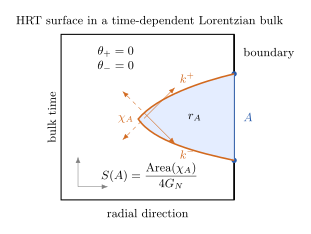
The HRT surface is anchored on but is extremized in the full Lorentzian bulk. In a time-dependent state it need not lie on the boundary time slice. In the schematic AdS drawing, the gray curve is a constant-time RT-like candidate, while the black curve is a covariant extremal surface with vanishing first variation in both independent normal directions.
In a time-reflection-symmetric geometry, the HRT surface lies on the symmetric slice and reduces to the RT minimal surface. Away from such symmetry, the distinction is essential. A surface that is minimal on one arbitrary slice may fail to be extremal in spacetime, and therefore cannot represent a Lorentzian entropy.
Extremal, not minimal
Section titled “Extremal, not minimal”The word “extremal” deserves care. In Euclidean geometry, a shortest curve is a minimum of length. In Lorentzian geometry, a spacelike surface has both spacelike and timelike deformations. There is no positive-definite notion of “minimum in all directions.” Moving a spacelike surface slightly in a timelike normal direction can decrease or increase its area in ways that do not define a simple global minimum.
For a codimension-two surface , choose two future-directed null normals and . The null expansions and measure the fractional change of the area element as the surface is deformed along the two null congruences:
where is the determinant of the induced metric on . The HRT extremality condition is
Equivalently, the mean-curvature vector of vanishes. This is the Lorentzian analogue of the minimal-surface equation, but the interpretation is different: the area is stationary under all local variations, not necessarily globally smallest among all spacetime deformations. The final minimization is only among the stationary candidates satisfying the anchoring and homology constraints.
This is why the HRT prescription is often written in the two-step form
The extremization is local and Lorentzian. The minimization is global and discrete: it selects the dominant saddle when several extremal surfaces are available.
Homology in Lorentzian signature
Section titled “Homology in Lorentzian signature”The homology condition is not a decorative technicality. It is what prevents the formula from choosing surfaces that are locally small but have the wrong topological relation to the boundary region.
In the static RT setting, and jointly bound a spatial bulk region :
In the covariant setting, the corresponding object is an achronal bulk region satisfying
The entanglement wedge of is then
where is the bulk domain of dependence of the homology region. This definition is one of the main reasons HRT is so central in modern holography. The HRT surface is not merely a surface for computing an entropy; it is the boundary of the bulk region encoded in the boundary density matrix .
This statement is classical at the level of HRT. The next pages add quantum corrections, replacing by a quantum extremal surface and replacing area by generalized entropy.
The maximin construction
Section titled “The maximin construction”The HRT formula is elegant, but the phrase “extremal surface in Lorentzian spacetime” can feel geometrically slippery. The maximin construction gives a more RT-like way to think about the answer.
Consider a complete achronal bulk slice whose boundary contains a Cauchy slice of the boundary theory. On that slice, find the minimal-area surface homologous to :
Now vary the slice and choose the minimal surface whose area is largest:
Under suitable assumptions, including global hyperbolicity and a null curvature condition, this maximin surface is the HRT surface:
Thus the covariant prescription can be remembered as
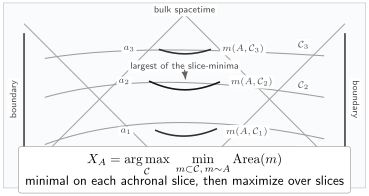
The maximin construction restores a slice-by-slice geometric intuition. On each achronal slice , one finds the minimal surface homologous to . The HRT surface is the member of this family whose area is maximal under deformations of the slice, and then minimal among competing extremal saddles.
The maximin viewpoint is not just a visualization. It is a theorem powerful enough to prove important properties of covariant holographic entropy, including strong subadditivity and entanglement wedge nesting, in regimes where the relevant energy and causality assumptions hold.
The intuition is close to the classical area theorem. The null curvature condition focuses null congruences, so pushing candidate surfaces along null directions does not create forbidden shortcuts that would violate entropy inequalities. HRT surfaces behave like the covariant version of minimal cuts.
Causal wedge and entanglement wedge
Section titled “Causal wedge and entanglement wedge”Given a boundary domain of dependence , the causal wedge is the bulk region that can both receive signals from and send signals to :
The causal wedge is important because it is the most conservative bulk region accessible from boundary causal propagation. If a bulk point is outside , no ordinary causal signal can be sent from to the point and back.
The entanglement wedge is generally larger:
Under standard classical assumptions one has, schematically,
This inclusion is one of the first hints that entanglement knows more than causal propagation. The boundary density matrix is not limited to reconstructing only the causal wedge; in AdS/CFT, the correct bulk region associated with is the entanglement wedge. Later pages explain how this becomes entanglement wedge reconstruction and holographic quantum error correction.
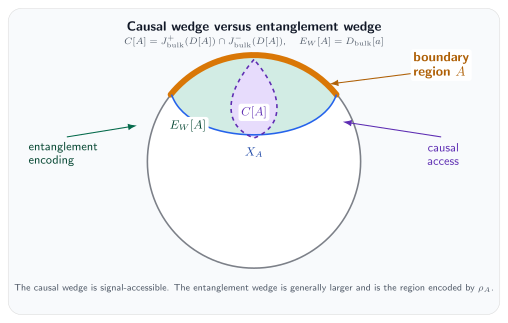
The causal wedge is determined by causal propagation from the boundary domain of dependence . The entanglement wedge is bounded by and the HRT surface , and is typically larger. This gap is the geometric origin of why subregion duality is stronger than causal reconstruction.
The surface on the boundary of the causal wedge is sometimes called the causal information surface. Its area defines causal holographic information, which is an interesting geometric quantity, but it is not generally equal to von Neumann entropy. The entropy is computed by , not by .
Entanglement wedge nesting
Section titled “Entanglement wedge nesting”One of the most important consistency conditions is entanglement wedge nesting. If the boundary domain of dependence of is contained in that of ,
then the associated bulk entanglement wedges should be nested:
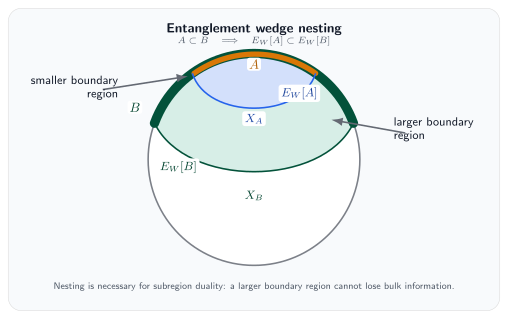
Entanglement wedge nesting says that if the boundary domain of dependence of is contained in that of , then the corresponding bulk entanglement wedge of is contained in that of . This is the geometric precursor of monotonicity of reconstruction and relative entropy.
This property is essential for subregion duality. If is a smaller boundary region than , then anything reconstructible from should also be reconstructible from . In the language of quantum error correction, enlarging the available physical subsystem should not reduce the set of logical bulk operators one can reconstruct.
At the classical HRT level, entanglement wedge nesting follows from the maximin construction under appropriate energy conditions. At the quantum level, the statement becomes more subtle and is tied to quantum extremal surfaces, the generalized second law, and quantum focusing.
Strong subadditivity and covariance
Section titled “Strong subadditivity and covariance”A nontrivial test of any proposed entropy formula is strong subadditivity:
For static RT surfaces, this inequality has a beautiful cut-and-paste proof on a common spatial slice. In the covariant case, the relevant HRT surfaces need not lie on the same slice, so the original proof does not directly apply.
The maximin construction solves this problem. Roughly, one chooses a slice on which the relevant maximin surfaces can be compared, applies the same minimal-surface recombination logic as in RT, and then uses the maximizing property to relate the result to the covariant HRT areas. The proof is technically subtler than the static one, but the physical moral is simple:
HRT is covariant without giving up the basic entropy inequalities required of boundary von Neumann entropy.
At leading classical order, holographic entropies also obey the monogamy of mutual information inequality
or equivalently
This inequality is not true in arbitrary quantum systems, but it is true for classical holographic entropy. Its validity is a strong constraint on the kinds of large- states with simple Einstein-gravity duals.
Example: why HRT is needed in collapse geometries
Section titled “Example: why HRT is needed in collapse geometries”Consider a boundary state dual to gravitational collapse in AdS. Before the collapse, the bulk may be close to vacuum AdS. After the collapse, it may contain a black brane or black hole. The boundary entropy of a region evolves during this process.
A static RT prescription would require choosing a preferred bulk time slice at each boundary time. But in a dynamical spacetime there is no unique preferred slice, and a surface minimal on one chosen slice may give a coordinate-dependent answer. HRT instead finds the spacetime extremal surface anchored at .
In AdS-Vaidya models, HRT surfaces refract across the null shell and probe both the pre-collapse and post-collapse regions. They reproduce characteristic features of holographic thermalization:
- short-distance entanglement equilibrates first;
- larger regions equilibrate later;
- extremal surfaces can probe behind apparent horizons;
- the entropy growth can be geometric even when no simple quasiparticle picture exists.
This is not a minor technical improvement. Time-dependent black holes are exactly where the information problem lives. HRT provides the covariant geometric language needed before one can discuss quantum extremal surfaces and islands.
Horizons are not HRT surfaces, except in special cases
Section titled “Horizons are not HRT surfaces, except in special cases”It is tempting to identify the HRT surface with a horizon. This is usually wrong.
An event horizon is a causal boundary defined globally by the ability of light rays to reach future infinity. An apparent horizon is a quasi-local surface with one vanishing and one negative null expansion. An HRT surface is an extremal surface satisfying
and anchored to a boundary entangling surface.
These are different concepts. They coincide only in special symmetric cases. For example, in the eternal two-sided AdS black hole, the entropy of one entire boundary CFT is computed by the bifurcation surface of the horizon:
But for a proper subregion of the boundary, or in a time-dependent geometry, the HRT surface is generally not the event horizon or apparent horizon. It may pass behind horizons, avoid them, or undergo phase transitions between topologically distinct saddles.
Relation to replica derivations
Section titled “Relation to replica derivations”The HRT formula is not only a plausible covariant guess. It also emerges from the gravitational replica method.
The rough logic is as follows. To compute the Rényi entropy,
one studies a boundary Schwinger–Keldysh or replica contour appropriate to the Lorentzian density matrix. In the bulk, one seeks saddle geometries compatible with this replicated boundary contour. Near , the fixed locus of the replica symmetry behaves like a codimension-two cosmic brane whose tension vanishes as . The equation of motion for this locus becomes precisely the extremality condition for .
Thus the same principle that led to RT in static Euclidean settings leads to HRT in Lorentzian settings: the entropy is controlled by the saddle-point response of the gravitational path integral to a conical defect or cosmic brane insertion.
This derivation is one reason HRT is the correct starting point for replica wormholes. Replica wormholes do not replace HRT; they generalize the same saddle-point logic to situations where the dominant replica geometry has new topology and where the correct surface is a quantum extremal surface.
From HRT to QES
Section titled “From HRT to QES”HRT is the leading classical formula:
The next correction is not merely a small adjustment to the area. The bulk quantum fields inside the entanglement wedge also carry entanglement. The semiclassical expansion has the schematic form
Once the bulk entropy term is included, one should extremize the generalized entropy rather than the area alone:
The surface satisfying
is a quantum extremal surface. In evaporating black hole problems, this quantum correction is not a small conceptual detail. It is what allows an island saddle to dominate after the Page time.
So the logical progression is:
What HRT does and does not say
Section titled “What HRT does and does not say”HRT says that the leading large- von Neumann entropy of a boundary region with a classical Lorentzian bulk dual is computed by a homologous extremal surface. It does not say that entropy propagates causally like a classical signal. Entanglement entropy is a nonlocal functional of the quantum state.
HRT says that the entanglement wedge can be larger than the causal wedge. It does not by itself construct the boundary operator that reconstructs a bulk field in the wedge. That is the subject of entanglement wedge reconstruction.
HRT says that certain surfaces behind horizons contribute to boundary entropies. It does not imply that a boundary observer can send a local signal into the black hole interior and receive it back through ordinary causal propagation.
HRT is a classical formula. It does not include the bulk entanglement term, edge modes, graviton-loop corrections, or island saddles. Those enter through FLM, quantum extremal surfaces, and the gravitational replica method.
Common pitfalls
Section titled “Common pitfalls”Pitfall 1: “HRT is just RT on a different time slice.”
Not quite. HRT is not defined by first choosing a convenient time coordinate and minimizing on that slice. It is a spacetime extremization problem. The maximin theorem says that, under assumptions, the HRT surface can be found by an optimized slice construction, but the answer is not tied to an arbitrary foliation.
Pitfall 2: “Extremal means smallest.”
In Lorentzian signature, extremal means stationary under local deformations. The prescription then chooses the smallest area among the allowed extremal surfaces. These are distinct steps.
Pitfall 3: “The causal wedge is the bulk dual of .”
The causal wedge is reconstructible by causal propagation, but the full subregion dual is the entanglement wedge. The two agree only in special cases.
Pitfall 4: “The HRT surface is a horizon.”
A horizon is a causal object. An HRT surface is an entropy object. They coincide in special symmetric examples, but generally differ.
Pitfall 5: “Covariant entropy means acausal physics.”
No. Entanglement entropy is not a local signal. A covariant extremal surface can depend on the global state without allowing superluminal communication.
Exercises
Section titled “Exercises”Exercise 1: Extremality and null expansions
Section titled “Exercise 1: Extremality and null expansions”Let be a codimension-two spacelike surface with future-directed null normals and . Show that stationarity of the area under arbitrary normal deformations implies
Solution
A general infinitesimal normal deformation can be written as
where and are arbitrary functions on . The first variation of the area has the form
up to normalization conventions for the null normals. If for arbitrary and , then the integrand must vanish independently in both directions. Hence
This is the codimension-two Lorentzian extremality condition.
Exercise 2: Reduction to RT in a static spacetime
Section titled “Exercise 2: Reduction to RT in a static spacetime”Suppose the bulk has a time-reflection symmetry , and the boundary region lies on the fixed time slice . Explain why the HRT surface lies on the slice and reduces to the RT surface.
Solution
The time-reflection symmetry maps any allowed extremal surface anchored on to another allowed extremal surface with the same area. If the relevant surface is unique, it must be invariant under the reflection and therefore lies on the fixed slice . More generally, one can choose a reflection-symmetric representative among degenerate saddles.
On the fixed slice, the timelike variation of the area vanishes by symmetry. The remaining extremality condition is precisely the condition that the surface be minimal within the spatial slice. Therefore the HRT prescription reduces to the RT prescription:
Exercise 3: Maximin intuition
Section titled “Exercise 3: Maximin intuition”On each achronal slice , let be the minimal surface homologous to . Why does the HRT surface correspond to maximizing over , rather than minimizing it over ?
Solution
On a fixed slice, minimizing is the RT-like operation: it chooses the least-area cut on that slice. But Lorentzian time deformations are not positive-definite minimization directions. If one minimized over all slices, one could often push surfaces toward null or singular regions in ways that do not represent a stationary Lorentzian entropy surface.
The maximin prescription first performs the physically meaningful spatial minimization on each achronal slice. It then chooses the slice for which this minimal cut has largest area. Under the null curvature condition, this maximin surface is stationary under deformations of the slice and therefore satisfies the HRT extremality condition. The maximizing step is what enforces Lorentzian extremality rather than arbitrary coordinate-slice minimization.
Exercise 4: Causal wedge versus entanglement wedge
Section titled “Exercise 4: Causal wedge versus entanglement wedge”Define
Explain why suggests that entanglement wedge reconstruction is stronger than causal reconstruction.
Solution
The causal wedge consists of points that can communicate causally with the boundary domain of dependence . Bulk fields in this region can plausibly be reconstructed using causal propagation from boundary data in .
The entanglement wedge is defined instead by the HRT surface and the homology region. If , then there can be bulk points in that are not causally accessible from . Reconstruction of those points cannot be ordinary causal reconstruction. It must use the quantum information contained in the reduced density matrix .
This is the geometric motivation for entanglement wedge reconstruction: the boundary subregion encodes a bulk region larger than what causal propagation alone would suggest.
Exercise 5: The entropy of one side of an eternal black hole
Section titled “Exercise 5: The entropy of one side of an eternal black hole”Consider the thermofield-double state dual to an eternal two-sided AdS black hole. For the region equal to the entire right boundary CFT, what is the HRT surface and what entropy does it compute?
Solution
For equal to the entire right boundary, is empty. The homology condition still allows a nontrivial closed bulk surface separating the right exterior from the left exterior. In the time-reflection-symmetric eternal black hole, the relevant HRT surface is the bifurcation surface of the horizon.
The entropy is therefore
which equals the thermal entropy of the right CFT at leading order. Since the full thermofield-double state is pure, this also equals .
Further reading
Section titled “Further reading”- V. E. Hubeny, M. Rangamani, and T. Takayanagi, “A Covariant Holographic Entanglement Entropy Proposal”.
- A. C. Wall, “Maximin Surfaces, and the Strong Subadditivity of the Covariant Holographic Entanglement Entropy”.
- V. E. Hubeny and M. Rangamani, “Causal Holographic Information”.
- M. Headrick, V. E. Hubeny, A. Lawrence, and M. Rangamani, “Causality & Holographic Entanglement Entropy”.
- X. Dong, A. Lewkowycz, and M. Rangamani, “Deriving Covariant Holographic Entanglement”.
- M. Rangamani and T. Takayanagi, “Holographic Entanglement Entropy”.
Where this page fits
Section titled “Where this page fits”The previous page introduced RT as the static geometric formula for boundary entanglement. This page explained why the correct Lorentzian replacement is an extremal surface and why the resulting entanglement wedge is generally larger than the causal wedge.
The next step is to add quantum corrections. The FLM formula replaces pure area by area plus bulk entanglement, and quantum extremal surfaces replace classical HRT surfaces by extrema of generalized entropy. That is the direct path to the island formula.