
CFT Cheatsheet
This appendix collects the conformal field theory facts used repeatedly in the course. It is not a substitute for a full CFT course. It is a working reference for AdS/CFT calculations: which quantities are fixed by symmetry, which quantities are genuine dynamical data, and how those data become bulk fields, masses, couplings, and semiclassical gravity.
A CFT is a quantum field theory invariant under transformations that preserve angles. In flat Euclidean space, the global conformal group is for -dimensional CFTs. In Lorentzian signature, it is . The local group becomes much larger in , where the stress tensor generates two Virasoro algebras.
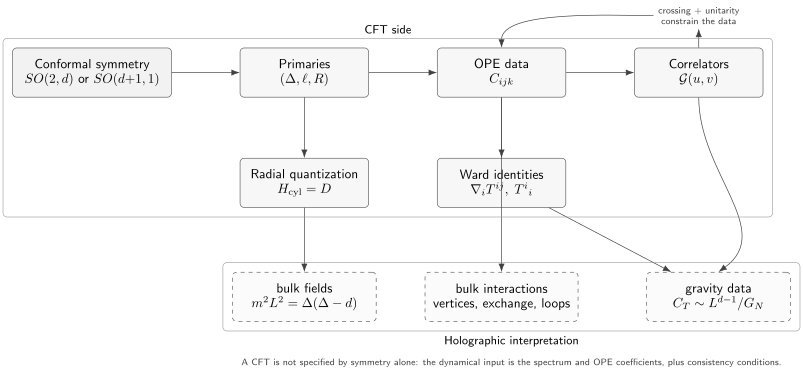
A CFT is specified by its spectrum of primaries and OPE coefficients, subject to symmetry, Ward identities, unitarity, and crossing. In holographic CFTs, the same data reorganize into bulk fields, masses, interactions, and eventually a semiclassical spacetime description.
One-line summary
Section titled “One-line summary”The intrinsic local data of a CFT are
Here are scaling dimensions, are spin or Lorentz-representation data, are global-symmetry representations, and are OPE coefficients after choosing operator normalizations.
In a holographic large- CFT,
Coordinates and conventions
Section titled “Coordinates and conventions”Unless stated otherwise, this appendix uses flat Euclidean coordinates , , with
Lorentzian formulas require operator-ordering and prescriptions. Euclidean, time-ordered, retarded, advanced, and Wightman correlators are different objects. For the real-time dictionary, use the Green Functions Cheatsheet together with the real-time holography pages.
A conformal map changes the metric by a local Weyl factor:
A scalar primary of scaling dimension transforms as
For spinning operators, the transformation also includes the local rotation induced by the conformal map.
Conformal Killing vectors
Section titled “Conformal Killing vectors”An infinitesimal conformal transformation is generated by a vector field satisfying
For , the independent global transformations are:
| transformation | infinitesimal form | generator |
|---|---|---|
| translations | ||
| rotations | ||
| dilatations | ||
| special conformal transformations |
A useful algebra convention is
with the standard rotation commutators for . Some authors include factors of depending on whether generators are chosen Hermitian or anti-Hermitian. The physics is in the representation theory: raises scaling dimension, lowers it, and primaries are annihilated by at the origin.
Primaries, descendants, and conformal multiplets
Section titled “Primaries, descendants, and conformal multiplets”A local operator is a primary if it is annihilated by special conformal generators at the origin:
It is an eigenoperator of dilatations:
Descendants are obtained by acting with translations:
The conformal multiplet generated from a primary is the CFT analogue of a highest-weight representation. The data attached to a primary are often summarized as
where is the scaling dimension, denotes spin or Lorentz representation data, and denotes global-symmetry representation data.
In AdS/CFT, a primary conformal multiplet corresponds to a bulk one-particle field together with its AdS descendants. The descendants are not new bulk species; they are excitations of the same bulk field.
Radial quantization and the cylinder
Section titled “Radial quantization and the cylinder”On , write
Then
Because a CFT is insensitive to Weyl rescaling up to anomaly terms, flat space is conformally equivalent to the cylinder:
The cylinder Hamiltonian is the dilatation operator:
A primary operator creates a cylinder energy eigenstate:
This is the CFT side of the global AdS statement that a free scalar field with dimension has normal-mode frequencies
Unitarity bounds in
Section titled “Unitarity bounds in d≥3d\ge3d≥3”For unitary CFTs in , primary dimensions obey lower bounds. For symmetric traceless tensor primaries:
| operator type | bound | saturation means |
|---|---|---|
| scalar, non-identity | free scalar equation when saturated | |
| spin | conserved current when saturated | |
| spinor | free fermion equation when saturated |
For spin , saturation gives
For spin , saturation gives
In holography, these shortening conditions correspond to gauge redundancies in the bulk: conserved currents map to gauge fields, and the conserved stress tensor maps to the graviton.
Two-point functions
Section titled “Two-point functions”For scalar primaries,
With an orthonormal basis of scalar primaries, one often sets . In holography, this normalization choice changes the normalization of the corresponding bulk fields and cubic couplings.
For vectors, define
A vector primary has
For a conserved current, :
For the stress tensor,
where
The coefficient measures the number of local degrees of freedom. In a holographic CFT with an Einstein-gravity dual,
For large- adjoint gauge theories, typically .
Three-point functions
Section titled “Three-point functions”For scalar primaries, conformal symmetry fixes the position dependence:
The coefficient is dynamical CFT data. In a classical holographic theory, it is computed by a cubic bulk coupling:
For spinning operators, three-point functions have a finite number of allowed tensor structures. Conservation, parity, supersymmetry, and global symmetries may reduce the number of independent coefficients.
Four-point functions and cross ratios
Section titled “Four-point functions and cross ratios”For four scalar primaries, conformal symmetry does not fix the whole answer. It reduces the answer to a function of cross ratios. For identical scalars of dimension ,
where
Here the first variable is the letter . It is visually close to the Greek letter , so in typed notes it is worth checking this carefully.
Crossing symmetry for identical scalars gives
This is the simplest bootstrap equation. In a holographic CFT, the large- expansion of is the boundary avatar of tree-level and loop-level bulk Witten diagrams.
The operator product expansion
Section titled “The operator product expansion”The OPE says that nearby operators can be replaced by a sum of local operators:
For scalar primaries, the leading primary contribution is schematically
The descendants are fixed by conformal symmetry. The numbers are the same OPE coefficients that appear in three-point functions, after choosing two-point normalizations.
The OPE is not just a short-distance heuristic. In Euclidean CFT, inside correlation functions, it has a finite radius of convergence set by the nearest other operator insertion.
Conformal block expansion
Section titled “Conformal block expansion”In a four-point function, the OPE decomposes into conformal blocks:
where the sum is over primary operators appearing in the OPE. The conformal block contains the contribution of a primary and all descendants in its conformal multiplet.
The bootstrap equation is schematically
For holography, conformal block decompositions are useful because exchange Witten diagrams decompose into single-trace and double-trace conformal blocks. Bulk locality is encoded in the detailed pattern of these CFT contributions.
Large CFTs and generalized free fields
Section titled “Large NNN CFTs and generalized free fields”In a large- holographic CFT, normalized single-trace operators often satisfy
At leading order, many single-trace operators behave as generalized free fields. Their four-point functions factorize into products of two-point functions:
The corresponding double-trace operators have approximate dimensions
with
for weakly interacting bulk fields. This is the CFT origin of bulk Fock space.
Relevant, marginal, and irrelevant deformations
Section titled “Relevant, marginal, and irrelevant deformations”A deformation
has coupling dimension
Thus:
| operator dimension | name | RG behavior near the fixed point |
|---|---|---|
| relevant | grows toward the IR | |
| marginal | needs beta-function analysis | |
| irrelevant | suppressed in the IR |
In AdS/CFT, a relevant deformation changes the boundary condition for a bulk field and often drives the geometry away from AdS in the interior. Domain-wall geometries are the gravitational representation of RG flows.
A marginal operator can be exactly marginal, marginally relevant, or marginally irrelevant. In SYM, the complexified gauge coupling is exactly marginal.
Conserved currents
Section titled “Conserved currents”A conserved global current obeys
In a unitary CFT, a conserved spin-one current has protected dimension
It couples to a background gauge field:
The source dimension is
In AdS/CFT,
The boundary current is global from the CFT perspective. The bulk gauge field is dynamical in the gravitational theory, but its boundary value is a nondynamical source unless one explicitly gauges the boundary symmetry.
Stress tensor
Section titled “Stress tensor”The stress tensor obeys
in flat space for an undeformed CFT, up to anomalies and contact terms. It has protected dimension
It couples to the background metric:
The holographic map is
The coefficient in the two-point function is proportional to the inverse bulk Newton constant:
In even-dimensional CFTs, the stress-tensor trace on a curved background can have a Weyl anomaly:
For a two-dimensional CFT, one common convention is
with sign depending on curvature and stress-tensor conventions.
Ward identities
Section titled “Ward identities”The Euclidean generating functional is written here as
One-point functions are obtained by variation:
Different sign conventions for and source insertions change signs. The reliable rule is to check the source term in the action.
For a scalar source coupled to , diffeomorphism invariance gives schematically
Weyl invariance gives
when sources are present. For an undeformed flat-space CFT, the right-hand side vanishes.
These are the boundary versions of radial constraint equations in holographic renormalization.
Two-dimensional CFT special case
Section titled “Two-dimensional CFT special case”In two Euclidean dimensions, use complex coordinates
A primary has holomorphic and antiholomorphic weights , with
The two-point function is
The local conformal algebra becomes two copies of Virasoro:
and similarly for with central charge .
For AdS/CFT with parity invariance,
This infinite-dimensional structure is special to two boundary dimensions. Do not assume Virasoro methods automatically generalize to higher-dimensional CFTs.
Euclidean versus Lorentzian CFT
Section titled “Euclidean versus Lorentzian CFT”Most conformal kinematics is cleanest in Euclidean signature. Radial quantization and reflection positivity then reconstruct a unitary Lorentzian theory under suitable assumptions.
The Lorentzian theory contains causal information absent from Euclidean kinematics alone. For example:
- Wightman functions depend on operator ordering;
- retarded functions encode response;
- commutators vanish at spacelike separation;
- singularities have prescriptions;
- thermal correlators satisfy KMS relations.
In holography, Euclidean regularity gives Euclidean correlators, while Lorentzian retarded correlators require infalling boundary conditions at horizons.
Embedding-space shorthand
Section titled “Embedding-space shorthand”For many conformal-kinematic formulas, one embeds -dimensional points into a projective null cone in . A boundary point is represented by a null vector satisfying
Scalar correlators become homogeneous functions of dot products . The advantage is that conformal transformations act linearly as transformations in Euclidean signature.
This course rarely needs embedding space explicitly, but many CFT and Witten-diagram references use it.
CFT data to bulk dictionary
Section titled “CFT data to bulk dictionary”| CFT quantity | Bulk meaning |
|---|---|
| scalar primary | scalar field |
| dimension | mass through |
| spin primary | spin- bulk field |
| conserved current | bulk gauge field |
| stress tensor | bulk metric fluctuation |
| up to convention | |
| single-trace operator | single-particle bulk state |
| double-trace operator | two-particle bulk state |
| OPE coefficient | cubic bulk coupling after normalization |
| anomalous double-trace dimensions | bulk binding/scattering data |
| large factorization | weak bulk interactions |
| large single-trace gap | local bulk EFT below the string scale |
This table is a guide, not a theorem in isolation. The full statement requires a consistent large- CFT with the right spectrum and OPE data.
Normalization traps
Section titled “Normalization traps”Two-point normalization changes OPE coefficients
Section titled “Two-point normalization changes OPE coefficients”If
then
Only after fixing two-point normalizations do OPE coefficients become directly comparable.
conventions vary
Section titled “CTC_TCT conventions vary”The coefficient is defined with different numerical normalizations in different communities. Always compare the complete two-point-function convention, not just the symbol .
Contact terms are not optional bookkeeping
Section titled “Contact terms are not optional bookkeeping”Ward identities often contain contact terms. In momentum space, contact terms appear as polynomials in momenta. They can shift local pieces of correlators and are tied to counterterm choices in holography.
Conserved currents are global currents in the boundary theory
Section titled “Conserved currents are global currents in the boundary theory”A bulk gauge field is dual to a global symmetry current in the boundary CFT. To make the boundary symmetry dynamical, one must gauge it by adding boundary degrees of freedom or integrating over the boundary gauge field.
“Primary” does not mean “elementary”
Section titled ““Primary” does not mean “elementary””A primary operator is defined representation-theoretically by its transformation under conformal symmetry. It can be elementary in a Lagrangian theory, composite, non-Lagrangian, or an abstract operator in a bootstrap description.
Mini-reference: formulas to remember
Section titled “Mini-reference: formulas to remember”Scalar two-point function:
Scalar three-point function:
Cross ratios:
OPE:
State-operator map:
Bulk mass-dimension relation:
Unitarity bounds:
Dictionary checkpoint
Section titled “Dictionary checkpoint”The CFT side of AdS/CFT is not just “some boundary theory.” The precise boundary input is CFT data,
plus global-symmetry, anomaly, contact-term, and large- structure. The simplest holographic translation is
A large- CFT with a sparse low-dimension single-trace spectrum is the natural boundary candidate for a local semiclassical bulk dual.
Common confusions
Section titled “Common confusions”“Conformal symmetry fixes all correlators.”
Section titled ““Conformal symmetry fixes all correlators.””It fixes two- and three-point position dependence, but not the operator spectrum or OPE coefficients. Four-point functions contain nontrivial functions of cross ratios. The dynamical content of a CFT is precisely the allowed CFT data.
“Scale invariance and conformal invariance are always the same.”
Section titled ““Scale invariance and conformal invariance are always the same.””In many familiar unitary relativistic QFTs, scale invariance plus additional assumptions implies conformal invariance, but this is not a purely automatic identity in all possible theories and dimensions. AdS/CFT uses conformal invariance because the AdS isometry group matches the conformal group.
“A primary operator is a fundamental field.”
Section titled ““A primary operator is a fundamental field.””No. A primary is the top state of a conformal multiplet. It can be elementary in a Lagrangian theory, composite, non-Lagrangian, or an abstract operator in a bootstrap description.
“A conserved current is just another spin-one operator.”
Section titled ““A conserved current is just another spin-one operator.””Conservation shortens the conformal multiplet and fixes the dimension to . In holography, this shortening is reflected by bulk gauge redundancy.
“A marginal operator is automatically exactly marginal.”
Section titled ““A marginal operator is automatically exactly marginal.””No. A dimension- operator at a fixed point is marginal at first order. It may become marginally relevant, marginally irrelevant, or exactly marginal depending on beta functions and symmetry constraints.
“CFT central charge always means the same thing.”
Section titled ““CFT central charge always means the same thing.””In two dimensions, is the Virasoro central charge. In higher dimensions, people use coefficients such as , , and depending on context. Holographic formulas depend on the normalization.
Exercises
Section titled “Exercises”Exercise 1: Derive the scalar two-point scaling
Section titled “Exercise 1: Derive the scalar two-point scaling”Use scale invariance to show that a scalar-primary two-point function must scale as if the two operators have the same dimension.
Solution
Let
Under , a scalar primary contributes one factor of at each insertion. Thus
Rotational invariance implies , so
Special conformal transformations further imply that scalar primaries of different dimensions have vanishing two-point functions in a basis of scaling operators.
Exercise 2: Source dimension
Section titled “Exercise 2: Source dimension”A scalar operator has dimension . What is the dimension of its source in
Solution
The action is dimensionless in units where . Since
we require
Thus
This is why relevant operators with have positive-dimension couplings.
Exercise 3: Current dimension from conservation
Section titled “Exercise 3: Current dimension from conservation”Use the spin- unitarity bound
for to determine the dimension of a conserved current and a conserved stress tensor.
Solution
For a spin-one current, , saturation gives
The shortening condition is current conservation:
For the stress tensor, , saturation gives
The corresponding shortening condition is stress-tensor conservation:
Exercise 4: Double-trace dimensions
Section titled “Exercise 4: Double-trace dimensions”Two scalar single-trace operators have dimensions and . In a generalized-free large- limit, what are the approximate dimensions of the double-trace primaries with spin and radial excitation number ?
Solution
The approximate double-trace primaries are schematically
where the dots enforce primary and traceless conditions. Their dimensions are
At leading generalized-free order,
In a weakly interacting holographic CFT,
encoding bulk binding and scattering effects.
Further reading
Section titled “Further reading”- Slava Rychkov, EPFL Lectures on Conformal Field Theory in Dimensions.
- David Simmons-Duffin, TASI Lectures on the Conformal Bootstrap.
- P. Di Francesco, P. Mathieu, and D. Sénéchal, Conformal Field Theory.
- H. Osborn and A. Petkou, Implications of Conformal Invariance in Field Theories for General Dimensions.
- S. Ferrara, R. Gatto, and A. F. Grillo, classic work on conformal representations and unitarity bounds.
- G. Mack, classic work on conformal representations and unitarity bounds.