
Large N Gauge Theory
Large- gauge theory is the first place where AdS/CFT starts to look less like magic. A gauge theory with gauge group or contains fields with color indices. When those fields are in the adjoint representation, they are matrices. Feynman diagrams then carry not only spacetime and momentum information, but also color topology.
The large- limit turns this topology into an organizing principle. Instead of expanding only in a small coupling constant, we reorganize diagrams by the genus of a two-dimensional surface. Planar diagrams dominate, nonplanar handles are suppressed by powers of , and the resulting expansion has the same form as a closed-string perturbation series.
This is the field-theory reason why holography does not merely relate a gauge theory to a classical spacetime. At large , gauge theory begins to behave like a weakly coupled string theory. In favorable cases, such as strongly coupled super-Yang–Mills theory, that string theory has a low-energy limit described by classical gravity in AdS.
Why this matters
Section titled “Why this matters”AdS/CFT has two separate semiclassical limits:
and
This page explains the first arrow. The next pages will refine the operator dictionary, but the basic slogan is already visible:
More precisely, for canonically normalized single-trace operators,
This is exactly the pattern one expects from weakly interacting single-particle fields in a bulk theory: two-point functions normalize the particles, three-point functions measure cubic interactions, and higher connected amplitudes become increasingly suppressed.
The ‘t Hooft limit
Section titled “The ‘t Hooft limit”Consider a gauge theory with gauge group or . The Yang–Mills coupling is not the best variable to keep fixed as becomes large. The useful coupling is the ‘t Hooft coupling
The ‘t Hooft large- limit is
Equivalently,
This scaling is not cosmetic. It is what keeps the leading diagrams finite and nontrivial. If were held fixed instead, the number of color degrees of freedom would grow while the interaction strength stayed too large. If were sent to zero too quickly, the large- theory would become trivial.
The ‘t Hooft limit holds fixed the effective coupling felt by a typical color loop.
Adjoint fields are matrices
Section titled “Adjoint fields are matrices”An adjoint field may be written as
or, more explicitly, as a matrix
The two color indices are the key. A fundamental field carries one color line. An adjoint field carries two color lines, one for the upper index and one for the lower index. This turns ordinary Feynman diagrams into ribbon graphs.
The adjoint propagator schematically carries color structure
The important point is not the detailed spacetime factor. The important point is the pair of Kronecker deltas. They show how color flows through the diagram.
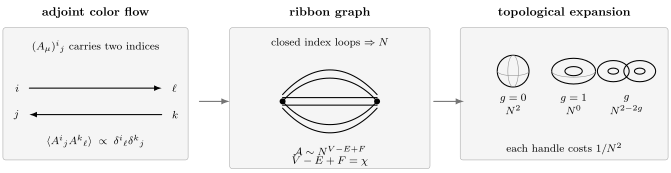
Large- perturbation theory is organized by the topology of double-line color graphs. A connected diagram with genus and boundaries scales as , up to a function of the ‘t Hooft coupling .
Double-line notation
Section titled “Double-line notation”In ordinary Feynman diagrams, a propagator is drawn as a single line. For an adjoint field, it is more informative to draw the propagator as two oppositely oriented color lines:
When diagrams are drawn this way, each closed color loop contributes a factor of because it represents a sum over a free color index:
Thus the power of associated with a diagram can be read combinatorially:
- each closed color face contributes ;
- each propagator contributes a factor proportional to ;
- each interaction vertex contributes compensating factors determined by the action;
- at fixed , the remaining -dependence depends only on topology.
For a connected vacuum ribbon graph, the result is
where is the number of faces, is the number of edges, and is the number of vertices of the ribbon graph. But
where is the Euler characteristic of the two-dimensional surface on which the ribbon graph can be drawn without crossings. For a closed oriented surface of genus ,
Therefore
Planar diagrams have and scale as . Diagrams with one handle have and scale as . Diagrams with two handles scale as , and so on.
The expansion of the connected vacuum functional takes the form
This is the large- topological expansion.
Why planar diagrams dominate
Section titled “Why planar diagrams dominate”At large with fixed ,
So the leading contribution comes from genus-zero diagrams. These are called planar diagrams, because they can be drawn on the plane or sphere without crossing double-line color strands.
The name “planar” is topological, not geometric in spacetime. A planar diagram may involve complicated momentum integrals and many vertices. What matters is that its color ribbon graph can be placed on a sphere without handles.
The large- expansion is therefore not the same as weak-coupling perturbation theory. Even when is not small, one may still hope that the theory has an expansion in powers of :
This distinction is essential in AdS/CFT. Classical gravity is expected when is large and is large. Perturbative gauge-theory Feynman diagrams are useful when is small. The most interesting holographic regime is precisely where ordinary perturbation theory fails, but the expansion remains meaningful.
Boundaries and operator insertions
Section titled “Boundaries and operator insertions”So far we discussed vacuum diagrams. Correlation functions of single-trace operators introduce marked boundaries on the ribbon surface.
A typical single-trace operator is
The trace ties color indices into a loop. In the ribbon graph, that loop behaves like a boundary component. For connected correlators of canonically normalized single-trace operators, the large- scaling is
At leading genus,
Thus
This is the standard normalization used when one wants single-trace operators to create single-particle bulk states with order-one two-point functions.
A warning about normalization is useful here. Some authors use unnormalized operators such as , while others insert powers of or so that two-point functions are order one. The physics is not changed by this convention, but the explicit powers of in correlators move around. Whenever comparing formulas, first check how the operators and sources are normalized.
Large- factorization
Section titled “Large-NNN factorization”The most important consequence of the previous scaling is factorization. Suppose and are gauge-invariant single-trace or multi-trace operators normalized so that their expectation values are order one. Then connected correlations are suppressed:
for bosonic gauge-invariant observables of the usual single-trace type.
This resembles a classical limit. In ordinary quantum mechanics, connected fluctuations are suppressed when . In large- gauge theory, connected fluctuations of suitable gauge-invariant observables are suppressed when .
This is one reason the bulk dual can become classical. The boundary theory remains a quantum field theory, but its gauge-invariant collective variables behave more and more classically as grows.
The next page will examine this point more carefully because it is the bridge from large- field theory to bulk Fock space.
The string-theory interpretation
Section titled “The string-theory interpretation”The genus expansion of large- gauge theory looks like the perturbative expansion of a closed string theory. A closed-string partition function has the schematic form
where is the string coupling and is the genus of the string worldsheet.
The gauge-theory expansion has the form
Comparing the powers gives the rough identification
In the canonical AdS/CFT example, the more precise parametric relation is
up to conventional numerical factors. At fixed large , large still means weak string coupling.
This does not mean every large- gauge theory has a simple classical gravity dual. The large- expansion suggests a string description, but classical Einstein gravity requires more. Roughly, the string theory must have a regime in which massive string modes are much heavier than the AdS curvature scale. In the boundary language, that corresponds to a large gap in the spectrum of higher-spin single-trace operators.
So the hierarchy is:
but
Why degrees of freedom?
Section titled “Why N2N^2N2 degrees of freedom?”An adjoint matrix has approximately components. This simple fact has many holographic consequences.
For example, the free energy density of a deconfined large- adjoint plasma typically scales as
The central charge or stress-tensor two-point coefficient of a holographic CFT also scales as
On the gravity side, the coefficient controlling classical gravitational dynamics is the inverse Newton constant in AdS units:
This relation is one of the most important normalization facts in the entire course. It says that the bulk classical action is large:
A large action suppresses quantum fluctuations around a saddle point. Thus the same that counts adjoint degrees of freedom in the gauge theory becomes the semiclassical parameter of the bulk gravitational path integral.
A useful toy model of the counting
Section titled “A useful toy model of the counting”To see the counting without the complications of gauge fixing and vector indices, consider a matrix field with an action schematically normalized as
This normalization makes the -counting transparent. The propagator carries a factor
while an interaction vertex carries a factor
A graph with propagators, vertices, and closed color faces gives
At fixed , the power of is
The detailed power of depends on the graph and the interaction vertices. The power of knows only the topology.
This is the core of the ‘t Hooft expansion.
Relation to confinement and mesons
Section titled “Relation to confinement and mesons”Large- ideas were originally developed as a way to understand strong interactions. In QCD-like theories with fundamental quarks, quark loops add boundaries to the ribbon surface. A diagram with genus and quark boundaries scales like
Thus each additional quark loop costs a factor of . In the strict large- limit, mesons become stable narrow resonances, and interactions among color-singlet hadrons are suppressed.
This historical connection is useful but should not be confused with the AdS/CFT examples studied later. The canonical AdS/CFT theory is not QCD. It is conformal, supersymmetric, and contains only adjoint fields in its simplest form. The common lesson is the topological organization of gauge dynamics.
What large does and does not do
Section titled “What large NNN does and does not do”Large does something profound: it creates a controlled expansion parameter even in strongly coupled gauge theories. But it does not automatically solve the theory.
At fixed , the planar contribution may still be a complicated function. If is small, ordinary perturbation theory can approximate it. If is large, perturbation theory in fails. AdS/CFT becomes powerful precisely because it can sometimes compute at large using classical gravity.
So there are two expansions:
and
In the classical gravity regime of AdS/CFT,
The first condition suppresses bulk loops. The second suppresses string-scale corrections.
Dictionary checkpoint
Section titled “Dictionary checkpoint”The large- dictionary is:
| Gauge-theory statement | Bulk interpretation |
|---|---|
| adjoint fields are matrices | color flow becomes ribbon topology |
| fixed | smooth ‘t Hooft large- limit |
| planar diagrams dominate | genus-zero string worldsheets dominate |
| each handle costs | closed-string loops are suppressed |
| suppresses connected interactions | bulk fields interact weakly |
| large factorization | classical bulk saddle behavior |
The single most important sentence is this:
Common confusions
Section titled “Common confusions”“Large means the gauge theory is weakly coupled.”
Section titled ““Large NNN means the gauge theory is weakly coupled.””No. The ‘t Hooft coupling may be small or large. Large controls the topology of color diagrams. It does not by itself make the planar theory easy.
“Planar diagrams are just diagrams that look planar on the page.”
Section titled ““Planar diagrams are just diagrams that look planar on the page.””No. Planarity refers to the double-line color graph. A diagram is planar if its ribbon graph can be drawn on a sphere without crossing color lines.
“The string coupling is exactly .”
Section titled ““The string coupling is exactly 1/N1/N1/N.””Parametrically, large suppresses string loops. In the canonical AdS/CFT normalization, is proportional to , up to numerical conventions. What is robust is that the closed-string genus expansion is controlled by powers of at fixed appropriate coupling.
“Every large- gauge theory has an Einstein gravity dual.”
Section titled ““Every large-NNN gauge theory has an Einstein gravity dual.””No. Large suggests a string-like expansion, not necessarily a weakly curved gravitational description. A simple Einstein gravity dual requires additional dynamical conditions, such as strong coupling and a sparse spectrum of low-dimension single-trace higher-spin operators.
“ and make no difference.”
Section titled ““SU(N)SU(N)SU(N) and U(N)U(N)U(N) make no difference.””At leading large , the distinction is often subleading for adjoint-sector observables. But it can matter for global issues, decoupled factors, line operators, and precise dictionary questions. This course will usually ignore the distinction until it matters.
Exercises
Section titled “Exercises”Exercise 1: Euler counting
Section titled “Exercise 1: Euler counting”A connected vacuum ribbon graph has vertices, propagators, and closed color faces. Assume the action is normalized so that propagators contribute and vertices contribute . Show that the graph scales as
at fixed , and identify this exponent with the Euler characteristic.
Solution
The color faces give a factor . The propagators give . The vertices give . Multiplying these factors gives
At fixed , the power of is . For a ribbon graph drawn on a closed oriented surface, this is the Euler characteristic
For genus ,
so the graph scales as times a function of .
Exercise 2: Cost of a handle
Section titled “Exercise 2: Cost of a handle”Compare a planar connected vacuum diagram with a genus-one connected vacuum diagram. By what power of is the genus-one diagram suppressed?
Solution
A planar connected vacuum diagram has , so it scales as
A genus-one connected vacuum diagram has , so it scales as
The ratio is
Thus one handle costs .
Exercise 3: Three-point interactions
Section titled “Exercise 3: Three-point interactions”Assume canonically normalized single-trace operators obey
at leading planar order. What is the scaling of a connected three-point function? What does this suggest for the corresponding cubic bulk coupling?
Solution
For ,
If the operators create canonically normalized single-particle bulk states, then the connected three-point function measures a cubic interaction among those bulk fields. The scaling suggests that the cubic bulk coupling is of order .
Exercise 4: Why large is not enough for classical gravity
Section titled “Exercise 4: Why large NNN is not enough for classical gravity”Explain why the existence of a expansion does not by itself imply a weakly curved Einstein gravity dual.
Solution
The expansion organizes the theory by topology and suggests a weakly coupled string expansion. However, a string theory can still be highly stringy: many massive string modes may have masses comparable to the curvature scale, and higher-derivative corrections may be important. A weakly curved Einstein gravity dual requires not only weak string coupling, controlled by large , but also suppression of string-scale corrections. In the canonical example this is achieved at large ‘t Hooft coupling , where is large.
Further reading
Section titled “Further reading”- G. ‘t Hooft, A Planar Diagram Theory for Strong Interactions. The original source of the topological large- expansion.
- G. ‘t Hooft, Large N. A concise retrospective lecture on large- ideas.
- E. Witten, Baryons in the 1/N Expansion. A classic analysis of how hadronic physics simplifies at large .
- O. Aharony, S. S. Gubser, J. Maldacena, H. Ooguri, and Y. Oz, Large N Field Theories, String Theory and Gravity. The standard broad review connecting large- field theory to AdS/CFT.