
The Parameter Map
The decoupling argument identifies two interacting sectors of one D3-brane system:
This page translates the knobs. On the boundary side we can choose the rank , the Yang–Mills coupling , and the theta angle . On the bulk side we have the number of five-form flux units, the string coupling , the axion , the string length , the AdS radius , and Newton constants such as and .
The main map, in the conventions used in this course, is
The two expansion parameters that matter most are therefore
This is the quantitative reason behind the most famous qualitative slogan of AdS/CFT:
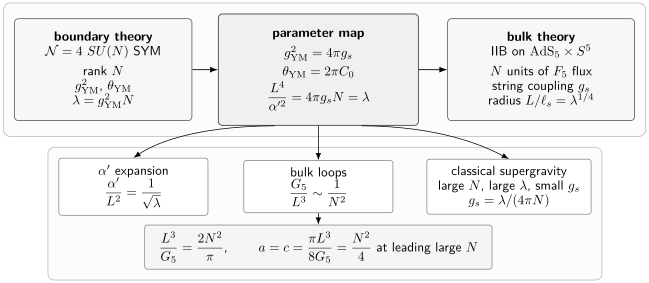
The basic parameter map of the canonical AdS/CFT duality. The boundary rank becomes the five-form flux number through , the Yang–Mills coupling fixes the string coupling, and the ‘t Hooft coupling fixes the AdS radius in string units. Large suppresses bulk loops, while large suppresses string-scale curvature corrections.
Why this matters
Section titled “Why this matters”The parameter map is not a decorative table. It tells us which calculations are controlled.
If , the boundary gauge theory may be perturbative, but the bulk curvature radius is string-scale or smaller:
A classical spacetime description is then not reliable. The dual bulk is still supposed to exist, but it is a highly stringy quantum-gravity system.
If , the curvature radius is large compared with the string length:
Stringy corrections are suppressed, and a supergravity description becomes plausible.
If , connected bulk quantum loops are suppressed. In the five-dimensional description this is encoded in
Thus the classical supergravity limit is not just “large coupling.” It is the combined regime
A useful way to say this is:
for a simple weakly coupled type IIB supergravity approximation. In the strict ‘t Hooft limit, one takes with fixed; then . To get weakly curved classical gravity, one subsequently wants large.
The boundary parameters
Section titled “The boundary parameters”The boundary theory is four-dimensional super-Yang–Mills. Its microscopic continuous parameters are usually packaged into the complex coupling
The rank is discrete. In the canonical statement one often writes rather than . The center-of-mass sector of the D3-brane stack is free and decouples from the interacting theory. At large this distinction rarely affects leading holographic observables, but conceptually the interacting CFT is the part.
The most important real coupling is the ‘t Hooft coupling
This is the parameter held fixed in the planar limit. Ordinary perturbation theory in the gauge theory is an expansion at small , but large- perturbation theory reorganizes diagrams at fixed . In the planar limit, the genus expansion is controlled by , while the dynamics within each planar diagram depends on .
For AdS/CFT, this distinction is priceless. The two parameters and separately control two different bulk approximations:
The bulk parameters
Section titled “The bulk parameters”The bulk theory is type IIB string theory on
with both factors having the same radius . The string length is
The string coupling is
where is the type IIB dilaton, which is constant in the maximally supersymmetric AdS background.
The background also has units of self-dual Ramond–Ramond five-form flux through the sphere. Schematically,
The precise normalization depends on the convention used for Ramond–Ramond fields, but the physical statement is invariant: the integer is the quantized five-form flux number. The same integer is the number of D3-branes before the near-horizon limit and the rank of the gauge group after the open-string description is taken.
The bulk axion combines with the dilaton into the type IIB axio-dilaton
With our convention , the complex couplings match as
This matching is one of the cleanest places where the duality knows about more than the metric. The boundary theta angle is not a geometric radius; it is the boundary avatar of a bulk Ramond–Ramond scalar.
The relation between the Yang–Mills coupling and the string coupling comes from the D3-brane worldvolume action. A D3-brane supports open strings. The massless open-string modes include a gauge field along the brane. For coincident branes the Chan–Paton labels make the fields matrix-valued, giving a non-Abelian gauge theory.
The low-energy D3-brane action contains a Yang–Mills term of the form
Expanding the D3-brane Dirac–Born–Infeld action to quadratic order in the worldvolume field strength gives, in the trace convention used here,
This numerical factor is a convention magnet. Authors who normalize generators or traces differently may write a factor of instead of . For this course the convention is fixed by the two equations
The invariant lesson is not the lonely factor of . The invariant lesson is that the open-string loop-counting parameter and the gauge coupling are the same physical knob.
The relation between and comes from the closed-string description. A stack of coincident D3-branes is a source for the Ramond–Ramond five-form field strength. The extremal D3-brane solution has metric
with harmonic function
Solving the type IIB equations with units of five-form flux fixes
Combining this with the open-string relation gives
Therefore
This is the key strong/weak feature of the duality. A strongly coupled boundary theory, , corresponds to a bulk spacetime whose curvature radius is large in string units. A weakly coupled boundary theory, , corresponds to a bulk background that is too stringy for classical Einstein gravity.
The curvature expansion
Section titled “The curvature expansion”String theory corrects supergravity by higher-derivative terms. Schematically, the low-energy action contains terms of the form
where the detailed supersymmetric completion is complicated but the scaling lesson is simple. Curvature in AdS units is of order
Thus the expansion parameter for stringy curvature corrections is roughly
This does not mean every correction appears at order . Supersymmetry often removes lower-order corrections; in type IIB on AdS, the famous leading higher-derivative correction is associated with an term, giving effects that scale as a power such as in many observables. But the organizing principle is still
So when a holographic calculation uses only the two-derivative Einstein action, it is secretly assuming a strong-coupling expansion on the boundary side.
The loop expansion and
Section titled “The loop expansion and N2N^2N2”The ten-dimensional Newton constant is related to string parameters by
Compactifying on gives the five-dimensional Newton constant
Since
we have
Using
one finds
Equivalently,
This is the gravitational version of the statement that the boundary theory has order degrees of freedom. The small parameter for bulk quantum loops in five-dimensional AdS units is
This also explains why classical black-hole entropy scales like in the boundary theory. A horizon area is measured in units of , so
For the canonical theory, the central charges at leading large are
For , the exact free-field value is proportional to rather than . The difference is subleading at large , which is why the gravity formula captures the leading classical result.
The full map in one table
Section titled “The full map in one table”| Boundary quantity | Bulk quantity | Meaning |
|---|---|---|
| rank | units of flux through | quantized D3-brane charge |
| open-string coupling equals gauge coupling | ||
| gauge theta angle equals RR axion | ||
| complex coupling equals axio-dilaton | ||
| AdS radius in string units | ||
| stringy curvature corrections | ||
| bulk loop corrections | ||
| central charge | number of degrees of freedom | |
| single-trace stringy gap | separation between supergravity and string modes |
The last entry deserves emphasis. A massive string state has mass of order
In AdS units, this corresponds roughly to a boundary scaling dimension
Thus at large , stringy single-trace operators become very heavy. Low-dimension single-trace operators are then described by supergravity modes. This is the first concrete version of the “large gap” idea that will reappear later when we discuss what kind of CFT can have a local Einstein-like bulk dual.
Regimes of the correspondence
Section titled “Regimes of the correspondence”The same duality exists across all values of and , but different languages are useful in different regimes.
| Boundary regime | Bulk description | Controlled by |
|---|---|---|
| finite , finite | full quantum type IIB string theory on AdS | exact duality, not usually calculable |
| , finite | weak string coupling but generally string-scale curvature | planar string theory |
| , | perturbative SYM; bulk is highly stringy | gauge perturbation theory |
| , | weakly curved bulk; supergravity useful if | classical gravity plus corrections |
| , | clean classical type IIB supergravity | two-derivative gravity limit |
The phrase “classical gravity dual” usually refers to the last two rows, especially the regime in which both bulk loops and string corrections are suppressed.
A note on : it does not decouple
Section titled “A note on S5S^5S5: it does not decouple”It is tempting to say that the dual of a four-dimensional CFT is simply a five-dimensional gravitational theory on AdS. That is often a useful shorthand, but the canonical string background is ten-dimensional:
The sphere is not small compared with AdS. Its radius is also . Therefore the Kaluza–Klein masses on are of order
which means the corresponding operator dimensions are of order one, not parametrically large. The Kaluza–Klein tower is an essential part of the spectrum.
So why do people often use five-dimensional gravity? Because for many questions there are consistent truncations: subsectors of the ten-dimensional theory in which setting all other fields to zero is compatible with the equations of motion. But this is not the same as saying the modes are heavy and can be integrated out in a Wilsonian sense.
This distinction prevents a common misunderstanding. Large makes the string scale heavy compared with the AdS scale. It does not make the Kaluza–Klein scale heavy compared with the AdS scale.
Relation to central charge and entropy
Section titled “Relation to central charge and entropy”The parameter map also explains the normalization of thermodynamic quantities.
A four-dimensional CFT with order adjoint degrees of freedom has thermal entropy density of the form
The planar AdS black brane gives
at infinite and infinite for strongly coupled SYM. The same comes from
This is why black-brane computations naturally know about the rank of the boundary gauge group. The horizon area is a geometric quantity, but the unit in which it is measured is Newton’s constant, and Newton’s constant is fixed by .
What is exact and what is conventional
Section titled “What is exact and what is conventional”There are two kinds of statements on this page.
Some are exact structural identifications of the canonical duality:
Others include convention-dependent numerical factors:
The factor depends on how the Yang–Mills action and Lie-algebra generators are normalized. Changing conventions should not change physics. It only changes where factors of and appear.
In this course we keep one convention throughout so that formulas line up cleanly:
When comparing to other references, always check the author’s normalization of
A surprising fraction of apparent disagreements in AdS/CFT notes are just trace-normalization disagreements wearing a fake moustache.
Dictionary checkpoint
Section titled “Dictionary checkpoint”The parameter map gives the following working translations:
and
The cleanest classical gravity regime is therefore
The exact duality is broader than this regime. The classical gravity limit is only the corner in which the bulk description becomes easiest.
Common confusions
Section titled “Common confusions”“Large is enough for classical gravity.”
Section titled ““Large NNN is enough for classical gravity.””Large suppresses bulk loops, but it does not suppress stringy curvature corrections. If is not large, then is not large compared with , and the bulk is stringy even at infinite .
“Large means large string coupling.”
Section titled ““Large λ\lambdaλ means large string coupling.””Not necessarily. In the canonical map,
One can have and still have if is much larger than . This is why the classical supergravity regime requires a hierarchy, not just a single large number.
“Setting removes the physics of .”
Section titled ““Setting L=1L=1L=1 removes the physics of LLL.””Setting is a unit choice. The physical information is in dimensionless ratios such as
You can set in equations, but you cannot set both and to arbitrary values. They encode and .
“The is small and can be ignored.”
Section titled ““The S5S^5S5 is small and can be ignored.””No. In the canonical background, has the same radius as AdS. Some five-dimensional truncations are consistent and extremely useful, but the full spectrum includes Kaluza–Klein modes on with masses of order .
“The parameter map proves the duality.”
Section titled ““The parameter map proves the duality.””The map is part of the evidence and part of the definition of the correspondence, but by itself it is not a proof. It comes from comparing two decoupled descriptions of the same D3-brane system and matching symmetries, charges, couplings, spectra, and protected observables.
Exercises
Section titled “Exercises”Exercise 1: Radius in string units
Section titled “Exercise 1: Radius in string units”Using
show that
What happens to the curvature radius in string units when ?
Solution
Since , we have
Therefore
Taking the fourth root gives
As , the AdS radius becomes much larger than the string length. This is the weak-curvature limit of the bulk string background.
Exercise 2: Five-dimensional Newton constant
Section titled “Exercise 2: Five-dimensional Newton constant”Use
to show that
Solution
Dimensional reduction on the sphere gives
Using the given formulas,
Thus
Now square
to get
Substituting gives
Exercise 3: Which regime is classical supergravity?
Section titled “Exercise 3: Which regime is classical supergravity?”For each regime, decide whether classical two-derivative gravity is reliable.
- , .
- , .
- , .
Solution
-
is large, so bulk loops are suppressed, but is tiny. The bulk curvature radius is smaller than the string scale: . Classical supergravity is not reliable.
-
is large and is large. Also
This is a good classical supergravity regime.
-
is large, so curvature corrections are suppressed, but
is very large. The simple weakly coupled type IIB supergravity expansion is not reliable. One should not call this the standard classical gravity limit.
Exercise 4: The stringy gap
Section titled “Exercise 4: The stringy gap”A massive string excitation has . Estimate the scaling of the corresponding boundary operator dimension at large .
Solution
For a heavy bulk particle in AdS, the boundary scaling dimension is roughly its mass in AdS units:
For a string-scale excitation,
Therefore
At large , stringy operators become parametrically heavy compared with the low-lying supergravity spectrum.
Further reading
Section titled “Further reading”- J. Maldacena, The Large Limit of Superconformal Field Theories and Supergravity.
- O. Aharony, S. S. Gubser, J. Maldacena, H. Ooguri, and Y. Oz, Large Field Theories, String Theory and Gravity.
- G. T. Horowitz and J. Polchinski, Gauge/gravity duality.
- N. Itzhaki, J. Maldacena, J. Sonnenschein, and S. Yankielowicz, Supergravity and The Large Limit of Theories With Sixteen Supercharges.
- J. Polchinski, TASI Lectures on D-branes.
The next page explains why these same relations imply the emergence of classical gravity in the large-, large- corner of the duality.