
Coordinate Systems in AdS
A coordinate system in AdS is never just notation. It usually encodes a choice of boundary conformal frame, radial gauge, causal patch, state, or numerical strategy. The same spacetime can look like a cylinder, a half-space, a thermal black brane, or a near-boundary expansion depending on what question we ask.
This page is a working reference. The goal is not to list every possible chart on , but to make the standard charts feel natural and to explain what each one is good for in holography.
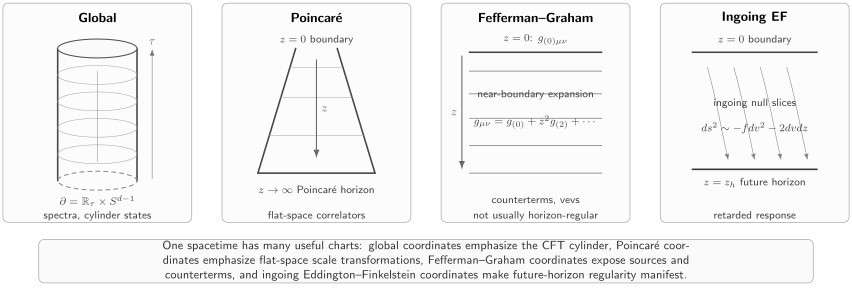
The main coordinate systems used in this course. Global coordinates naturally describe the CFT on the cylinder ; Poincaré coordinates describe a flat-space conformal patch; Fefferman–Graham coordinates expose sources, counterterms, and one-point functions; ingoing Eddington–Finkelstein coordinates are adapted to future horizons and retarded response.
Why coordinates matter in AdS/CFT
Section titled “Why coordinates matter in AdS/CFT”The boundary theory is not sensitive to an arbitrary coordinate label in the bulk. It is sensitive to the conformal structure induced at the AdS boundary, the choice of state, and the boundary conditions imposed on bulk fields. Coordinate systems matter because they make different parts of this structure manifest.
For example:
| Bulk coordinates | Boundary viewpoint | Best use |
|---|---|---|
| global coordinates | CFT on | spectra, normal modes, Hilbert space, global black holes |
| Poincaré coordinates | CFT on | local correlators, RG intuition, black branes |
| Fefferman–Graham coordinates | asymptotic expansion near the boundary | sources, counterterms, stress tensor, vevs |
| Euclidean Poincaré coordinates | CFT on | Euclidean correlators, bulk-to-boundary propagators |
| Schwarzschild-like black-brane coordinates | thermal state with static time | thermodynamics, free energy, entropy |
| ingoing Eddington–Finkelstein coordinates | causal infalling frame | retarded correlators, quasinormal modes, time evolution |
The safest philosophy is this:
but
This distinction prevents many early mistakes. The Poincaré patch is not a different AdS/CFT duality from global AdS. Fefferman–Graham gauge is not a complete global description of a black hole. Schwarzschild time is not the best coordinate for regularity at the future horizon. Each chart answers a different question well.
The embedding-space starting point
Section titled “The embedding-space starting point”It is useful to keep one coordinate-independent definition in the background. Lorentzian is the hyperboloid
inside with metric
The induced metric on this hyperboloid is the AdS metric. Different coordinate systems are different parametrizations of the same surface.
The isometry group is , matching the conformal group of a -dimensional Lorentzian CFT. That group-theoretic fact is often the cleanest way to remember why AdS geometry is the right bulk geometry for a CFT.
Global coordinates
Section titled “Global coordinates”Global coordinates cover the entire AdS hyperboloid, up to the usual issue that the original hyperboloid contains closed timelike curves. In physics we normally pass to the universal cover and let the global time coordinate run over .
A standard parametrization is
where parametrizes . The induced metric is
Here is dimensionless. The physical global time is . If we define
then the same metric becomes
The boundary lies at , or equivalently . Near the boundary,
After stripping off the divergent conformal factor , the boundary metric is
Equivalently, in dimensionless time,
Thus global AdS is naturally dual to the CFT on the cylinder
When to use global coordinates
Section titled “When to use global coordinates”Global coordinates are the right language for questions involving the full CFT Hilbert space. They are especially useful for:
- the state-operator correspondence;
- normal modes and spectra;
- global AdS black holes;
- finite-volume thermal physics on ;
- causal questions involving the full boundary cylinder.
The energy conjugate to global time is the CFT Hamiltonian on the cylinder. For a primary operator of scaling dimension , the corresponding cylinder energy is essentially . This is why global AdS is the natural home of the statement
Poincaré coordinates
Section titled “Poincaré coordinates”Poincaré coordinates are the workhorse of AdS/CFT. They describe a patch of AdS whose boundary is flat Minkowski space.
The metric is
where
The boundary is at . The deep interior of the Poincaré patch is .
The embedding-space map is conveniently written as
This covers the region
So the Poincaré chart is not the entire global AdS spacetime. It is a wedge. This matters when discussing global causality, finite-volume spectra, and states that do not fit inside the Poincaré patch.
Scale transformations are manifest
Section titled “Scale transformations are manifest”The metric is invariant under
On the boundary, this becomes the ordinary scale transformation of the CFT. This is the cleanest first glimpse of the UV/IR relation:
and
A cutoff surface is therefore interpreted as a UV regulator in the boundary theory, with a scale of order
The precise proportionality depends on conventions, Weyl frame, and how the cutoff is implemented. The robust statement is the inverse relation between radial depth and boundary energy scale.
When to use Poincaré coordinates
Section titled “When to use Poincaré coordinates”Poincaré coordinates are ideal for:
- CFT correlators on flat ;
- the GKP/Witten prescription in its simplest form;
- bulk-to-boundary propagators;
- planar black branes;
- translationally invariant states;
- momentum-space calculations.
The price is that global features are hidden. The surface is called the Poincaré horizon in pure AdS. It is not a curvature singularity and not a black-hole horizon. It is a horizon of the coordinate patch.
Global boundary versus Poincaré boundary
Section titled “Global boundary versus Poincaré boundary”The boundary of global AdS is the cylinder . The boundary of the Poincaré patch is Minkowski space , plus subtleties at the Poincaré horizon and points at infinity.
These are related by a conformal map. Let the cylinder metric be
Let be the radial coordinate on Minkowski space, so that
A standard map is
Then
Thus Minkowski space is conformal to a patch of the cylinder. This is the boundary reason why global AdS and the Poincaré patch describe different conformal frames and different regions of the same underlying conformal compactification.
Euclidean AdS
Section titled “Euclidean AdS”The Euclidean continuation of Poincaré AdS is
This space is hyperbolic space . It is the standard arena for Euclidean CFT correlators. The boundary is at , together with the usual point at infinity after conformal compactification.
Euclidean AdS is especially useful because elliptic boundary-value problems are cleaner than Lorentzian initial-boundary-value problems. For example, the scalar bulk-to-boundary propagator in Euclidean Poincaré AdS takes the schematic form
This formula is one of the first workhorses for deriving CFT two-point functions holographically.
Fefferman–Graham coordinates
Section titled “Fefferman–Graham coordinates”Fefferman–Graham coordinates are not just another chart. They are the near-boundary gauge in which the holographic dictionary becomes systematic.
For an asymptotically locally AdS spacetime, the metric can be written near the boundary as
The boundary lies at . The leading term in the expansion of defines the boundary metric representative:
More generally, for an even boundary dimension , logarithmic terms can appear:
The coefficient is the source for the CFT stress tensor. Roughly speaking, contains the state-dependent information from which is extracted, after adding the appropriate counterterms and local anomaly terms.
This is why Fefferman–Graham gauge is central in holographic renormalization:
What Fefferman–Graham coordinates do not do
Section titled “What Fefferman–Graham coordinates do not do”Fefferman–Graham coordinates are adapted to the boundary, not necessarily to the whole spacetime. They can break down at horizons, caustics, or other places where the family of geodesics normal to the cutoff surface becomes singular.
This is a common practical point. Use Fefferman–Graham coordinates to read off boundary data. Use other coordinates to solve a problem globally if they are better adapted to horizons or time evolution.
Planar black-brane coordinates
Section titled “Planar black-brane coordinates”The finite-temperature state of a CFT on flat space is dual, in the simplest Einstein-gravity setting, to a planar AdS black brane. In Schwarzschild-like coordinates,
with
The boundary is at . The future event horizon is at
The Hawking temperature is
The entropy density is the horizon area density divided by :
These formulas are the geometric beginning of thermal holography:
and
The Schwarzschild-like coordinate is excellent for thermodynamics, but the metric component diverges at the horizon. This is a coordinate singularity, not a curvature singularity. For real-time response, we usually switch to horizon-regular coordinates.
Ingoing Eddington–Finkelstein coordinates
Section titled “Ingoing Eddington–Finkelstein coordinates”For the black brane, define the tortoise coordinate by
An ingoing time coordinate is
Then
Substituting into the black-brane metric gives
This metric is regular at the future horizon in the coordinates relevant for infalling observers. The coordinate labels ingoing null slices.
In pure Poincaré AdS, where , the same transformation is simply
and the metric becomes
Why this chart matters for retarded correlators
Section titled “Why this chart matters for retarded correlators”The retarded Green’s function asks how the system responds after a source is applied. In the bulk, the causal prescription is that perturbations should be infalling at the future horizon. Ingoing Eddington–Finkelstein coordinates make this condition smooth rather than singular.
That is why many real-time and numerical calculations are performed in EF-like coordinates. They are also the natural coordinates for characteristic evolution in gravitational collapse, Vaidya geometries, and time-dependent black brane backgrounds.
Global AdS black holes
Section titled “Global AdS black holes”For a CFT on at finite temperature, the relevant static bulk geometries are not planar black branes but global AdS black holes. A common form is
where, for the uncharged Einstein-gravity black hole,
The horizon radius is determined by
Planar black branes and global black holes are locally similar near sufficiently large horizons, but they represent different boundary systems:
This distinction becomes important in the Hawking–Page transition and in discussions of confinement/deconfinement analogies.
A coordinate user’s guide
Section titled “A coordinate user’s guide”Here is a quick decision tree.
Use global coordinates when…
Section titled “Use global coordinates when…”You care about the entire boundary cylinder, normal modes, global causal structure, or states created by local operators in radial quantization.
Typical question:
Use Poincaré coordinates when…
Section titled “Use Poincaré coordinates when…”You care about flat-space correlators, translationally invariant states, or simple scale transformations.
Typical question:
Use Fefferman–Graham coordinates when…
Section titled “Use Fefferman–Graham coordinates when…”You need to identify sources, expectation values, conformal anomalies, or the boundary stress tensor.
Typical question:
Use black-brane coordinates when…
Section titled “Use black-brane coordinates when…”You want temperature, entropy, free energy, static thermodynamics, or equilibrium transport.
Typical question:
Use ingoing Eddington–Finkelstein coordinates when…
Section titled “Use ingoing Eddington–Finkelstein coordinates when…”You want retarded Green’s functions, infalling boundary conditions, quasinormal modes, time-dependent backgrounds, or numerical evolution across a future horizon.
Typical question:
Dictionary checkpoint
Section titled “Dictionary checkpoint”Coordinate systems translate into boundary language as follows.
| Bulk statement | Boundary interpretation |
|---|---|
| global boundary is | CFT quantized on the cylinder |
| Poincaré boundary is | CFT in flat-space conformal frame |
| ultraviolet boundary scale | |
| large | infrared radial depth |
| Fefferman–Graham leading metric | source for |
| black-brane horizon at | thermal state with |
| horizon area density | entropy density |
| ingoing EF regularity | retarded/infalling prescription |
The deepest lesson is that the CFT does not live at a particular radial coordinate. It lives at the conformal boundary. The radial coordinate organizes how bulk fields approach that boundary and how energy scales are represented geometrically.
Common confusions
Section titled “Common confusions”“The Poincaré patch is all of AdS.”
Section titled ““The Poincaré patch is all of AdS.””It is not. Poincaré coordinates cover only the region of the full AdS hyperboloid. They are perfect for many local CFT questions on flat space, but global questions may require global coordinates.
“The Poincaré horizon is a black-hole horizon.”
Section titled ““The Poincaré horizon is a black-hole horizon.””In pure AdS, is a coordinate horizon of the Poincaré patch. It is not associated with thermal entropy. A black-brane horizon at is physically different: it corresponds to a thermal state and has a nonzero horizon area density.
“Fefferman–Graham coordinates are always the best coordinates.”
Section titled ““Fefferman–Graham coordinates are always the best coordinates.””They are best near the boundary. They are not necessarily good at horizons. Holographic renormalization likes Fefferman–Graham gauge; real-time horizon physics often likes Eddington–Finkelstein gauge.
“Changing the boundary metric representative changes the theory.”
Section titled ““Changing the boundary metric representative changes the theory.””A CFT is naturally defined on a conformal class of metrics, though Weyl anomalies and sources can make the details important. Global-cylinder and flat-space descriptions are related by conformal transformations, but the state and operator insertions must be transformed carefully.
“The sign of the EF cross term is universal.”
Section titled ““The sign of the EF cross term is universal.””The sign depends on whether the radial coordinate increases inward or outward and on whether one uses ingoing or outgoing null coordinates. In this course, with increasing inward, ingoing EF coordinates for the black brane give
Other papers may use , in which case the corresponding cross term often has the opposite sign.
Exercises
Section titled “Exercises”Exercise 1: Derive the global AdS metric
Section titled “Exercise 1: Derive the global AdS metric”Starting from
with , derive
Solution
Compute the embedding metric
The first two coordinates give
For , using and , one obtains
Adding the two contributions gives
which is the desired metric.
Exercise 2: Check the Poincaré scaling isometry
Section titled “Exercise 2: Check the Poincaré scaling isometry”Show that
is invariant under
Solution
Under the transformation,
Therefore the numerator transforms as
while the denominator transforms as
The factors cancel, so the metric is invariant. On the boundary this is the ordinary scale transformation of the CFT.
Exercise 3: Derive the planar black-brane temperature
Section titled “Exercise 3: Derive the planar black-brane temperature”For
show that
Solution
Go to Euclidean time . Near the horizon, set
Define
Then
Near the horizon, the Euclidean part of the metric is
Define a radial coordinate by
Then
The near-horizon metric becomes
Smoothness at the origin requires the angular coordinate
to have period . Therefore
Exercise 4: Convert Schwarzschild time to ingoing EF time
Section titled “Exercise 4: Convert Schwarzschild time to ingoing EF time”Starting from the black-brane metric and defining
show that the metric becomes
Solution
From
we get
Substitute into
This gives
The last two terms cancel, leaving
Therefore
Further reading
Section titled “Further reading”- O. Aharony, S. S. Gubser, J. Maldacena, H. Ooguri, and Y. Oz, Large Field Theories, String Theory and Gravity.
- E. Witten, Anti de Sitter Space and Holography.
- K. Skenderis, Lecture Notes on Holographic Renormalization.
- G. W. Gibbons, Anti-de-Sitter Spacetime and Its Uses.
- C. A. Ballon Bayona and N. R. F. Braga, Anti-de Sitter Boundary in Poincaré Coordinates.