
Metallic Transport Without Quasiparticles
The previous pages described finite-density holographic states: charged black branes, throats, and more general EMD scaling geometries. We now ask the question that makes these states look like metals rather than just finite-density thermal states:
For a conventional metal, the first answer is almost automatic: quasiparticles carry charge, heat, and momentum. The second answer is then phrased in terms of scattering events. Impurities, phonons, and Umklapp processes relax the quasiparticle distribution, and the Boltzmann equation turns this microscopic relaxation into the DC conductivity.
Holographic metals force a different organization. The low-energy theory need not contain long-lived quasiparticles at all. But it still has conserved densities: charge, energy, and, if translations are unbroken, momentum. At long times, a strongly interacting system is therefore not best described as a dilute gas. It is best described as a fluid.
This gives the central lesson of the page:
When that overlap is nonzero, current cannot fully decay unless momentum also decays. This is the momentum bottleneck. It is one of the most important ideas in holographic quantum matter, and it is also one of the most common sources of confusion. A fast microscopic equilibration time does not by itself imply a finite DC resistivity. A strongly coupled plasma can equilibrate rapidly and still have infinite DC conductivity if translations are exact.
In this page, is the number of boundary spatial dimensions. We mostly suppress spatial indices and work in an isotropic state at nonzero charge density , entropy density , temperature , chemical potential , energy density , pressure , and momentum susceptibility . In a relativistic fluid,
In nonrelativistic Galilean systems, is the mass density. In more general lattice or Lifshitz-like theories, is simply the static susceptibility relating momentum density to a uniform velocity source.
The metal is not the scattering rate
Section titled “The metal is not the scattering rate”A tempting but dangerous slogan is
where is some short microscopic time. This is often useful in elementary Drude theory, but it is not a general principle. A DC resistivity is controlled by the decay of the part of the electrical current that overlaps with conserved or nearly conserved quantities. At finite density, the most important such quantity is momentum.
Suppose the system is perfectly translationally invariant. Then the total momentum is conserved:
Now turn on a small electric field . At nonzero charge density, the electric field injects momentum into the fluid. Schematically,
If there is no mechanism for momentum to leave the electronic system, the fluid accelerates. The current grows, and the zero-frequency conductivity is singular. This is not because the fluid failed to thermalize. It is because it thermalized subject to a conserved total momentum.
This is the right hydrodynamic version of a familiar phenomenon. In a clean electron—phonon system, an electron can scatter off a phonon, but the momentum has merely moved from the electron sector into the phonon sector. Unless momentum eventually escapes to a lattice, impurity background, boundary, or external bath, the combined system keeps flowing.
In a holographic metal, this logic is built in from the start. The charged horizon rapidly absorbs local disturbances and produces dissipation, but global momentum conservation remains a boundary conservation law. The bulk horizon can dissipate the incoherent part of a current. It cannot by itself violate an exact boundary translation symmetry.
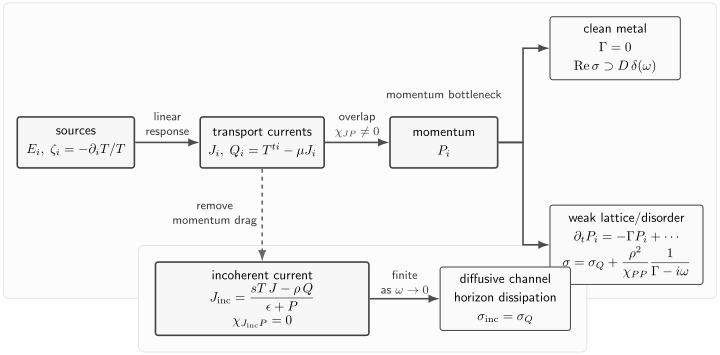
The momentum bottleneck in a finite-density metal. Sources drive electric and heat currents. If these currents overlap with conserved momentum , the clean DC response contains a delta function. Weak translation breaking gives a narrow Drude peak with width . The incoherent current is constructed to have zero overlap with momentum and therefore remains finite in the clean limit.
Thermoelectric response
Section titled “Thermoelectric response”At finite density, electrical and thermal transport should be discussed together. The natural linear-response matrix is
Here
is the heat current, and
is the thermal drive. The coefficient is the thermal conductivity at zero electric field. The experimentally common thermal conductivity at zero electric current is instead
In time-reversal invariant isotropic systems, Onsager reciprocity gives
The distinction between and is not cosmetic. In a clean charged fluid, , , and all contain divergent pieces because the fluid velocity carries charge and heat. But the open-circuit thermal conductivity can remain finite, because imposing removes the momentum-carrying sound channel.
The Kubo formulas are obtained by coupling to a boundary gauge field and to a boundary metric perturbation. In an isotropic state, for example,
up to the usual contact terms fixed by the precise source convention. Holographically, is read from a bulk Maxwell flux, while is read from a mixed gauge—metric flux. The important conceptual point is that these fluxes are not independent at finite density: gauge-field perturbations and metric perturbations mix.
Clean charged hydrodynamics
Section titled “Clean charged hydrodynamics”Consider an isotropic charged fluid in the translationally invariant limit. At long wavelengths, its hydrodynamic variables are
For small velocities , the ideal parts of the charge and heat currents are
The momentum density is
In a relativistic fluid, , so this becomes
There is also a dissipative part of the current. In a relativistic charged fluid, a convenient first-order constitutive relation is
The coefficient is often called the quantum critical conductivity, the incoherent conductivity, or simply the intrinsic conductivity. It measures the part of charge transport that does not rely on dragging momentum.
The heat current is then
Now apply uniform sources with frequency . Momentum conservation becomes
Equivalently,
Substituting back into the currents gives the clean-limit thermoelectric conductivities. In the relativistic convention above,
Similarly,
and
The symbol should be understood with the retarded prescription:
Therefore the real part of the conductivity contains a zero-frequency delta function. A clean finite-density fluid is a perfect conductor, even if it has no quasiparticles.
The open-circuit thermal conductivity is finite. Taking the limit after forming
one obtains
This result is a clean example of why transport in a fluid is not reducible to a single relaxation time. The closed-circuit thermal response is dragged by momentum; the open-circuit thermal response removes the charged flow and leaves an intrinsic dissipative channel.
Drude weight from current—momentum overlap
Section titled “Drude weight from current—momentum overlap”The clean-limit divergence is not an accident of hydrodynamics. It follows from a general operator statement. If an electrical current overlaps with any conserved quantity, the conductivity contains a delta function.
Let be conserved operators, orthogonalized with respect to the static susceptibility inner product. A schematic Mazur-Suzuki bound says
where is the Drude weight. If momentum is the only relevant conserved vector operator, this gives
in the simplest isotropic case. For a relativistic fluid,
This formula is beautifully minimal. It does not mention quasiparticles, Fermi surfaces, mean free paths, or a Boltzmann equation. It only says that a uniform current has a projection onto a conserved momentum.
The result also explains why zero-density relativistic CFTs are different. At , the electric current has no overlap with momentum by charge-conjugation symmetry, so can be finite even when translations are exact. This was the setting of quantum critical transport on the previous thermal pages.
The incoherent current
Section titled “The incoherent current”The most useful way to isolate intrinsic dissipation is to build a current with no momentum overlap. In a relativistic charged fluid, define
Using the ideal current relations
we see that the velocity cancels:
Therefore
This current diffuses rather than propagates as sound. In the simple relativistic constitutive relations above, its conductivity is just
This is one of the central objects in holographic metallic transport. It is the part of electrical response that the horizon can dissipate without first asking whether boundary momentum is exactly conserved.
The associated hydrodynamic mode is an incoherent diffusion mode. It is not ordinary charge diffusion at fixed energy, nor ordinary heat diffusion at fixed charge; it is the diffusive eigenmode orthogonal to pressure and momentum perturbations.
In a charged fluid, linearized hydrodynamics has the following structure:
The sound mode carries momentum, heat, and charge. This is the mode responsible for the clean Drude singularity. The incoherent mode is the one that remains finite in the strict clean limit.
Weak momentum relaxation
Section titled “Weak momentum relaxation”Real materials are not perfectly translationally invariant. They have lattices, disorder, impurities, boundaries, phonons, and sometimes spatially modulated order. In holography, translation breaking can be modeled by explicit lattices, random sources, linear axions, Q-lattices, helical sources, massive gravity, or fully inhomogeneous boundary conditions. The next page treats these mechanisms in detail. Here we first describe the universal low-frequency structure when momentum relaxation is weak.
Assume momentum is no longer exactly conserved but is long-lived:
Here is the momentum relaxation rate. The hydrodynamic regime assumes
where is the local equilibration time. In holographic non-quasiparticle fluids, is typically of order , so a small produces a narrow low-frequency peak sitting on top of a broader incoherent background.
Solving the momentum equation at frequency gives
Thus the thermoelectric matrix takes the universal coherent-plus-incoherent form
The electrical conductivity is
This is a generalized Drude formula. It looks like the elementary Drude result, but the meaning is different. In the quasiparticle Drude model, is often interpreted as a single-particle scattering rate. In a hydrodynamic metal without quasiparticles, is the relaxation rate of a collective conserved quantity.
The DC conductivity is
When is small, the coherent term dominates. The resistivity is then approximately
assuming . The superscript reminds us not to confuse charge density with electrical resistivity.
The optical conductivity has a narrow Drude peak of width :
In the limit , this peak becomes the delta function of the clean theory.
Coherent and incoherent metals
Section titled “Coherent and incoherent metals”This gives a useful classification.
A coherent metal has a long-lived momentum mode:
in units with , or more generally . Its optical conductivity has a visible Drude-like peak. The peak is not proof of quasiparticles; it may be a hydrodynamic momentum peak.
An incoherent metal has no long-lived momentum mode controlling the current. This can happen because momentum is strongly relaxed, or because the current has little overlap with momentum. The transport is then dominated by diffusion and intrinsic conductivities such as .
In an incoherent hydrodynamic metal, momentum is not a hydrodynamic variable. The remaining conservation laws are charge and energy:
The constitutive relations take the diffusive form
Together with thermodynamic susceptibilities,
the conservation equations become coupled diffusion equations. In matrix form,
where
This is the generalized Einstein relation: conductivity equals diffusivity times susceptibility. In an incoherent metal, diffusion constants are the natural transport data.
The memory-matrix formula
Section titled “The memory-matrix formula”Hydrodynamics tells us what happens if we know . The memory-matrix formalism tells us how to compute when translations are weakly broken.
Suppose the clean Hamiltonian is translationally invariant, and we add a weak spatially dependent source:
Translations are explicitly broken because depends on position. The momentum is no longer conserved. Using as the generator of translations,
At leading order in the weak source, the momentum relaxation rate is
This formula is the non-quasiparticle analog of Fermi’s golden rule. The source supplies momentum . The clean strongly coupled fluid supplies spectral weight at that momentum and low energy. Momentum can relax efficiently only if the clean theory contains low-energy degrees of freedom at the wavevector into which the lattice or disorder scatters.
For a single periodic lattice,
the formula reduces schematically to
This is a powerful expression because it separates transport into two questions:
- What operator breaks translations?
- How much low-energy spectral weight does the clean IR theory have at the corresponding momentum?
The second question is where the geometry matters. For many finite- scaling geometries, low-energy spectral weight at fixed nonzero is exponentially suppressed. Then a lattice is inefficient at relaxing momentum, and the Drude peak is extremely narrow. In semi-local geometries, low-energy spectral weight can remain available at nonzero , and momentum relaxation can follow a power law in temperature.
For an -like IR, one often finds
at zero temperature, with the finite-temperature scaling form implying
The resulting resistivity in the coherent regime is
This is not a universal prediction of holography. It is a prediction of a specific clean IR scaling theory plus a specific translation-breaking operator. The moral is better than a single exponent: transport is controlled by the spectral weight available to absorb momentum.
Holographic interpretation
Section titled “Holographic interpretation”In the bulk, translation symmetry of the boundary is tied to diffeomorphism invariance. The boundary momentum density is dual to metric perturbations . The electrical current is dual to gauge-field perturbations . At finite density, the background electric field couples these two fluctuation sectors.
That coupling is the bulk avatar of the current—momentum overlap.
In the clean charged black brane, the relevant perturbations satisfy coupled linearized Einstein—Maxwell equations. The low-frequency solution contains a mode corresponding to boosting the entire black brane. This is the gravitational version of the hydrodynamic velocity . Because a boost costs no relaxation in the translationally invariant theory, the conductivity has the clean pole.
Translation breaking changes this story. In the bulk, it can appear as:
- a spatially modulated boundary source, requiring inhomogeneous bulk fields;
- scalar profiles such as , often called linear axions;
- Q-lattices or helical lattices, which preserve homogeneous ODEs by combining spatial translations with internal rotations;
- massive gravity, where the graviton effectively acquires a mass and momentum is not conserved;
- random boundary sources, producing disordered horizons.
In weak translation breaking, all these mechanisms reduce to the same hydrodynamic-memory-matrix structure. In strong translation breaking, the details matter, and one often needs horizon Stokes equations or full numerical relativity in the bulk. That is the subject of the next page.
Wiedemann—Franz and what replaces it
Section titled “Wiedemann—Franz and what replaces it”A Fermi liquid at low temperature obeys the Wiedemann—Franz law,
under the usual assumptions that the same quasiparticles carry heat and charge and that elastic scattering dominates.
A holographic metal need not obey this law. The reason is transparent in hydrodynamics. Charge, heat, and momentum are distinct collective variables. Depending on the measurement protocol, heat and charge can either be jointly dragged by momentum or arranged so that the momentum-drag channel cancels out.
In a clean charged relativistic fluid,
Therefore
in the strict clean DC limit. This is a dramatic violation of Wiedemann—Franz behavior, but not a mystery. The electrical current overlaps with conserved momentum; the open-circuit heat current has had that overlap subtracted.
With weak momentum relaxation, the Lorenz ratio becomes a diagnostic of which channel dominates. If the coherent Drude peak dominates both heat and charge transport, thermoelectric susceptibilities control the ratio. If the incoherent channel dominates, the intrinsic diffusion matrix controls it. In neither case is the Fermi-liquid Lorenz number guaranteed.
Common pitfalls
Section titled “Common pitfalls”Pitfall 1: “Strong interactions make the resistivity finite.”
Not by themselves. Strong interactions can equilibrate the fluid quickly, but if they conserve total momentum and current overlaps with momentum, they cannot produce a finite DC resistivity.
Pitfall 2: “The holographic horizon is a momentum sink.”
The horizon is dissipative, but it does not violate exact boundary conservation laws. A clean charged black brane has a horizon and still has infinite DC conductivity at nonzero density.
Pitfall 3: “A Drude peak means quasiparticles.”
A Drude peak means a long-lived current-carrying mode. In a holographic metal, that mode is often hydrodynamic momentum.
Pitfall 4: “ is a small correction.”
In coherent metals, may be a subleading background under a large Drude peak. In incoherent metals, it can be the main transport coefficient.
Pitfall 5: “Linear-in- resistivity follows from .”
A Planckian equilibration time is suggestive but insufficient. The DC resistivity depends on momentum relaxation, current overlap, and the spectral weight of the operator that breaks translations.
Worked example: charged relativistic fluid
Section titled “Worked example: charged relativistic fluid”Let us derive the electrical conductivity in the simplest clean relativistic hydrodynamic setting.
Use
for a uniform electric field and no temperature gradient. Momentum conservation gives
Since
Fourier transforming in time gives
Thus
The current is
Therefore
A small momentum relaxation rate is included by replacing
which yields
That is the hydrodynamic Drude peak.
Exercises
Section titled “Exercises”Exercise 1: Clean-limit delta function
Section titled “Exercise 1: Clean-limit delta function”Consider a translationally invariant relativistic charged fluid with constitutive relation
and momentum density
Use momentum conservation in a uniform electric field to derive the singular part of .
Solution
Momentum conservation gives
Fourier transforming,
Thus
Substituting into the current,
Therefore
With the retarded prescription, contains in its real part. The clean DC conductivity is singular whenever .
Exercise 2: Incoherent current
Section titled “Exercise 2: Incoherent current”Show that
has no ideal velocity contribution in a relativistic charged fluid.
Solution
The ideal current relations are
Therefore
So has no overlap with the hydrodynamic velocity and hence no overlap with momentum. This is why its conductivity can remain finite even in the translationally invariant limit.
Exercise 3: Generalized Drude formula
Section titled “Exercise 3: Generalized Drude formula”Assume weak momentum relaxation,
and use and . Derive .
Solution
Fourier transforming gives
Thus
The current is therefore
Hence
Exercise 4: Memory-matrix relaxation rate for a periodic lattice
Section titled “Exercise 4: Memory-matrix relaxation rate for a periodic lattice”Let
Show that the leading memory-matrix estimate of the momentum relaxation rate has the form
Solution
The momentum operator generates translations. The translation-breaking source gives
For
we have
The memory-matrix formula is schematically
Because is proportional to , the correlator is proportional to . Thus
The precise numerical prefactor depends on Fourier-transform conventions and on whether the cosine is written as two complex modes.
Exercise 5: Why Wiedemann—Franz can fail cleanly
Section titled “Exercise 5: Why Wiedemann—Franz can fail cleanly”In the clean relativistic charged fluid, use
where , to show that is finite as .
Solution
Compute
The terms proportional to cancel between and . Keeping the finite term gives
This can be written as
Using , we obtain
Thus diverges in the clean limit while is finite. The Wiedemann—Franz ratio therefore goes to zero in this limit.
Further reading
Section titled “Further reading”- S. A. Hartnoll, A. Lucas, and S. Sachdev, Holographic Quantum Matter, sections 5.1—5.6, for the momentum bottleneck, thermoelectric matrix, hydrodynamic Drude weights, incoherent conductivity, and memory-matrix formalism.
- J. Zaanen, Y. Liu, Y.-W. Sun, and K. Schalm, Holographic Duality in Condensed Matter Physics, chapter 12, for a condensed-matter-facing discussion of translation breaking, memory matrices, lattices, and massive gravity.
- S. A. Hartnoll, Theory of universal incoherent metallic transport, for the modern language of incoherent metals and diffusion-dominated transport.
- R. A. Davison and B. Goutéraux, work on momentum relaxation and incoherent transport, for systematic hydrodynamic and holographic treatments beyond the simplest relativistic model.
- A. Lucas and S. Sachdev, reviews and lectures on hydrodynamic transport, memory matrices, and strange metals, for a broader field-theory perspective.