
Double Holography
Guiding question. Why can a quantum extremal island problem in a lower-dimensional gravitating theory sometimes be redrawn as an ordinary classical RT/HRT problem in one higher dimension?
The island formula is powerful, but it contains a hard term:
The gravitational part is local and geometric. The difficult part is often the matter entropy , especially outside two-dimensional conformal field theory. Double holography is the trick of choosing the matter sector to have its own holographic dual. Then the matter entropy is computed by an RT/HRT surface in an auxiliary higher-dimensional spacetime. The quantum-corrected island problem in the brane description becomes an ordinary classical extremal-surface problem in the ambient bulk.
The useful slogan is
The slogan should not be read as a new independent postulate. It is a realization of the same generalized-entropy rule in a special class of theories where the matter entropy is geometrized.
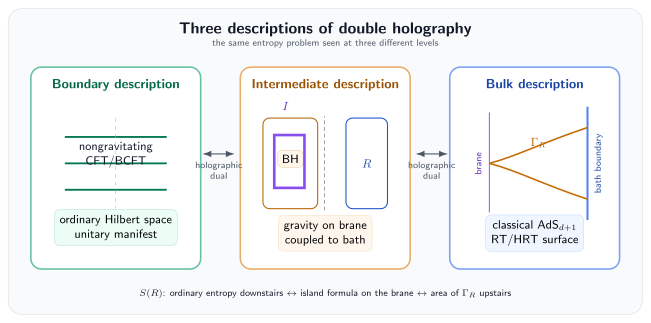
Double holography relates three descriptions. The boundary description is a nongravitating quantum system. The intermediate description is a gravitating brane coupled to a bath, where radiation entropies are computed by the island formula. The higher-dimensional description replaces the strongly coupled matter entropy by a classical RT/HRT surface in an ambient bulk.
This page is a bridge. The previous pages explained the island formula and replica-wormhole derivation. Here the same Page transition is seen as a familiar RT/HRT phase transition.
1. What is being doubled?
Section titled “1. What is being doubled?”Ordinary holography gives two descriptions of one system:
Double holography adds one more layer. A useful setup has a lower-dimensional gravitating region, often a brane, coupled to a nongravitating bath. The matter living on the brane and bath is itself a large- holographic CFT. Therefore it has a higher-dimensional classical dual.
The same physics can then be organized in three languages.
| Description | What is dynamical? | How is computed? | What the island looks like |
|---|---|---|---|
| Boundary quantum system | Nongravitating microscopic degrees of freedom | In principle from | No separate spacetime region is fundamental |
| Brane/bath description | Lower-dimensional gravity on a brane plus quantum matter and a bath | Island formula with | A region in the gravitating brane spacetime |
| Ambient-bulk description | Classical gravity in one higher dimension, with a brane | RT/HRT surface anchored to | The intersection of the entanglement wedge of with the brane |
The word “double” refers to two holographic steps. The brane theory has a holographic dual, and the matter entropy appearing in the brane description is itself computed holographically.
A common cartoon is a Karch–Randall or AdS/BCFT-like geometry. A brane cuts off part of an asymptotically AdS bulk. The brane carries induced gravity. A nongravitating bath is attached to the brane or to the asymptotic boundary. A black hole localized on the brane emits radiation into the bath. The radiation entropy can be computed either by the brane island formula or by a higher-dimensional extremal surface.
2. The three descriptions
Section titled “2. The three descriptions”Boundary description
Section titled “Boundary description”At the most microscopic level, there is a nongravitating quantum theory: for example a boundary CFT, a defect CFT, a BCFT, or a pair of coupled quantum systems. The radiation region is an ordinary subsystem, so its entropy is simply
This description is conceptually clean but often computationally inaccessible. It contains no fundamental island region. Islands are emergent features of a semiclassical gravitational description.
Brane/bath description
Section titled “Brane/bath description”The intermediate description contains a lower-dimensional gravitating brane coupled to nongravitating bath degrees of freedom. A black hole can live on the brane. The radiation region lies in the nongravitating bath. In this description the island formula reads schematically
where is the effective Newton constant for brane gravity. If the brane theory is two-dimensional, the area term is replaced by the appropriate dilaton entropy evaluated at the island endpoints.
This is where the island is most naturally named: is a region on the gravitating brane that is included with the bath region in the entropy functional.
Ambient-bulk description
Section titled “Ambient-bulk description”In the higher-dimensional description, the strongly coupled CFT matter has been replaced by classical geometry. The brane is embedded in a higher-dimensional asymptotically AdS spacetime. The entropy of is computed by an RT/HRT surface in the ambient bulk:
The ellipsis may include brane-localized area terms if the model contains an explicit brane Einstein-Hilbert action, and quantum corrections if the ambient bulk is not treated strictly classically. In the cleanest large- limit, the leading answer is just the area of a classical extremal surface.
The island arises because may end on or pass through the brane in such a way that the entanglement wedge of intersects the brane in a nontrivial region. That intersection is the brane island.
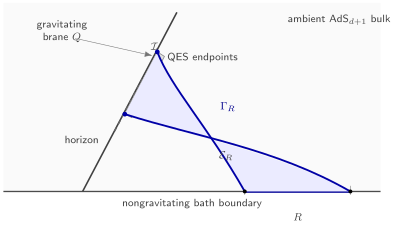
In the ambient-bulk description, the entropy of the bath region is computed by an RT/HRT surface . When the dominant surface reaches the brane, its endpoint determines the island boundary in the brane description. The entanglement wedge of then includes the island .
3. How the island functional becomes an area functional
Section titled “3. How the island functional becomes an area functional”Suppose the matter theory appearing in the brane/bath description is a holographic CFT. Then its entropy is computed by an extremal surface in one higher dimension:
Substituting this into the island formula gives
This expression is already almost a higher-dimensional RT/HRT prescription. The extra extremization over tells the higher-dimensional surface where it may attach to the brane. In the ambient-bulk picture, the brane endpoint is not added by hand; it is part of the extremal-surface variational problem.
For a simple model with no explicit brane Einstein-Hilbert term, the surface satisfies an orthogonality condition at the brane. With a brane-localized gravitational entropy term, the endpoint condition is modified. The modified condition is the geometric version of the QES equation:
Thus the brane QES condition is not mysterious in double holography. It is the endpoint variation of a higher-dimensional extremal surface.

The brane description uses a generalized entropy functional: a brane gravitational term plus a matter entropy. If the matter sector is holographic, the matter entropy is itself an RT/HRT area. Extremizing over the island endpoint and the auxiliary surface is equivalent to extremizing a higher-dimensional geometric surface.
4. The brane, the bath, and localized gravity
Section titled “4. The brane, the bath, and localized gravity”A useful double-holographic model typically has a brane embedded in an ambient spacetime . A schematic gravitational action is
Here is the brane tension and is the induced metric on . In AdS/BCFT-like models, the brane is an end-of-the-world brane obeying a Neumann-type boundary condition. In Karch–Randall-like models, the brane can support localized gravity. The effective Newton constant on the brane is controlled by the ambient Newton constant and the radial extent of the gravitational wavefunction; schematically,
where depends on the brane embedding, cutoff, and dimension. The precise coefficient is model-dependent and not important for the island logic.
The bath is a nongravitating region that can absorb Hawking radiation. In the ambient-bulk picture, it is usually represented by an asymptotic boundary region. The brane black hole and bath are coupled by transparent boundary conditions, so radiation can leave the brane system and be collected in .
The virtue of this setup is that the black hole on the brane can be highly quantum from the brane viewpoint while being represented by a classical higher-dimensional geometry. That is the regime where double holography is most useful: lower-dimensional quantum gravity is hard, but higher-dimensional classical geometry is tractable.
5. Islands as entanglement-wedge intersections
Section titled “5. Islands as entanglement-wedge intersections”The most invariant statement is not that “the RT surface ends at the island.” Rather:
Here is the higher-dimensional entanglement wedge of the bath region , and is the gravitating brane. Before the Page transition, the entanglement wedge of does not include a black-hole interior region on the brane. After the transition, it does.
This interpretation makes the reconstruction meaning transparent. The island is the part of the brane geometry that belongs to the entanglement wedge of the radiation. Therefore operators in the island should be reconstructible from the radiation degrees of freedom, in the same sense that ordinary entanglement wedge reconstruction reconstructs bulk operators from a boundary subregion.
There is no local signal from to . The connection is a fine-grained encoding relation. Double holography makes the encoding geometric by drawing a higher-dimensional wedge, but it does not convert entanglement into a causal channel.
6. The Page transition as an RT/HRT phase transition
Section titled “6. The Page transition as an RT/HRT phase transition”In the brane description, the Page transition is a switch between the no-island and island saddles:
In the ambient-bulk description, the same transition is a switch between two classical extremal surfaces:
The no-island surface computes the Hawking-like entropy and grows with the collected radiation. The island surface pays an area cost associated with the brane QES but includes the relevant interior partners in the same entropy wedge. After the Page time, the island surface has smaller area.
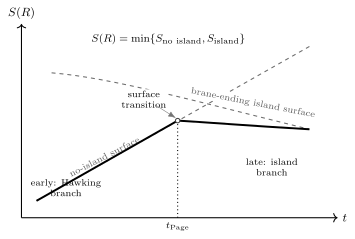
The Page transition is a saddle switch. In the brane description, the dominant generalized-entropy saddle changes from no island to island. In the ambient-bulk description, this is an ordinary RT/HRT phase transition between two candidate extremal surfaces anchored to the radiation region .
This is why double holography is pedagogically powerful. The island formula can look alien because the radiation entropy appears to be computed by adding a spacetime region behind the horizon. In double holography, the same event is the familiar phenomenon that the minimal RT surface can change topology or homology class.
7. A simple geometric dictionary
Section titled “7. A simple geometric dictionary”The following dictionary is useful when moving between descriptions.
| Brane/bath language | Ambient-bulk language |
|---|---|
| Radiation region | Boundary subregion anchoring |
| Candidate island | Intersection |
| Island boundary | Endpoint/contact locus of on the brane |
| Matter entropy | Area of an auxiliary RT/HRT surface |
| QES equation | Extremal-surface endpoint condition |
| Page transition | RT/HRT phase transition |
| Island reconstruction | Entanglement wedge reconstruction for |
There is also a useful warning. The higher-dimensional entanglement wedge is a geometric object in the ambient bulk. The lower-dimensional island is the part of that wedge lying on the gravitating brane. Confusing the two can lead to sloppy statements such as “the radiation contains the whole higher-dimensional bulk.” The correct statement is region-dependent and code-subspace-dependent.
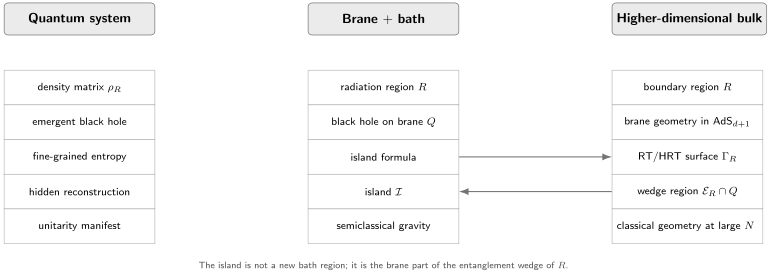
Double holography translates lower-dimensional quantum-gravity questions into higher-dimensional classical geometry. The island formula, Page transition, and radiation reconstruction become statements about RT/HRT surfaces and entanglement wedges in the ambient bulk.
8. Relation to AdS/BCFT and Karch–Randall branes
Section titled “8. Relation to AdS/BCFT and Karch–Randall branes”Double-holographic island models borrow ingredients from two older holographic constructions.
In AdS/BCFT, a conformal field theory with a boundary is dual to an asymptotically AdS spacetime ending on an end-of-the-world brane. The brane tension determines the angle at which the brane sits in the ambient geometry. RT surfaces may end on the brane, and this gives geometric access to boundary entropy and boundary-condition data.
In Karch–Randall-type braneworlds, an AdS brane embedded in a higher-dimensional AdS space supports localized lower-dimensional gravity. The graviton is often not exactly massless in the simplest noncompact constructions, but gravity can be approximately lower-dimensional over a range of scales. This is enough for many double-holographic island models, where the brane black hole is a lower-dimensional quantum-gravitational object completed by a higher-dimensional classical dual.
These details matter because double holography is not a single model. It is a framework. Different choices of brane tension, bath coupling, dimension, matter theory, and boundary conditions give different computational laboratories.
9. Why double holography is useful
Section titled “9. Why double holography is useful”Double holography has three major virtues.
First, it gives a geometric picture of islands. Instead of directly computing a hard matter entropy in a strongly coupled theory, one draws extremal surfaces in a higher-dimensional spacetime.
Second, it extends the island story beyond purely two-dimensional conformal-matter calculations. In two dimensions, matter entropies can often be computed analytically by conformal maps. In higher dimensions, those entropies are much harder. If the matter is holographic, the entropy is again geometric.
Third, it gives intuition for reconstruction. Once the island is literally the intersection of the radiation entanglement wedge with the brane, the claim that island operators are reconstructible from radiation looks like ordinary entanglement wedge reconstruction.
10. What double holography does not prove by itself
Section titled “10. What double holography does not prove by itself”Double holography is a controlled laboratory, not a magic wand.
It assumes holographic matter
Section titled “It assumes holographic matter”The matter entropy is geometrized only because the matter sector is large- and holographic. Generic weakly coupled matter does not come with a classical extra dimension.
The brane theory may be a relative theory
Section titled “The brane theory may be a relative theory”In many braneworld models, lower-dimensional gravity is not a completely standalone UV-complete quantum gravity theory. It is completed by the ambient bulk. This is not a flaw for the double-holographic calculation, but it matters when interpreting the result as a statement about autonomous lower-dimensional gravity.
The bath is idealized
Section titled “The bath is idealized”A nongravitating bath with transparent coupling is designed to make radiation entropy well-defined. Astrophysical black holes in asymptotically flat spacetime do not literally come with such a bath. The bath is a clean theoretical device, not a claim about laboratory detectors.
The calculation is usually semiclassical
Section titled “The calculation is usually semiclassical”The leading ambient-bulk RT/HRT computation captures the leading large- entropy. Finite- effects, bulk quantum corrections, factorization subtleties, and microscopic decoding questions remain separate issues.
A geometric bridge is not a causal bridge
Section titled “A geometric bridge is not a causal bridge”The ambient geometry may connect the radiation wedge to an interior region in a way reminiscent of ER=EPR. This does not mean signals can travel from the island to the bath through a classical traversable wormhole. The statement is about entanglement wedges and operator reconstruction.
11. Double holography and the meaning of the island
Section titled “11. Double holography and the meaning of the island”The conceptual payoff is sharp:
This sentence contains much of the modern picture. The island is not inserted to rescue unitarity by hand. In double holography, it appears because the minimal extremal surface anchored to changes. The radiation entropy is then computed by a wedge whose brane intersection includes an interior region.
This perspective also clarifies why the island is invisible to coarse local measurements on the radiation. Entanglement wedge reconstruction is a highly nonlocal encoding statement. A region can belong to the entanglement wedge of even though no simple local signal travels from that region to .
Thus double holography is best viewed as a microscope for the island formula. It shows the same QES rule from another angle, in models where quantum matter entropy becomes geometry.
12. Common pitfalls
Section titled “12. Common pitfalls”Pitfall 1: “Double holography proves the island formula for every theory.”
No. It gives a powerful realization in theories with holographic matter and suitable brane/bath structure. It supports and illustrates the general island prescription, but it does not replace the replica-wormhole derivation or solve every model of evaporation.
Pitfall 2: “The island is literally in the bath.”
No. The island is a region in the gravitating brane spacetime. It belongs to the entanglement wedge of the bath region after the Page transition.
Pitfall 3: “The higher-dimensional wormhole is traversable.”
No. The relevant connection is an entanglement-wedge connection, not a signal-propagation channel.
Pitfall 4: “The no-island and island surfaces are two small corrections to the same saddle.”
No. They are distinct semiclassical saddles. The Page transition occurs because the dominant saddle changes.
Pitfall 5: “The brane area term is optional bookkeeping.”
No. In the brane description it is the gravitational entropy of the island boundary. In the ambient description it is encoded by the geometry and possible brane-localized gravitational terms. Removing it changes the variational problem.
Exercises
Section titled “Exercises”Exercise 1. From brane QES to bulk RT
Section titled “Exercise 1. From brane QES to bulk RT”Suppose the matter sector on a brane is holographic, so that
Show schematically that the brane island formula becomes a joint extremization over and a higher-dimensional surface .
Solution
Substitute the holographic expression for into the island formula:
Equivalently, this is a joint saddle problem,
The variation with respect to gives the ordinary higher-dimensional extremal-surface equation. The variation with respect to gives the brane QES condition, which becomes the endpoint or contact condition for the higher-dimensional surface.
Exercise 2. Orthogonality as a special endpoint condition
Section titled “Exercise 2. Orthogonality as a special endpoint condition”Consider a higher-dimensional RT surface that is allowed to end on a brane. If there is no brane-localized entropy term, argue that the surface should meet the brane orthogonally.
Solution
The area variation of a surface with a free endpoint has a boundary term. If the endpoint is constrained to lie on the brane but is otherwise free to move along it, stationarity requires the boundary term to vanish for all endpoint displacements tangent to the brane. This means the conormal of the extremal surface at the endpoint has no component tangent to the brane. Equivalently, the surface meets the brane orthogonally.
If a brane-localized entropy term is present, its variation contributes an additional endpoint force. The orthogonality condition is then replaced by a balanced contact-angle condition, which is the ambient-bulk version of the QES equation.
Exercise 3. A toy Page transition
Section titled “Exercise 3. A toy Page transition”Let the no-island and island entropies be modeled by
with . Find the qualitative Page time.
Solution
The Page time is determined by equality of the two candidate saddles:
There is no elementary closed form unless one uses the Lambert function. If the exponential correction is small at the transition, then
The physical entropy is
Thus the entropy initially follows the growing no-island branch and later follows the island branch.
Exercise 4. Entanglement-wedge interpretation
Section titled “Exercise 4. Entanglement-wedge interpretation”In a double-holographic model, explain why the statement does not imply that a signal can be sent from to .
Solution
The entanglement wedge is a reconstruction region, not a causal future. If lies in the entanglement wedge of , then operators in have boundary representations on within the appropriate code subspace. This is an encoding statement about the fine-grained quantum state. It does not mean that a local excitation in can propagate causally to through the semiclassical geometry. Causal propagation is governed by light cones; entanglement wedge reconstruction is governed by the redundancy of the holographic code.
Exercise 5. Why holographic matter matters
Section titled “Exercise 5. Why holographic matter matters”Why is double holography especially useful for higher-dimensional island calculations?
Solution
In two-dimensional CFT, matter entropies can often be computed analytically by conformal maps. In higher dimensions, is generally difficult. If the matter theory is holographic, this entropy becomes the area of a higher-dimensional RT/HRT surface. The island problem is then converted into classical geometry. This is why double holography gives access to higher-dimensional island examples that would otherwise be technically hard.
Further reading
Section titled “Further reading”- A. Almheiri, R. Mahajan, J. Maldacena, and Y. Zhao, “The Page curve of Hawking radiation from semiclassical geometry”.
- T. Takayanagi, “Holographic Dual of BCFT”.
- M. Fujita, T. Takayanagi, and E. Tonni, “Aspects of AdS/BCFT”.
- A. Karch and L. Randall, “Locally Localized Gravity”.
- A. Almheiri, T. Hartman, J. Maldacena, E. Shaghoulian, and A. Tajdini, “The entropy of Hawking radiation”.