
AdS Coordinate Systems
This appendix is a coordinate atlas for the AdS geometries used throughout the course. It is deliberately practical. The same spacetime can look like a cylinder, a half-space, a black hole exterior, or a radial RG flow depending on the coordinates. The physics is invariant; the coordinate system chooses the questions that are easy to ask.
Two warnings prevent most mistakes.
First, the AdS boundary is conformal data, not an ordinary finite-distance wall. A coordinate system usually chooses a representative of the boundary conformal class.
Second, not every coordinate chart covers all of AdS. Poincare coordinates are indispensable for flat-space CFT correlators, but they cover only a patch of global AdS. Global coordinates are indispensable for Hilbert-space questions on the cylinder.
Unless stated otherwise, the bulk dimension is , the boundary dimension is , and the AdS radius is .
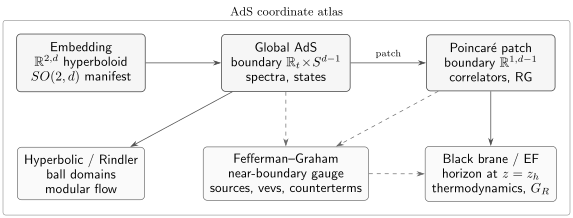
The most common coordinate systems for . Global coordinates see the boundary cylinder, Poincare coordinates see flat boundary space, Fefferman–Graham coordinates organize near-boundary data, black-brane and Eddington–Finkelstein coordinates describe thermal states, and hyperbolic/Rindler coordinates are natural for ball-shaped regions and modular flow.
Quick coordinate dictionary
Section titled “Quick coordinate dictionary”| Coordinates | Typical metric form | Boundary frame | Best used for |
|---|---|---|---|
| embedding | none chosen | symmetries, global definitions | |
| global | states, normal modes, global black holes | ||
| compact global | causal diagrams, boundary at | ||
| Poincare | vacuum correlators, RG intuition | ||
| Euclidean Poincare | Euclidean correlators, | ||
| Fefferman–Graham | arbitrary | holographic renormalization | |
| domain wall | usually flat or curved QFT metric | RG flows, relevant deformations | |
| planar black brane | thermal flat-space CFT | thermodynamics, transport | |
| ingoing EF | thermal flat-space CFT | horizons, real-time correlators | |
| hyperbolic/Rindler | ball entanglement, modular flow |
The table hides many normalization choices. The sections below spell out the versions used in this course.
Embedding-space definition
Section titled “Embedding-space definition”Lorentzian can be defined as the hyperboloid
inside with metric
The induced metric has constant negative curvature,
The manifest symmetry group of the hyperboloid is . This is the global conformal group of a -dimensional Lorentzian CFT, up to global/discrete subtleties.
The literal hyperboloid contains closed timelike curves because the time coordinate is periodic. In AdS/CFT one normally means the universal cover, where the global time coordinate is unwrapped.
Global coordinates
Section titled “Global coordinates”A standard global parametrization is
where , , and coordinates a unit . The induced metric is
The boundary lies at . Multiplying by and taking the limit gives the boundary conformal representative
Thus global AdS is adapted to a CFT on
This is the natural coordinate system for state-operator correspondence, normal modes, finite-volume spectra, and global AdS black holes.
Compact global coordinates
Section titled “Compact global coordinates”Define
Then global AdS becomes
This is often the cleanest form for causal diagrams. The conformally related metric
is a finite cylinder with boundary at . Null rays reach the boundary in finite global time. This is why asymptotically AdS spacetimes require boundary conditions: the boundary is timelike.
Poincare coordinates
Section titled “Poincare coordinates”Poincare coordinates are adapted to the flat-space CFT vacuum. In Lorentzian signature,
The boundary is at , and the Poincare horizon is at . The boundary conformal representative is Minkowski space,
A useful embedding map is
where and . This makes clear that Poincare coordinates cover only the region where
Poincare AdS is often also written with
Then
In these coordinates the boundary is at , while the Poincare horizon is at .
Euclidean AdS
Section titled “Euclidean AdS”Euclidean AdS is hyperbolic space . The Poincare half-space metric is
This coordinate system is ideal for Euclidean CFT correlators on . The regularity condition in the interior is usually simple: the Euclidean solution should be smooth and should not grow pathologically as .
Euclidean global AdS can be written as
If is periodically identified, the boundary is , which prepares a thermal state of the CFT on the sphere.
Fefferman–Graham gauge
Section titled “Fefferman–Graham gauge”Fefferman–Graham coordinates are not primarily a global coordinate system. They are a near-boundary gauge. In one common convention,
The expansion has the schematic form
The coefficient is the boundary metric source. The coefficient contains state-dependent information and is related to the renormalized stress tensor. The logarithmic term appears for even boundary dimension and is tied to the Weyl anomaly.
A second common convention uses :
Fefferman–Graham gauge fixes
but it does not fix all diffeomorphisms. The residual transformations include boundary diffeomorphisms and Weyl transformations of .
Domain-wall coordinates
Section titled “Domain-wall coordinates”For holographic RG flows it is often useful to write
where is usually a flat or curved boundary metric. Pure Poincare AdS is recovered from
up to a constant rescaling of boundary coordinates. The boundary is , and moving inward toward smaller corresponds roughly to flowing toward the infrared.
For Einstein-scalar flows, scalar profiles are interpreted as running couplings or expectation values. Domain-wall coordinates make this interpretation transparent but are often less convenient for extracting precise counterterms than Fefferman–Graham coordinates.
Planar black brane coordinates
Section titled “Planar black brane coordinates”The planar AdS-Schwarzschild black brane is
The boundary is at , and the horizon is at . Smoothness of the Euclidean geometry gives
The same geometry can be written in coordinates as
Then
Black-brane coordinates are adapted to a thermal CFT on . They are the default setup for transport, real-time correlators, and finite-density generalizations.
Ingoing Eddington–Finkelstein coordinates
Section titled “Ingoing Eddington–Finkelstein coordinates”Schwarzschild-like black-brane coordinates are singular at the future horizon. For real-time problems one often uses ingoing Eddington–Finkelstein coordinates. Define
Then
and the black-brane metric becomes
This form is regular at the future horizon. Infalling fields are smooth functions of and near . That is the geometric origin of the infalling prescription for retarded Green functions.
Global AdS black holes and topological black holes
Section titled “Global AdS black holes and topological black holes”A useful family of static asymptotically AdS metrics is
with
Here is a unit metric of constant curvature
The cases are:
| Horizon geometry | Boundary spatial geometry | Common use | |
|---|---|---|---|
| sphere | Hawking–Page transition | ||
| plane | thermal plasma, transport | ||
| hyperbolic space or quotient | or quotient | ball entanglement, hyperbolic black holes |
The planar case is obtained from the large-black-hole or infinite-volume limit of the spherical case.
Hyperbolic/Rindler AdS coordinates
Section titled “Hyperbolic/Rindler AdS coordinates”A particularly important hyperbolic slicing is
This is pure AdS written as a hyperbolic black hole with horizon at . It is not a new state of the full theory; it is a coordinate patch adapted to an accelerated observer or, on the boundary, to the domain of dependence of a ball-shaped region.
This coordinate system is central in the relation between vacuum entanglement across a sphere and thermal physics on .
Coordinate transformations worth memorizing
Section titled “Coordinate transformations worth memorizing”The most useful transformations are:
and
You do not need to memorize the full global-to-Poincare transformation. What matters more is the conceptual fact: Poincare coordinates cover only a wedge of global AdS, and the Poincare boundary is conformal to Minkowski space plus a point.
Which coordinates should I use?
Section titled “Which coordinates should I use?”Use global coordinates when the boundary theory lives on , when you care about the spectrum, or when the state-operator correspondence is central.
Use Poincare coordinates when the boundary theory lives on flat space and translation invariance is present.
Use Fefferman–Graham coordinates when you need near-boundary expansions, sources, counterterms, and one-point functions.
Use domain-wall coordinates when you want physical intuition for RG flows.
Use black-brane coordinates when you want thermodynamics.
Use ingoing Eddington–Finkelstein coordinates when you want retarded real-time correlators or regularity at a future horizon.
Use hyperbolic coordinates when the boundary problem involves ball-shaped regions, modular flow, or hyperbolic thermal states.
Common confusions
Section titled “Common confusions”“The coordinate is the energy scale.”
Section titled ““The coordinate zzz is the energy scale.””More carefully, small corresponds to the UV and large corresponds to the IR in many Poincare-domain-wall setups. But is a bulk coordinate, not literally an energy. The energy-scale interpretation is a powerful organizing principle, not a replacement for a holographic calculation.
“The Poincare horizon is a black-hole horizon.”
Section titled ““The Poincare horizon is a black-hole horizon.””In pure AdS, the Poincare horizon at is a coordinate horizon, not a thermal black-hole horizon. It becomes physically analogous to a horizon in certain wedges, but it does not by itself imply a nonzero CFT temperature.
“Fefferman–Graham coordinates always reach the horizon.”
Section titled ““Fefferman–Graham coordinates always reach the horizon.””No. Fefferman–Graham coordinates are guaranteed only near the conformal boundary under suitable asymptotic assumptions. They often break down before reaching a black-hole horizon.
“The boundary metric is unique.”
Section titled ““The boundary metric is unique.””The boundary metric is defined only up to Weyl rescaling. A coordinate system chooses a representative of the boundary conformal class.
Exercises
Section titled “Exercises”Exercise 1: Compact global AdS
Section titled “Exercise 1: Compact global AdS”Starting from
set and . Derive the compact global metric.
Solution
Since
we have
Also
and
Combining terms gives
Exercise 2: Black-brane temperature
Section titled “Exercise 2: Black-brane temperature”For
derive from smoothness at .
Solution
Near the horizon set , with . Then
The part of the metric is approximately
Define
Then the metric becomes
Smoothness at the origin requires the angular variable to have period , so
Exercise 3: Why ingoing EF coordinates are regular
Section titled “Exercise 3: Why ingoing EF coordinates are regular”Show that the transformation
turns
into
Solution
The definition gives
Therefore
Expanding,
The singularity has disappeared. This is why ingoing EF coordinates are regular at a future horizon.
Further reading
Section titled “Further reading”- E. Witten, Anti de Sitter Space and Holography.
- O. Aharony, S. S. Gubser, J. Maldacena, H. Ooguri, and Y. Oz, Large Field Theories, String Theory and Gravity.
- S. de Haro, S. N. Solodukhin, and K. Skenderis, Holographic Reconstruction of Spacetime and Renormalization in the AdS/CFT Correspondence.
- K. Skenderis, Lecture Notes on Holographic Renormalization.