
Finite Density and Bulk Gauge Fields
Finite density is the first place where holography begins to look less like a formal dictionary and more like a tool for many-body physics. Instead of asking only for vacuum correlators or thermal correlators, we ask for a state with a nonzero density of a conserved charge.
On the field-theory side, the basic object is a conserved current and a charge
A thermal state at chemical potential is described by
On the gravity side, the current is dual to a bulk gauge field . The chemical potential is the boundary value of its time component, and the charge density is the radial electric flux.
This is the basic finite-density dictionary:
The point of this page is to make this statement precise and to explain what it does, and does not, mean.
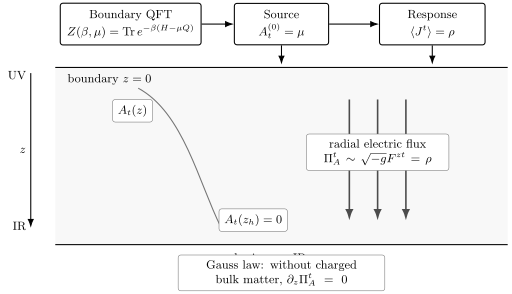
A conserved boundary current is sourced by the boundary value of a bulk gauge field. For a homogeneous finite-density state, and the radial electric flux is proportional to the charge density .
Why this matters
Section titled “Why this matters”Finite density introduces three new pieces of physics.
First, it gives us a controlled holographic way to study strongly coupled compressible systems. The boundary theory has a conserved charge and a nonzero density of that charge. In ordinary weakly coupled language one might expect quasiparticles, a Fermi surface, or a condensate. Holography does not require any of those assumptions.
Second, finite density forces us to distinguish carefully between global and gauge symmetries. A bulk gauge symmetry is dual to a global symmetry of the boundary CFT. Unless we explicitly choose boundary conditions that make the boundary gauge field dynamical, is an external source, not a dynamical photon.
Third, finite density produces new black-hole geometries. Turning on charge in the boundary theory usually means turning on electric flux in the bulk. If that flux backreacts, the neutral AdS black brane becomes a charged Reissner–Nordström-AdS black brane. That is the next page.
Boundary setup: a current and its source
Section titled “Boundary setup: a current and its source”Let the boundary theory have a conserved current satisfying
in flat space, or
on a curved background, up to anomalies that we ignore for now.
The current is sourced by a background gauge field . A common Lorentzian convention is
Then the generating functional obeys
A chemical potential for the charge is introduced by setting
for a homogeneous static state. In Euclidean signature, this statement is often phrased as a background holonomy around the thermal circle.
A more invariant statement is that the chemical potential is the gauge-invariant difference between the boundary value of and the value at the horizon:
For a smooth Euclidean black-hole saddle, one usually chooses a gauge in which
This is not just a cosmetic convention. At the Euclidean horizon the thermal circle shrinks, so the one-form must be regular there. The horizon value of is therefore fixed by regularity in the usual grand-canonical black-hole saddle.
Bulk setup: Maxwell field in AdS
Section titled “Bulk setup: Maxwell field in AdS”The minimal bulk action for a conserved current is a Maxwell action in an asymptotically AdS spacetime:
Here is the bulk gauge coupling. Its precise normalization depends on the top-down model or bottom-up convention. In a top-down compactification, is determined by the internal space and flux data. In a bottom-up model, it is a phenomenological parameter fixed by the normalization of the current two-point function.
The Maxwell equation is
or equivalently
when no charged bulk matter is present.
Near the AdS boundary, the gauge field has an expansion of the form
The leading term is the source. The subleading coefficient is related to the expectation value of the current. In particular, for a homogeneous electric potential in pure asymptotic AdS,
with the sign chosen so that in the convention used here.
The more invariant definition is through the renormalized canonical momentum:
For the Maxwell field, before adding possible finite counterterms,
where is the outward unit normal to the cutoff surface and is the induced metric. Different sign conventions for the outward normal shift an overall sign, so the safest rule is always to define the current by varying .
Chemical potential as boundary data
Section titled “Chemical potential as boundary data”In the grand-canonical ensemble, we fix . In holography this means Dirichlet boundary conditions for :
The boundary generating functional is then
The Euclidean thermal partition function at chemical potential is
The grand potential is
and the charge density is
In the classical gravity limit,
for the dominant Euclidean saddle.
Charge density as radial electric flux
Section titled “Charge density as radial electric flux”Now assume a static homogeneous ansatz
The Maxwell equation gives
Thus the radial electric flux is independent of :
This is the bulk form of charge conservation. The same constant can be evaluated near the boundary, where it is proportional to , or deeper in the bulk, where it may be carried by a charged horizon, charged matter fields, or charged branes.
This simple observation is surprisingly powerful. It tells us that a finite-density holographic state is not just a black hole with a parameter named . It is a bulk configuration carrying electric flux.
Grand canonical versus canonical ensemble
Section titled “Grand canonical versus canonical ensemble”There are two natural finite-density ensembles.
In the grand-canonical ensemble, the chemical potential is fixed:
The on-shell action computes .
In the canonical ensemble, the charge density is fixed. This corresponds to fixing the radial electric flux rather than the boundary value of . At the level of the variational principle, one performs a Legendre transform of the action. Schematically,
Then the free energy is
This distinction matters for charged black holes, where stability and phase structure can differ between ensembles.
Gauge invariance and the meaning of
Section titled “Gauge invariance and the meaning of μ\muμ”A constant shift of looks like a gauge transformation, so why is physical?
The answer is that chemical potential is not the absolute value of at one point. It is a boundary condition relative to the regularity condition in the interior. For a black-hole saddle,
Equivalently, in Euclidean signature it is tied to the holonomy of the gauge field around the thermal circle, with regularity imposed where the circle contracts.
This is why the common gauge choice
is physically meaningful even though itself is gauge-dependent.
Boundary global symmetry, not boundary electromagnetism
Section titled “Boundary global symmetry, not boundary electromagnetism”A frequent confusion is to say that the bulk gauge field is dual to electromagnetism in the boundary theory. That is usually not correct.
In the standard Dirichlet quantization, is a nondynamical source for a global current . The boundary theory has a global symmetry. The bulk field is gauge redundant because the dual current is conserved.
The source can be interpreted as an externally imposed electromagnetic field, but it is not a fluctuating boundary photon unless we change the boundary conditions and add boundary gauge dynamics.
So the usual dictionary is
This point is essential in AdS/CMT. Holography often studies strongly coupled charged matter in a background electromagnetic field, not a full theory of dynamical electromagnetism.
Probe gauge field versus backreacted finite density
Section titled “Probe gauge field versus backreacted finite density”There are two levels of finite-density holography.
Probe limit
Section titled “Probe limit”One may study a Maxwell field on a fixed neutral geometry. This is useful for current correlators and conductivities at small density or in approximations where the stress tensor contribution of the gauge field is neglected.
The Maxwell field then solves
on a fixed background such as pure AdS or AdS-Schwarzschild.
Backreacted limit
Section titled “Backreacted limit”At finite charge density of order the large- degrees of freedom, the electric field carries stress-energy. Then the metric and gauge field must solve Einstein–Maxwell equations. The simplest homogeneous solution is the Reissner–Nordström-AdS black brane.
This is the natural gravitational dual of a thermal CFT state at nonzero chemical potential and charge density.
Finite density and scale invariance
Section titled “Finite density and scale invariance”A CFT at nonzero and has scales. Conformal invariance is not absent, but it is realized through scaling relations.
For a homogeneous CFT in spacetime dimensions,
or equivalently
when . The stress tensor remains traceless in flat space, so
for an isotropic homogeneous state, up to anomalies or explicit deformations.
The thermodynamic identities are
and
These relations are useful checks on any charged black-brane computation.
What carries the charge in the bulk?
Section titled “What carries the charge in the bulk?”The radial flux equation tells us that charge exists in the bulk, but not what carries it.
There are several possibilities:
- The flux can end on a charged horizon. This is the simplest Reissner–Nordström-AdS picture.
- The flux can be carried by charged bulk matter outside the horizon.
- The flux can be carried by charged branes or stringy degrees of freedom.
- The flux can be partly behind the horizon and partly in visible bulk matter.
This distinction matters physically. Charge hidden behind the horizon is sometimes called fractionalized charge in the holographic condensed-matter literature. Charge carried by bulk matter outside the horizon is more directly associated with gauge-invariant charged operators or condensates in the boundary theory.
This course does not need that terminology yet, but it is useful to know that the simple dictionary is only the start. The distribution of electric flux in the radial direction contains physical information about the state.
Linear response at finite density
Section titled “Linear response at finite density”Current-current correlators at finite density are computed by perturbing the bulk gauge field:
The retarded correlator is obtained from the response/source ratio:
At finite density, current perturbations often mix with metric perturbations because the background electric field couples gauge and gravitational fluctuations. This is not a technical annoyance; it is the bulk reflection of the fact that charge transport, momentum transport, and energy transport are coupled in a charged fluid.
For example, in a translationally invariant finite-density theory, the electrical conductivity contains a delta function at zero frequency because momentum cannot relax. Holographically, that delta function is tied to coupled gauge-metric perturbations.
Dictionary checkpoint
Section titled “Dictionary checkpoint”The finite-density dictionary is:
| Boundary quantity | Bulk quantity |
|---|---|
| conserved current | bulk gauge field |
| source for | boundary value |
| chemical potential | |
| charge density | radial electric flux |
| grand-canonical ensemble | Dirichlet boundary condition for |
| canonical ensemble | fixed electric flux / Legendre-transformed action |
| current correlators | gauge-field fluctuations |
| finite-density backreaction | charged black brane or charged bulk matter |
The shortest useful slogan is:
Common confusions
Section titled “Common confusions”“The bulk gauge field is the boundary photon.”
Section titled ““The bulk gauge field is the boundary photon.””Usually no. In standard AdS/CFT boundary conditions, the bulk gauge field is dual to a global current in the boundary theory. Its boundary value is an external source. A dynamical boundary photon requires changing the boundary conditions and adding boundary gauge dynamics.
“A constant is pure gauge, so chemical potential is meaningless.”
Section titled ““A constant AtA_tAt is pure gauge, so chemical potential is meaningless.””The physical chemical potential is the difference between the boundary value and the regular interior value. For a black hole, smoothness fixes in the Euclidean gauge, so is meaningful.
“Finite charge density always means a charged black hole.”
Section titled ““Finite charge density always means a charged black hole.””Not always. A charged black hole is the simplest homogeneous backreacted saddle. But charge can also be carried by charged scalar fields, fermion fluids, branes, or other bulk degrees of freedom.
“The coefficient of is always exactly the charge density.”
Section titled ““The coefficient of zd−2z^{d-2}zd−2 is always exactly the charge density.””It is proportional to the charge density, but the proportionality depends on the Maxwell normalization, counterterms, and conventions. The invariant prescription is variation of with respect to .
“Finite density breaks conformal invariance explicitly.”
Section titled ““Finite density breaks conformal invariance explicitly.””A chemical potential introduces a scale in the state or ensemble, but the underlying theory can still be conformal. Thermodynamic functions then obey scaling relations such as .
Exercises
Section titled “Exercises”Exercise 1: Solve the near-boundary Maxwell equation
Section titled “Exercise 1: Solve the near-boundary Maxwell equation”In pure Poincare AdS,
consider a static homogeneous potential . Show that the Maxwell equation gives
for .
Solution
The Maxwell equation is
For the AdS metric,
Thus
Therefore
Integrating gives
for . The constant is the source, and is proportional to the charge density.
Exercise 2: Why must vanish at a smooth Euclidean horizon?
Section titled “Exercise 2: Why must AtA_tAt vanish at a smooth Euclidean horizon?”Near a nonextremal Euclidean horizon, the metric takes the schematic form
Explain why the one-form is regular at only if vanishes there in a smooth gauge.
Solution
At , the angular coordinate degenerates. The one-form is not regular at the origin of polar coordinates. In Cartesian coordinates,
which is singular at . Therefore a one-form proportional to is regular at the origin only if its coefficient vanishes sufficiently fast. For a smooth static black-hole gauge field, this means choosing
or in Lorentzian notation after Wick rotation,
The chemical potential is then the boundary value relative to this regular horizon value.
Exercise 3: Thermodynamic conjugates
Section titled “Exercise 3: Thermodynamic conjugates”Starting from the grand potential , show that
Solution
The grand partition function is
Then
Thus
Dividing by the spatial volume gives
Exercise 4: Boundary global symmetry
Section titled “Exercise 4: Boundary global symmetry”Why is it natural that a bulk gauge field is dual to a conserved boundary current rather than to an arbitrary vector operator?
Solution
A bulk gauge transformation is a redundancy:
In the boundary generating functional, the corresponding source changes as
Gauge invariance of the generating functional implies
Since is arbitrary, this gives
Thus bulk gauge redundancy is precisely what enforces conservation of the dual current.
Further reading
Section titled “Further reading”- S. A. Hartnoll, Lectures on holographic methods for condensed matter physics.
- J. McGreevy, Holographic duality with a view toward many-body physics.
- A. Chamblin, R. Emparan, C. V. Johnson, and R. C. Myers, Holography, Thermodynamics and Fluctuations of Charged AdS Black Holes.
- N. Iqbal and H. Liu, Universality of the hydrodynamic limit in AdS/CFT and the membrane paradigm.