
Euclidean Gravity and Free Energy
Why this matters
Section titled “Why this matters”The previous pages used black holes and black branes as geometries that encode thermal CFT states. This page explains the quantitative rule behind that statement:
In the saddle approximation,
where is the Helmholtz free energy of the boundary theory in the ensemble specified by the Euclidean boundary conditions. This is the workhorse behind Hawking–Page transitions, black-brane thermodynamics, holographic pressure, and the comparison of competing saddles.
The conceptual point is simple but powerful: equilibrium thermodynamics in the boundary theory is computed by comparing smooth Euclidean bulk fillings of the same boundary thermal manifold.
Boundary setup: thermal partition functions
Section titled “Boundary setup: thermal partition functions”For a QFT on a spatial manifold , the canonical thermal partition function is
The Euclidean path integral representation is a path integral on
with periodic boundary conditions for bosons and antiperiodic boundary conditions for fermions around .
If one also turns on chemical potentials, sources, or background fields, the partition function becomes a functional. For example, a source for an operator and a background metric give
In thermal holography, this boundary Euclidean manifold is not merely decorative. It is the asymptotic boundary condition for the Euclidean bulk saddle.
Bulk setup: fill the thermal boundary
Section titled “Bulk setup: fill the thermal boundary”The Euclidean bulk path integral is formally
In the classical gravity limit this becomes a saddle-point expansion:
At leading order in large , the dominant saddle is the one with the smallest renormalized Euclidean action. Thus
Equivalently,
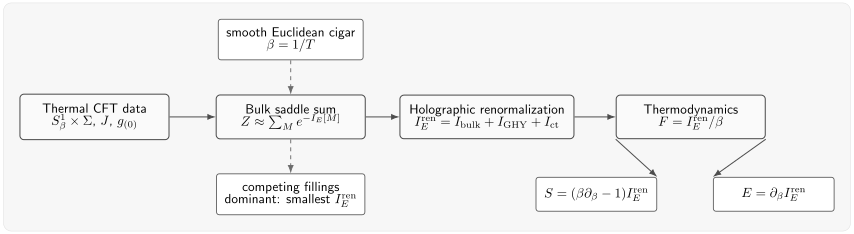
The Euclidean thermal CFT partition function is represented by a bulk filling whose conformal boundary contains the same thermal circle. In the saddle approximation, the renormalized Euclidean action gives ; thermodynamic derivatives of give , , pressure, and charge densities.
The Euclidean gravitational action
Section titled “The Euclidean gravitational action”For pure Einstein gravity with negative cosmological constant, a common Euclidean convention is
Here:
- is the induced metric on the cutoff boundary;
- is the trace of the extrinsic curvature;
- is a sum of local counterterms on the cutoff surface;
- for AdS.
The counterterms are not optional. The raw on-shell action diverges because the AdS boundary has infinite volume. Holographic renormalization defines
where includes the bulk action, the Gibbons–Hawking–York boundary term, and the counterterms on the cutoff surface .
A useful warning: different sign conventions for the Euclidean action and extrinsic curvature exist in the literature. The invariant statement is the saddle relation
Thermodynamics from
Section titled “Thermodynamics from IEI_EIE”In the canonical ensemble,
Equivalently,
If the ensemble includes a chemical potential for a charge , then the Euclidean source is usually the boundary value of a bulk gauge field component, and the action computes the grand potential:
Boundary conditions matter. Fixing the boundary value of computes a grand-canonical ensemble, while fixing electric flux computes a canonical ensemble. These two choices differ by a boundary Legendre transform.
Example: planar black brane free energy
Section titled “Example: planar black brane free energy”Consider the Euclidean planar AdS black brane
Smoothness at the Euclidean horizon requires
For this solution, holographic renormalization gives the renormalized Euclidean action density
Therefore the free energy density is
The pressure is
and conformal invariance gives
The entropy density is either the thermodynamic derivative
or the Bekenstein–Hawking area density
Using , these agree. The first law also works:
This is one of the cleanest demonstrations that the horizon is not merely a geometric feature. It carries the entropy of the thermal CFT state.
A quick regulated-action check
Section titled “A quick regulated-action check”It is useful to see where the free energy comes from. On shell,
For the planar black brane,
Thus the regulated bulk action per is
This is divergent. The Gibbons–Hawking–York term and counterterms cancel the divergence and adjust the finite term. The final renormalized answer is
The lesson is not the numerical factor alone. The lesson is that finite thermodynamics comes from the renormalized on-shell action, not from the bulk volume integral by itself.
Example: global AdS black holes
Section titled “Example: global AdS black holes”For a CFT on , the relevant Euclidean boundary is
Two important smooth bulk fillings are:
The global AdS-Schwarzschild metric has
with
The temperature is
The free energy is
So large black holes with have and dominate over thermal AdS, while small black holes with have and do not dominate the canonical ensemble. The transition occurs at
This is the Hawking–Page transition. On the boundary, it is interpreted as a large- thermal phase transition on compact space.
Entropy from the Euclidean action
Section titled “Entropy from the Euclidean action”The formula
reproduces the Bekenstein–Hawking entropy. One intuitive derivation uses a conical defect.
Near a Euclidean horizon, the metric locally looks like
Smoothness requires . If instead the angular period is , the origin has a conical defect with localized curvature. Evaluating the derivative of the action with respect to at gives
In higher-derivative gravity, this result is replaced by Wald entropy or its appropriate generalization. In two-derivative Einstein gravity, it is the area law.
Which saddle wins?
Section titled “Which saddle wins?”At leading large , the saddle with smallest dominates:
If two saddles exchange dominance as changes, the boundary theory has a large- phase transition. The Hawking–Page transition is the canonical example:
Then
while
At finite , the transition is rounded or corrected by subleading saddles and quantum fluctuations. In the strict classical gravity limit, the saddle competition becomes sharp.
Dictionary checkpoint
Section titled “Dictionary checkpoint”| Boundary quantity | Euclidean bulk quantity |
|---|---|
| thermal circle | asymptotic Euclidean time circle |
| partition function | bulk Euclidean path integral |
| free energy | |
| entropy | or horizon area |
| pressure | for homogeneous states |
| chemical potential | boundary value of Euclidean gauge field |
| phase transition | exchange of dominant Euclidean saddle |
The Euclidean action computes equilibrium thermodynamics. It does not, by itself, compute real-time response. For that we need the Lorentzian prescription.
Common confusions
Section titled “Common confusions”“The free energy is just the bulk action without boundary terms.”
Section titled ““The free energy is just the bulk action without boundary terms.””No. The Gibbons–Hawking–York term and counterterms are essential. Without them, the variational problem is not correct and the action is divergent.
“A Euclidean black hole has a Lorentzian horizon.”
Section titled ““A Euclidean black hole has a Lorentzian horizon.””The Euclidean geometry has a smooth origin where the thermal circle caps off. The Lorentzian horizon is recovered after analytic continuation. The Euclidean cap is why the temperature is fixed.
“All saddles with the same boundary are equally important.”
Section titled ““All saddles with the same boundary are equally important.””They all contribute in principle, but in the classical large- limit the smallest renormalized action dominates. Subdominant saddles are exponentially suppressed by factors of order in standard large- examples.
“The Euclidean action always computes Helmholtz free energy.”
Section titled ““The Euclidean action always computes Helmholtz free energy.””Only if the boundary conditions define a canonical ensemble. If sources such as chemical potentials are fixed, the action computes an appropriate thermodynamic potential, usually a grand potential.
“Euclidean correlators are enough for transport.”
Section titled ““Euclidean correlators are enough for transport.””Euclidean correlators determine Matsubara data. Transport coefficients require real-time retarded correlators and a prescription for horizon boundary conditions. This is the subject of the next page.
Exercises
Section titled “Exercises”Exercise 1: Planar black-brane equation of state
Section titled “Exercise 1: Planar black-brane equation of state”Starting from
show that and .
Solution
The pressure is
Conformal invariance gives , so for a homogeneous thermal state
hence
The entropy density from the horizon area is
Then
Since , we get
Exercise 2: Hawking–Page free energy sign
Section titled “Exercise 2: Hawking–Page free energy sign”For a global AdS black hole,
For which values of does the black hole dominate over thermal AdS?
Solution
With the usual normalization in which thermal AdS has , the black hole dominates when . Since the prefactor
is positive, the sign is determined by . Therefore
The transition occurs at , corresponding to
Exercise 3: Entropy from the action
Section titled “Exercise 3: Entropy from the action”Suppose a saddle has
where and are independent of along the family considered. Use
to find the entropy.
Solution
First compute
Then
For an Einstein black hole, is the Bekenstein–Hawking entropy
Further reading
Section titled “Further reading”- G. W. Gibbons and S. W. Hawking, Action Integrals and Partition Functions in Quantum Gravity.
- S. W. Hawking and D. N. Page, Thermodynamics of Black Holes in Anti-de Sitter Space.
- E. Witten, Anti de Sitter Space, Thermal Phase Transition, and Confinement in Gauge Theories.
- V. Balasubramanian and P. Kraus, A Stress Tensor for Anti-de Sitter Gravity.
- K. Skenderis, Lecture Notes on Holographic Renormalization.