
Quantum Extremal Surfaces and the Island Rule
The RT/HRT prescription is a classical large- formula. It says that the leading entropy of a boundary region is an area in Planck units. That is already surprising, but it is not yet enough for black-hole information.
The Page curve is a statement about fine-grained entropy. Hawking’s semiclassical calculation gives an entropy that keeps growing. A unitary theory demands that the fine-grained entropy of the radiation eventually turns over. The missing ingredient is that the entropy formula itself must be quantum-corrected. The classical HRT surface must be replaced by a surface that extremizes not just area, but generalized entropy.
The central object of this page is
Here is a codimension-two bulk surface, and is the bulk region bounded by and the boundary region whose entropy is being computed. A quantum extremal surface is a surface satisfying
The entropy is obtained by evaluating on the appropriate quantum extremal surface and then choosing the smallest value among competing saddles.
For ordinary holographic subregions, this is the quantum-corrected RT/HRT prescription. For Hawking radiation collected in a nongravitating bath, it becomes the island rule:
The island is a region in the gravitating spacetime. Its boundary is a QES. The crucial new feature is that, after the Page time, the fine-grained entropy of the radiation is not computed from the radiation region alone, but from plus an area term. In words: part of the black-hole interior belongs to the radiation’s entanglement wedge.
This is the first page where the modern resolution of the Page-curve problem becomes visible.
The classical limit and the large- expansion
Section titled “The classical limit and the large-NNN expansion”In a holographic CFT with a semiclassical Einstein-gravity dual, the bulk Newton constant is small. Schematically,
where is the AdS radius and is the rank or central-charge parameter of the boundary theory. The classical HRT area term is therefore of order :
Bulk quantum fields contribute ordinary entanglement entropy across the HRT surface. This bulk entropy is typically order :
The leading classical formula therefore has the structure
with
At first sight, an correction may look too small to matter for black-hole information. This intuition is misleading. There are two reasons.
First, fine-grained entropy is sensitive to competition between saddles. Two candidate surfaces can differ by an amount that changes sign as the black hole evolves. A subleading correction can move the transition point, and a new saddle can completely change the late-time answer.
Second, when the region whose entropy is being computed is an external radiation region, the relevant surface may include a new component near the black-hole horizon. The area term of that new component is of order the remaining black-hole entropy, not a tiny perturbation of the no-island answer. Thus the island contribution can dominate after the Page time.
FLM: the first quantum correction
Section titled “FLM: the first quantum correction”The Faulkner-Lewkowycz-Maldacena correction is the first quantum correction to RT/HRT in a fixed semiclassical bulk. In its simplest Einstein-gravity form, for a boundary region with classical RT/HRT surface or , it says
The ellipsis includes local terms needed to renormalize the UV divergences of the bulk entanglement entropy and possible higher-derivative/Wald-like contributions if the bulk theory is not pure Einstein gravity.
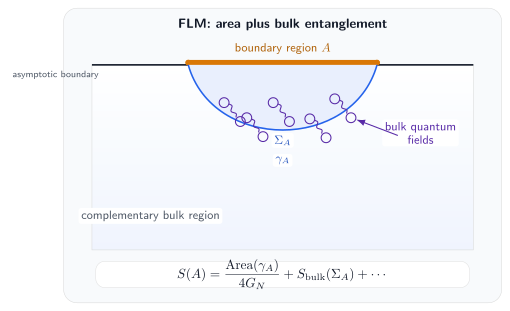
The important conceptual point is that is an ordinary QFT entropy in the bulk effective field theory. If the classical surface divides the bulk into two regions, one computes the entanglement entropy of bulk fields between those two regions. The novelty is that this ordinary entropy is added to the geometric area entropy.
A useful way to remember the hierarchy is:
while
More explicitly, if denotes the bulk region between and the classical extremal surface, then
This entropy is divergent in continuum QFT. The divergence is local near the entangling surface and is absorbed into renormalizations of and other local gravitational couplings. Thus the physically meaningful quantity is the renormalized generalized entropy, not the bare area term or the bare bulk entropy separately.
Why the surface must move
Section titled “Why the surface must move”FLM evaluates the bulk entropy on the classical RT/HRT surface. That is correct at first subleading order. But once the bulk entropy is present, the true entropy functional is no longer just area. A surface that extremizes area need not extremize
This motivates the quantum extremal surface prescription.
Let be a candidate codimension-two surface anchored on and homologous to . Define
where denotes local counterterm contributions. Then is a QES if
In Lorentzian signature, a codimension-two surface has two independent future-directed null normals, usually called and . Classical extremality of an HRT surface means that both classical null expansions vanish:
Quantum extremality replaces this by the vanishing of the quantum expansions:
where are the variations of under deformations of the surface along the two null directions. In a schematic notation,
Thus the QES is the surface where the tendency of the area term and the tendency of the bulk entropy term balance.
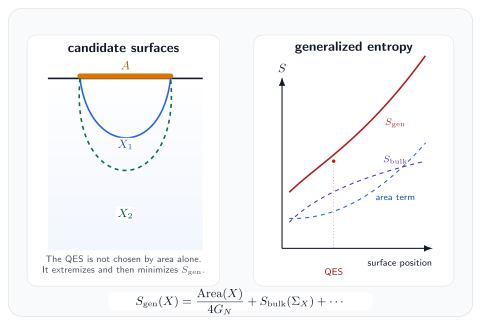
The order of operations matters:
One should not minimize over all possible surfaces without imposing the extremality condition. The QES prescription is a saddle-point prescription inherited from the gravitational path integral.
Quantum-corrected holographic entropy
Section titled “Quantum-corrected holographic entropy”For a boundary region in a holographic theory, the quantum-corrected entropy formula is
Here means that is anchored on and satisfies the appropriate homology constraint. The bulk region is the spatial region bounded by and ; in the covariant case it is better to say that the entanglement wedge is the domain of dependence of such a region.
This formula reduces to familiar prescriptions in limits:
| Limit | Entropy prescription |
|---|---|
| classical static bulk | RT minimal surface |
| classical time-dependent bulk | HRT extremal surface |
| first bulk quantum correction | FLM area plus on classical surface |
| all perturbative bulk orders | QES extremizes generalized entropy |
| evaporating black hole with bath | island rule for radiation entropy |
A subtle but important point: the surface displacement caused by is perturbatively small in ordinary subregion problems. If the classical area term is order , then a smooth change in the surface location induced by an order-one entropy gradient is typically of order . Because the classical surface is already area-extremal, this displacement does not change the entropy at order . That is why the FLM formula can evaluate on the classical surface. But the all-orders prescription must use the quantum extremal surface.
Generalized entropy and renormalization
Section titled “Generalized entropy and renormalization”The generalized entropy is not simply a formal sum of two finite quantities. The bulk entropy of quantum fields across a sharp surface is UV divergent. For example, in a local QFT in spacetime dimensions, the leading divergence has the form
where is a short-distance cutoff. This divergence is local on . In a gravitational theory, the same local structure renormalizes the coefficient of the area term, meaning Newton’s constant and possible higher-curvature couplings.
Thus the meaningful object is
The split between “area” and “bulk entropy” depends on the renormalization scheme. The sum does not. This is why the generalized entropy, not the bare Bekenstein-Hawking area term by itself, is the natural quantity in semiclassical gravity.
This point is already visible in black-hole thermodynamics. The generalized second law concerns
not alone. QES is the subregion-entanglement version of the same idea.
From QES to islands
Section titled “From QES to islands”So far has been a boundary region of a holographic CFT. The island rule enters when we compute the entropy of Hawking radiation in a nongravitating reservoir or bath.
A typical setup is:
- a black hole in a gravitating region,
- transparent or absorbing boundary conditions that allow Hawking radiation to escape,
- a nongravitating bath where the radiation is collected,
- a radiation region in that bath.
The bath is important because ordinary von Neumann entropy is straightforwardly defined for . Gravity obstructs naive Hilbert-space factorization inside the gravitating region, but the radiation region in the bath is nongravitating and has an ordinary density matrix.
The island formula says that the fine-grained entropy of is not necessarily computed by matter entropy on alone. Instead,
with
Here is a possible island region inside the gravitating spacetime. The boundary is the QES. If , the formula gives the no-island saddle:
If , the matter entropy is computed on the union , and one adds the area of the island boundary.
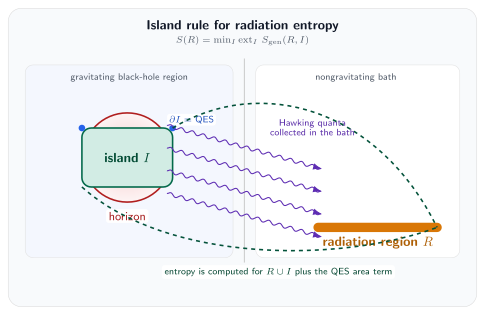
This formula is striking because the region is not part of the external detector. It is a region behind or near the black-hole horizon. The modern interpretation is not that the detector literally contains the island as a local subsystem. Rather, the fine-grained radiation density matrix knows about degrees of freedom whose semiclassical bulk representation lies in . In entanglement-wedge language, the island is part of the entanglement wedge of the radiation.
Early time: the no-island saddle
Section titled “Early time: the no-island saddle”At early times, the radiation region contains a relatively small amount of Hawking radiation. The natural saddle is the empty island:
Then
which reproduces the Hawking result. The entropy grows because each outgoing Hawking mode is entangled with a partner mode that remains in the black-hole region. If the outgoing modes are collected in while the partners are traced over, the radiation entropy increases.
In a simple thermal approximation, one often writes
where is the coarse-grained entropy flux. This is not the exact fine-grained answer at all times; it is the entropy associated with the no-island saddle.
The important lesson is that the Hawking result is not discarded. It is one legitimate saddle in the gravitational entropy calculation. It dominates early, then loses to another saddle.
Late time: the island saddle
Section titled “Late time: the island saddle”At late times, the no-island entropy would exceed the entropy available in the remaining black hole. This is the Page-curve crisis. The island saddle resolves the crisis by changing the region whose matter entropy is computed.
The matter state of can have much smaller entropy than the matter state of alone. Heuristically, the island contains many of the interior partner modes of the Hawking radiation. Including those partners in the entropy calculation purifies part of the radiation state.
The island saddle has the schematic form
In many evaporating black-hole examples, lies near the horizon. The area term is then approximately the black-hole entropy at the relevant time:
Because decreases during evaporation, the island saddle naturally gives a decreasing entropy after the Page time. The final answer is the lower of the no-island and island saddles:
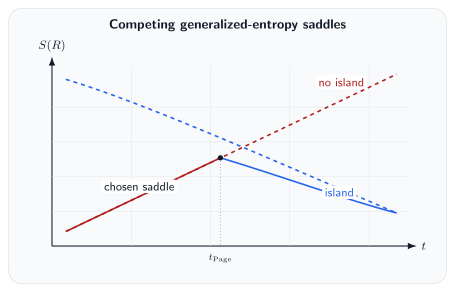
This formula should look familiar from the previous page. The Page curve was introduced there as an information-theoretic expectation. Here it appears as a saddle transition in the gravitational entropy formula.
A schematic Page-time estimate
Section titled “A schematic Page-time estimate”Suppose the no-island saddle gives
while the island saddle is approximately controlled by the remaining black-hole entropy,
The Page time is estimated by equating the two:
This is the semiclassical version of Page’s entropy budget. Before this time, the growing radiation entropy is smaller than the island answer. After this time, the no-island answer is too large and the island saddle dominates.
For an evaporating black hole, is not constant. In realistic higher-dimensional evaporation, the precise time dependence depends on greybody factors, particle content, ensemble, and boundary conditions. But the conceptual structure is robust:
Why the island lowers the entropy
Section titled “Why the island lowers the entropy”A common first reaction is: adding a region should increase entropy, so why can be smaller than ?
The answer is that von Neumann entropy is not monotonic under adding degrees of freedom. For a pure Bell pair ,
Adding the purifying partner reduces the entropy. The same logic applies to Hawking radiation. If the island contains the semiclassical partners of some Hawking modes, then the entropy of can be lower than the entropy of .
This is not a violation of strong subadditivity or any ordinary entropy inequality. It is the familiar fact that a larger subsystem can be more pure if it includes correlations that were previously traced out.
The new gravitational statement is that the entropy formula instructs us to include a region behind the horizon when computing the radiation’s fine-grained entropy.
Entanglement wedge interpretation
Section titled “Entanglement wedge interpretation”For an ordinary boundary region , the QES prescription defines a quantum-corrected entanglement wedge. If is the dominant QES, the entanglement wedge is the bulk domain of dependence of the region bounded by and .
For radiation in a bath, the same language says:
This is the most compact modern interpretation of islands. The island is the part of the gravitating region that is encoded in the radiation system. After the Page transition, certain interior observables can be reconstructed from the radiation, at least within an appropriate code subspace and with important qualifications that will be discussed later.
This statement also explains why the island formula is not a naive violation of locality. Semiclassical locality is a statement about operators in a fixed bulk effective field theory. Entanglement wedge reconstruction is a statement about how that effective bulk description is encoded in the exact quantum-gravity degrees of freedom. The two statements are compatible only because the bulk reconstruction map is subtle and redundant.
The next pages will make this precise using relative entropy, JLMS, and quantum error correction.
Relation to the replica trick
Section titled “Relation to the replica trick”The island formula is not merely a clever guess. It is supported by gravitational replica calculations.
In ordinary QFT, the von Neumann entropy can be computed from Renyi entropies:
For radiation entropy in a gravitational system, is computed by a gravitational path integral with replicas. The path integral can have more than one saddle. One class of saddles keeps the replicas disconnected and reproduces the no-island Hawking answer. Another class connects the replicas through the black-hole interior. These are replica wormholes.
In the limit, the replica-wormhole saddle leads to an extremization condition for a surface in the original geometry. That surface is the QES, and the resulting entropy is the island formula.
A full discussion of replica wormholes deserves its own page. For now, the message is this:
What exactly is being minimized?
Section titled “What exactly is being minimized?”It is helpful to separate three operations that are often compressed into the notation .
First, choose a candidate topology and homology class. For radiation entropy, this includes choosing whether there is no island, one island, multiple islands, and so on.
Second, within that class, solve the QES equations:
This gives one or more saddle surfaces.
Third, evaluate the generalized entropy on all the saddle surfaces and choose the smallest value:
The minimization is analogous to choosing the dominant saddle in a semiclassical path integral. At large , the dominant saddle can change discontinuously as external parameters vary. This produces sharp entropy phase transitions. At finite , such transitions are smoothed.
Common pitfalls
Section titled “Common pitfalls”Pitfall 1: “The island is literally inside the radiation detector.”
Section titled “Pitfall 1: “The island is literally inside the radiation detector.””No. The island is a region in the gravitating spacetime that belongs to the radiation’s entanglement wedge. It is encoded in the radiation degrees of freedom in the quantum-gravity description. It is not a local spatial subregion of the nongravitating bath.
Pitfall 2: “The island formula changes the local Hawking calculation.”
Section titled “Pitfall 2: “The island formula changes the local Hawking calculation.””Not directly. The local Hawking calculation still describes the production of radiation in semiclassical effective field theory. What changes is the fine-grained entropy calculation. The no-island saddle gives the Hawking entropy; the island saddle gives another contribution to the same fine-grained quantity.
Pitfall 3: “The island appears because we decide to include it by hand.”
Section titled “Pitfall 3: “The island appears because we decide to include it by hand.””The island is included because the gravitational entropy prescription sums over allowed QES saddles. The island saddle dominates only when its generalized entropy is smaller than the no-island saddle.
Pitfall 4: “Area and bulk entropy are separately physical.”
Section titled “Pitfall 4: “Area and bulk entropy are separately physical.””The split is scheme-dependent. The renormalized generalized entropy is physical. UV divergences in are absorbed into local gravitational couplings.
Pitfall 5: “Islands alone are a complete microscopic derivation of unitary evaporation.”
Section titled “Pitfall 5: “Islands alone are a complete microscopic derivation of unitary evaporation.””Islands explain how the semiclassical gravitational entropy calculation can reproduce the Page curve. They do not by themselves give an explicit microscopic decoding algorithm for arbitrary evaporating black holes, nor do they remove all questions about factorization, ensemble averaging, or the nonperturbative definition of the gravitational path integral.
A compact summary
Section titled “A compact summary”The sequence of ideas is:
The physical meaning is:
This is the first genuinely gravitational mechanism in the course that reproduces the Page curve.
Exercises
Section titled “Exercises”Exercise 1: FLM order counting
Section titled “Exercise 1: FLM order counting”Let be a coordinate parametrizing deformations of a classical extremal surface. Suppose the generalized entropy near the classical surface has the schematic form
where and are order-one constants. Show that the QES is displaced by and that this displacement changes only at order .
Solution
Extremizing gives
Therefore
Substituting back,
The correction from the displacement is
which is order . Thus at order , one may evaluate the bulk entropy on the classical extremal surface. This is why FLM is consistent as the first quantum correction.
Exercise 2: A toy Page transition
Section titled “Exercise 2: A toy Page transition”Assume the no-island saddle gives
and the island saddle gives
with . Find the Page time and the final entropy curve.
Solution
The Page transition occurs when the two saddle entropies are equal:
Thus
The entropy is the smaller of the two saddles:
Therefore
This is a sharp large- Page curve: increasing before the transition and decreasing after it.
Exercise 3: Extremizing a simplified generalized entropy
Section titled “Exercise 3: Extremizing a simplified generalized entropy”Consider the toy generalized entropy
where , , and are positive constants. Derive the QES equation .
Solution
Differentiate term by term:
For the logarithmic term,
so
The QES equation is therefore
The first term comes from the area or dilaton contribution; the second term comes from the matter entropy.
Exercise 4: Why can adding an island reduce entropy?
Section titled “Exercise 4: Why can adding an island reduce entropy?”Give a finite-dimensional quantum example where . Explain how this example is related to the island formula.
Solution
Take a Bell pair
The reduced state of is
so
But the joint state on is pure, so
Adding the purifying partner reduces the entropy. In the island formula, the island can contain semiclassical partner degrees of freedom correlated with the radiation. Therefore can be smaller than .
Exercise 5: Renormalized generalized entropy
Section titled “Exercise 5: Renormalized generalized entropy”Explain why the area term and the bulk entropy term are not separately cutoff-independent, but their sum can be.
Solution
The bulk entanglement entropy across a sharp surface has UV divergences localized near the surface. The leading divergence is proportional to the area of the surface:
In a gravitational theory, the coefficient of the area term is also a bare coupling:
Renormalizing Newton’s constant absorbs the area-proportional divergence. Additional local divergences are absorbed into higher-curvature couplings. Therefore the split between the geometric term and the matter entropy term depends on the cutoff and scheme, but the renormalized generalized entropy
can be cutoff-independent.
Exercise 6: Entanglement wedge interpretation of islands
Section titled “Exercise 6: Entanglement wedge interpretation of islands”State in one sentence what it means to say that an island belongs to the radiation’s entanglement wedge. Then explain why this does not mean that semiclassical locality has simply failed everywhere.
Solution
The statement means that, after the Page transition, the bulk region reconstructable from the radiation degrees of freedom includes an interior region in the gravitating spacetime.
This does not mean that local effective field theory is useless. Semiclassical locality describes approximate bulk operators within a chosen effective description. Entanglement wedge reconstruction describes how those approximate bulk operators are encoded in the exact quantum-gravity Hilbert space. The encoding is redundant and nonlocal from the boundary or radiation viewpoint. Thus an interior operator can have a representation in the radiation without being a local operator in the bath region.
Further reading
Section titled “Further reading”- T. Faulkner, A. Lewkowycz, and J. Maldacena, “Quantum corrections to holographic entanglement entropy,” arXiv:1307.2892. The FLM correction: bulk entanglement entropy as the leading quantum correction to RT.
- N. Engelhardt and A. C. Wall, “Quantum Extremal Surfaces: Holographic Entanglement Entropy beyond the Classical Regime,” arXiv:1408.3203. The QES prescription and generalized entropy extremization.
- A. Almheiri, N. Engelhardt, D. Marolf, and H. Maxfield, “The entropy of bulk quantum fields and the entanglement wedge of an evaporating black hole,” arXiv:1905.08762. One of the first island/QES computations in an evaporating black-hole setup.
- G. Penington, “Entanglement Wedge Reconstruction and the Information Paradox,” arXiv:1905.08255. The Page transition from quantum RT surfaces and entanglement wedge reconstruction.
- A. Almheiri, T. Hartman, J. Maldacena, E. Shaghoulian, and A. Tajdini, “Replica Wormholes and the Entropy of Hawking Radiation,” arXiv:1911.12333. Replica wormholes and the island rule.
- G. Penington, S. H. Shenker, D. Stanford, and Z. Yang, “Replica wormholes and the black hole interior,” arXiv:1911.11977. Replica-wormhole derivations and connections to reconstruction.
- A. Almheiri, T. Hartman, J. Maldacena, E. Shaghoulian, and A. Tajdini, “The entropy of Hawking radiation,” arXiv:2006.06872. A broad review of islands, QES, and replica wormholes.