
Hawking Radiation and the Information Paradox
Black-hole entropy already tells us that horizons know about quantum states. Hawking radiation makes the statement dynamical. A black hole is not merely a cold classical absorber; when quantum fields propagate on a black-hole spacetime, an observer far away detects a flux of approximately thermal particles with temperature
This result is beautiful, robust, and dangerous. It turns the formal analogy between area and entropy into real thermodynamics, but it also produces the black-hole information paradox. If a black hole forms from a pure quantum state and then evaporates into radiation that is exactly thermal and independent of the initial state, the process appears to be
where is mixed. Ordinary quantum mechanics does not allow a closed system to evolve from a pure state to a mixed state by a unitary operator. The paradox is the tension between this semiclassical prediction and the expectation that quantum gravity should be a unitary quantum theory.
The conceptual chain is
The question is not whether Hawking radiation exists. The question is how the subtle correlations required by unitarity are represented in a gravitational description that seems to produce independent thermal quanta.
Conventions and notation
Section titled “Conventions and notation”We use units with , and we often keep explicit. For a stationary black hole, is the surface gravity and
For a four-dimensional Schwarzschild black hole,
We use the following labels for the entanglement structure of evaporation:
| Symbol | Meaning |
|---|---|
| early Hawking radiation already far from the black hole | |
| a late outgoing Hawking mode outside the horizon | |
| the interior partner mode of | |
| remaining black-hole degrees of freedom | |
| future null infinity, where outgoing radiation is measured in asymptotically flat spacetime | |
| future event horizon | |
| reduced density matrix of the radiation region | |
| fine-grained von Neumann entropy |
The letters and are not universal notation, but they are very convenient for the AMPS/firewall discussion.
What Hawking actually computed
Section titled “What Hawking actually computed”Hawking’s calculation is a calculation in quantum field theory on a classical curved spacetime. One considers a spacetime in which matter collapses to form a black hole. A quantum field is expanded in modes that look like positive-frequency modes in the far past and in modes that look like positive-frequency modes at future infinity. Because the geometry is time-dependent and contains a horizon, these two notions of positive frequency are not the same.
Schematically, the annihilation operator of an outgoing mode at future infinity is related to operators in the past by a Bogoliubov transformation,
If the coefficients are nonzero, the in-vacuum contains out-particles:
For a black hole, the result is thermal at the Hawking temperature. For neutral bosonic modes in a stationary black-hole background, the occupation number seen at infinity takes the schematic form
Here is a greybody factor: the probability that a mode created near the horizon propagates through the curvature potential barrier and reaches infinity. The spectrum is therefore not exactly a perfect blackbody spectrum at infinity, but the thermal factor is universal. Greybody factors modify the angular and frequency dependence of the flux; they do not by themselves encode the missing microscopic information.
A useful way to see where the thermal factor comes from is the exponential relation between a regular near-horizon null coordinate and the retarded time measured at infinity. Near the horizon of a stationary black hole one has, schematically,
A mode that is smooth as a positive-frequency function of is not purely positive-frequency as a function of . The logarithm hidden in
is the source of the thermal Bogoliubov mixing.
This is why Hawking radiation is often said to be a horizon effect. More precisely, it is a global effect of quantum fields in the causal geometry of collapse. The popular picture of particle-antiparticle pairs being created just outside the horizon is a useful cartoon, but it should not be mistaken for the derivation.
The two-mode squeezed state
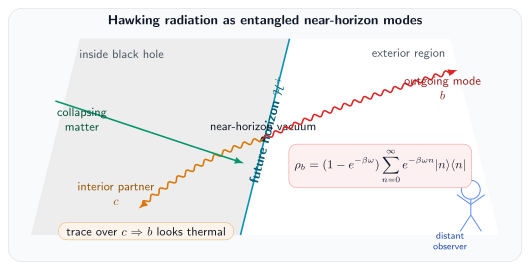
Section titled “The two-mode squeezed state”The thermal character of Hawking radiation can be understood from the entanglement structure of the near-horizon vacuum. Locally, a sufficiently large black-hole horizon looks like a Rindler horizon. The smooth vacuum is not a product state between the two sides of the horizon. For each bosonic frequency mode, it has the schematic two-mode squeezed form
The mode is outside the horizon and can escape as Hawking radiation. The mode is its interior partner. If an exterior observer has no access to , the observer describes by the reduced density matrix
This is a thermal density matrix at temperature .
The mean occupation number follows immediately:
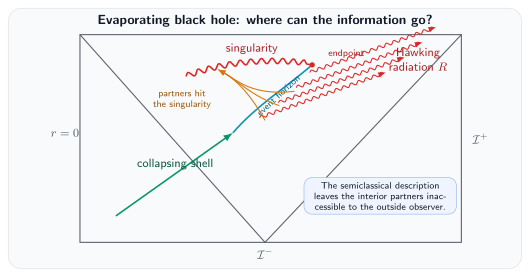
This derivation captures the essential entanglement logic. It also displays the seed of the information problem. The outgoing mode is not emitted as a pure state. It is emitted as part of an entangled pair. If the interior partner is forever inaccessible and eventually hits a singularity, the outside radiation remains mixed.
Evaporation
Section titled “Evaporation”Hawking radiation carries positive energy to infinity. Energy conservation then implies that the black hole loses mass. In four dimensions, dimensional analysis gives the leading Schwarzschild scaling
up to a numerical coefficient depending on the particle content and greybody factors. Integrating gives the evaporation time
where is the initial mass. In units with restored, this scales as .
The scaling has two important consequences.
First, large black holes are cold and long-lived:
Second, for most of the lifetime of a large black hole, the curvature near the horizon is very small in Planck units. The paradox is therefore not simply a complaint about the final Planckian endpoint. The semiclassical calculation appears trustworthy over a very long time and in a region where local curvatures can be arbitrarily small.
The endpoint is certainly outside the regime of semiclassical gravity. But waiting until the endpoint is too late for a conventional local explanation of unitarity: by then the Hawking radiation has already carried away most of the black hole’s energy.
The pure-to-mixed problem
Section titled “The pure-to-mixed problem”Suppose a black hole forms from collapse of a pure state. If the black hole evaporates completely and the only final degrees of freedom are the Hawking quanta at infinity, unitarity requires the final radiation state to be pure:
Equivalently,
with
The semiclassical Hawking calculation instead suggests that the outgoing radiation is approximately thermal and largely independent of the details of the collapsing state. If one traces over the interior partners, one obtains a mixed density matrix,
with positive von Neumann entropy
This is not merely ordinary coarse graining. In ordinary thermodynamics, smoke from a burning book may look thermal, but the microscopic state of the smoke and environment is pure if the initial state was pure. The information is hidden in complicated correlations. Hawking’s leading semiclassical calculation appears to produce a genuinely mixed state because the purifying degrees of freedom are behind the horizon and are not present in the final radiation.
One can express the dangerous possibility as a nonunitary map
where is sometimes called a superscattering map. A unitary theory would have
Information loss would mean that no such unitary exists for the complete process. Many arguments suggest that fundamental nonunitarity would create deep problems with locality, energy conservation, CPT, or the structure of quantum mechanics itself. AdS/CFT makes this especially sharp: a black hole in the bulk should be described by states in an ordinary boundary quantum theory with unitary time evolution.
Coarse-grained thermality is not the paradox
Section titled “Coarse-grained thermality is not the paradox”It is important to separate two statements:
- Hawking radiation is approximately thermal in low-point observables.
- The exact final radiation state is mixed.
The first statement is compatible with unitary quantum mechanics. Many ordinary systems emit radiation that is nearly thermal in simple observables. The second statement is the paradox. If the exact final state is mixed after complete evaporation of a closed system, then the time evolution is not unitary.
This distinction is why the phrase “the radiation is thermal” should be used carefully. The exact radiation state could be pure while still looking thermal to coarse probes. A unitary Page curve precisely requires this: the early radiation can look thermal locally, while the full radiation state contains subtle long-range correlations.
The difficulty is that Hawking’s semiclassical calculation seems to produce too little correlation. The outgoing mode is entangled with its interior partner , not with the earlier radiation . If this pair-production structure remains true throughout evaporation, the entropy of the radiation keeps increasing.
Small corrections are not enough
Section titled “Small corrections are not enough”One might hope that tiny quantum-gravity corrections to each emitted Hawking pair could accumulate over the long evaporation time and restore unitarity. This hope is too naive.
A useful toy model is one qubit pair emitted at each step. The leading Hawking pair has the Bell-like form
After tracing over , the outgoing qubit is maximally mixed. If each emission step is only slightly corrected,
then the radiation entropy still increases by nearly one bit at each step:
The precise inequality depends on how the correction is modeled, but the message is robust: perturbatively small corrections to the local Hawking process cannot by themselves make the radiation entropy turn around after the Page time. To recover unitarity, something order-one must happen in the entanglement structure, even if low-energy local observables remain close to their semiclassical values.
This is one reason the modern island formula is so striking. It does not say that the local Hawking flux suddenly becomes violently nonthermal at the Page time. Instead, it changes the fine-grained entropy calculation by changing the gravitational region included in the entanglement wedge.
Page behavior and the late-mode problem
Section titled “Page behavior and the late-mode problem”The next page develops the Page curve carefully. Here we only need the essential consequence.
If black-hole evaporation is unitary, then the fine-grained entropy of the radiation cannot grow forever. It should grow at early times, reach a maximum around the Page time, and then decrease to zero when evaporation is complete:
After the Page time, the black hole has fewer remaining internal degrees of freedom than the radiation has already carried away. A newly emitted quantum should reduce the entropy of the radiation:
This means must be correlated with the early radiation in just the right way. But the local smooth-horizon picture says that is entangled with an interior partner :
The same quantum system cannot be independently maximally entangled with two different systems. This is the monogamy of entanglement. In black-hole language, it becomes the AMPS/firewall paradox.
The AMPS triad
Section titled “The AMPS triad”The sharp modern version of the paradox is often phrased as a conflict among three principles:
- Unitarity: the complete evaporation process is unitary, so the final radiation is pure.
- Semiclassical effective field theory: outside the horizon, low-energy quantum fields propagate according to local effective field theory.
- Smooth horizon: a freely falling observer crossing the horizon of a large black hole sees nothing singular or Planckian at the horizon.
The claim is not that each principle is absurd. Each one is individually well motivated. The problem is that they do not fit together in the naive evaporating black-hole geometry, especially after the Page time.
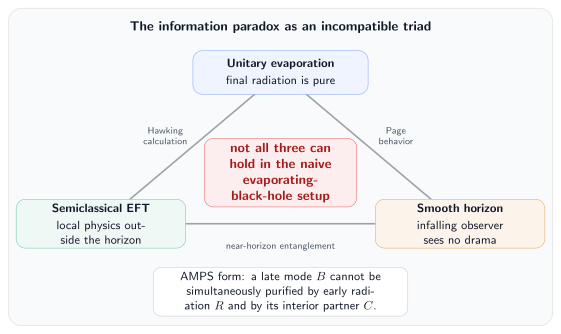
A schematic entropy version uses strong subadditivity. Let be early radiation, a late outgoing mode, and its interior partner. Strong subadditivity says
If the horizon is smooth, then and are approximately in the local vacuum entangled state, so
Moreover, if is a locally produced pure pair, adding it should not change the entropy of much, so
Then strong subadditivity gives
But after the Page time, unitarity requires the late outgoing mode to purify the early radiation:
These inequalities are incompatible if . Thus, something in the assumptions must give.
Complementarity and stretched horizons
Section titled “Complementarity and stretched horizons”Before the firewall argument, a leading idea was black-hole complementarity. The basic proposal is that there are two valid descriptions that should not be combined into a single global semiclassical story.
For a distant exterior observer, infalling matter never truly crosses the horizon in finite Schwarzschild time. It is absorbed by a stretched horizon, a timelike membrane located roughly a Planck distance outside the mathematical event horizon. This membrane has microscopic degrees of freedom, thermalizes the infalling information, and eventually re-emits it in Hawking radiation.
For a freely falling observer, nothing special happens at the horizon of a large black hole. The observer crosses smoothly and sees the infalling matter continue inward.
Complementarity says that these two descriptions are not contradictory because no single observer can verify both stories. It is a radical but elegant idea: the exterior and interior descriptions are complementary ways of encoding the same physics, not independent copies of the information.
The AMPS argument challenged whether complementarity can be maintained for an old black hole. After the Page time, an observer could in principle collect early radiation , then jump into the black hole and compare it with the interior partner of a late mode . If is already encoded in by unitarity but also locally entangled with by smoothness, complementarity seems to require a more subtle mechanism than the original stretched-horizon picture.
Firewalls
Section titled “Firewalls”One possible response is to give up the smooth horizon. If the late mode is not entangled with an interior partner , then the near-horizon state is not the ordinary vacuum. For an infalling observer, the absence of the usual short-distance entanglement across the horizon can appear as high-energy excitations at or near the horizon: a firewall.
The firewall proposal preserves unitarity and exterior effective field theory, but sacrifices the equivalence-principle expectation that a large black-hole horizon is locally uneventful. This is a dramatic move. For a sufficiently large black hole, curvature at the horizon is tiny, so ordinary general relativity would predict no local drama there.
Firewalls are best understood not as a universally accepted answer, but as a diagnostic. They show that the information problem is not confined to the singularity. If unitarity is restored while standard exterior effective field theory remains valid, the entanglement structure near the horizon must change in a way that can be order-one after the Page time.
Other traditional possibilities
Section titled “Other traditional possibilities”Several broad responses to the paradox were explored before the modern island story.
Information loss. One could accept that black-hole evaporation is fundamentally nonunitary. This follows the most literal reading of the semiclassical calculation. The cost is a major modification of quantum mechanics.
Stable or long-lived remnants. Perhaps evaporation stops at a Planck-scale remnant that stores all the information. The difficulty is that a remnant would need to contain an arbitrarily large number of internal states while having bounded mass and size. This tends to create severe problems with pair production and effective field theory.
Information escapes through small corrections. Perhaps the radiation is not exactly thermal, and tiny corrections encode the information. As explained above, small local corrections to each Hawking pair are not enough if the horizon remains semiclassical in the usual way.
Nonlocal information transfer. Perhaps quantum gravity violates locality in a subtle way, allowing information behind the horizon to be encoded in outgoing radiation. Holography strongly suggests that locality is emergent and approximate, but one must explain why ordinary local physics works so well outside the black hole.
Final-state or singularity effects. Perhaps the singularity imposes a special boundary condition that transfers information to the radiation. Such proposals are clever, but they must confront causality, robustness, and the meaning of quantum evolution in a spacetime with singularities.
Horizon-scale microstructure. Perhaps black-hole microstates do not have empty semiclassical horizons. Fuzzball-like ideas take this route. The challenge is to reconcile microstructure with the success of the smooth black-hole geometry for many coarse observables.
Modern developments do not simply erase these older ideas. Islands, entanglement wedges, and quantum error correction give a more precise language for some of the nonlocal and complementary aspects that earlier proposals were trying to capture.
Why AdS/CFT sharpens the paradox
Section titled “Why AdS/CFT sharpens the paradox”In asymptotically flat spacetime, the complete nonperturbative definition of quantum gravity is subtle. In AdS/CFT, the situation is sharper. The bulk gravitational system is dual to a boundary conformal field theory with an ordinary Hilbert space and unitary time evolution:
If the bulk contains a black hole, that black hole is described by some state or ensemble of states in the CFT. The boundary theory does not have a mechanism for fundamental pure-to-mixed evolution. Therefore, the bulk description must be compatible with unitarity.
There is a small caveat. A large AdS black hole with reflecting boundary conditions does not evaporate away in the same way as an asymptotically flat black hole. Radiation bounces off the AdS boundary and returns. To discuss evaporation in AdS, one usually couples the boundary theory to an auxiliary bath, imposes absorbing boundary conditions, or studies related setups in which radiation can escape.
But the conceptual point remains: AdS/CFT gives strong evidence that black-hole evaporation should be unitary. The task is to find the bulk mechanism by which the semiclassical calculation is corrected.
This is precisely where the later pages enter. The Page curve tells us what unitarity demands. RT/HRT, quantum extremal surfaces, and islands explain how a gravitational entropy calculation can reproduce that demand.
Trans-Planckian issue versus information problem
Section titled “Trans-Planckian issue versus information problem”Tracing a Hawking quantum backward in time toward the horizon gives an exponentially blueshifted mode. This is the trans-Planckian issue. It raises a legitimate question: why should the calculation be trusted when it seems to involve arbitrarily high frequencies in the past?
The robustness of Hawking radiation has been studied from many viewpoints. The thermal flux depends mainly on the near-horizon causal structure and is insensitive to many modifications of ultra-high-frequency physics. This does not mean the trans-Planckian issue is trivial, but it is not the same as the information paradox.
The information paradox persists even if one accepts the Hawking flux as a robust low-energy prediction. The hard question is about the exact fine-grained state of all the radiation, not merely the existence of an approximately thermal flux.
A useful toy density matrix
Section titled “A useful toy density matrix”A minimal model of Hawking emission is
where is the outgoing qubit and is the interior partner. Tracing over gives
The entropy is
For , this is . The outgoing qubit is maximally mixed. If many such pairs are produced independently, the entropy of the radiation grows approximately linearly with the number of emitted qubits:
This toy model is not a real black-hole calculation, but it isolates the entanglement logic. The problem is not that radiation quanta exist. The problem is that the purifying partners are assigned to the black-hole interior rather than to the radiation system that remains after evaporation.
Common pitfalls
Section titled “Common pitfalls”Pitfall 1: “The pair-creation cartoon is the derivation.” The cartoon is useful for intuition, but Hawking’s calculation is a global mode calculation using QFT in curved spacetime. The cartoon can mislead if taken too literally.
Pitfall 2: “Thermal-looking radiation automatically violates unitarity.” It does not. Ordinary unitary systems produce radiation that looks thermal to coarse probes. The paradox concerns the exact fine-grained state after complete evaporation.
Pitfall 3: “Greybody factors solve the information problem.” Greybody factors make the spectrum differ from a perfect blackbody spectrum at infinity. They do not provide enough state-dependent correlations to purify the radiation.
Pitfall 4: “The problem happens only at the Planckian endpoint.” The entanglement entropy of the radiation grows throughout the semiclassical era. By the endpoint, most of the energy has already escaped.
Pitfall 5: “A smooth horizon is obviously compatible with unitary evaporation.” For young black holes this seems plausible. For old black holes, entanglement monogamy makes the compatibility highly nontrivial.
Pitfall 6: “AdS black holes always evaporate like asymptotically flat black holes.” With standard reflecting AdS boundary conditions, radiation returns to the black hole. Evaporation in AdS requires an absorbing boundary, a bath, or a related nonequilibrium setup.
Takeaway equations
Section titled “Takeaway equations”The formulas to remember are:
The first five equations summarize Hawking’s semiclassical radiation. The last two summarize why old black holes are difficult: Page behavior wants late modes to purify early radiation, while smooth-horizon effective field theory wants late modes to be entangled with interior partners.
Exercises
Section titled “Exercises”Exercise 1: Tracing over the interior partner
Section titled “Exercise 1: Tracing over the interior partner”Consider the two-mode state
Show that it is normalized. Then trace over and show that is thermal if .
Solution
The norm is
The density matrix is
Tracing over uses , so
If , then
which is the thermal density matrix for a harmonic oscillator mode of frequency .
Exercise 2: Mean occupation number
Section titled “Exercise 2: Mean occupation number”Using the density matrix from Exercise 1, compute
Show that when .
Solution
We use
Differentiating with respect to gives
so
Therefore
Setting gives
Exercise 3: Evaporation scaling
Section titled “Exercise 3: Evaporation scaling”For a four-dimensional Schwarzschild black hole, use
and the Stefan-Boltzmann scaling in units with to show that
Ignore greybody factors and numerical constants.
Solution
The radiated power scales as
Using
we get
Since the black hole loses energy,
Integrating,
Thus
up to an order-one numerical coefficient and species-dependent corrections.
Exercise 4: Pure-to-mixed evolution and unitarity
Section titled “Exercise 4: Pure-to-mixed evolution and unitarity”Show that if a density matrix evolves by , then a pure initial state remains pure. Conclude that an exact map from a pure collapse state to a mixed final radiation state cannot be unitary.
Solution
A pure state density matrix obeys
Under unitary evolution,
Then
Also
Thus is also pure. A mixed state has and positive von Neumann entropy. Therefore an exact pure-to-mixed map cannot be of the form for the complete closed system.
Exercise 5: AMPS from strong subadditivity
Section titled “Exercise 5: AMPS from strong subadditivity”Let be early radiation, a late outgoing mode, and its interior partner. Strong subadditivity says
Assume a smooth horizon gives and . Show that this implies
Why does this conflict with Page behavior after the Page time?
Solution
Substituting the smooth-horizon assumptions into strong subadditivity gives
Therefore
Since is a nontrivial outgoing quantum, . This implies
But after the Page time, unitary evaporation requires the newly emitted mode to help purify the early radiation:
The two inequalities are incompatible. This is the entropy version of the AMPS monogamy problem.
Exercise 6: Why the endpoint cannot easily save locality
Section titled “Exercise 6: Why the endpoint cannot easily save locality”Suppose a black hole of initial entropy evaporates semiclassically until it reaches Planck size, and suppose the Hawking radiation emitted before the endpoint carries entropy of order . Explain why a Planck-sized remnant that stores all the information would need an enormous number of internal states.
Solution
If the evaporation process is unitary but the radiation emitted before the endpoint is still mixed, the missing purification must be stored in whatever remains. For an initial black hole with entropy
the number of possible initial black-hole microstates is roughly
A remnant that purifies the radiation for arbitrary initial states must distinguish at least this many possibilities. Therefore it needs an internal Hilbert space dimension of order
But can be arbitrarily large for a sufficiently massive initial black hole, while the remnant is assumed to have Planck-scale mass and size. Thus the remnant would need an unbounded number of internal states at bounded energy, which is the source of the usual remnant difficulties.
Further reading
Section titled “Further reading”- S. W. Hawking, “Particle Creation by Black Holes”, Communications in Mathematical Physics 43 (1975) 199–220.
- S. W. Hawking, “Breakdown of Predictability in Gravitational Collapse”, Physical Review D 14 (1976) 2460.
- D. N. Page, “Information in Black Hole Radiation”, Physical Review Letters 71 (1993) 3743–3746.
- L. Susskind, L. Thorlacius, and J. Uglum, “The Stretched Horizon and Black Hole Complementarity”, arXiv:hep-th/9306069.
- A. Almheiri, D. Marolf, J. Polchinski, and J. Sully, “Black Holes: Complementarity or Firewalls?”, arXiv:1207.3123.
- S. D. Mathur, “The Information Paradox: A Pedagogical Introduction”, arXiv:0909.1038.
- J. Maldacena, “The Large Limit of Superconformal Field Theories and Supergravity”, arXiv:hep-th/9711200.
The next page, Page Curve and Fine-Grained Entropy, explains the target entropy curve that any unitary resolution must reproduce.