
Islands in JT Gravity
The island formula is most transparent in two-dimensional dilaton gravity. The reason is not that the black hole information problem is really two-dimensional. The reason is that two-dimensional gravity lets us separate the essential ingredients from the technical clutter of higher-dimensional black holes.
Jackiw-Teitelboim gravity, usually called JT gravity, is especially useful because its metric is locally fixed to be AdS, while its dilaton keeps track of the transverse area that would have appeared in a higher-dimensional near-extremal black hole. In this model the island mechanism can be explained with actual formulas rather than just slogans.
The central result of this page is the JT version of the island rule:
Here is a nongravitating radiation region in an external bath, is a possible island inside the gravitating region, is the set of quantum extremal-surface points bounding the island, is the JT dilaton, and is an ordinary matter entropy computed in a fixed semiclassical background.
The formula says something wonderfully weird but precise: after the Page time, the fine-grained entropy of Hawking radiation is computed as though a region behind the horizon belongs to the radiation system.
Why JT gravity?
Section titled “Why JT gravity?”A near-extremal charged black hole in higher dimensions has a long throat whose geometry is approximately AdS times a compact transverse space:
The transverse area is not constant once we move along the throat. After reducing on , this area becomes a two-dimensional scalar field, the dilaton . The two-dimensional metric describes the AdS throat, while remembers the higher-dimensional area.
This is the conceptual reason the entropy term in JT gravity is
where is a codimension-two surface. In two spacetime dimensions a codimension-two surface is just a point, so the “area of a surface” becomes the value of a scalar at a point.
JT gravity is simple in a very specific sense. It has no local graviton. The metric equation fixes the curvature, and the remaining gravitational dynamics are mostly boundary dynamics and dilaton dynamics. But this simplicity is a feature, not a bug: the island transition is an entropy saddle transition, and JT gravity keeps that transition visible.
The JT action
Section titled “The JT action”A convenient Lorentzian convention is
Different papers use different signs and normalizations. What matters for us is the structure:
Varying with respect to gives
So the spacetime is locally AdS. The metric itself has no propagating local degrees of freedom. The nontrivial physics sits in the boundary trajectory, the dilaton profile, the matter fields, and the choice of saddle in the gravitational entropy calculation.
The constant multiplies the Euler characteristic. It gives an extremal entropy
The dynamical part of the entropy is controlled by . For a point , the generalized entropy contribution is
In higher-dimensional language, is the effective transverse area.
The JT black hole
Section titled “The JT black hole”A standard two-dimensional black-hole solution is
with dilaton
The horizon is at . The Hawking temperature is fixed by smoothness of the Euclidean cigar:
The entropy is
The mass above extremality is, in this convention,
Indeed,
This solution should be read as a controlled near-horizon model of near-extremal black-hole physics. The constant is the large extremal entropy. The temperature-dependent entropy is the part carried by the AdS throat.
Boundary dynamics and the Schwarzian
Section titled “Boundary dynamics and the Schwarzian”Even though the bulk curvature is fixed, the AdS boundary can wiggle. A boundary trajectory can be described by a reparametrization , where is the physical boundary time. The low-energy effective action for this mode is the Schwarzian action,
where
The coefficient is proportional to . The Schwarzian mode controls the thermodynamics and the gravitational response of nearly AdS systems. In the island calculation, however, we will mostly use a simpler fact: the dilaton gives a large entropy cost for placing a QES, and the matter fields give an entropy benefit.
Coupling the black hole to a bath
Section titled “Coupling the black hole to a bath”To make an evaporating black hole, one attaches the AdS gravitating region to a nongravitating bath. The bath carries the same matter CFT, but gravity is turned off there. Transparent boundary conditions allow excitations to pass from the gravitating region into the bath.
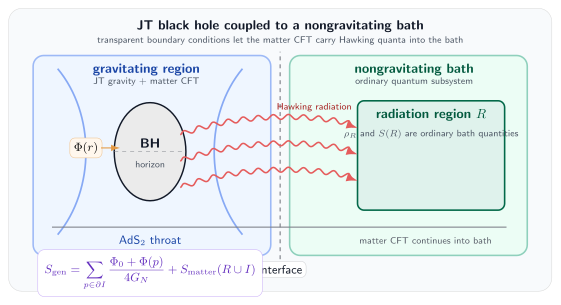
This setup is conceptually important. In a gravitating region, defining “the Hilbert space of a subregion” is subtle because of diffeomorphism constraints. In the bath, by contrast, gravity is absent and is an ordinary nongravitating subsystem with an ordinary reduced density matrix .
So the question
is sharply defined. The surprise is that the gravitational formula for this entropy may include an island that lies in the gravitating region.
The island formula in JT gravity
Section titled “The island formula in JT gravity”For a bath region , the island prescription says to consider candidate regions in the gravitating region and compute
Then one extremizes over the island endpoint locations and chooses the minimal saddle:
The two most important candidate saddles are:
The first is the no-island saddle. It reproduces the Hawking answer. The second is the island saddle. It gives the Page-curve answer at late times.
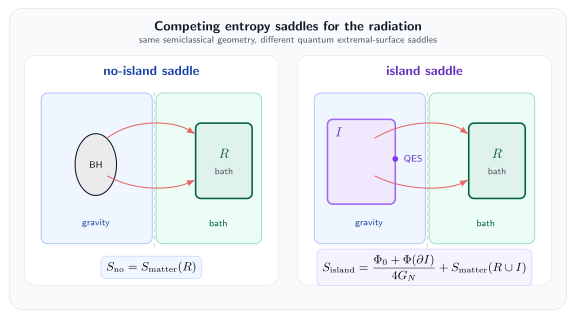
The notation can be dangerously simple. The island is not inserted by hand as a new physical rule about where the radiation lives. It is a saddle in a gravitational entropy calculation. The gravitational path integral decides whether the saddle contributes dominantly.
Matter entropy in two-dimensional CFT
Section titled “Matter entropy in two-dimensional CFT”The technical advantage of JT gravity is that the matter entropy is often computable using two-dimensional CFT formulas.
For a single interval of length in the vacuum of a CFT,
At temperature ,
For large ,
The coefficient
is the thermal entropy density of a two-dimensional CFT. This is why the no-island entropy grows linearly with time in simple evaporating setups: as time passes, the radiation region contains a longer and longer thermal segment of outgoing Hawking radiation.
For multiple intervals, the entropy is a twist-operator correlation function. In general it depends on the full CFT data. In many island calculations one works in limits where the relevant conformal block or free-field approximation makes the answer simple enough to see the saddle transition explicitly.
The no-island saddle: Hawking growth
Section titled “The no-island saddle: Hawking growth”Set . Then
The radiation region contains outgoing Hawking modes. In a simple thermal approximation,
The precise coefficient depends on whether one studies a one-sided or two-sided setup, and on the precise definition of . The essential feature does not depend on these details:
This is Hawking’s answer in island language. It is a perfectly legitimate saddle. It is just not always the dominant saddle.
The island saddle: the partners are included
Section titled “The island saddle: the partners are included”Now allow a nonempty island behind the horizon. The generalized entropy has two competing pieces:
The geometric cost is large:
But the matter entropy can drop dramatically. The outgoing Hawking quanta in are entangled with interior partners. If the island contains those partners, then the matter entropy of is much smaller than the entropy of alone.
At late times the island saddle has the schematic form
for a one-sided setup, or twice this value for a symmetric two-sided setup. The term is the residual CFT entropy after including the island. The leading behavior is controlled by the black-hole entropy rather than by the growing Hawking entropy.
Thus the late-time entropy is not
but rather
This is the Page curve in its simplest semiclassical disguise.
Why the QES sits near the horizon
Section titled “Why the QES sits near the horizon”The QES condition is the extremality condition for . Near the horizon, let be a small coordinate distance from the horizon along a spatial slice. A useful schematic model is
The first term grows as the endpoint moves away from the horizon. The logarithmic term models the matter-entropy advantage of moving the endpoint. Extremizing gives
so
Do not overinterpret the exact coefficient. It depends on the coordinate choice and the simplified matter entropy. The robust lesson is that the QES is parametrically close to the horizon when is small.
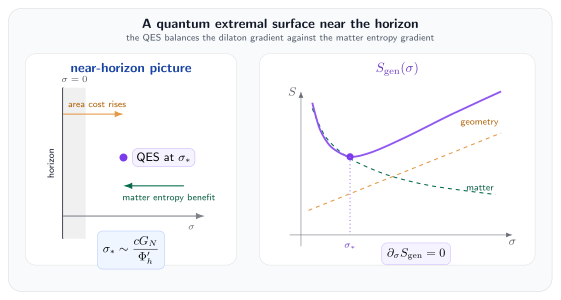
This is the two-dimensional version of a very general intuition: the island endpoint appears near the horizon because the horizon is where the geometric entropy cost is just right for capturing the interior partners of Hawking radiation.
The Page transition
Section titled “The Page transition”The fine-grained radiation entropy is obtained by comparing saddles:
Before the Page time,
so the no-island saddle dominates and the entropy follows Hawking’s increasing answer.
After the Page time,
so the island saddle dominates and the entropy follows the black-hole entropy scale. For an evaporating black hole, decreases, so the radiation entropy decreases after the transition.
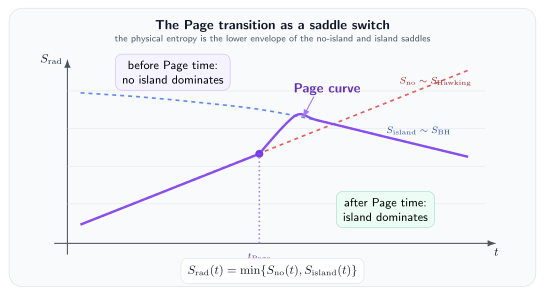
In the approximation where changes slowly compared with the radiation entropy growth, the Page time is estimated by
or
Again, the coefficient depends on the setup. The parametric statement is the important one: the Page time is when the semiclassical Hawking entropy becomes comparable to the black-hole entropy.
Entanglement-wedge interpretation
Section titled “Entanglement-wedge interpretation”Before the Page time, the radiation entanglement wedge is essentially the bath region . The interior partners are not reconstructible from the radiation alone.
After the Page time, the dominant QES changes. The radiation entanglement wedge includes . Thus operators in the island are encoded in the radiation system, at least within the appropriate code subspace and with the usual caveats about reconstruction complexity and state dependence.
This gives a geometric explanation of Page’s information-theoretic expectation. The radiation entropy decreases not because local Hawking emission stops looking thermal, but because the fine-grained entropy prescription changes saddles.
A useful slogan is
The island is the bulk region that must be included so that the radiation has the correct fine-grained entropy.
What the JT calculation teaches
Section titled “What the JT calculation teaches”The JT island calculation teaches several lessons that survive beyond two dimensions.
First, the Hawking calculation computes a real semiclassical saddle, but not always the dominant saddle for fine-grained entropy.
Second, the correction is nonperturbative from the viewpoint of the naive entropy answer. The island saddle can change by order , even though local effective field theory near the horizon remains an excellent approximation for simple observables.
Third, the generalized entropy is the correct object to extremize. The separation between the geometric term and matter entropy is regulator dependent, but the renormalized sum is meaningful.
Fourth, the island rule explains the Page curve but does not by itself give every microscopic matrix element of the black-hole -matrix. Entropy is a coarse functional of the density matrix. The full state is much more detailed.
Fifth, the calculation is powerful precisely because lives in a nongravitating bath. The bath gives a clean operational meaning to the radiation entropy.
Common pitfalls
Section titled “Common pitfalls”Pitfall 1: “The island is manually added to purify the radiation.”
No. The island appears by extremizing and minimizing . At early times the island saddle is subdominant. At late times it dominates.
Pitfall 2: “The island means the Hawking calculation was locally wrong.”
Not in the usual sense. The local Hawking state can remain an excellent semiclassical approximation. The failure is in using the wrong global saddle for a fine-grained entropy.
Pitfall 3: “JT gravity solves the full four-dimensional problem.”
JT gravity is a controlled model, not a complete model of realistic black holes. It captures universal near-AdS and gravitational-entropy physics, but higher-dimensional evaporation has additional technical and conceptual issues.
Pitfall 4: “The area term and matter entropy are separately physical.”
Their split is cutoff dependent. The generalized entropy is the physical object after renormalization of gravitational couplings.
Pitfall 5: “The Page curve gives the final quantum state.”
No. The Page curve gives a fine-grained entropy. It strongly constrains the state, but it does not provide all amplitudes or a complete decoding protocol.
Exercises
Section titled “Exercises”Exercise 1: JT equation of motion
Section titled “Exercise 1: JT equation of motion”Consider the dynamical part of the JT action,
Vary the action with respect to . What equation does this impose on the metric?
Solution
The variation with respect to is direct:
Since is arbitrary, the equation of motion is
Therefore
The spacetime is locally AdS.
Exercise 2: First law for the JT black hole
Section titled “Exercise 2: First law for the JT black hole”For the JT black hole
Show that the mass
satisfies .
Solution
Differentiate the entropy:
Then
Differentiating the mass gives
Hence
Exercise 3: Late-time growth of thermal CFT entropy
Section titled “Exercise 3: Late-time growth of thermal CFT entropy”Use
to show that for ,
Solution
For ,
Taking
we find
Therefore
The second term is independent of , so
Exercise 4: A toy QES extremization
Section titled “Exercise 4: A toy QES extremization”Consider the schematic generalized entropy
Find the extremal value and determine whether it is a local minimum.
Solution
Differentiate:
Setting this to zero gives
The second derivative is
Thus the extremum is a local minimum.
Exercise 5: Estimate the Page time
Section titled “Exercise 5: Estimate the Page time”Suppose the no-island entropy is
and the island entropy is approximately constant,
Estimate .
Solution
The Page transition occurs when the two saddles have equal generalized entropy:
Thus
Using
we obtain
This estimate assumes the black-hole entropy changes slowly compared with the entropy production rate.
Exercise 6: Why the island saddle is not a violation of no-cloning
Section titled “Exercise 6: Why the island saddle is not a violation of no-cloning”After the Page time, the radiation entanglement wedge includes an island behind the horizon. Explain why this does not mean that the same independent quantum information exists both inside the black hole and in the radiation as two separate copies.
Solution
The island statement is a statement about reconstruction in a gravitational code. It says that operators in the island have representatives acting on the radiation Hilbert space, within an appropriate code subspace. It does not say that there are two independent tensor-factor copies of the same degrees of freedom.
This is analogous to quantum error correction. A logical operator can have multiple physical reconstructions on different sets of physical qubits, but the logical degree of freedom is not duplicated as independent quantum data. The different reconstructions are different representatives of the same encoded operator.
In gravitational language, after the Page transition the island lies in the entanglement wedge of the radiation. The interior description and the radiation reconstruction are complementary descriptions inside the code, not two independent copies violating monogamy or no-cloning.
Further reading
Section titled “Further reading”- A. Almheiri, N. Engelhardt, D. Marolf, and H. Maxfield, “The entropy of bulk quantum fields and the entanglement wedge of an evaporating black hole”. The early QES/island analysis in a two-dimensional JT setup.
- G. Penington, “Entanglement Wedge Reconstruction and the Information Paradox”. A complementary island/QES route to the Page curve.
- A. Almheiri, R. Mahajan, J. Maldacena, and Y. Zhao, “The Page curve of Hawking radiation from semiclassical geometry”. The island rule and semiclassical Page curve in a geometric formulation.
- A. Almheiri, T. Hartman, J. Maldacena, E. Shaghoulian, and A. Tajdini, “Replica Wormholes and the Entropy of Hawking Radiation”. The replica-wormhole derivation of the island rule in JT gravity.
- A. Almheiri, T. Hartman, J. Maldacena, E. Shaghoulian, and A. Tajdini, “The entropy of Hawking radiation”. A pedagogical review of the island and replica-wormhole story.
- J. Maldacena, D. Stanford, and Z. Yang, “Conformal symmetry and its breaking in two dimensional Nearly Anti-de-Sitter space”. The Schwarzian and nearly AdS foundation of modern JT gravity.
- A. Almheiri and J. Polchinski, “Models of AdS Backreaction and Holography”. Earlier AdS dilaton-gravity models and backreaction.
- P. Saad, S. H. Shenker, and D. Stanford, “JT gravity as a matrix integral”. Essential for the nonperturbative and ensemble aspects of JT gravity.