
Complexity Proposals: Volume, Action, and Beyond
The previous page explained why the thermofield-double state is dual to the eternal two-sided AdS black hole. A striking feature of that geometry is that the Einstein-Rosen bridge keeps growing even after ordinary thermodynamic quantities have reached equilibrium. The entropy of each boundary theory is constant, but the interior volume of the two-sided black hole continues to increase for a very long time.
This observation led to a new question:
What boundary quantity measures the growth of the black-hole interior after entropy has saturated?
The proposed answer is quantum computational complexity.
Roughly, the complexity of a quantum state is the minimal number of elementary gates required to prepare it from a simple reference state. Complexity is not as universal as entropy. It depends on the choice of reference state, gate set, tolerance, and allowed operations. Nevertheless, for chaotic large- systems, its qualitative behavior seems to match an important set of gravitational facts:
This page introduces the two standard holographic complexity proposals:
and then explains how complexity enters black-hole information through shock waves, the switchback effect, decoding hardness, and Python’s-lunch geometries.
The most important warning is this: holographic complexity is more conjectural than RT/HRT or QES. It is not a theorem with the same status as the area law for entropy in controlled semiclassical regimes. It is a research program, motivated by a remarkable collection of structural matches between quantum circuits and black-hole interiors.
Why entropy is not enough
Section titled “Why entropy is not enough”Consider the eternal AdS black hole dual to the thermofield-double state
The reduced density matrix on the right is thermal:
The right entropy is therefore the thermal entropy,
for a large holographic black hole. This entropy is time-independent under the two-sided evolution generated by
Yet the two-sided geometry changes. A spatial slice passing through the Einstein-Rosen bridge grows longer behind the horizons. The exterior geometry is stationary, but the interior bridge grows.
This is the puzzle entropy cannot answer:
The horizon area counts a coarse measure of available black-hole degrees of freedom. It does not count how complicated the state has become under chaotic time evolution. In a chaotic quantum system, a state can remain thermal in all simple observables while becoming increasingly complex as a vector in Hilbert space.
A useful hierarchy of timescales is:
Here is a local thermalization or dissipation time, is the scrambling time, is the timescale on which complexity saturates near its maximum, and is a rough recurrence timescale. Entropy is already close to equilibrium near , while complexity can continue growing until exponentially late times.
This long growth is the central motivation for using complexity to describe black-hole interiors.
Circuit complexity in quantum mechanics
Section titled “Circuit complexity in quantum mechanics”Let be a simple reference state and let be a chosen set of elementary gates. The state complexity of at tolerance is schematically
Similarly, the complexity of a unitary is the minimal number of elementary gates required to approximate :
For a system with effective qubits, the Hilbert-space dimension is
A generic state has exponentially large complexity,
up to conventions about the gate set and tolerance. In a black-hole context, is of order the entropy:
Thus the maximum complexity of a black-hole microstate is expected to scale roughly as
This is qualitatively very different from entropy. The entropy of the black hole is order , but the maximum complexity is exponentially large in . This makes complexity a natural candidate for a quantity that can keep growing for a time of order .
There is no unique definition of complexity in continuum QFT. One must choose a reference state, a notion of elementary operation, and a regulator. The holographic proposals should therefore be understood as large-, strongly coupled, geometrized notions of complexity, not as universal field-theoretic definitions valid in every context.
The complexity = volume proposal
Section titled “The complexity = volume proposal”The first standard holographic proposal says that the complexity of the two-sided boundary state is proportional to the volume of a maximal bulk spatial slice connecting the two boundaries:
up to an order-one convention-dependent coefficient. Here is a length scale of order the AdS radius, and is a codimension-one bulk surface satisfying
where and are boundary time slices on the left and right CFTs.
The dimensions work as follows. In bulk dimensions,
Therefore
is dimensionless, as complexity should be.
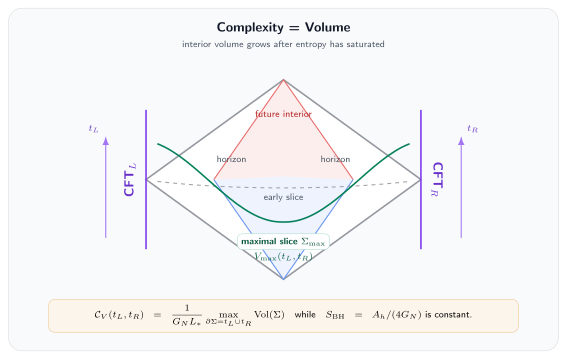
For the eternal black hole with , the maximal slice grows at late times approximately linearly:
where is a geometry-dependent rate set by the black-hole scale. Hence
Since is proportional to the number of degrees of freedom, the growth rate is of order entropy times temperature:
This scaling is what one expects for a large chaotic quantum system whose many degrees of freedom are all performing computational work at a thermal rate.
A useful mental picture
Section titled “A useful mental picture”The volume proposal says that the black-hole interior is not primarily measured by entropy. Entropy measures the horizon area. Complexity measures how long and intricate the bridge has become.
In the thermofield-double state, increasing makes the wormhole longer. In the boundary theory, the same operation applies time evolution to both CFTs:
Although one-point functions and thermal correlators may look stationary, the state has moved to a more complex location in Hilbert space. The ER bridge is the geometric record of this motion.
The complexity = action proposal
Section titled “The complexity = action proposal”The second standard proposal is complexity = action:
Here is the on-shell gravitational action evaluated on the Wheeler-DeWitt patch. The Wheeler-DeWitt patch is the domain of dependence of any bulk Cauchy slice anchored at the chosen boundary times. Equivalently, it is the bulk region swept out by all spacelike surfaces ending at the specified boundary time slices.
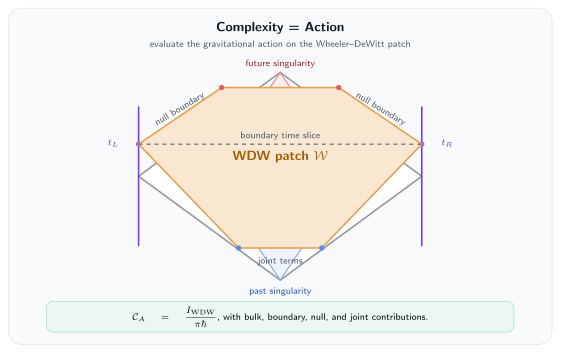
The action includes bulk terms, boundary terms, joint terms, and null-boundary contributions. Schematically,
For Einstein gravity with negative cosmological constant, the bulk term is
The full definition is subtle because null boundaries and their joints require careful treatment. This is one reason the action proposal is technically more delicate than the volume proposal.
Nevertheless, the action proposal has an attractive feature: it does not require choosing an arbitrary length scale by hand. The conversion factor is simply .
Late-time growth and Lloyd’s bound
Section titled “Late-time growth and Lloyd’s bound”For many neutral AdS black holes, the complexity=action proposal gives a late-time growth rate
where is the black-hole mass. This resembles Lloyd’s proposed bound on the rate of computation,
This match was one of the motivations for the action proposal and for the slogan that black holes are among the fastest computers in nature.
A few cautions are important.
First, the precise meaning and general validity of Lloyd’s bound in quantum systems are subtle. Second, charged, rotating, time-dependent, or higher-derivative black holes require additional care. Third, holographic complexity itself is not defined as sharply as entropy, so one should not treat the late-time rate as a universal theorem.
The robust qualitative lesson is more modest:
This is the feature shared by the volume and action proposals.
Complexity of formation
Section titled “Complexity of formation”A useful diagnostic is the complexity of formation. For the thermofield-double state, define
where and are reference vacuum states or ground states for the two CFTs. In the bulk, this compares the complexity of the eternal black hole with that of two copies of empty AdS.
The complexity of formation is analogous to a thermodynamic formation quantity. It asks how hard it is to create the entangled two-sided black-hole state, not how fast complexity grows after it has been created.
At high temperature, one expects the complexity of formation to be proportional to the entropy:
This is much smaller than the maximum complexity , but much larger than order-one complexity. It reflects the fact that preparing a large entangled black hole is already computationally expensive, even before the bridge begins its long linear growth.
Shock waves and the switchback effect
Section titled “Shock waves and the switchback effect”One of the most beautiful tests of holographic complexity involves shock waves.
Consider perturbing the thermofield-double state by an operator inserted at an early boundary time . Evolving to the present produces a precursor operator schematically of the form
The circuit has a forward time evolution, an insertion, and a backward time evolution. Naively, one might expect the complexity to grow like
where is a complexity growth rate. But chaotic dynamics produces cancellations for a while. The forward and backward evolutions cancel except near the perturbation, until the perturbation has spread over the system.
The time needed for this spreading is the scrambling time:
The resulting behavior is the switchback effect:
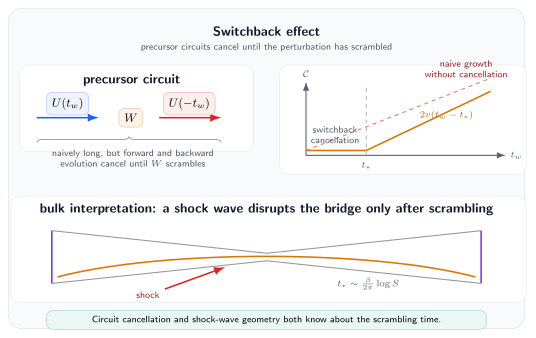
In the bulk, an early operator insertion creates a gravitational shock wave near the horizon. The shock changes the geometry of the Einstein-Rosen bridge. The volume and action proposals reproduce the same scrambling-time delay that appears in the boundary circuit picture.
This is one of the strongest pieces of evidence that holographic complexity is capturing something real: the same delay appears in two very different languages.
Complexity and chaos
Section titled “Complexity and chaos”The switchback effect is closely related to quantum chaos.
In a chaotic many-body system, a simple operator becomes complicated under Heisenberg evolution:
At early times, acts only on a few degrees of freedom. After scrambling, it acts effectively on order degrees of freedom. The scrambling time is therefore the time when a local perturbation has grown into a system-size perturbation.
In holographic systems, this growth is diagnosed by out-of-time-order correlators. A characteristic behavior is
with Lyapunov exponent
Black holes saturate this chaos bound in the simplest Einstein-gravity regime. The scrambling time follows from the condition
which gives
This is the same timescale that appears in shock-wave geometries and in the switchback effect. Complexity, chaos, and near-horizon gravitational blueshift are therefore tightly linked.
Complexity and decoding Hawking radiation
Section titled “Complexity and decoding Hawking radiation”The island formula says that after the Page time, the entanglement wedge of the Hawking radiation can include an island inside the black hole. In principle, this means that certain interior operators are encoded in the radiation.
But “encoded” is not the same as “easy to decode.”
The Harlow-Hayden argument says that distilling a particular qubit of information from Hawking radiation may require time exponential in the black-hole entropy:
for some order-one constant in the relevant complexity model. Thus information can be present in the radiation while remaining computationally inaccessible to any realistic observer.
This distinction is crucial. The Page curve is an entropy statement. It tells us about the fine-grained correlations between the radiation and the remaining black hole. It does not provide an efficient algorithm for extracting a diary thrown into the black hole.
Holographically, the same distinction appears geometrically. Entanglement wedge reconstruction says that a region can reconstruct operators in its wedge. Complexity asks how hard that reconstruction is.
Python’s lunch
Section titled “Python’s lunch”A modern geometric refinement of decoding hardness is the Python’s lunch proposal.
The rough picture is this. In some semiclassical geometries, a reconstruction region has an entanglement wedge containing the desired bulk point, but the path from the boundary to that point passes through a geometric obstruction. In entropy language, there may be more than one quantum extremal surface: a locally minimal QES and a larger “bulge” surface. The difference in generalized entropy behaves like a computational barrier.
Let be the relevant locally minimal QES and let be the larger intermediate surface. Define
Then the decoding complexity is conjectured to scale schematically as
up to model-dependent prefactors and polynomial corrections.
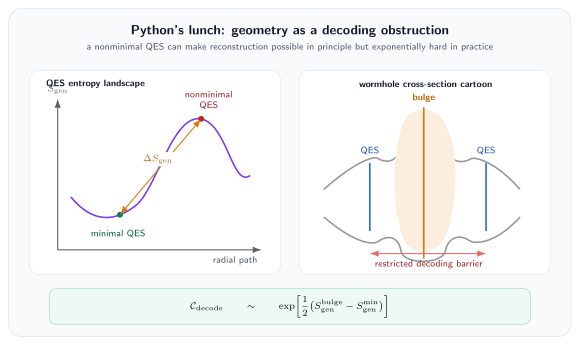
This proposal is especially relevant for black-hole information. Islands say that the radiation contains the interior in its entanglement wedge. Python’s lunch says that reconstructing the interior from the radiation can nevertheless be exponentially hard.
The message is clean:
A region may contain the information in principle, but the recovery map may be too complex to implement in practice.
Complexity is not an entropy
Section titled “Complexity is not an entropy”Because both entropy and complexity are information-theoretic words, it is easy to confuse them. They measure different things.
Entropy counts effective uncertainty or the logarithm of a number of accessible states. For a thermal system,
Complexity measures the minimal number of elementary operations needed to prepare a state or implement a unitary. For a typical state in a Hilbert space of entropy ,
Entropy can saturate quickly. Complexity can keep growing for exponentially long times.
In black holes, this distinction becomes geometric:
The RT/QES formula tells us which degrees of freedom are entangled with which. Complexity proposals try to tell us how hard it is to prepare, evolve, or decode those degrees of freedom.
Beyond CV and CA
Section titled “Beyond CV and CA”The two proposals above are the classics, but they are not the end of the story. Many variants have been explored. Some replace volume by spacetime volume; some modify the bulk functional; some use generalized volumes; some try to connect holographic complexity to tensor-network costs, circuit geometry, path-integral optimization, Nielsen geometry, Krylov complexity, or operator growth.
A deliberately schematic family of proposals is
where is a bulk region or surface associated with the boundary time slice, and is a diffeomorphism-invariant functional.
This flexibility is both a strength and a weakness. It allows the subject to adapt to different physical questions, but it also means that complexity is less sharply pinned down than entropy.
A good working attitude is:
This attitude is particularly useful for students. One should learn the standard CV and CA proposals, understand the evidence from shock waves and late-time growth, and then treat newer proposals as attempts to isolate which features are universal.
Relation to the black-hole information problem
Section titled “Relation to the black-hole information problem”Complexity enters black-hole information in three logically distinct ways.
First, it explains why the black-hole interior can keep growing after entropy saturates. This is most transparent in the eternal two-sided black hole.
Second, it sharpens the difference between information being present and information being accessible. The Page curve and island formula can imply that the radiation contains information, while Harlow-Hayden and Python’s-lunch arguments suggest that extracting it may be exponentially hard.
Third, it helps diagnose the operational meaning of bulk reconstruction. Entanglement wedge reconstruction is an existence statement: an operator has a boundary representation. Complexity asks whether that representation is simple, nonlocal, exponentially complicated, or practically unreachable.
This gives a useful dictionary:
This is why complexity belongs in a sequence on black-hole information even though it is not itself an entropy formula.
Common pitfalls
Section titled “Common pitfalls”Pitfall 1: “Complexity is just another entropy.”
Section titled “Pitfall 1: “Complexity is just another entropy.””No. Entropy measures the size of an effective state space or the mixedness of a reduced density matrix. Complexity measures the minimal cost of preparing a state or implementing a unitary. They have very different saturation scales.
Pitfall 2: “The volume proposal and action proposal must both be exactly right.”
Section titled “Pitfall 2: “The volume proposal and action proposal must both be exactly right.””They cannot both be unique exact definitions in all regimes unless their differences are physically irrelevant in the appropriate limit. It is better to regard them as candidate bulk duals of related notions of complexity.
Pitfall 3: “If the radiation contains the island, decoding must be easy.”
Section titled “Pitfall 3: “If the radiation contains the island, decoding must be easy.””Entanglement wedge reconstruction guarantees existence within a code subspace. It does not guarantee an efficient decoding algorithm. Complexity is the missing operational ingredient.
Pitfall 4: “A long Einstein-Rosen bridge means a traversable shortcut.”
Section titled “Pitfall 4: “A long Einstein-Rosen bridge means a traversable shortcut.””No. The bridge can become very long while remaining nontraversable. Complexity growth is compatible with causal disconnection of the two boundaries unless an explicit coupling is added.
Pitfall 5: “The CA late-time rate proves Lloyd’s bound.”
Section titled “Pitfall 5: “The CA late-time rate proves Lloyd’s bound.””The match is suggestive, but the bound and its precise domain of validity are subtle. The main robust lesson is the long linear growth of an interior-sensitive quantity.
Exercises
Section titled “Exercises”Exercise 1: dimensions in the CV proposal
Section titled “Exercise 1: dimensions in the CV proposal”In bulk dimensions, show that
is dimensionless.
Solution
In bulk dimensions, a codimension-one spatial slice has dimension , so
The Newton constant has dimension
because the Einstein-Hilbert action contains
and has dimension . Therefore
Thus
is dimensionless.
Exercise 2: entropy saturation versus complexity growth
Section titled “Exercise 2: entropy saturation versus complexity growth”Suppose a black hole has entropy and temperature . Explain why it is natural for entropy to saturate on a time of order or , while complexity can grow until a time of order .
Solution
Entropy measures coarse information such as the effective number of thermally occupied states. Local thermalization occurs when simple observables lose memory of their initial values, which happens on a dissipation time of order in a strongly coupled thermal system. Scrambling of initially localized information across all degrees of freedom takes the longer time
After this, the system can already look thermal to simple probes.
Complexity is different. It measures the minimal circuit size needed to prepare the full state. A typical state in a Hilbert space with entropy has complexity of order
If complexity grows at a rate polynomial in , it takes an exponential time to approach this maximum. Hence entropy can saturate quickly while complexity continues to grow until times of order .
Exercise 3: switchback delay
Section titled “Exercise 3: switchback delay”Consider the precursor unitary
Explain why its complexity is not simply the sum of the complexities of and for all .
Solution
If were absent, the product would be
so the forward and backward evolutions would cancel exactly. With inserted, the cancellation is spoiled only in the part of the circuit affected by .
At early times, the Heisenberg-evolved operator
has not yet spread through the whole system. Most of the forward and backward time evolutions still cancel. Only after the scrambling time
has become a system-size operator. After that, the cancellation is inefficient, and the complexity grows approximately like the sum of the two time evolutions with a delay. This delay is the switchback effect.
Exercise 4: CA and Lloyd scaling
Section titled “Exercise 4: CA and Lloyd scaling”Assume the complexity=action proposal gives
at late times for a neutral AdS black hole. Explain why this resembles a bound on computational speed.
Solution
A proposed quantum bound on computation says that a system with available energy cannot increase its complexity faster than roughly
For a neutral black hole, the relevant energy is its mass . The CA result
therefore saturates the same form of the bound. This motivates the slogan that black holes are extremely efficient computers.
The interpretation should be treated carefully because the general validity of such bounds and the precise definition of complexity are subtle. The important point is that the gravitational action growth has the same scaling as the fastest possible energy-limited computation.
Exercise 5: Page curve versus decoding
Section titled “Exercise 5: Page curve versus decoding”The island formula says that after the Page time, the radiation entropy is computed by a saddle including an island. Does this imply that an observer can efficiently extract an infalling diary from the radiation? Explain.
Solution
No. The island formula is an entropy statement. It says that the fine-grained entropy of the radiation is computed as though part of the black-hole interior belongs to the radiation’s entanglement wedge. Equivalently, it implies that the radiation contains enough quantum information to reconstruct certain interior degrees of freedom within the appropriate code subspace.
But reconstruction need not be efficient. The boundary representation of an interior operator may be extremely complicated. Harlow-Hayden-type arguments suggest that distilling specific information from Hawking radiation can require time exponential in the black-hole entropy:
Thus the information can be present in principle but inaccessible in practice.
Exercise 6: Python’s-lunch barrier
Section titled “Exercise 6: Python’s-lunch barrier”Suppose a reconstruction problem has a locally minimal QES with generalized entropy and a bulge surface with generalized entropy . If
estimate the Python’s-lunch decoding complexity using
Solution
Here
The proposed scaling gives
Thus the decoding cost is polynomial in in this toy estimate. If instead were of order , the same formula would give an exponentially large decoding complexity.
Further reading
Section titled “Further reading”- Douglas Stanford and Leonard Susskind, “Complexity and Shock Wave Geometries”. The original detailed volume/ER-bridge discussion and switchback-effect test.
- Adam R. Brown, Daniel A. Roberts, Leonard Susskind, Brian Swingle, and Ying Zhao, “Complexity Equals Action”. The short paper proposing the action of the Wheeler-DeWitt patch as holographic complexity.
- Adam R. Brown, Daniel A. Roberts, Leonard Susskind, Brian Swingle, and Ying Zhao, “Complexity, Action, and Black Holes”. The longer technical treatment of the CA proposal.
- Leonard Susskind, “Computational Complexity and Black Hole Horizons”. Early conceptual essays connecting complexity, horizons, and black-hole interiors.
- Leonard Susskind and Ying Zhao, “Switchbacks and the Bridge to Nowhere”. A focused discussion of switchbacks and ER-bridge growth.
- Daniel A. Roberts, Douglas Stanford, and Leonard Susskind, “Localized Shocks”. Shock waves, chaos, and their gravitational interpretation.
- Daniel Harlow and Patrick Hayden, “Quantum Computation vs. Firewalls”. The decoding-complexity argument in the black-hole information problem.
- Adam R. Brown, Hrant Gharibyan, Geoff Penington, and Leonard Susskind, “The Python’s Lunch: Geometric Obstructions to Decoding Hawking Radiation”. The geometric obstruction picture for hard decoding.
- Adam R. Brown and Leonard Susskind, “Second Law of Quantum Complexity”. Complexity growth as a thermodynamic-like arrow of time.
- Michael A. Nielsen, Mark R. Dowling, Mark Gu, and Andrew C. Doherty, “Quantum Computation as Geometry”. A useful entry point to the circuit-geometry viewpoint on complexity.