
Page Curve and Fine-Grained Entropy
The information paradox becomes sharp only after we distinguish two questions that sound similar but are conceptually different.
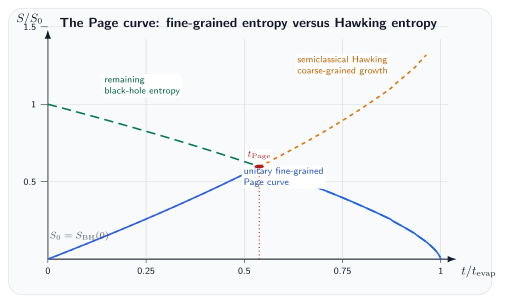
The first question is thermodynamic: what entropy is carried by the Hawking radiation if we treat it as an approximately thermal flux? This is the entropy computed by the semiclassical Hawking calculation. It grows as more quanta are emitted.
The second question is microscopic: what is the von Neumann entropy of the radiation as a subsystem of a closed quantum system? This is the fine-grained entropy
where denotes the Hawking radiation already emitted and denotes the remaining black-hole degrees of freedom. If black-hole formation and evaporation are unitary, the total state is pure at all times. Therefore
This equality is already enough to explain the qualitative shape of the Page curve. Early in evaporation, the radiation subsystem is small and can be highly mixed. Late in evaporation, the remaining black-hole subsystem is small, so it cannot purify an arbitrarily mixed radiation state. Therefore the fine-grained entropy of the radiation must first rise and then fall.
The result is the Page curve:
up to corrections that are subleading compared with in the semiclassical limit. This formula is not yet the island formula. It is the target that the island formula must reproduce. The Page curve is the information-theoretic answer demanded by unitary quantum mechanics, while Hawking’s original calculation gives the semiclassical answer before the late-time correlations are included.
Conventions and notation
Section titled “Conventions and notation”We use units with . We keep and explicit when they clarify scaling. The von Neumann entropy of a density matrix is
Unless otherwise stated, logarithms are natural logarithms, so entropy is measured in nats. To convert to bits, divide by .
The basic subsystems are:
| Symbol | Meaning |
|---|---|
| Hawking radiation already emitted and collected far from the black hole | |
| remaining black-hole degrees of freedom | |
| radiation emitted before some chosen time | |
| radiation emitted after that time | |
| a newly emitted Hawking mode outside the horizon | |
| the interior partner mode of in the semiclassical description | |
| Bekenstein-Hawking entropy | |
| entropy of the radiation computed from the semiclassical Hawking flux | |
| von Neumann entropy of the exact radiation density matrix | |
| time when the fine-grained entropy of radiation reaches its maximum |
When is a complete closed system in a pure state,
This is a kinematic statement about bipartite pure states. It is not a dynamical assumption about black holes.
Fine-grained versus coarse-grained entropy
Section titled “Fine-grained versus coarse-grained entropy”The coarse-grained entropy of a gas asks for the entropy after forgetting microscopic data and retaining only macroscopic variables such as energy, volume, and particle number. The fine-grained entropy of a quantum state is instead the von Neumann entropy of the exact density matrix.
For a closed system in a pure state,
This can be true even when a subsystem has large entropy. If the system factorizes as , then
and a standard theorem says
for every pure state on . Subsystem entropy is entanglement entropy. It measures how much information about is stored in , not whether the full state is mixed.
This is the first point at which the black-hole problem becomes subtle. The Hawking calculation naturally computes a radiation density matrix after tracing over the interior. It gives a state that looks thermal mode by mode. But unitarity is a statement about the exact global state of the radiation plus whatever degrees of freedom remain. These are not the same question.
The distinction can be summarized as follows:
| Quantity | What it measures | Expected behavior in unitary evaporation |
|---|---|---|
| entropy of the approximate thermal radiation flux | grows as more radiation is emitted | |
| von Neumann entropy of the exact radiation state | rises, peaks, and returns to zero | |
| thermodynamic entropy capacity of the remaining black hole | decreases during evaporation | |
| or | correlations between radiation and remaining hole | large near the Page time |
A useful diagnostic is the information deficit
Before the Page time this is small in the simplest random-state estimate. After the Page time it grows. At the end of unitary evaporation, the radiation may still have a large thermodynamic entropy, but its fine-grained entropy must be zero if the final state is pure.
Page theorem
Section titled “Page theorem”The Page curve is based on a simple but powerful lesson from random pure states. Let
and choose a pure state randomly with respect to the Haar measure. Suppose . Page’s result for the average entropy of subsystem is
Equivalently, in terms of harmonic numbers ,
For ,
Thus the smaller subsystem is almost maximally mixed:
The deviation from maximal entropy,
is tiny when the other subsystem is much larger. This is why information can be present in principle but nearly impossible to see in simple observables.
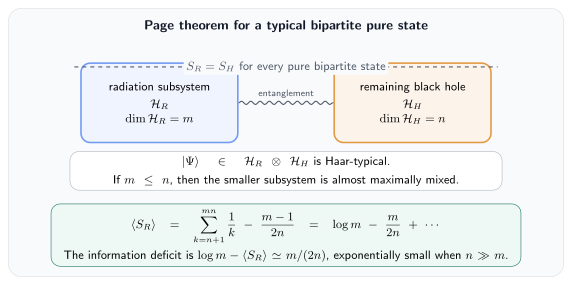
The slogan is:
More precisely, if , then . If , then . Therefore, for a typical pure state,
This is a statement about typicality, not about thermal equilibrium in the usual canonical-ensemble sense. It does not say that every state is random. It says that if the dynamics of the black hole scrambles information efficiently enough, then the entropy of a subsystem is well approximated by the entropy of the smaller available Hilbert space.
Applying Page theorem to evaporation
Section titled “Applying Page theorem to evaporation”Now apply this bipartite lesson to an evaporating black hole. The outside observer describes the system as
where is the radiation already emitted and is the remaining black hole. This factorization is a useful effective description, not an exact microscopic statement about gravitational Hilbert spaces. The quantum-gravity lesson is precisely that such factorizations require care. Still, the Page argument is best understood first in this simple language.
The effective dimension of the remaining black-hole Hilbert space is controlled by the Bekenstein-Hawking entropy:
The effective entropy capacity of the emitted radiation is controlled by the coarse-grained entropy of the Hawking flux:
If the total state is pure and sufficiently typical, then
Thus
This is the Page curve.
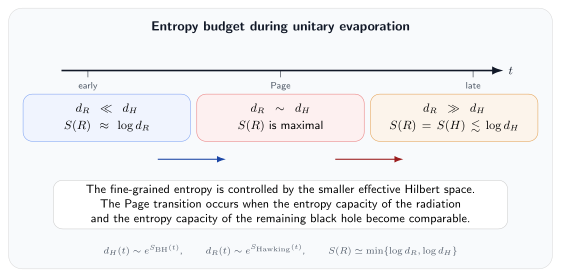
Before the Page time,
so the radiation is the smaller subsystem and
The Hawking calculation is then qualitatively correct for the entropy: the radiation looks nearly thermal and the fine-grained entropy grows.
After the Page time,
so the remaining black hole is the smaller subsystem and
The exact radiation state can no longer be close to an uncorrelated thermal state. It must contain correlations that purify the early radiation. These correlations are not visible in the local semiclassical calculation that treats each outgoing Hawking mode as nearly independent.
A simple evaporation estimate
Section titled “A simple evaporation estimate”For a four-dimensional Schwarzschild black hole,
A dimensional estimate of the evaporation rate gives
where is a dimensionless number depending on the particle species and greybody factors. Integrating gives the scaling
and therefore
In the crudest reversible entropy-bookkeeping model,
The Page time is then determined by
so
Using the Schwarzschild scaling,
hence
This number is not universal. The actual thermodynamic entropy carried away by the radiation can be written schematically as
where is an order-one coefficient that depends on the evaporation channel, greybody factors, and what one counts as radiation. Then the Page-time condition becomes
or
The robust statement is not the precise numerical coefficient. The robust statement is that the Page time occurs when the entropy capacity of the remaining black hole becomes comparable to the entropy capacity of the emitted radiation.
What information is in the radiation?
Section titled “What information is in the radiation?”A common misleading phrase is “information begins to come out after the Page time.” This is almost right, but it needs refinement.
In a unitary theory, information was never destroyed. The exact final state is determined by the exact initial state. What changes at the Page time is the accessibility of information from the radiation subsystem.
A useful measure is the difference between the coarse-grained entropy and the fine-grained entropy:
At early times, in the random-state approximation,
even though the exact state already contains correlations. These correlations are spread over a huge Hilbert space and are not visible in simple few-body observables. After the Page time,
so the deficit from thermality becomes macroscopic.
Another useful quantity is mutual information. For two systems and ,
For a pure state on ,
so
Near the Page time this mutual information is large. The radiation and remaining black hole are strongly entangled. Near the end of unitary evaporation, becomes trivial and : all the purification must be inside the radiation itself.
This is the sense in which the late radiation cannot be a product of independent thermal emissions. A state can look thermal in every simple local measurement and still be globally pure because the purification is stored in very high-order correlations.
Why the Hawking curve is not the Page curve
Section titled “Why the Hawking curve is not the Page curve”The semiclassical Hawking calculation treats quantum fields on a classical black-hole background. It predicts that each outgoing mode is entangled mainly with an interior partner . Repeating this process gives an approximate product structure
and therefore a radiation entropy that grows as more modes are emitted:
This is the Hawking curve. It is the right answer for a coarse-grained calculation that ignores subtle correlations among radiation quanta. It is not the right answer for the exact fine-grained entropy if evaporation is unitary.
The contradiction becomes sharp after the Page time. The Hawking calculation says that a newly emitted mode is purified by its interior partner . But the Page argument says that, for an old black hole, the new radiation must be correlated with the early radiation in order for to decrease. A single quantum system cannot be independently maximally entangled with two different systems. This is the entropy bookkeeping behind the firewall paradox discussed in the previous page.
The Page curve therefore does two things:
- It says what unitary evaporation should look like at the level of entropy.
- It exposes where the semiclassical Hawking description must be incomplete.
The island formula and replica wormholes will later explain how a gravitational entropy calculation can reproduce this curve.
Hayden-Preskill: old black holes as mirrors
Section titled “Hayden-Preskill: old black holes as mirrors”The Page curve also changes the operational question: after the Page time, how quickly can information thrown into a black hole come back out?
Suppose the black hole is old, meaning that more than the Page-time amount of radiation has already escaped. The remaining black hole is then smaller than its purifier, the early radiation . Alice throws in a -qubit message . If the black-hole dynamics is well modeled by a rapidly scrambling unitary, then after a scrambling time the message is mixed throughout the black-hole degrees of freedom.
Hayden and Preskill argued that Bob, who possesses the early radiation and then collects a modest amount of new Hawking radiation, can in principle decode Alice’s message. In the ideal random-unitary model, the new radiation need only contain slightly more than qubits, up to overheads and errors. The hard part is not that the information is absent. The hard part is decoding it.
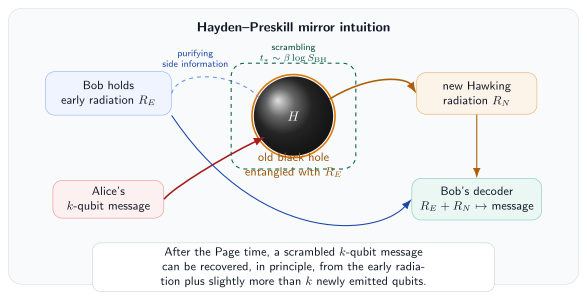
The relevant scrambling time is often estimated as
where . This is the fast-scrambler scaling. The precise coefficient and the operational decoding complexity are separate questions. The Page-curve lesson is simply that old black holes have a very different information-theoretic behavior from young black holes.
The Page curve as a target for gravity
Section titled “The Page curve as a target for gravity”The Page curve is not itself a gravitational derivation. It is an information-theoretic benchmark.
A complete gravitational calculation should explain why the fine-grained radiation entropy is approximately
before the Page time, but approximately
after the Page time.
The modern answer uses quantum extremal surfaces and islands. In its simplest schematic form, the island rule says
Before the Page time, the dominant saddle has no island, so the result agrees with the Hawking calculation. After the Page time, a new saddle with an island dominates, and the generalized entropy is controlled by an area term comparable to the remaining black-hole entropy. Thus the island formula gives a semiclassical gravitational mechanism for the Page curve.
That statement is profound, but it should not be read too quickly. The Page curve tells us the answer expected from unitarity. The island formula tells us how that answer emerges from a gravitational entropy prescription. Replica wormholes explain why the island saddle appears in the gravitational replica path integral. These are logically distinct steps.
Common pitfalls
Section titled “Common pitfalls”Pitfall 1: “The Page curve is the entropy of the black hole.”
No. The Page curve is usually the fine-grained entropy of the radiation subsystem. It equals the entropy of the remaining black hole only when the combined system is pure.
Pitfall 2: “Hawking radiation is not thermal after the Page time.”
Locally it may still look very close to thermal. The point is that the exact global radiation state cannot be a product of independent thermal states. The purification is hidden in correlations.
Pitfall 3: “The Page theorem proves black-hole unitarity.”
It does not. Page’s argument assumes unitary evaporation and typicality. It derives the expected entropy curve under those assumptions.
Pitfall 4: “The Page time is exactly halfway through evaporation.”
Not in general. It is roughly the time when the radiation entropy capacity and remaining black-hole entropy capacity are comparable. The fraction of the lifetime depends on the evaporation model.
Pitfall 5: “The late radiation alone contains the message.”
In the Hayden-Preskill setup, the early radiation is crucial side information. Without it, the new radiation by itself generally does not reveal the message efficiently.
Pitfall 6: “A decreasing entropy means radiation disappears.”
No. More radiation is emitted, so the coarse-grained entropy can keep increasing. The fine-grained entropy decreases because newly emitted quanta purify correlations already present in the earlier radiation.
Exercises
Section titled “Exercises”Exercise 1: Fine-grained entropy of a Bell pair
Section titled “Exercise 1: Fine-grained entropy of a Bell pair”Consider the two-qubit Bell state
Compute the entropy of the full two-qubit state and the entropy of the first qubit.
Solution
The full state is pure:
so
Tracing over the second qubit gives
Therefore
This is the simplest example of the Page-curve principle: a globally pure state can have mixed subsystems.
Exercise 2: The large- limit of Page’s formula
Section titled “Exercise 2: The large-nnn limit of Page’s formula”Assume and
Using
show that for ,
Solution
Use the asymptotic expansion:
and
Then
Subtracting the Page correction gives
The two terms proportional to combine as
Thus
For , the leading correction is
up to terms smaller in the relevant hierarchy.
Exercise 3: A toy Page curve from Hilbert-space dimensions
Section titled “Exercise 3: A toy Page curve from Hilbert-space dimensions”Let
for . Assume the total state is a typical pure state on . Find and the Page time.
Solution
For a typical pure state,
Here
Therefore
The Page time is the crossing point:
Thus
The maximum entropy is
This toy model gives a triangular Page curve. A realistic evaporating black hole has a smoother curve because is not linear in time.
Exercise 4: Schwarzschild Page time in the reversible estimate
Section titled “Exercise 4: Schwarzschild Page time in the reversible estimate”Assume a four-dimensional Schwarzschild black hole has
In the reversible estimate,
Find .
Solution
The Page time is determined by
Using the assumed reversible estimate,
Thus
Substitute the Schwarzschild scaling:
Cancel :
Raise both sides to the power :
Therefore
The precise numerical fraction changes if the emitted radiation entropy is not equal to the decrease of .
Exercise 5: Mutual information between radiation and remaining black hole
Section titled “Exercise 5: Mutual information between radiation and remaining black hole”Suppose is pure. Show that
What does this imply near the Page time?
Solution
By definition,
Since is pure,
Also, for a bipartite pure state,
Therefore
Near the Page time, is of order the black-hole entropy scale, so is also large. The radiation and remaining black hole are strongly correlated. After the black hole disappears in a unitary process, becomes trivial and .
Exercise 6: Why early radiation is side information
Section titled “Exercise 6: Why early radiation is side information”In the Hayden-Preskill setup, assume Alice throws a -qubit message into an old black hole. Explain why Bob needs the early radiation as side information. Why is the newly emitted radiation alone not enough in general?
Solution
For an old black hole, the remaining black hole is already highly entangled with the early radiation . The message thrown into the black hole is scrambled into , but is not an isolated memory system. Its purifier is outside, in .
After scrambling, a small amount of new radiation can carry enough information to complete the decoding, but only for an observer who also has access to the purifying side information . Without , the newly emitted radiation is generally still highly mixed and does not by itself contain a clean copy of Alice’s message.
This is how the mirror analogy avoids a naive contradiction. The black hole is not simply returning the message as ordinary visible radiation. Rather, the message is recoverable from a highly nonlocal joint system:
The decoding operation may be extremely complicated even when recovery is possible in principle.
Further reading
Section titled “Further reading”- D. N. Page, “Average Entropy of a Subsystem”, Physical Review Letters 71 (1993) 1291–1294.
- D. N. Page, “Information in Black Hole Radiation”, Physical Review Letters 71 (1993) 3743–3746.
- P. Hayden and J. Preskill, “Black Holes as Mirrors: Quantum Information in Random Subsystems”, Journal of High Energy Physics 09 (2007) 120.
- Y. Sekino and L. Susskind, “Fast Scramblers”, Journal of High Energy Physics 10 (2008) 065.
- A. Almheiri, T. Hartman, J. Maldacena, E. Shaghoulian, and A. Tajdini, “The Entropy of Hawking Radiation”, Reviews of Modern Physics 93 (2021) 035002.
- A. Almheiri, R. Mahajan, J. Maldacena, and Y. Zhao, “The Page Curve of Hawking Radiation from Semiclassical Geometry”, arXiv:1908.10996.