
Higher-Dimensional Islands and Double Holography
The island formula was first made computationally sharp in two-dimensional models, especially JT gravity. But the black holes that originally motivated the information paradox are not two-dimensional. A natural question is therefore:
Are islands a special artifact of AdS/JT gravity, or are they a robust feature of semiclassical gravity in higher dimensions?
The answer from modern holography is that islands are much more general than JT gravity. The cleanest way to see this is through double holography, where a lower-dimensional gravitating theory coupled to a nongravitating bath has an equivalent description as an ordinary higher-dimensional classical bulk geometry. In that higher-dimensional description, the island transition is simply an RT/HRT phase transition.
The slogan of this page is
This slogan is powerful because it turns a surprising gravitational entropy formula into a familiar geometric minimization problem.
Why higher dimensions are harder
Section titled “Why higher dimensions are harder”The island formula for a nongravitating radiation region coupled to a gravitating region is
In two-dimensional JT gravity, the “area” is a dilaton value at a point, and the matter entropy is often the entropy of intervals in a two-dimensional CFT. That makes the calculation analytically tractable.
In higher dimensions, every piece of the formula becomes harder:
| Ingredient | JT gravity | Higher-dimensional gravity |
|---|---|---|
| QES location | points | codimension-two surfaces |
| Area term | dilaton value | geometric area functional |
| Matter entropy | often CFT intervals | hard QFT entropy in curved spacetime |
| Extremization | ordinary equations | nonlinear PDEs for surfaces |
| Black-hole geometry | locally AdS | dynamical geometry with gravitons |
| Bath coupling | simple transparent boundary | model-dependent boundary conditions |
The hardest term is usually . Even if the geometry is known, the entropy of quantum fields on a curved higher-dimensional background is not usually available in closed form.
Double holography solves this technical problem by making the matter sector itself holographic. Then the matter entropy can be computed by an RT/HRT surface in one higher dimension. The cost is that we have introduced a special large- matter sector, but the reward is enormous: the island formula becomes visible as classical geometry.
The three descriptions of double holography
Section titled “The three descriptions of double holography”A doubly holographic model has three useful descriptions of the same physics.
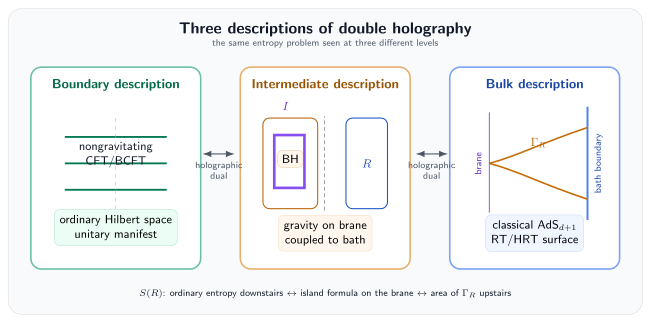
Let the full classical bulk have dimension . Inside it sits a codimension-one brane , often called a Planck brane, Karch-Randall brane, or end-of-the-world brane, depending on the setup. The brane has dimension .
The three descriptions are:
-
Boundary description. A nongravitating -dimensional CFT, often with a defect, boundary, or interface. This is a conventional quantum system, so entropies of boundary subregions are ordinary density-matrix entropies.
-
Brane description. A -dimensional effective gravitational theory living on , coupled to bath degrees of freedom. This is the description in which one writes the island formula.
-
Bulk description. A -dimensional classical gravitational theory. Entropies are computed by RT/HRT surfaces in the full bulk. In this description, the island transition is an ordinary extremal-surface transition.
This is why the word “double” is used. There is the usual AdS/CFT relation between the boundary theory and the bulk geometry, but there is also an intermediate lower-dimensional gravitational description induced on the brane.
A compact way to write the triality is
The middle description is the one closest to semiclassical black-hole physics. The bottom description is the one in which calculations become geometric.
A braneworld action
Section titled “A braneworld action”A schematic Euclidean action for the bulk-plus-brane description is
Here is the -dimensional AdS bulk, is the asymptotic AdS boundary where the nongravitating bath lives, is the brane, is the brane tension, and may include brane-localized matter and, in some models, an intrinsic Einstein-Hilbert term on the brane.
The brane tension controls the embedding of in the bulk. Geometrically, it fixes the angle at which the brane cuts off the AdS spacetime. Physically, the brane supports an effective gravitational theory. In Randall-Sundrum and Karch-Randall models, lower-dimensional gravity appears because graviton modes are localized near the brane or because the bulk region near the brane induces a lower-dimensional gravitational action.
One can schematically summarize this induced gravity as
where is an effective warped volume scale of the extra dimension. The exact coefficient depends on the brane embedding, counterterms, cutoff, and whether an intrinsic brane Einstein-Hilbert term is included.
The important point for island physics is not the precise coefficient. The important point is that the brane description has a gravitational area term, while the full bulk description computes entropy by ordinary higher-dimensional extremal surfaces.
Entropy in the three descriptions
Section titled “Entropy in the three descriptions”Let be a radiation region in the nongravitating bath. In the boundary description, is simply
In the brane description, gravity is dynamical on . The entropy is computed by the island rule:
Here is a possible island on the brane, and is a codimension-two surface within the brane.
In the bulk description, the matter sector of the brane description is holographic. Thus is itself computed by an RT/HRT surface in the -dimensional bulk. The full answer may be written schematically as
The second term is included when there is an intrinsic brane gravity term. In the simplest purely induced-gravity setup, it can be absorbed into the renormalized brane Newton constant or appears through the bulk geometry and counterterms. The dots denote higher-derivative entropy terms and bulk quantum corrections.
The important feature is
The endpoint of the higher-dimensional RT/HRT surface on the brane is the boundary of the island in the brane description.
How an island becomes an RT surface
Section titled “How an island becomes an RT surface”Suppose we want the entropy of the bath radiation region . In the full bulk, we look for extremal surfaces anchored on . There may be two competing topologies.
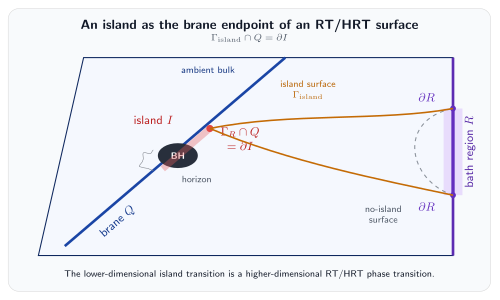
The two most important saddles are
The no-island surface stays away from the brane island endpoint. In time-dependent eternal-black-hole examples, its area grows because the surface stretches through the wormhole or black-hole interior. From the brane viewpoint, this is the Hawking-like answer.
The island surface reaches the brane and ends on a codimension-two surface . From the brane viewpoint, this is the QES. The corresponding entropy includes the brane area cost plus the entropy of .
The physical entropy is the smaller of the two extremized generalized entropies:
At early times, the no-island surface usually dominates. At late times, the island surface dominates. This is the higher-dimensional version of the Page transition.
The endpoint condition on the brane
Section titled “The endpoint condition on the brane”If an RT surface is allowed to end on a brane, extremizing its area gives a boundary condition at the endpoint. In the simplest case, where there is no extra endpoint entropy term, the condition is orthogonality:
This is the same variational logic as a soap film ending freely on a wall. The free endpoint can slide along the wall, so the area is stationary only when the surface meets the wall orthogonally.
If there is an intrinsic brane area term, the endpoint condition is modified. Schematically, the extremality condition becomes
In the brane description, this is precisely the QES condition
Thus the geometric endpoint condition in the higher-dimensional bulk is the same as extremizing generalized entropy in the brane theory.
Eternal black holes in equilibrium with a bath
Section titled “Eternal black holes in equilibrium with a bath”Many higher-dimensional island examples use an eternal AdS black hole in equilibrium with a bath rather than a one-sided evaporating black hole. This setup is technically cleaner because the spacetime can be time-translation invariant.
The brane description has a black hole coupled to bath degrees of freedom. One asks for the entropy of a radiation region in the bath. Without islands, the relevant extremal surface can grow through the black-hole interior. This produces a linearly growing entropy similar to the Hartman-Maldacena growth in the two-sided eternal black hole.
With islands, a different extremal surface appears. This surface ends on the brane near the black-hole horizon or outside it, depending on the model and region. Its area is approximately time-independent at late times. The entropy therefore saturates rather than growing forever.
A schematic late-time comparison is
while
The precise coefficient depends on the entanglement-velocity physics of the holographic matter sector, and denotes cutoff-scale or finite-distance contributions. The qualitative result is robust: the no-island saddle grows, while the island saddle gives a bounded answer.
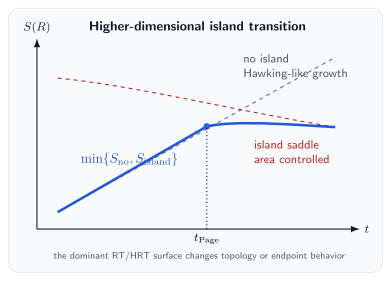
The Page time is estimated by equating the two saddle values:
For the crude linear-plus-constant model above,
This formula should not be taken too literally. Its purpose is to show the entropy budget. The Page time is the time when the area cost of creating the island becomes cheaper than continuing the Hawking-like entropy growth.
What was shown in higher-dimensional island models?
Section titled “What was shown in higher-dimensional island models?”The first higher-dimensional island constructions demonstrated that the phenomenon is not confined to JT gravity. A typical example is a five-dimensional asymptotically AdS bulk whose boundary realizes a four-dimensional black hole in a Hartle-Hawking state coupled to a bath. In such models one can find two kinds of extremal surfaces:
The island saddle avoids the eternal-black-hole version of the information paradox by preventing the entropy of the bath region from growing without bound.
Later braneworld models made the calculation more flexible. In these models, black holes live on the brane and are coupled to bath regions. The higher-dimensional RT problem can often be reduced to solving ordinary differential equations for extremal surfaces. For non-extremal black holes, the island saddle has the right qualitative behavior to reproduce Page-curve physics in arbitrary dimension. Extremal black holes are subtler: in some parameter regimes, the expected island saddle is absent or does not dominate.
This last point is pedagogically important. “There are islands” is not a magic theorem that every candidate surface always dominates. The prescription is a saddle calculation. One must find the candidate QES surfaces, extremize them, compare generalized entropies, and check the regime of validity.
A useful geometric picture
Section titled “A useful geometric picture”Here is a way to visualize the role of the brane.
The asymptotic AdS boundary carries the nongravitating bath. The Planck brane cuts into the bulk and supports gravity. A black hole may live on the brane. RT/HRT surfaces anchored on a bath region may either remain mostly in the bath side of the bulk or cross toward the brane. If such a surface ends on the brane, the endpoint is interpreted as the boundary of an island.
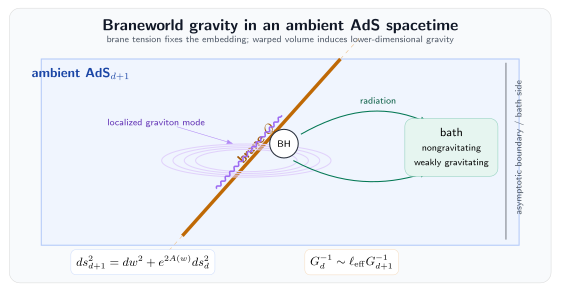
This picture also explains why the island formula is not a mysterious new rule from the full bulk viewpoint. The higher-dimensional RT surface has always been allowed to change topology and choose the minimal area. What looks new in the lower-dimensional description is that a surface can end in a gravitating region and thereby assign part of that region to the entanglement wedge of the bath.
Islands and entanglement wedges in double holography
Section titled “Islands and entanglement wedges in double holography”The island rule says that after the Page transition,
That is, the island belongs to the entanglement wedge of the bath region . In double holography this statement is almost literal. The RT/HRT surface bounds a higher-dimensional entanglement wedge. When the dominant surface hits the brane, the corresponding wedge includes a region of the brane. That brane region is the island.
So we have the chain of equivalences
This is the same logic as ordinary entanglement wedge reconstruction, but now applied to a radiation region. It is one of the cleanest ways to say what islands mean physically:
In the brane description this sounds dramatic. In the higher-dimensional description it is the familiar statement that an RT/HRT surface changed phase and therefore the entanglement wedge changed.
Relation to Page curves
Section titled “Relation to Page curves”In an evaporating one-sided black hole, the Page curve is the fine-grained entropy of all radiation emitted into the bath. In an eternal equilibrium setup, the interpretation is slightly different: one studies bath regions entangled with a black hole in a thermal state, and the analog of the information paradox is that a naive Hartman-Maldacena surface would give unbounded entropy growth.
Both cases have the same entropy mechanism:
The physical entropy is the lower envelope. In a one-sided evaporation problem, the late-time entropy decreases or saturates in a way compatible with unitarity. In an eternal equilibrium problem, the entropy does not grow forever.
One should therefore distinguish three related but not identical curves:
| Setup | Entropy being computed | Typical late-time behavior |
|---|---|---|
| One-sided evaporation | entropy of accumulated radiation | Page-curve turnover |
| Eternal black hole with bath | entropy of bath region | saturation after island transition |
| Two-sided thermofield double | entropy of boundary subregions | RT/HRT phase transitions and entanglement-plateau behavior |
All three are governed by extremal-surface competition.
Gravitating baths and massless-gravity caveats
Section titled “Gravitating baths and massless-gravity caveats”Double holographic island calculations are cleanest when the bath is nongravitating. This is not merely a convenience. In an ordinary QFT bath, a spatial region has a standard reduced density matrix, or at least a local operator algebra with familiar UV divergences. Thus is a sharp entropy question.
If the bath itself gravitates, the situation changes. Local operators must be gravitationally dressed, and the dressing generally reaches an asymptotic boundary or another reference structure. A naive Hilbert-space factorization by spatial region is obstructed by diffeomorphism constraints. Then one must define the radiation using an algebra, an asymptotic boundary, a relational construction, or a controlled sector decomposition.
There is a related issue in Karch-Randall constructions. In many higher-dimensional doubly holographic models, the effective brane graviton is massive or quasi-localized rather than an exactly massless long-range graviton. This can be a perfectly good controlled model, but it means that one should not blindly export every conclusion to arbitrary asymptotically flat massless gravity. The conservative lesson is:
Higher-dimensional double holography gives strong evidence that islands are robust in controlled braneworld models, but the definition of the radiation algebra and the role of gravitational dressing must be checked when the bath or asymptotic region also gravitates.
This is not a failure of the island idea. It is a reminder that in gravity, entropy questions are questions about algebras, boundaries, and code subspaces, not merely about coordinate regions.
Does double holography prove islands in all dimensions?
Section titled “Does double holography prove islands in all dimensions?”Double holography gives strong evidence that islands are not two-dimensional artifacts. But it does not mean every higher-dimensional black hole calculation is now solved.
Several caveats matter.
First, doubly holographic matter is special. The bath and matter sector are usually large- and strongly coupled, so their entropy is geometric. This is a controlled limit, not a generic weakly coupled Standard Model bath.
Second, many models use brane gravity that is not exactly ordinary massless Einstein gravity at all scales. In Karch-Randall setups, for example, the effective graviton can be massive or quasi-localized. This is often acceptable for the island question but should not be confused with an exact model of asymptotically flat four-dimensional gravity.
Third, the bath is often nongravitating. That is not an accident. The entropy of radiation is easiest to define when lies in a nongravitating system with a factorized Hilbert space. If the bath itself has dynamical gravity, defining radiation subregions becomes algebraically and gravitationally subtler.
Fourth, the RT/HRT prescription computes entropies in holographic states. It does not by itself give a microscopic decoding algorithm. It tells us which region is in the entanglement wedge of , not how an observer efficiently reconstructs it.
Fifth, higher-dimensional extremal surfaces can have multiple branches, instabilities, and phase transitions. A candidate island is only physically relevant if it is an allowed extremal surface and gives the minimal generalized entropy.
Comparison with JT islands
Section titled “Comparison with JT islands”It is useful to compare the JT and higher-dimensional stories side by side.
| Concept | JT gravity | Higher-dimensional double holography |
|---|---|---|
| Gravitating region | AdS dilaton gravity | -dimensional brane gravity |
| Island boundary | points | codimension-two brane surfaces |
| Area term | ||
| Matter entropy | often CFT interval entropy | holographic RT/HRT surface in AdS |
| Page transition | saddle switch in | RT/HRT topology change |
| Main advantage | analytic control | geometric higher-dimensional interpretation |
| Main limitation | no local gravitons | model-dependent brane/bath physics |
The conceptual lesson is the same in both cases. The radiation entropy is not computed by the no-island Hawking saddle alone. The gravitational path integral or holographic entropy calculation includes additional saddles, and the dominant one changes at the Page transition.
A minimal worked model of the transition
Section titled “A minimal worked model of the transition”A crude but useful model keeps only two candidate saddles:
and
where and varies slowly compared with . The physical entropy is
If we ignore , the transition time is
The higher-dimensional interpretation is:
- is the area of the growing no-island RT/HRT surface;
- is the approximately constant area of the island surface;
- the Page transition is the point where the two surface areas cross.
This toy model hides all geometric details, but it captures the saddle logic.
Common pitfalls
Section titled “Common pitfalls”Pitfall 1: “Higher-dimensional islands are just dimensional reduction.”
Section titled “Pitfall 1: “Higher-dimensional islands are just dimensional reduction.””Not quite. Some calculations reduce sectors of higher-dimensional physics to an effective two-dimensional model, but doubly holographic braneworld examples provide genuinely higher-dimensional RT/HRT surfaces. The island endpoint is a codimension-two surface on the brane, not merely a point in JT gravity.
Pitfall 2: “Double holography means there are three different theories.”
Section titled “Pitfall 2: “Double holography means there are three different theories.””The three descriptions are different descriptions of the same physics in a controlled holographic setup. They emphasize different variables: boundary quantum degrees of freedom, effective brane gravity, or classical higher-dimensional geometry.
Pitfall 3: “The island surface must be behind the horizon.”
Section titled “Pitfall 3: “The island surface must be behind the horizon.””Not always. In eternal equilibrium examples, islands may lie outside the horizon depending on the region and setup. In evaporating models, islands often include part of the interior. The precise location is determined by QES extremization.
Pitfall 4: “Any surface touching the brane gives an island.”
Section titled “Pitfall 4: “Any surface touching the brane gives an island.””No. A candidate island must come from an allowed extremal surface and must win the minimization. The formula is not “include every island”; it is “extremize and minimize over candidates.”
Pitfall 5: “Double holography eliminates all conceptual puzzles.”
Section titled “Pitfall 5: “Double holography eliminates all conceptual puzzles.””It clarifies the geometric mechanism of islands, but it does not by itself solve factorization puzzles, define the full nonperturbative gravitational path integral, or give an efficient decoding procedure for Hawking radiation.
Summary
Section titled “Summary”Higher-dimensional islands are the natural continuation of the island story beyond JT gravity. The main ideas are:
- In higher dimensions, direct QES calculations are difficult because both the area functional and the matter entropy are hard.
- Double holography makes the matter sector holographic, so the matter entropy becomes an RT/HRT problem in one higher dimension.
- A brane island is the portion of the Planck brane included in the entanglement wedge of the radiation region.
- The QES condition in the brane description is the endpoint extremality condition of an RT/HRT surface in the full bulk.
- The Page transition is an RT/HRT surface phase transition.
- The mechanism is robust, but the details depend on brane embedding, boundary conditions, whether the bath gravitates, and which extremal surface dominates.
The central formula to remember is
in the brane description, together with its double-holographic interpretation:
Exercises
Section titled “Exercises”Exercise 1. The three descriptions
Section titled “Exercise 1. The three descriptions”In a doubly holographic model, identify where the following objects live: the bath region , the island , the QES , the full RT/HRT surface , and the ordinary density matrix .
Solution
The bath region lives in the nongravitating boundary or bath part of the theory. Since this region is nongravitating, is an ordinary reduced density matrix.
The island lives in the lower-dimensional gravitating brane description. More geometrically, it is the part of the Planck brane included in the entanglement wedge of .
The QES is a codimension-two surface on the brane. In the full bulk description, it is the intersection
The full RT/HRT surface lives in the -dimensional classical bulk and is anchored on .
Exercise 2. Endpoint extremality
Section titled “Exercise 2. Endpoint extremality”Explain why a freely ending RT surface should meet a brane orthogonally when there is no brane-localized endpoint entropy term.
Solution
The endpoint of the RT surface can slide along the brane. When we vary the area functional, the bulk Euler-Lagrange equations impose extremality in the interior of the surface, but there is also a boundary term at the endpoint. Since endpoint variations tangent to the brane are allowed, the boundary term must vanish for all such tangent variations.
For a minimal surface ending on a wall, this is the usual free-boundary condition. It says that the conormal of the surface at the endpoint has no component tangent to the brane. Equivalently, the RT surface meets the brane orthogonally.
If a brane area term is added, the boundary variation of that term modifies the endpoint condition. In the brane description, the modified endpoint equation is precisely the QES extremality condition for generalized entropy.
Exercise 3. A toy Page transition
Section titled “Exercise 3. A toy Page transition”Suppose the no-island and island saddles have entropies
where and . Compute the physical entropy and the transition time.
Solution
The physical entropy is the lower envelope:
The transition occurs when the two saddles are equal:
Therefore
Before this time, . After this time, . The toy model describes saturation rather than a decreasing Page curve, which is appropriate for many eternal equilibrium setups.
Exercise 4. Induced Newton constant from a warped direction
Section titled “Exercise 4. Induced Newton constant from a warped direction”Consider a simplified warped metric
Assume the Einstein-Hilbert action in dimensions is reduced on . Show schematically that the lower-dimensional Newton constant satisfies
Solution
The -dimensional Einstein-Hilbert action contains
For the warped product metric,
The part of the higher-dimensional Ricci scalar containing the -dimensional Ricci scalar is schematically
Therefore the coefficient of after integrating over is
Matching this to
gives
The exact result may include counterterms, brane-localized terms, and cutoff-dependent contributions, but the scaling explains how lower-dimensional gravity can be induced by the warped bulk.
Exercise 5. Why is a nongravitating bath useful?
Section titled “Exercise 5. Why is a nongravitating bath useful?”Why do island calculations often put the radiation region in a nongravitating bath rather than in a region with dynamical gravity?
Solution
In a nongravitating quantum system, a spatial region has an ordinary Hilbert-space factor or at least an ordinary local algebra. Therefore the reduced density matrix and entropy are sharply defined.
In a gravitating region, diffeomorphism constraints obstruct a naive factorization into subregions. Gravitational dressing and edge-mode issues mean that the phrase “the entropy of a spatial region” must be treated algebraically and carefully. This does not mean gravitational entropies cannot be defined, but it makes the setup subtler.
A nongravitating bath isolates the question: what is the fine-grained entropy of Hawking radiation in an ordinary quantum system coupled to a black hole? The island formula then tells us that the answer may include a region inside the gravitating sector.
Exercise 6. JT versus double holography
Section titled “Exercise 6. JT versus double holography”Explain why the island transition is analytically easier in JT gravity but geometrically more transparent in double holography.
Solution
JT gravity is analytically easier because the metric is locally AdS, the area term is replaced by a dilaton value, and the matter entropy is often the entropy of intervals in a two-dimensional CFT. This reduces the QES problem to extremizing a function of one or a few variables.
Double holography is geometrically more transparent because the matter entropy in the brane description is computed by an RT/HRT surface in the higher-dimensional bulk. The island transition is therefore an ordinary geometric phase transition between extremal surfaces. The island boundary is simply the endpoint of the higher-dimensional surface on the brane.
So JT gravity is the cleanest calculator, while double holography is the cleanest geometric picture.
Further reading
Section titled “Further reading”- Ahmed Almheiri, Raghu Mahajan, Juan Maldacena, and Ying Zhao, “The Page curve of Hawking radiation from semiclassical geometry”. The foundational double-holographic computation of the Page curve from semiclassical geometry.
- Ahmed Almheiri, Raghu Mahajan, and Juan Maldacena, “Islands outside the horizon”. Explains equilibrium islands and the possibility of islands outside horizons.
- Ahmed Almheiri, Raghu Mahajan, and Jorge E. Santos, “Entanglement islands in higher dimensions”. A direct higher-dimensional island construction using extremal surfaces in a higher-dimensional AdS geometry.
- Hong Zhe Chen, Robert C. Myers, Dominik Neuenfeld, Ignacio A. Reyes, and Joshua Sandor, “Quantum Extremal Islands Made Easy, Part I: Entanglement on the Brane”. A clean introduction to the doubly holographic mechanism for islands.
- Hong Zhe Chen, Robert C. Myers, Dominik Neuenfeld, Ignacio A. Reyes, and Joshua Sandor, “Quantum Extremal Islands Made Easy, Part II: Black Holes on the Brane”. A detailed study of extremal and non-extremal black holes on the brane in arbitrary dimension.
- Andreas Karch and Lisa Randall, “Locally Localized Gravity”. The original Karch-Randall braneworld construction relevant for localized brane gravity.
- Lisa Randall and Raman Sundrum, “An Alternative to Compactification”. The RS2 mechanism for localizing gravity with a warped extra dimension.
- Tadashi Takayanagi, “Holographic Dual of BCFT”. A foundational reference for end-of-the-world branes and holographic boundary CFTs.
- Hao Geng and Andreas Karch, “Massive Islands”. Discusses the role of the graviton mass in higher-dimensional island models.
- Hao Geng, Andreas Karch, Carlos Perez-Pardavila, Suvrat Raju, Lisa Randall, Marcos Riojas, and Sanjit Shashi, “Information Transfer with a Gravitating Bath”. A careful analysis of what changes when the bath is allowed to gravitate.