
Holographic Entanglement: RT and HRT
The Page curve tells us what unitary black-hole evaporation must accomplish: the fine-grained entropy of the Hawking radiation should rise, reach a maximum, and then fall. But the Page argument is not yet a gravitational calculation. It is an information-theoretic target.
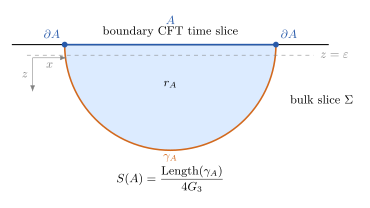
The Ryu-Takayanagi and Hubeny-Rangamani-Takayanagi prescriptions are the first place where this target begins to look geometrical. They say that, in a holographic theory with a classical bulk dual, the entanglement entropy of a boundary region is computed by the area of a bulk codimension-two surface. In a static state, the surface is a minimal surface. In a time-dependent Lorentzian spacetime, it is an extremal surface.
At leading order in the classical gravity limit,
Here is a spatial region in the boundary CFT, is the Ryu-Takayanagi surface, and is the covariant HRT surface. This formula is one of the sharpest statements of the holographic principle. The entropy of a boundary region is not computed by counting bulk degrees of freedom in a volume. It is computed by the area of a surface in one higher-dimensional spacetime.
This page discusses the classical, leading-order entropy formula. Quantum corrections, quantum extremal surfaces, and islands are the subject of the next page.
Conventions and notation
Section titled “Conventions and notation”We consider a -dimensional holographic CFT with a semiclassical Einstein-gravity dual in an asymptotically AdS spacetime of dimension . The bulk Newton constant is , and the AdS radius is . In AdS/CFT, we write for the three-dimensional Newton constant.
The basic notation is:
| Symbol | Meaning |
|---|---|
| spatial boundary region whose entropy we compute | |
| complement of on the same boundary Cauchy slice | |
| entangling surface separating from | |
| reduced density matrix obtained by tracing out | |
| von Neumann entropy | |
| RT surface in a static bulk geometry | |
| HRT surface in a Lorentzian time-dependent bulk geometry | |
| bulk homology region bounded by and the RT or HRT surface | |
| entanglement wedge, the domain of dependence of | |
| boundary UV cutoff |
The classical RT/HRT formula computes the leading large- contribution to entropy. In a matrix large- theory dual to Einstein gravity, this leading term is typically of order . Bulk quantum corrections are of order and will be added later through the FLM and QES prescriptions.
Throughout this page, an “area” means the area of a codimension-two bulk surface in Planck units. In AdS, codimension-two surfaces are one-dimensional curves, so “area” means geodesic length.
Entanglement entropy in quantum field theory
Section titled “Entanglement entropy in quantum field theory”For a quantum system with Hilbert space factorization
and a state , the reduced density matrix of is
The entanglement entropy of is the von Neumann entropy
If is pure on the full system, then
In a continuum QFT, however, is UV divergent. The leading divergence comes from short-distance correlations across . In boundary spacetime dimensions, with spatial dimension , the leading term scales as
where is a UV cutoff and is not universal. In a two-dimensional CFT, the entangling surface consists of points, and the divergence is logarithmic. For a single interval of length in the vacuum of a CFT,
This logarithm is one of the simplest precision tests of the RT formula.
There is a crucial conceptual point here. Entanglement entropy in QFT is naturally associated with a boundary between regions. RT says that in a holographic theory, the UV entanglement across is geometrized as a bulk surface stretching inward from . The boundary short-distance divergence becomes the near-boundary divergence of the bulk area.
The RT formula
Section titled “The RT formula”Consider a static holographic state whose bulk dual has a time-reflection-symmetric spatial slice . Let be a region on the boundary time slice . The Ryu-Takayanagi prescription says
where is the codimension-two surface in satisfying three conditions.
First, is anchored on the entangling surface:
Second, is homologous to . This means that there exists a bulk region such that
Third, among all such surfaces, has minimal area:
The symbol means that is anchored on and obeys the homology constraint. Combining the conditions, one often writes
The factor is the same factor that appears in the Bekenstein-Hawking entropy. RT is therefore not an arbitrary geometric trick. It identifies entanglement entropy with a generalized version of black-hole entropy.
Example: interval entropy from a geodesic in AdS
Section titled “Example: interval entropy from a geodesic in AdS3_33”Take Poincare AdS,
On the time-reflection-symmetric slice , consider the boundary interval
The RT surface is the semicircle
anchored at and regulated by cutting it off at . Parametrize the semicircle as
with and
The induced line element is
Thus the regularized geodesic length is
The RT formula gives
Using the Brown-Henneaux central charge
we obtain
which is exactly the universal CFT result for a vacuum interval.
This example illustrates three essential features at once:
- the RT surface is anchored on ;
- the UV divergence of is the near-boundary divergence of the geodesic length;
- the coefficient of the logarithm is fixed by the central charge through the bulk Newton constant.
Why the homology constraint matters
Section titled “Why the homology constraint matters”The condition is not enough. The surface must also be homologous to . Without homology, RT would give wrong answers in black-hole geometries and would fail to implement basic quantum-information constraints.
The homology condition says that and together bound a bulk region . In a static geometry,
In a covariant geometry, the same idea is phrased in terms of an achronal bulk hypersurface whose boundary contains and the HRT surface.
A simple black-hole example is the eternal AdS black hole, dual to the thermofield-double state
The full two-sided state is pure, so
But if we take to be only the left boundary CFT, then is nonzero. The RT surface is the bifurcation surface of the black hole, and
where is the horizon cross-section. This is the thermal entropy of one CFT, and also the entanglement entropy between the two sides of the TFD state.
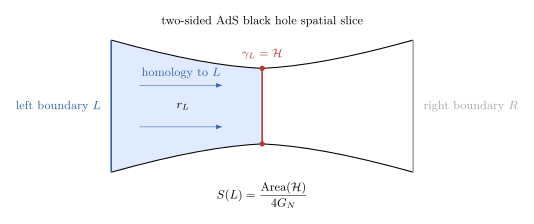
The homology constraint also resolves an apparent ambiguity for disconnected boundary regions. There may be several candidate surfaces with the same endpoints. Only those that can be completed into an appropriate bulk region are allowed, and among those the minimal-area surface dominates.
RT surfaces and black-hole thermodynamics
Section titled “RT surfaces and black-hole thermodynamics”The relation between RT and black-hole entropy is not cosmetic. It is structural.
For a thermal state of a holographic CFT, the bulk dual is often an AdS black hole. The entropy of the entire boundary system is the thermal entropy,
which is the Bekenstein-Hawking entropy of the horizon. For a subregion in the same thermal state, the RT surface may either remain outside the horizon or combine with a horizon piece, depending on the size of and the dimension.
This is the geometric origin of entropy plateaux. When is small, its entropy is dominated by a surface close to the boundary region. When is large, it can be more efficient to compute the entropy of and add the black-hole entropy. In a thermal mixed state, this is consistent with the Araki-Lieb inequality
In a thermal state, is not zero; it is the thermal entropy. Holographically, that entropy is the horizon area.
This is one of the earliest hints of the logic that will later become central in the island formula. Entropy is obtained by comparing several geometric saddles. The physically correct entropy is the minimum among allowed candidates. As parameters change, the dominant surface can jump.
RT phase transitions
Section titled “RT phase transitions”RT surfaces can undergo phase transitions at large . These transitions are not thermodynamic phase transitions of the full finite- quantum theory. Rather, they are saddle-point transitions in the leading classical area formula. At finite , the entropy is expected to be smooth, but at large the leading term can become nonanalytic.
A clean example is the entropy of two disjoint intervals in a holographic CFT. Let the four endpoints be ordered as
There are two natural RT candidates for :
and
The entropy is computed by the smaller of the two areas:
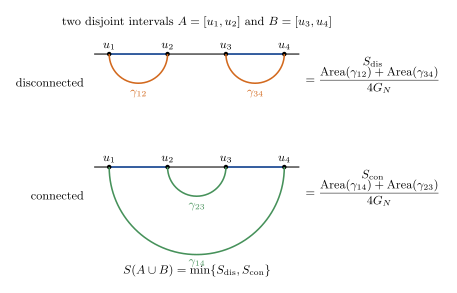
For equal intervals of length separated by distance in the vacuum CFT, the disconnected candidate gives
The connected candidate gives
The connected candidate dominates when
Equivalently,
The mutual information
is positive in the connected phase and vanishes at leading order in the disconnected phase. This “all or nothing” behavior is a large- idealization. In an exact CFT, the mutual information is not literally zero unless the regions are infinitely separated; it is merely subleading compared with the classical area term.
The moral is important for black-hole information. Surface transitions are ordinary in holographic entropy. The Page transition in island calculations will later be another member of this family: a competition between a no-island saddle and an island saddle.
Entropy inequalities from geometry
Section titled “Entropy inequalities from geometry”RT makes several general entropy inequalities almost visual.
The simplest is subadditivity:
This follows because one candidate surface for can be built from the union of the minimizing surfaces for and , after discarding unnecessary pieces if needed. Since the actual RT surface for is minimal among allowed candidates, its area cannot exceed the area of that constructed candidate.
Strong subadditivity is
In the static RT setting, there is a beautiful cut-and-paste proof. Take the minimal surfaces for and . Their union can be repartitioned into candidate surfaces for and . Because the true RT surfaces for those regions are minimal, their combined area is no larger than the repartitioned candidate. This proves the inequality.
Holographic entropies obey an additional inequality not true for arbitrary quantum states: monogamy of mutual information,
or equivalently
This special inequality reflects the restricted entanglement structure of states with classical Einstein-gravity duals. Generic quantum states do not obey it. This is a useful warning: holographic states are not generic quantum states. They are very special large-, strongly coupled states whose leading entanglement is organized by geometry.
From RT to HRT
Section titled “From RT to HRT”The RT formula assumes that the bulk geometry is static or at least admits a suitable time-reflection-symmetric slice. Black-hole formation and evaporation are time-dependent. So are quenches, collapses, shocks, and many real-time processes in holography. In Lorentzian signature, “minimal area” on a spacelike slice is not a covariant concept.
The HRT prescription replaces the static minimal surface by a covariant extremal surface.
For a boundary region lying on a boundary Cauchy slice, the HRT surface satisfies
it is homologous to , and its area is stationary under local deformations in spacetime:
Equivalently, for a smooth codimension-two surface, the two independent future-directed null expansions vanish:
The HRT entropy is
with an appropriate prescription for choosing the correct extremal surface when more than one exists. Roughly, one extremizes the area and then selects the globally minimal extremal surface consistent with anchoring and homology. More refined formulations, such as the maximin construction, make the causal properties precise.
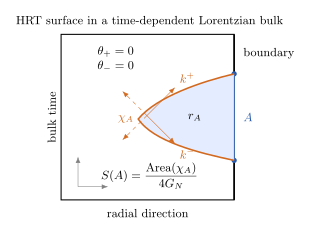
In a static spacetime with a time-reflection symmetry, the HRT surface lies on the symmetric slice and reduces to the RT surface. Thus HRT is not a different formula; it is the covariant completion of RT.
Extremal does not mean smallest on a time slice
Section titled “Extremal does not mean smallest on a time slice”It is easy to misread HRT as “find the smallest surface in spacetime.” That is not correct. Lorentzian geometry has no positive-definite notion of spacetime distance or spacetime area under arbitrary timelike deformations. Instead, one looks for a surface whose area is stationary under all allowed local deformations.
For a codimension-two surface in Lorentzian spacetime, there are two independent null normal directions. The expansions and measure how the area changes when the surface is pushed along the two null congruences. Extremality means both vanish.
This is analogous to the bifurcation surface of a stationary black hole. The horizon cross-section at the bifurcation surface has vanishing future and past null expansions. This is why black-hole horizons and HRT surfaces are naturally described by the same geometric language.
However, extremality alone is not enough. There can be many extremal surfaces anchored to the same . The entropy is computed by the one with the least area among the relevant extremal candidates. This is the covariant analogue of the minimization in RT.
Entanglement wedge preview
Section titled “Entanglement wedge preview”Given an RT or HRT surface, the homology region is the bulk region bounded by and the surface. The entanglement wedge is the domain of dependence of this region:
This definition is simple, but its implications are enormous. The next major idea after RT/HRT is that is the bulk region encoded in the boundary density matrix . In other words, bulk operators inside can be reconstructed from boundary operators supported in .
This is already suggested by the RT formula. The entropy of is determined by a surface that encloses a bulk region. The entropy does not merely know about ; it knows about how is extended into the bulk. The geometric extension is the entanglement wedge.
Later, when we discuss islands, the same language becomes even more dramatic. After the Page time, the entanglement wedge of the Hawking radiation can include an island behind the horizon. But before quantum corrections, the classical RT/HRT machinery is the essential starting point.
What is being assumed?
Section titled “What is being assumed?”The RT/HRT formula is not a theorem of arbitrary quantum gravity. It is a semiclassical holographic statement with assumptions.
First, the boundary theory should have a large- expansion and a sparse enough spectrum for a classical bulk geometry to exist. The leading RT/HRT term is the classical gravitational saddle.
Second, the bulk dynamics is assumed to be well described by Einstein gravity at the scales relevant to the surface. If the bulk action contains higher-derivative terms, the area functional is replaced by a more general entropy functional, such as the Wald-Dong-Camps functional.
Third, the formula as written computes the leading classical entropy. Bulk matter entanglement gives subleading corrections. The first correction has the schematic form
This is the FLM correction. Once the surface itself is allowed to shift because of the bulk entropy term, the correct object becomes a quantum extremal surface. That is the topic of the next page.
Fourth, the boundary region must be specified on a boundary Cauchy slice. In time-dependent setups, the HRT surface is covariant, but it is still anchored to the entangling surface of a well-defined boundary region.
Finally, the homology constraint is part of the prescription, not an optional add-on. Many tempting but incorrect entropy calculations fail because they minimize over surfaces with the right boundary endpoints but the wrong topology.
Connection to the Page curve
Section titled “Connection to the Page curve”At first glance, RT/HRT may seem far removed from the Page curve. One is about boundary subregions in AdS/CFT. The other is about evaporating black holes and Hawking radiation. The bridge is the idea of competing entropy saddles.
In RT/HRT, the entropy is not computed by a fixed surface chosen once and for all. It is computed by the dominant surface among several candidates. As the region changes, or as the state evolves, the dominant surface can switch.
Schematically,
The island formula has the same structure, but with generalized entropy instead of area:
The Page transition is then a generalized-entropy phase transition. Before the Page time, the no-island saddle dominates and the radiation entropy grows like Hawking’s answer. After the Page time, an island saddle dominates and the entropy follows the decreasing black-hole entropy.
Thus RT/HRT teaches the mathematical habit needed for modern black-hole information: do not compute entropy from a single local density of states. Compare allowed geometric saddles, impose the homology constraint, and choose the dominant one.
Common pitfalls
Section titled “Common pitfalls”Pitfall 1: “The RT surface is just the shortest curve with the right endpoints.”
Section titled “Pitfall 1: “The RT surface is just the shortest curve with the right endpoints.””This is true only in very simple AdS examples. In general the surface is codimension-two, must obey homology, and may compete with other surfaces of different topology.
Pitfall 2: “HRT means minimal area in spacetime.”
Section titled “Pitfall 2: “HRT means minimal area in spacetime.””Lorentzian spacetime does not have such a notion. HRT surfaces are extremal surfaces with vanishing null expansions. One then chooses the appropriate minimal-area member among relevant extremal candidates.
Pitfall 3: “The area term is the complete entropy.”
Section titled “Pitfall 3: “The area term is the complete entropy.””Only at leading classical order. Quantum bulk entanglement gives corrections. For black-hole information, those corrections are not decorative; they are decisive.
Pitfall 4: “RT/HRT applies to every CFT state.”
Section titled “Pitfall 4: “RT/HRT applies to every CFT state.””The formula applies to states with a suitable semiclassical gravitational dual. Generic CFT states need not be geometrical in this sense.
Pitfall 5: “If mutual information vanishes in an RT calculation, the regions are exactly uncorrelated.”
Section titled “Pitfall 5: “If mutual information vanishes in an RT calculation, the regions are exactly uncorrelated.””At leading large , the classical area contribution may give . Subleading quantum corrections can still produce nonzero correlations.
Summary
Section titled “Summary”The RT/HRT prescriptions turn boundary entanglement into bulk geometry:
For static states, the surface is the minimal RT surface on a spatial slice. For time-dependent states, it is the covariant HRT surface . In both cases the surface must be anchored on and homologous to .
The AdS/CFT interval calculation shows how the CFT logarithm arises from a regulated geodesic length. Black-hole examples show why homology is essential and why horizon area appears as entanglement entropy. Disconnected-region examples show that holographic entropy is governed by saddle competition and phase transitions.
This is the classical skeleton. The next step is to add quantum bulk entropy and allow the surface itself to extremize the generalized entropy. That leads to quantum extremal surfaces and, ultimately, islands.
Exercises
Section titled “Exercises”Exercise 1: Geodesic length for a vacuum interval
Section titled “Exercise 1: Geodesic length for a vacuum interval”In Poincare AdS,
consider the interval at . Show that the regularized length of the semicircular geodesic is
Then use to reproduce
Solution
The geodesic on the slice is
Parametrize it by
The cutoff gives
On the curve,
so
Therefore
For small ,
so
The RT formula gives
Using ,
and hence
Exercise 2: Why homology is needed in the two-sided black hole
Section titled “Exercise 2: Why homology is needed in the two-sided black hole”Consider the eternal AdS black hole dual to the thermofield-double state of two CFTs. Let and denote the entire left and right boundaries. Explain why
Why would a prescription that only minimized over surfaces with the right boundary endpoints be ambiguous or wrong?
Solution
The thermofield-double state is pure on the combined Hilbert space , so the entropy of the full system must vanish:
Holographically, the RT surface for the union of both complete boundaries is the empty surface, which has zero area and is homologous to .
For a single boundary, say , the state obtained by tracing out is thermal. The RT surface homologous to is the bifurcation surface of the black-hole horizon, denoted . Therefore
This equals the thermal entropy of one CFT and the entanglement entropy between the two CFTs.
The homology constraint is essential because the boundary of the region is empty, so anchoring alone would not distinguish between the empty surface and the horizon surface. Homology tells us which surface bounds a bulk region together with . For one boundary, the horizon surface is the relevant one; for both boundaries, the empty surface is relevant. Without homology, the prescription would not reproduce the distinction between a mixed thermal density matrix on one side and a pure TFD state on both sides.
Exercise 3: RT phase transition for two equal intervals
Section titled “Exercise 3: RT phase transition for two equal intervals”Take two equal intervals of length separated by distance in a holographic CFT vacuum. Use the leading geodesic formula
for each geodesic. Show that the connected RT configuration dominates when
Solution
Let the intervals be
The disconnected candidate has entropy
The connected candidate uses geodesics connecting to and to , so
The connected configuration dominates when
Since , this is equivalent to
Writing , we get
or
The positive root is
Therefore the connected phase dominates for
Exercise 4: A geometric proof of subadditivity
Section titled “Exercise 4: A geometric proof of subadditivity”Use the RT prescription to explain why
for two boundary regions and on the same time-reflection-symmetric slice.
Solution
Let and be the minimal RT surfaces for and . The union , possibly after discarding redundant pieces and respecting homology, gives a candidate surface for or a surface whose area bounds a candidate for .
The true RT surface is minimal among all allowed candidates homologous to . Therefore
Dividing by gives
which is subadditivity.
The fully rigorous proof must treat overlapping regions and homology carefully, but the geometric idea is simple: the union of individually minimizing surfaces gives an allowed or overcomplete candidate for the combined region, and the actual minimizing surface cannot be larger than a candidate.
Exercise 5: RT and Araki-Lieb in a thermal state
Section titled “Exercise 5: RT and Araki-Lieb in a thermal state”Let be a large subregion of a holographic CFT in a thermal state with entropy . Explain why RT permits an entropy of the schematic form
when is sufficiently large. How is this related to the Araki-Lieb inequality?
Solution
In a thermal holographic state, the bulk dual contains a black-hole horizon whose area gives the thermal entropy:
For a sufficiently large boundary region , the minimal surface homologous to can consist of a surface homologous to the smaller complement together with a horizon component. Its area is approximately
Dividing by gives
The Araki-Lieb inequality says
In a thermal mixed state, . The RT configuration above approximately saturates the inequality:
Geometrically, the horizon component accounts for the entropy of the full thermal state.
Exercise 6: RT versus HRT
Section titled “Exercise 6: RT versus HRT”State the difference between the RT and HRT prescriptions. Why is “minimal surface in spacetime” not the correct covariant generalization of RT?
Solution
RT applies to static or time-reflection-symmetric setups. One chooses a spatial slice and finds the minimal-area codimension-two surface on that slice, anchored on and homologous to :
HRT applies covariantly in Lorentzian spacetime. The surface is not merely minimal on a chosen spatial slice. It is extremal in spacetime:
or equivalently, for a smooth codimension-two surface,
Lorentzian spacetime has an indefinite metric, so there is no positive-definite notion of “smallest area under all spacetime deformations.” Timelike and null deformations behave differently from spatial deformations. The correct local condition is stationarity of the area under all allowed deformations, not absolute minimization in spacetime.
When multiple extremal surfaces exist, the HRT prescription chooses the appropriate minimal-area extremal surface consistent with anchoring and homology.
Further reading
Section titled “Further reading”- Shinsei Ryu and Tadashi Takayanagi, “Holographic Derivation of Entanglement Entropy from AdS/CFT,” arXiv:hep-th/0603001. The original RT proposal.
- Shinsei Ryu and Tadashi Takayanagi, “Aspects of Holographic Entanglement Entropy,” arXiv:hep-th/0605073. Early examples and checks.
- Veronika E. Hubeny, Mukund Rangamani, and Tadashi Takayanagi, “A Covariant Holographic Entanglement Entropy Proposal,” arXiv:0705.0016. The HRT prescription.
- Matthew Headrick and Tadashi Takayanagi, “A Holographic Proof of the Strong Subadditivity of Entanglement Entropy,” arXiv:0704.3719. The geometric cut-and-paste proof in the static setting.
- Aitor Lewkowycz and Juan Maldacena, “Generalized Gravitational Entropy,” arXiv:1304.4926. A gravitational replica derivation of the RT area term.
- Mukund Rangamani and Tadashi Takayanagi, “Holographic Entanglement Entropy,” arXiv:1609.01287. A comprehensive review.