
Replica Wormholes and the Gravitational Replica Trick
The island rule tells us what answer to compute:
Replica wormholes explain why this answer appears in a gravitational path integral.
This is the conceptual leap. In ordinary quantum field theory, the replica trick computes entropy on a fixed background. In gravity, the geometry itself is dynamical, so the replicated boundary conditions must be filled in by a sum over bulk geometries. Some of those geometries connect the replicas. These connected saddles are called replica wormholes.
The slogan of this page is
Replica wormholes do not replace Hawking’s local calculation of radiation. They change the computation of the fine-grained entropy, which is a nonlinear functional of the density matrix. This is why the local radiation can look nearly thermal while the fine-grained entropy follows the Page curve.
The ordinary replica trick
Section titled “The ordinary replica trick”Let be a subsystem with density matrix . The von Neumann entropy is
The replica trick computes it from the Rényi entropies
If the analytic continuation in is smooth near , then
In a Euclidean path integral, is computed by taking copies of the original path integral and gluing them cyclically along the region . The complement of is glued within each copy, while the two sides of the cut along are sewn from sheet to sheet .
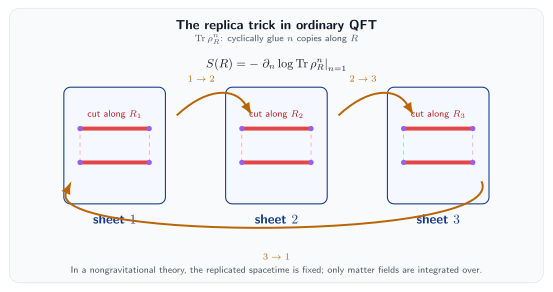
For example, in a two-dimensional CFT the entropy of an interval can be computed by inserting twist operators at the endpoints of the interval. The twist operators implement the cyclic permutation of replicas. The details are theory-dependent, but the geometric idea is universal: entropy is extracted from how the partition function changes when the spacetime is given a replica branch structure.
It is useful to introduce the normalized replica partition function
If denotes the unnormalized path integral on the -fold replicated geometry and denotes the original partition function, then
The entropy is therefore
where in the last expression we used the saddle approximation .
This last formula is the entrance to gravity. In a gravitational theory, is not the action of a field on a fixed replica geometry. It is the action of a saddle geometry whose boundary is the replicated spacetime.
What changes in gravity?
Section titled “What changes in gravity?”In gravity the metric is integrated over. Thus the replicated boundary condition does not determine a unique bulk topology. The gravitational replica partition function is schematically
Here is the replicated boundary geometry, is the dynamical metric, and denotes matter fields. The notation hides gauge-fixing, boundary terms, zero modes, and the choice of integration contour. For our purposes, the essential point is simple:
At semiclassical order, the path integral is approximated by a sum over saddles,
where labels different bulk solutions and topologies. Two broad classes are important.
Disconnected replica saddles. The bulk consists of copies of the original saddle, possibly with the matter fields sewn through the radiation region. These saddles reproduce the Hawking-like entropy that grows with time.
Connected replica saddles. The bulk replicas are joined through the gravitating region. These are replica wormholes. They give additional contributions to , and after analytic continuation to , they produce the island formula.
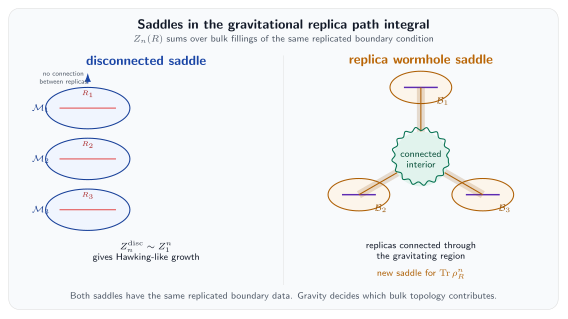
The word “wormhole” here should be read carefully. A replica wormhole is not a new classical Lorentzian bridge that an observer can travel through. It is a saddle of the replicated entropy path integral. It connects different replicas used to compute .
That distinction is important. Replica wormholes can affect entropy without showing up as ordinary perturbative corrections to local correlators in a single semiclassical spacetime.
The two basic saddles for Hawking radiation
Section titled “The two basic saddles for Hawking radiation”Consider an evaporating black hole coupled to a nongravitating bath, and let be a radiation region in the bath. The entropy is computed by the gravitational replica trick.
The disconnected saddle gives
where the matter entropy is evaluated in the semiclassical black-hole background. For Hawking radiation, this grows approximately linearly at late times in many simple models:
This is the entropy predicted by treating outgoing Hawking quanta as increasingly entangled with interior partners.
The connected replica-wormhole saddle instead gives
At late times this can be much smaller than because the island includes the interior partners of the radiation. The entropy is then approximately bounded by the remaining black-hole entropy rather than by the ever-growing Hawking entropy.
The full answer is the saddle with least generalized entropy:
This is the Page transition in gravitational language. At early times the disconnected saddle dominates. At late times the replica-wormhole saddle dominates.
Quotient geometry and cosmic branes
Section titled “Quotient geometry and cosmic branes”To see why replica wormholes give quantum extremal surfaces, assume for the moment that the dominant -replica saddle has a replica symmetry. We can quotient the saddle by this symmetry. The quotient geometry has one asymptotic copy of the boundary, but it contains a codimension-two fixed-point locus .
Near , the quotient geometry looks like a cone. The opening angle is
or equivalently the conical deficit is
This conical defect can be represented by a codimension-two cosmic brane with tension
The brane backreacts on the geometry. Its location is determined by the gravitational equations of motion, including the condition that the total action is stationary under variations of the brane position.
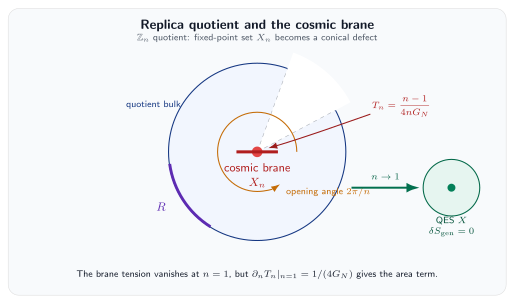
As , the tension vanishes:
But the first derivative with respect to is nonzero:
This derivative is precisely what produces the area term in the entropy.
At the same time, matter fields propagating on the quotient geometry contribute the bulk entropy term. Combining the gravitational area contribution with the matter contribution gives generalized entropy.
This is the mechanism behind the quantum extremal surface prescription.
From the replica derivative to generalized entropy
Section titled “From the replica derivative to generalized entropy”Let be the codimension-two surface that appears as the limit of the replica fixed-point set. The gravitational replica calculation gives a candidate entropy of the form
where is the bulk region bounded by and . In the island problem, becomes the union in the effective lower-dimensional description.
Why must be extremal? Because the replicated saddle must solve the equations of motion. Varying the location of the fixed-point set gives
Therefore
This is the quantum extremal surface condition.
The minimization comes from saddle dominance. Among all extremal saddles, the entropy is controlled by the one with least generalized entropy:
For radiation in a nongravitating bath, the surface is the island boundary , and the formula becomes
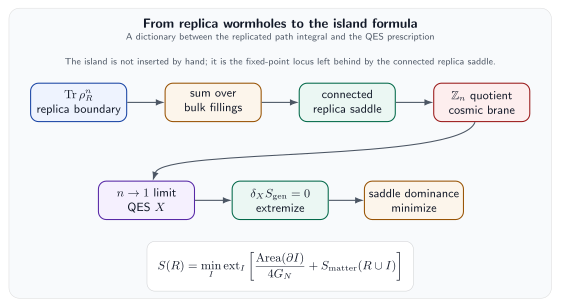
There is a useful way to remember the logic:
A simple saddle-competition model
Section titled “A simple saddle-competition model”The replica derivation can feel formal, so it is useful to keep a simple model in mind. Suppose the entropy of radiation is controlled by two candidate saddles:
and
where is the disconnected Hawking saddle and is the replica-wormhole saddle. The physical entropy is
The Page time is
Before , the disconnected saddle dominates. After , the replica-wormhole saddle dominates. Of course real calculations are more complicated: the island entropy is not exactly constant, the black-hole entropy decreases during evaporation, and greybody factors can matter. But the qualitative saddle competition is exactly the same.
This model also explains a common surprise. The replica-wormhole saddle may be exponentially small in the path integral for fixed integer , yet it can dominate the entropy after analytic continuation and differentiation. Entropy is not a linear observable. It is sensitive to correlations that are invisible in a naive local Hawking calculation.
Relation to JT gravity
Section titled “Relation to JT gravity”Replica wormholes were first understood most explicitly in two-dimensional models, especially JT gravity coupled to matter. In JT gravity, the gravitational part of the entropy is not an area of a transverse sphere but a dilaton value:
The island formula becomes
The replica-wormhole computation justifies this formula by explicitly summing over replicated JT geometries. For integer , the connected geometries join the replicas through the gravitational region. In the quotient description, one obtains a conical defect whose limit gives the QES near the horizon.
In simple evaporating JT setups, the no-island saddle gives the growing Hawking entropy, while the replica-wormhole saddle gives the late-time entropy of order the remaining black-hole entropy. This is the controlled two-dimensional version of the Page curve.
Why this is not a small correction to Hawking radiation
Section titled “Why this is not a small correction to Hawking radiation”A tempting but misleading question is: “Where is the correction to Hawking’s local emission process?”
Replica wormholes are not best understood as a large local correction to the stress tensor near the horizon. The local state of a small number of Hawking quanta can remain very close to the semiclassical answer. The correction is to the computation of the fine-grained entropy of a large radiation region.
There are three reasons this distinction matters.
First, fine-grained entropy is nonlinear:
Tiny changes in high-order correlations can change entropy without changing simple local observables much.
Second, the replica trick computes , not itself. The gravitational path integral for can contain topologies that are absent in the path integral for ordinary single-copy correlators.
Third, the Page curve is a statement about the entropy of the entire collected radiation, not about the spectrum of one emitted quantum. The island saddle becomes dominant only after enough radiation has been collected that the global entanglement structure matters.
Thus replica wormholes are compatible with the success of Hawking’s local calculation while modifying its global entropy conclusion.
Analytic continuation and replica symmetry
Section titled “Analytic continuation and replica symmetry”The derivation has real subtleties. They should not be hidden from students.
The replica path integral is naturally defined for positive integers . The entropy requires analytic continuation to real near :
This continuation is usually not constructed from first principles. One assumes that the relevant saddles admit a smooth continuation near . This assumption is standard in replica calculations but is conceptually nontrivial in gravity.
The quotient derivation also assumes a replica-symmetric saddle. If replica symmetry is broken, the simple cosmic-brane quotient picture must be modified. In many controlled examples, the replica-symmetric saddle gives the expected answer, but the general problem of classifying all saddles and contours is subtle.
There is also a question of integration contours. Euclidean gravitational path integrals are not ordinary convergent integrals over real metrics. Complex saddles can matter. In the island literature, replica wormholes are often complex or require careful contour choices.
These subtleties do not make the method useless. They mean that the replica-wormhole derivation is a semiclassical saddle-point argument, not a fully nonperturbative definition of quantum gravity.
Factorization and ensembles
Section titled “Factorization and ensembles”Replica wormholes are closely related to a broader question: do Euclidean wormholes imply ensemble averaging?
In an ordinary single CFT, partition functions of decoupled systems factorize:
But a gravitational path integral that includes wormholes connecting two asymptotic boundaries can produce connected contributions:
This looks natural if the gravitational path integral computes an ensemble average, since generally
In JT gravity, the connection to random matrix ensembles is explicit. In higher-dimensional AdS/CFT, where one often expects a single fixed CFT rather than an ensemble, the interpretation is less clear. This is the factorization puzzle, and it will be treated later in the open-problems page.
For the present page, the important point is narrower: replica wormholes provide a semiclassical gravitational derivation of the island rule. They do not by themselves settle every question about the nonperturbative definition of the gravitational path integral.
What replica wormholes teach us
Section titled “What replica wormholes teach us”Replica wormholes teach four lessons.
First, the entropy of Hawking radiation is not computed by a single fixed semiclassical geometry. It is computed by a replicated gravitational path integral that includes multiple saddles.
Second, the island formula is not an ad hoc rule. It is the limit of connected saddles in the replica path integral.
Third, the Page transition is a saddle transition. At early times, the disconnected Hawking saddle dominates. At late times, a connected replica-wormhole saddle dominates.
Fourth, semiclassical gravity contains more information about fine-grained entropy than Hawking’s original calculation used. The missing ingredient is not a violent local correction at the horizon, but the correct gravitational treatment of entropy.
Common pitfalls
Section titled “Common pitfalls”Pitfall 1: “The replica wormhole is a traversable wormhole.”
No. It is a Euclidean or complex saddle in a replicated entropy calculation. It connects replicas, not necessarily physical universes through which an observer can travel.
Pitfall 2: “The wormhole changes the state of each Hawking quantum.”
Not directly. The local Hawking spectrum can remain approximately thermal. Replica wormholes affect the fine-grained entropy of large radiation regions.
Pitfall 3: “The island is added by hand.”
The island appears as the remnant of the replica fixed-point set. In the quotient geometry, this fixed-point set is represented by a cosmic brane.
Pitfall 4: “The derivation is completely rigorous.”
It is a powerful semiclassical saddle-point derivation. It still depends on analytic continuation, saddle selection, replica symmetry or its controlled replacement, and a definition of the gravitational path integral.
Pitfall 5: “Replica wormholes solve factorization automatically.”
They solve a specific entropy problem semiclassically. The relationship between wormholes, ensemble averages, baby universes, and factorization remains a deeper structural issue.
Exercises
Section titled “Exercises”Exercise 1: Rényi entropies and the von Neumann limit
Section titled “Exercise 1: Rényi entropies and the von Neumann limit”Let be a diagonal density matrix with eigenvalues . Show that
satisfies
Solution
Define
Since , we have . The Rényi entropy is
Both numerator and denominator vanish as , so use l’Hôpital’s rule:
This is the von Neumann entropy.
Exercise 2: Normalized replica partition functions
Section titled “Exercise 2: Normalized replica partition functions”Suppose a Euclidean path integral gives an unnormalized replicated partition function and a single-copy partition function . Explain why
and show that in a saddle approximation ,
Solution
The density matrix must be normalized by the single-copy partition function. If is the unnormalized reduced density matrix, then
Taking the th power and tracing gives
The von Neumann entropy is
Using gives
Therefore
Exercise 3: Cosmic-brane tension near
Section titled “Exercise 3: Cosmic-brane tension near n=1n=1n=1”The cosmic brane in the replica quotient has tension
Compute and . Explain why the brane can produce an entropy contribution even though its tension vanishes at .
Solution
Rewrite
Then
and
The entropy is obtained by differentiating the replica action with respect to at . Thus the first derivative of the brane action contributes even though the brane tension itself vanishes at . This derivative produces the familiar area term .
Exercise 4: Extremizing generalized entropy
Section titled “Exercise 4: Extremizing generalized entropy”Suppose a candidate island boundary is labeled by a coordinate , and the generalized entropy is
Show that the QES condition is
Give a physical interpretation of the two terms.
Solution
The QES is obtained by stationarity of :
The first term is the change in gravitational entropy when the candidate surface moves. The second term is the change in bulk matter entropy of the region bounded by the surface. The QES balances these two effects. In the replica derivation, this balance is the condition that the cosmic-brane quotient geometry solves the equations of motion when the brane position is varied.
Exercise 5: A two-saddle Page transition
Section titled “Exercise 5: A two-saddle Page transition”Consider the toy model
with and . Find the Page time at which the dominant saddle changes.
Solution
The transition occurs when the two generalized entropies are equal:
Thus
For , and the no-island saddle dominates. For , and the replica-wormhole/island saddle dominates.
Exercise 6: Why local thermality is not enough
Section titled “Exercise 6: Why local thermality is not enough”Explain why the statement “each emitted Hawking quantum is approximately thermal” does not determine the fine-grained entropy of the full radiation system.
Solution
The entropy of the full radiation depends on the entire density matrix , including correlations among all emitted quanta. Knowing the reduced density matrix of each individual quantum only fixes one-body marginals. Many globally different states can have the same one-body marginals.
For example, a pure entangled state of many qubits can have each individual qubit maximally mixed. Thus local thermality does not imply that the global radiation state is maximally mixed. The Page curve is a statement about the global fine-grained entropy of the collected radiation, while Hawking’s local calculation mainly controls local emission probabilities and low-point observables.
Replica wormholes modify the gravitational computation of global entropy without requiring a large violation of local thermality for each emitted quantum.
Further reading
Section titled “Further reading”- P. Calabrese and J. Cardy, “Entanglement Entropy and Quantum Field Theory”. A classic introduction to the replica trick in QFT and CFT.
- A. Lewkowycz and J. Maldacena, “Generalized Gravitational Entropy”. The gravitational replica derivation of the RT formula.
- X. Dong, “The Gravity Dual of Rényi Entropy”. The cosmic-brane prescription for holographic Rényi entropies.
- T. Faulkner, A. Lewkowycz, and J. Maldacena, “Quantum Corrections to Holographic Entanglement Entropy”. The FLM bulk-entropy correction.
- N. Engelhardt and A. Wall, “Quantum Extremal Surfaces”. The QES prescription for generalized entropy.
- A. Almheiri, T. Hartman, J. Maldacena, E. Shaghoulian, and A. Tajdini, “Replica Wormholes and the Entropy of Hawking Radiation”. A central derivation of islands from replica wormholes.
- G. Penington, S. H. Shenker, D. Stanford, and Z. Yang, “Replica Wormholes and the Black Hole Interior”. Replica wormholes, the Page transition, and reconstruction.
- A. Almheiri, T. Hartman, J. Maldacena, E. Shaghoulian, and A. Tajdini, “The Entropy of Hawking Radiation”. A detailed review of islands, QES, and replica wormholes.
- D. Marolf and H. Maxfield, “Transcending the Ensemble: Baby Universes, Spacetime Wormholes, and the Order and Disorder of Black Hole Information”. Background for the factorization and ensemble issues discussed later.