
Bulk Reconstruction and Quantum Error Correction
The previous page introduced the entanglement wedge and the JLMS relation. The central claim was not merely that a boundary region computes an entropy, but that encodes a bulk region. This page explains what that encoding means operationally.
The slogan is
A bulk field operator can often be represented by many different boundary operators. A local bulk excitation near the center of AdS is not stored in one microscopic boundary location, much as a logical qubit in a quantum error-correcting code is not stored in one physical qubit. Instead, it is encoded redundantly and nonlocally.
The reconstruction problem is therefore not simply:
It is better phrased as:
The modern answer is entanglement wedge reconstruction:
within a suitable semiclassical code subspace. This statement is the bridge between RT/HRT/QES geometry and the quantum-information structure needed for black-hole information recovery.
The reconstruction problem
Section titled “The reconstruction problem”AdS/CFT says that a bulk theory of gravity in asymptotically AdS spacetime is equivalent to a nongravitational CFT living on the boundary. At the most formal level, one might write an equivalence of Hilbert spaces,
But this notation hides several important qualifications. A semiclassical bulk effective field theory is not the whole CFT Hilbert space. It describes a limited set of states: small perturbations around a particular classical geometry, or perhaps a controlled family of nearby geometries. This restricted set is called a code subspace:
More precisely, we should think of an encoding map
where embeds semiclassical bulk states into exact boundary states.
Given a bulk operator acting on , global reconstruction asks for a CFT operator such that
for every . Equivalently,
as an operator equation on the code subspace.
Subregion reconstruction is sharper. Let be a boundary subregion. We ask whether the same bulk operator can be represented by an operator supported only in :
This is highly nontrivial because a local bulk operator is generally dual to a very nonlocal CFT operator. The surprise of holography is not nonlocality by itself. The surprise is the organized redundancy: the same bulk operator can be reconstructed on different boundary regions, as long as those regions contain its entanglement wedge.
HKLL reconstruction: the perturbative starting point
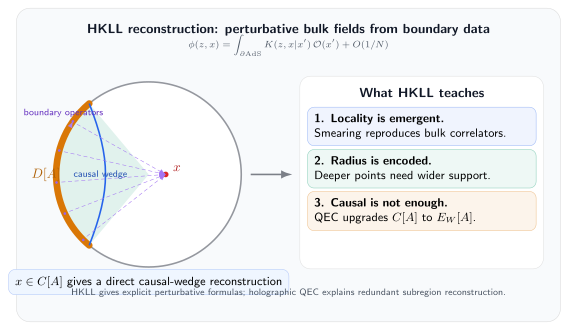
Section titled “HKLL reconstruction: the perturbative starting point”Before quantum error correction entered the story, the standard approach to bulk reconstruction was the Hamilton-Kabat-Lifschytz-Lowe construction, usually called HKLL. For a free scalar field in a fixed AdS background, one solves the bulk wave equation with boundary conditions determined by the dual single-trace primary operator .
Schematic form:
where is the AdS radial coordinate and is a smearing kernel determined by the bulk wave equation.
This formula is important for three reasons.
First, it makes the emergence of bulk locality concrete. Bulk commutators are reproduced by delicate cancellations among nonlocal boundary operators.
Second, it shows that the radial direction is encoded nonlocally. A bulk point deeper in AdS typically requires boundary data spread over a larger time or angular range.
Third, it exhibits the limitations of purely causal reconstruction. In simple cases, HKLL reconstructs operators in the causal wedge of a boundary domain. But holographic entropy formulas say that the boundary region should know about the larger entanglement wedge , not merely the causal wedge .
Interactions complicate the formula. A bulk field with interactions is reconstructed not just from a single-trace operator, but from a tower of multi-trace corrections:
At finite , exact local bulk operators cannot exist in the same naive sense as in effective field theory. A local field operator is an approximate operator, valid in a code subspace and at scales larger than the bulk cutoff. This is not a minor caveat; it is the beginning of the quantum-error-correcting interpretation.
Why ordinary locality looks paradoxical
Section titled “Why ordinary locality looks paradoxical”Suppose is a bulk operator deep in the interior of AdS. Because the boundary theory is nongravitational and complete, must have some boundary representation. But if the boundary representation is spread everywhere, how can it commute with local boundary operators spacelike separated from in the bulk?
The naive demand would be
whenever the boundary point is spacelike separated from the bulk point .
But if is built from boundary operators, this commutator cannot vanish as an exact operator identity on the entire CFT Hilbert space. The resolution is that bulk locality is an effective property inside a code subspace. The commutator is required to vanish in matrix elements between low-energy code states:
This is exactly the sort of statement quantum error correction is designed to express. Logical operators need not be unique as exact physical operators. They only need to act correctly on the code subspace.
Code subspaces
Section titled “Code subspaces”A code subspace is the part of the exact boundary Hilbert space that admits a controlled semiclassical bulk description. A typical example is
where is a CFT state dual to a classical geometry , and the excitations are small enough that they do not significantly change the geometry.
The size of the code subspace matters. If the code subspace is too large, it includes states with significantly different geometries. Then a single semiclassical reconstruction map may fail. In particular, the entanglement wedge of a boundary region can change as the state changes. A reconstruction that works in one phase may not work across an HRT/QES phase transition.
Thus a reconstruction statement always has an implicit domain of validity:
Here is the relevant bulk region and is the boundary region. Outside the code subspace, may have no simple interpretation as the same bulk operator.
This point is especially important for black holes. Interior reconstruction is not expected to be a single state-independent local map acting correctly on the entire Hilbert space of black-hole microstates. The correct statement is more modest and more precise: in a suitable code subspace around a given semiclassical situation, certain interior operators can be represented on suitable exterior or radiation degrees of freedom.
Quantum error correction in one page
Section titled “Quantum error correction in one page”A quantum error-correcting code protects a small logical Hilbert space inside a larger physical Hilbert space :
The image is the code subspace. Logical operators act on , while physical operators act on .
A noise process is correctable if there exists a recovery map such that
for all logical density matrices .
For our purposes, the most important noise process is erasure. Suppose the physical Hilbert space factors as
where is erased and remains. The noise is
Erasure of is correctable if all logical information can be recovered from :
There is an equivalent operator statement: every logical operator has a representative acting only on the unerased subsystem :
For exact erasure correction, the erased subsystem cannot know anything about the logical state. In a simple subspace code, this can be stated as
for all logical states , where is independent of .
Equivalently, every operator supported on the erased subsystem acts trivially on the code subspace:
This is the erasure version of the Knill-Laflamme condition. It says that the erased region cannot distinguish code states. If the erased region cannot distinguish them, the complementary region can recover them.
AdS/CFT as a quantum error-correcting code
Section titled “AdS/CFT as a quantum error-correcting code”In holography, the logical degrees of freedom are bulk effective degrees of freedom, while the physical degrees of freedom are boundary CFT degrees of freedom:
A local bulk operator is a logical operator. A CFT operator supported on a boundary region is a physical representative.
The quantum-error-correcting viewpoint says that bulk information is encoded redundantly. If a bulk point lies in the entanglement wedge of several different boundary regions, the same logical operator can have several different physical representatives:
provided all of these equations are understood as equations on the code subspace.
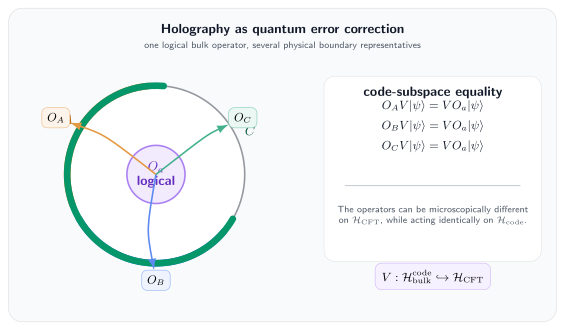
This redundancy resolves a puzzle. If a bulk point is near the center of AdS, it may be reconstructable from many sufficiently large boundary regions. This sounds like cloning, but it is not. There is only one logical degree of freedom. Different boundary operators are different representatives of the same logical operator, not independent copies of it.
The situation is analogous to a code where a logical qubit can be recovered from any two of three physical systems. The two-system reconstructions are not separate qubits. They are different ways of accessing the same encoded qubit.
Entanglement wedge reconstruction
Section titled “Entanglement wedge reconstruction”The main theorem-like statement of subregion duality is:
Here is a bulk region inside the entanglement wedge of , and is the encoding map from the bulk code subspace to the CFT.
A slightly more careful version requires both and its adjoint to be represented correctly:
This ensures that products and correlation functions are reproduced in the code subspace.
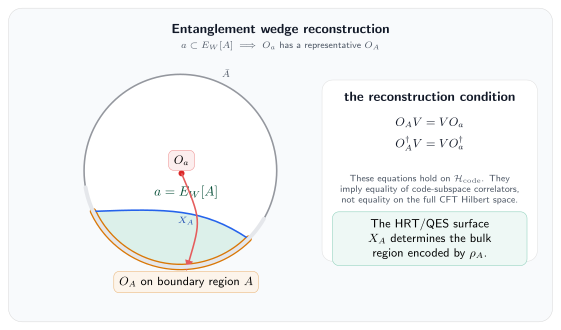
The key point is that the reconstructable region is the entanglement wedge, not the causal wedge:
HKLL-type causal reconstruction explains part of the story. Quantum error correction explains why reconstruction can extend beyond causal reach.
From JLMS to reconstruction
Section titled “From JLMS to reconstruction”The previous page emphasized the JLMS relation:
where is the bulk entanglement wedge region.
Relative entropy measures distinguishability. If boundary relative entropy in equals bulk relative entropy in , then the boundary region preserves exactly the information needed to distinguish code-subspace states inside .
Quantum information theory then gives a recovery statement. In finite-dimensional language, if a channel preserves relative entropy for a family of states,
then there exists a recovery map such that
for those states. In holography, the channel is the operation of restricting the boundary state to region , while reconstructs the bulk entanglement-wedge state.
This gives the conceptual chain
For exact finite-dimensional codes, the relevant recovery map can be written using the Petz map. For approximate holographic codes, one uses approximate recovery. The important physical point is that reconstruction is controlled by the same relative-entropy equality that made the entanglement wedge meaningful.
Approximate reconstruction
Section titled “Approximate reconstruction”Real holographic reconstruction is approximate. There are several reasons.
First, bulk effective field theory itself is approximate. It breaks down at the Planck scale, near singularities, and outside the code subspace.
Second, the expansion is perturbative. The distinction between single-trace, double-trace, and higher-trace corrections is organized by powers of , but exact finite- operators need not preserve semiclassical locality.
Third, entanglement wedges can jump. At a phase transition between two HRT or QES saddles, the identity of the reconstructable region changes nonanalytically at leading order. Near the transition, one should not expect a single simple reconstruction map to work uniformly.
One way to express approximate reconstruction is through correlation functions:
for all code states . Another is through an operator norm or diamond-norm statement for the recovery channel. The details matter in rigorous quantum information theory, but the conceptual message is simple: the boundary representative acts like the bulk operator to the accuracy of the semiclassical approximation.
A three-qutrit erasure code
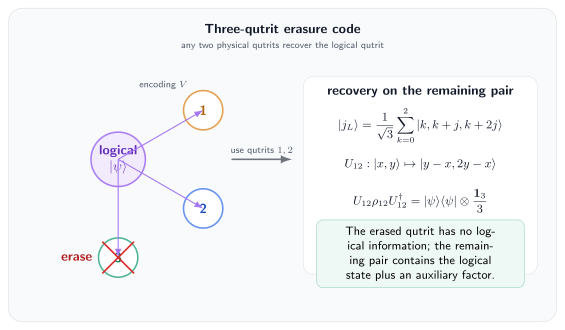
Section titled “A three-qutrit erasure code”A simple toy model captures the redundancy of subregion reconstruction. Consider one logical qutrit encoded into three physical qutrits. Let all arithmetic below be mod , and define
Explicitly,
and
For a general logical state
any single physical qutrit is maximally mixed:
Thus no single qutrit contains information about the logical state. The erasure of any one qutrit is correctable. The remaining two qutrits contain the logical qutrit plus an auxiliary gauge degree of freedom.
For example, using qutrits and , the unitary map
extracts the logical label into the first output factor and uses the second output factor as the erased-qutrit label. On the encoded state, the reduced density matrix on qutrits and becomes
The first factor is the recovered logical qutrit. The second factor is an unimportant gauge or syndrome-like degree of freedom.
The analogy with holography is not literal, but it is instructive. A boundary subregion that is too small may contain no information about a given bulk operator. A sufficiently large region can reconstruct it. Different sufficiently large regions can reconstruct the same logical operator without producing independent copies.
Tensor-network toy models
Section titled “Tensor-network toy models”The HaPPY code is a more geometric toy model of holographic quantum error correction. It uses perfect tensors arranged in a negatively curved network. Bulk legs represent logical degrees of freedom, while boundary legs represent physical CFT-like degrees of freedom.
A perfect tensor has the property that any bipartition with at most half of the legs on one side defines an isometry. This makes it possible to push logical operators from the bulk to many different boundary regions. The network geometry gives a discrete version of the RT formula: the entropy of a boundary region is counted by a minimal cut through the network.
The lessons of tensor-network models are valuable:
- bulk degrees of freedom can be logical degrees of freedom;
- boundary degrees of freedom can be physical degrees of freedom;
- minimal cuts mimic RT surfaces;
- operator pushing mimics entanglement wedge reconstruction;
- redundancy is natural rather than paradoxical.
But the limitations are equally important. Simple tensor networks are not full AdS/CFT. They often have fixed geometry, finite bond dimension, and no genuine gravitational dynamics. They are best used as models of the kinematics of holographic encoding, not as complete models of quantum gravity.
Complementary recovery and no-cloning
Section titled “Complementary recovery and no-cloning”Suppose and are complementary boundary regions. In a simple classical phase, the entanglement wedge of and the entanglement wedge of are complementary bulk regions separated by the same HRT surface.
Then one expects
while
This is called complementary recovery.
The no-cloning concern is avoided because noncommuting logical operators are not reconstructable on two disjoint complementary regions at the same time. If an operator is reconstructable on , then operators in commute with that representative as exact boundary operators. The only bulk operators that can be simultaneously assigned to both sides in an exact way are central operators, such as fixed-area data in an operator-algebra description. This is one reason the next page turns to operator-algebra quantum error correction.
At phase transitions, complementary recovery can change abruptly. A bulk region may move from to when a different extremal surface begins to dominate. This is the same phenomenon that appears in island transitions: after the Page time, part of the interior enters the radiation wedge.
Black-hole interiors and islands
Section titled “Black-hole interiors and islands”The black-hole information problem turns subregion reconstruction into something dramatic.
Let be the Hawking radiation collected in a nongravitating bath. Before the Page time, the dominant QES saddle is usually the no-island saddle:
Then the radiation entanglement wedge contains only the radiation region. Interior operators are not reconstructable from alone.
After the Page time, the island saddle can dominate:
The radiation entropy is computed by
and the entanglement wedge of the radiation becomes
Entanglement wedge reconstruction then says that operators in the island are encoded in the radiation:
This is a precise version of the statement that the Hawking radiation contains information about the black-hole interior after the Page transition.
Several caveats are essential.
First, is not a simple operator. It is generally very nonlocal in the radiation degrees of freedom.
Second, the reconstruction is code-subspace dependent. It works for a controlled family of states around the semiclassical configuration used in the QES calculation.
Third, reconstruction does not mean that an infalling observer and an exterior decoder possess two independent copies. The same logical operator has different descriptions in different regimes, constrained by complementarity and quantum error correction.
Fourth, reconstructability in principle is not the same as efficient decoding. Complexity barriers are part of the later story.
State dependence
Section titled “State dependence”Interior reconstruction is often described as state-dependent. This phrase can mean several different things, so it is worth being precise.
In ordinary QEC, the physical representative of a logical operator is defined relative to a chosen code subspace. If one changes the code subspace, the representative can change. This is a mild and standard form of state dependence.
In holography, the code subspace is often tied to a background geometry. If the geometry changes substantially, the entanglement wedge changes, the HRT/QES surfaces change, and the reconstruction map changes. This is not mysterious; it is the gravitational version of changing the code.
A stronger and more controversial notion would be an operator assignment that depends on the exact microstate in a way that threatens linearity. The QEC perspective helps separate the healthy version from the dangerous one. Within a fixed code subspace, reconstruction should be linear:
The representative may depend on the chosen code subspace, but it should not depend separately on the coefficients and inside that subspace.
Reconstruction versus measurement
Section titled “Reconstruction versus measurement”A boundary representative is an operator in the exact boundary theory. Saying that reconstructs means that its matrix elements and correlation functions agree with those of the bulk operator in the code subspace.
It does not necessarily mean that a semiclassical observer can easily measure . For a black-hole island, may require an astronomically complicated decoding operation on the Hawking radiation. It may also require knowing the correct code subspace and having control over a huge number of degrees of freedom.
Thus there are three distinct notions:
The island rule and entanglement wedge reconstruction address the first. Complexity proposals and decoding arguments address the second and third.
Common pitfalls
Section titled “Common pitfalls”Pitfall 1: “The bulk operator is literally located on many boundary regions.”
Section titled “Pitfall 1: “The bulk operator is literally located on many boundary regions.””No. The bulk operator is a logical operator. Different boundary representatives act the same way on the code subspace, but they are not identical microscopic operators on the full CFT Hilbert space.
Pitfall 2: “Redundant reconstruction violates no-cloning.”
Section titled “Pitfall 2: “Redundant reconstruction violates no-cloning.””No. Quantum error correction gives redundant access to one logical degree of freedom, not independent copies of it. Disjoint regions cannot both reconstruct the same noncommuting logical algebra in an unrestricted way.
Pitfall 3: “HKLL and QEC are competing approaches.”
Section titled “Pitfall 3: “HKLL and QEC are competing approaches.””They are better viewed as complementary. HKLL gives explicit perturbative smearing formulas in suitable backgrounds. QEC explains why reconstruction can be redundant, subregion-dependent, and valid only in code subspaces.
Pitfall 4: “Entanglement wedge reconstruction is exact at finite .”
Section titled “Pitfall 4: “Entanglement wedge reconstruction is exact at finite NNN.””Usually no. The clean geometric statement is semiclassical and perturbative. Exact finite- statements require more careful nonperturbative definitions.
Pitfall 5: “The radiation reconstruction of an island is a simple decoding procedure.”
Section titled “Pitfall 5: “The radiation reconstruction of an island is a simple decoding procedure.””No. Island reconstruction can be extremely nonlocal and computationally complex. The entropy formula tells us which information is encoded, not that it is easy to extract.
Pitfall 6: “State dependence automatically means inconsistency.”
Section titled “Pitfall 6: “State dependence automatically means inconsistency.””Not necessarily. Dependence on a chosen code subspace is standard in QEC. The dangerous issue would be nonlinear dependence on the exact state within a code subspace.
Summary
Section titled “Summary”The main points are:
- Bulk reconstruction asks how semiclassical bulk operators are represented in the exact boundary theory.
- HKLL reconstruction expresses perturbative bulk fields as smeared boundary operators, but it does not by itself explain full entanglement wedge reconstruction.
- A code subspace is the set of boundary states admitting a common semiclassical bulk description.
- A bulk operator is a logical operator; a boundary representative is a physical operator acting correctly on the code subspace.
- Erasure correction says that logical information can be recovered from a subsystem if the erased subsystem contains no distinguishing information.
- AdS/CFT behaves like a quantum error-correcting code: bulk information is encoded redundantly and nonlocally in boundary degrees of freedom.
- Entanglement wedge reconstruction says that bulk operators in have boundary representatives supported in .
- JLMS relative entropy equality provides the information-theoretic route from entropy formulas to reconstruction.
- Tensor-network models such as the HaPPY code illustrate the kinematics of holographic QEC but are not complete models of gravity.
- After the Page time, island operators are encoded in the radiation in the same entanglement-wedge reconstruction sense.
Exercises
Section titled “Exercises”Exercise 1: Operator equality on a code subspace
Section titled “Exercise 1: Operator equality on a code subspace”Let be an isometric encoding map. Suppose two physical operators and satisfy
for some logical operator . Show that and have the same matrix elements between code states, even if they are different operators on .
Solution
A code state has the form with . For two code states and ,
Since is an isometry,
Thus
The same calculation gives
Therefore
for all logical . The operators may differ outside the code subspace, but they are equivalent as logical representatives.
Exercise 2: Erasure and the environment has no information
Section titled “Exercise 2: Erasure and the environment has no information”Consider an exact erasure-correcting code with physical Hilbert space . Suppose the erasure of is correctable. Explain why the reduced state on must be independent of the logical input state.
Solution
If erasure of is correctable, then all logical information can be recovered from . If also contained information about the logical state, then one could distinguish at least some logical states by measuring while also recovering the same information from . For quantum information, this would contradict the no-cloning principle for arbitrary superpositions.
More formally, exact correctability of the erasure channel implies a decoupling condition. If is a reference system entangled with the logical input, then after encoding the joint state on must factorize:
Thus is uncorrelated with the reference and contains no logical information. In particular, for every logical density matrix ,
where is independent of .
Exercise 3: Single-qutrit marginals in the three-qutrit code
Section titled “Exercise 3: Single-qutrit marginals in the three-qutrit code”For the code
show that the reduced density matrix of physical qutrit is for any logical state .
Solution
The full state is
The reduced density matrix on qutrit is obtained by tracing over qutrits and :
The inner products impose
modulo . Subtracting the two equations gives , and then . Therefore only terms with and survive:
Since ,
Thus qutrit contains no information about the logical state. By symmetry, the same is true for qutrits and .
Exercise 4: Recovery from two qutrits
Section titled “Exercise 4: Recovery from two qutrits”Using the same three-qutrit code, show that qutrits and can recover the logical qutrit. Use the unitary
Solution
For the codeword , the pair appears as
for . Applying gives
The second output label is exactly the label carried by the erased third qutrit. This is why the trace over qutrit leaves an auxiliary maximally mixed factor instead of destroying the logical coherence.
For a general logical state,
After tracing out qutrit , the reduced state on qutrits and is mixed. But applying to qutrits and organizes that mixed state as
where
Thus the first output qutrit contains the recovered logical state, while the second output qutrit is an unimportant maximally mixed auxiliary system.
Exercise 5: Why redundant reconstruction is not cloning
Section titled “Exercise 5: Why redundant reconstruction is not cloning”Suppose a bulk logical operator has representatives and on two different boundary regions and . Explain why this does not mean that the bulk degree of freedom has been cloned.
Solution
The representatives satisfy
on the code subspace. This means that and implement the same logical operation on encoded states. It does not mean there are two independent logical systems.
In an error-correcting code, the same logical qubit may be recoverable from different subsets of physical qubits. These recoveries are different physical descriptions of one encoded logical qubit. They cannot be used to produce two independent copies of an arbitrary unknown quantum state, because the operators are constrained by their action on the same code subspace.
In holography, the same principle applies. Different boundary reconstructions are different representatives of one bulk logical operator, not independent bulk operators.
Exercise 6: Island reconstruction after the Page time
Section titled “Exercise 6: Island reconstruction after the Page time”Let be the Hawking radiation. Before the Page time, suppose . After the Page time, suppose the island saddle dominates and
What does entanglement wedge reconstruction imply for an operator localized in the island?
Solution
Entanglement wedge reconstruction says that operators inside the entanglement wedge of a boundary or nongravitating region can be represented on that region. Before the Page time, is not part of , so an operator localized in the would-be island is not reconstructable from the radiation alone.
After the Page time, the island is included in the radiation entanglement wedge:
Therefore there exists a radiation operator such that
for all states in the relevant code subspace.
This is the precise QEC meaning of the statement that the radiation contains the island. The representative may be extremely nonlocal and hard to construct, but it exists in principle within the semiclassical reconstruction regime.
Further reading
Section titled “Further reading”- Alex Hamilton, Daniel Kabat, Gilad Lifschytz, and David A. Lowe, Local bulk operators in AdS/CFT: A holographic description of the black hole interior. A foundational HKLL reconstruction paper.
- Ahmed Almheiri, Xi Dong, and Daniel Harlow, Bulk Locality and Quantum Error Correction in AdS/CFT. The key paper connecting bulk locality, subregion duality, and quantum error correction.
- Fernando Pastawski, Beni Yoshida, Daniel Harlow, and John Preskill, Holographic quantum error-correcting codes: Toy models for the bulk/boundary correspondence. Introduces the HaPPY tensor-network code.
- Daniel L. Jafferis, Aitor Lewkowycz, Juan Maldacena, and S. Josephine Suh, Relative entropy equals bulk relative entropy. The JLMS relation underlying entanglement wedge reconstruction.
- Xi Dong, Daniel Harlow, and Aron C. Wall, Reconstruction of Bulk Operators within the Entanglement Wedge in Gauge-Gravity Duality. Shows how relative entropy and QEC imply entanglement wedge reconstruction.
- Daniel Harlow, The Ryu-Takayanagi Formula from Quantum Error Correction. Explains RT-like formulas and reconstruction in the language of operator-algebra QEC.
- Thomas Faulkner and Aitor Lewkowycz, Bulk locality from modular flow. Develops modular-flow reconstruction of entanglement-wedge operators.
- Jordan Cotler, Patrick Hayden, Geoffrey Penington, Grant Salton, Brian Swingle, and Michael Walter, Entanglement Wedge Reconstruction via Universal Recovery Channels. Gives a robust approximate-recovery perspective.
- Daniel Harlow, TASI Lectures on the Emergence of the Bulk in AdS/CFT. A broad pedagogical review of bulk emergence, reconstruction, tensor networks, and holographic QEC.