
Black hole perturbations and master equations
1. Einstein–Maxwell theory in dimensions
Section titled “1. Einstein–Maxwell theory in DDD dimensions”We start with perturbations of Reissner–Nordström–AdS (RN–AdS) black holes / branes, but the dof counting and sector decomposition are much more general.
We consider Einstein–Maxwell with a cosmological constant (AdS):
A standard RN–AdS background (static, “maximally symmetric horizon”) can be written in the Kodama–Ishibashi (KI) form
where is an -dimensional space of constant curvature (sphere/plane/hyperboloid). A convenient parameterization is
For the planar brane relevant to AdS/CFT, take and Fourier-expand along the horizon directions.
2. Physical degrees of freedom in dimensions
Section titled “2. Physical degrees of freedom in DDD dimensions”Counting dofs of the fields (See more)
Section titled “Counting dofs of the fields (See more)”These are on-shell dofs (polarizations) of massless fields:
- Graviton in :
- Maxwell field in :
So Einstein–Maxwell has
Concrete checks:
- : , , total .
- : , , total .
3. Spin channels under
Section titled “3. Spin channels under SO(D−3)SO(D-3)SO(D−3)”On a planar AdS black brane, it is natural to Fourier expand along the boundary directions and (for ) choose momentum along one axis, say . This picks out the direction and leaves a residual rotation symmetry acting on the transverse directions :
Perturbations decompose into irreducible representations of :
- Scalar channel (): singlets, representation dimension: 1,
- Vector channel (): vectors (one transverse index ), representation dimension: ,
- Tensor channel (): traceless symmetric tensors under (exists only for , i.e. ), representation dimension:
The number of independent copies in each channel is the dimension of the corresponding representation. This “multiplicity bookkeeping’’ matters because each master equation typically comes with that many polarization copies. For example, in () one finds
which matches the familiar helicity language under : two helicity- modes, two helicity- modes, and one helicity- mode. In the transverse group is trivial (), so this helicity classification degenerates; on spherical horizons one instead uses parity (odd/even) as the natural organizing principle.
4. Decomposing physical dofs by channel
Section titled “4. Decomposing physical dofs by channel”A clean way to see the channel decomposition is to restrict the little-group representations from down to .
4.1 Graviton channel split
Section titled “4.1 Graviton channel split”The graviton dofs satisfy the identity
Interpretation:
- tensor channel: the “genuine” helicity-2/tensor polarizations,
- vector channel: momentum-flux–type polarizations,
- scalar channel: energy-density–type polarization.
4.2 Maxwell channel split
Section titled “4.2 Maxwell channel split”The Maxwell dofs satisfy
There is no tensor piece for a Maxwell field.
4.3 Combined Einstein–Maxwell
Section titled “4.3 Combined Einstein–Maxwell”So the physical dofs per channel are
- tensor: (graviton only),
- vector: (graviton + Maxwell),
- scalar: (graviton + Maxwell).
This already tells you how many independent master scalars are needed.
5. Master scalars: how many and why?
Section titled “5. Master scalars: how many and why?”A useful “rule of thumb” that is actually quite robust on symmetric backgrounds:
In a given symmetry channel, the number of independent master scalars equals the number of field species that contribute to that channel.
For Einstein–Maxwell:
-
tensor channel: only the graviton contributes
1 master scalar . -
vector channel: graviton + Maxwell contribute
2 master scalars, often diagonalized to on RN backgrounds. -
scalar channel: graviton + Maxwell contribute
2 master scalars, often diagonalized to on RN backgrounds.
So for :
The total dof count is then
matching the field-theory result exactly.
6. A table summary
Section titled “6. A table summary”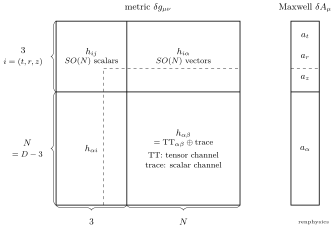
6.1 Field dofs
Section titled “6.1 Field dofs”| Dimension | graviton dofs | Maxwell dofs | total |
|---|---|---|---|
6.2 Channel dofs and master equations (planar/helicity viewpoint)
Section titled “6.2 Channel dofs and master equations (planar/helicity viewpoint)”| Channel (spin under ) | rep dimension (“copies”) | dofs in channel | # master scalars |
|---|---|---|---|
| tensor | |||
| vector | |||
| scalar |
7. Gauge invariance and what “master scalar” means
Section titled “7. Gauge invariance and what “master scalar” means”7.1 The gauge redundancies
Section titled “7.1 The gauge redundancies”Linear perturbations involve:
- diffeomorphisms: ,
- gauge transformations: .
A master variable is a combination of that is gauge invariant under both, and for which the linearized equations reduce to a decoupled 2nd-order equation.
7.2 Two common formalisms
Section titled “7.2 Two common formalisms”- Kodama–Ishibashi (KI): harmonic decomposition on and covariant 2D orbit-space equations. Works for any and .
- Kovtun–Starinets (KS): helicity channels for planar branes in radial gauge (common in holography). Equivalent in content.
This page uses KI notation for general and occasionally translates intuition into helicity language.
8. Master equations in the KI formalism (general )
Section titled “8. Master equations in the KI formalism (general DDD)”In all sectors, after Fourier transforming the master equation takes the universal “Schrödinger/Sturm–Liouville” form
with .
8.1 Tensor channel (exists only for )
Section titled “8.1 Tensor channel (exists only for D≥5D\ge 5D≥5)”- No Maxwell tensor-type perturbations exist, so this sector is purely gravitational.
- The tensor master equation is equivalent to the wave equation for a minimally coupled massless scalar on the same background (after appropriate rescaling and harmonic separation).
Intuition: there is no other field content in Einstein–Maxwell that can transform as a TT rank-2 tensor under the horizon symmetry, so no mixing is possible.
8.2 Vector channel (2 master fields )
Section titled “8.2 Vector channel (2 master fields ΦV±\Phi_{V\pm}ΦV±)”Vector harmonics have eigenvalue on , and define
The vector sector mixes gravitational and Maxwell perturbations but can be diagonalized into two decoupled master fields , each obeying
A standard closed-form expression for the KI vector potentials is
where
8.3 Scalar channel (2 master fields )
Section titled “8.3 Scalar channel (2 master fields ΦS±\Phi_{S\pm}ΦS±)”Scalar harmonics have eigenvalue and define
The scalar sector again mixes gravitational and Maxwell perturbations. KI show it can be diagonalized into two decoupled master fields obeying
The scalar potentials admit a compact representation in terms of auxiliary variables
and
The explicit polynomials and functions are known in closed form but are lengthy; for practical work, it is often best to implement them symbolically once and reuse them for numerics.
9. Specialization: AdS (parity and isospectrality)
Section titled “9. Specialization: AdS4_44 (parity and isospectrality)”9.1 No tensor channel in
Section titled “9.1 No tensor channel in D=4D=4D=4”For we have and there are no TT tensor harmonics on . So there is no “tensor-type” sector.
Perturbations are usually organized instead into:
- odd (axial) parity,
- even (polar) parity.
In Einstein–Maxwell, each parity sector contains coupled gravito-electromagnetic perturbations. After building gauge invariants, each parity typically yields two decoupled master equations (often described as “gravitational-led” and “electromagnetic-led”).
9.2 About isospectrality
Section titled “9.2 About isospectrality”In 4D asymptotically flat RN, the axial and polar potentials are related by a Chandrasekhar/Darboux transformation, which implies isospectrality under appropriately matched boundary conditions.
In AdS, the bulk differential operators can still be related in a similar way, but spectral equivalence can depend on the AdS boundary conditions (because the Darboux map can send one boundary condition to a different Robin condition in the partner problem). So:
- the equations can be “partnered,”
- the spectra can coincide or not depending on which AdS boundary conditions you impose.
This is a key conceptual difference between “isospectral potentials” and “isospectral QNM spectra.”
10. Specialization: AdS (helicity channels and isospectrality breaking down)
Section titled “10. Specialization: AdS5_55 (helicity channels and isospectrality breaking down)”For AdS we have and for planar branes the transverse group is :
- tensor channel = helicity-2 (2 copies),
- vector channel = helicity-1 (2 copies),
- scalar channel = helicity-0 (1 copy).
Einstein–Maxwell therefore gives:
- 1 tensor master equation (2 polarizations),
- 2 vector master equations (each with 2 polarizations),
- 2 scalar master equations (each with 1 polarization),
total dofs.
Unlike , there is no generic Chandrasekhar-type partnering between the distinct helicity channels, and even within a fixed channel the “” potentials are not typically supersymmetric partners. So there is no generic isospectrality tying together the AdS channels.
11. Summary checklist
Section titled “11. Summary checklist”When you perturb an RN–AdS black hole/brane in Einstein–Maxwell:
- Count dofs: , .
- Choose symmetry basis:
- planar: classify under (tensor/vector/scalar),
- spherical in : parity (odd/even),
- KI: tensor/vector/scalar harmonics on .
- Build gauge-invariant variables.
- Reduce to master scalars: In total there are 5 distinct master equations in (tensor + 2 vector + 2 scalar), with multiplicities determined by symmetry. In there is no tensor channel, and the system is often described as odd/even parity (axial/polar) instead.
- Impose physically appropriate boundary conditions (ingoing at the horizon; AdS boundary conditions consistent with your dual CFT sources/vevs).
Adding a scalar field: Einstein–Maxwell–dilaton (EMD)
Section titled “Adding a scalar field: Einstein–Maxwell–dilaton (EMD)”Einstein–Maxwell is the simplest charged matter system. In holography and string-inspired models one often adds a neutral scalar (a “dilaton” or modulus), with a scalar potential and a scalar-dependent gauge kinetic function. This turns the decoupled RN story into a matrix-valued master problem: the tensor channel remains a single equation, the vector channel becomes a coupled system, and the scalar channel becomes a coupled system in general. This structure is systematic and holds in any dimension for backgrounds with a maximally symmetric -dimensional spatial part. See [7] for more details.
Action and background ansatz
Section titled “Action and background ansatz”A very general EMD model (covering most “bottom-up” holographic setups) is
where is the gauge kinetic function and is the scalar potential. (Different normalizations are common; the only essential points are that and are arbitrary functions and can have a nontrivial radial profile.)
A time-independent background with a maximally symmetric -dimensional spatial part can be written as
with and labeling spherical/planar/hyperbolic horizons. In EMD, are all dynamical and typically need to be obtained numerically for a given choice of .
Degrees of freedom: what changes when a scalar is added?
Section titled “Degrees of freedom: what changes when a scalar is added?”A single real scalar field contributes one physical degree of freedom in any .
So the total on-shell dof count becomes
For AdS and AdS:
- : dofs,
- : dofs.
Channel decomposition under (planar/helicity viewpoint)
Section titled “Channel decomposition under SO(D−3)SO(D-3)SO(D−3) (planar/helicity viewpoint)”Fix momentum along one direction. The residual transverse rotation group is . The new scalar field is a singlet, so it contributes only to the scalar channel.
Let .
- Tensor channel dofs (graviton only): .
- Vector channel dofs (graviton + Maxwell): .
- Scalar channel dofs (graviton + Maxwell + scalar): .
This implies the following master-field counting for generic modes:
| Channel | # master scalars | copies per master scalar | total dofs carried |
|---|---|---|---|
| tensor | |||
| vector | |||
| scalar |
As a check:
Special cases
Section titled “Special cases”- AdS (): no tensor channel. You have a vector/odd sector with 2 master scalars and a scalar/even sector with 3 master scalars (gravity + gauge + scalar), totaling 5.
- AdS (): tensor channel exists and has 2 polarizations; the scalar channel carries 3 master scalars (one copy), so total dofs are .
Master equations become a coupled Klein–Gordon system (potential matrices)
Section titled “Master equations become a coupled Klein–Gordon system (potential matrices)”A powerful general result is that you can express all gauge-invariant perturbations in terms of master scalars that satisfy a matrix-valued Klein–Gordon-type system.
For each helicity/channel (tensor/vector/scalar), introduce a vector of master scalars
and a symmetric potential matrix of size .
Then the master system takes the universal form
where is the wave operator on the background metric and contains non-derivative couplings only (no derivative mixing). The matrices are symmetric, and positivity of eigenvalues of an appropriate (possibly deformed) potential matrix gives a sufficient stability criterion. In general, these coupled systems do not fully diagonalize into independent ODEs. Only in special cases (notably Reissner–Nordström, where the scalar is absent/constant) do you recover the fully decoupled KI equations.
When can you further decouple (diagonalize) the coupled systems? (See more)
Section titled “When can you further decouple (diagonalize) the coupled systems? (See more)”Even though the master equations are “only” coupled by a potential matrix, you still cannot usually diagonalize them by a constant change of basis, because the eigenvectors typically depend on . Generically one can treat the vector/scalar channel as a genuinely coupled system.
- In the vector channel, a necessary and sufficient condition for full decoupling into two independent equations is that the eigenvectors of the potential matrix are -independent. A simple equivalent condition is that
If this holds, the two decoupled potentials are just the two eigenvalues of .
- In the scalar channel, decoupling would require an -independent eigenbasis for the matrix, which is rarer.
Practical workflow: perturbations in EMD models
Section titled “Practical workflow: perturbations in EMD models”Most holographic EMD backgrounds are not analytic, so a robust workflow is:
- Background: solve the background ODEs for numerically for your chosen .
- Choose a channel (tensor/vector/scalar) using the residual symmetry (helicity under for planar branes; tensor/vector/scalar harmonics for KI on ).
- Build gauge invariants:
- tensor: already gauge invariant,
- vector: gauge invariants from ,
- scalar: gauge invariants from (schematically).
- Solve the master system:
- tensor: one ODE,
- vector: coupled ODE system,
- scalar: coupled ODE system.
- Boundary conditions:
- impose ingoing conditions at the horizon (matrix Frobenius expansion),
- impose the AdS boundary conditions appropriate to your quantization (Dirichlet/Neumann/mixed for ; standard source/vev conditions for metric and gauge field).
- Spectra/Green’s functions: compute quasinormal modes or retarded correlators by solving the coupled boundary value problem (e.g. determinant method: build a basis of ingoing solutions and look for vanishing sources).
Final remarks: Exceptional modes and degenerations
Section titled “Final remarks: Exceptional modes and degenerations”The sector decomposition and master-field diagonalizations described above are for generic modes. At special momenta/harmonics, some of the usual constructions degenerate. This reflects symmetry enhancement and constraints: some modes become non‑radiative (pure gauge or parameter shifts), even though the underlying linearized equations remain regular.
Planar branes: why is special
Section titled “Planar branes: why k=0k=0k=0 is special”For a planar brane, perturbations are usually expanded as . For , the momentum selects a direction and the little group is , giving the familiar tensor/vector/scalar channels. At strictly there is no preferred direction and the symmetry enlarges to , so the distinction between “sound/shear/tensor’’ channels ceases to be intrinsic; different finite‑ channels can coincide by symmetry.
Technically, many convenient gauge‑invariant variables (and some diagonalization steps) are constructed assuming and contain explicit divisions by (or by harmonic combinations that reduce to in the planar case), so taking can make the chosen variables ill‑defined even when the physics is smooth.
Spherical horizons: lowest harmonics () are exceptional
Section titled “Spherical horizons: lowest harmonics (ℓ=0,1\ell=0,1ℓ=0,1) are exceptional”On compact horizons (e.g. ), the harmonic decomposition introduces discrete modes. The lowest harmonics are special:
- For vector-type perturbations, the exceptional case (including the vector harmonic on ) carries no gravitational dynamical degree of freedom in the source-free problem; it corresponds physically to adding infinitesimal rotation.
- For scalar-type perturbations, the mode changes the available gauge generators and harmonic building blocks; the generic gauge-invariant variables of the master-equation construction are not defined, and the physical system reduces (often to a parameter-shift mode plus possibly matter fluctuations).
EMD systems: couplings can vanish and the effective rank can drop
Section titled “EMD systems: couplings can vanish and the effective rank can drop”In EMD theories the master equations are typically coupled (vector: , scalar: ), and full decoupling is not generic. But the potential-matrix entries often carry explicit factors such as and background-profile-dependent terms (from , , , , etc.), so mixing can disappear in special limits (including planar ) or for special backgrounds.
References
Section titled “References”[1] S. Chandrasekhar, The Mathematical Theory of Black Holes (Oxford University Press, Oxford; New York, 1983).
[2] H. Kodama and A. Ishibashi, A Master Equation for Gravitational Perturbations of Maximally Symmetric Black Holes in Higher Dimensions, Prog. Theor. Phys. 110, 701–722 (2003) [arXiv:hep-th/0305147].
[3] H. Kodama and A. Ishibashi, Master Equations for Perturbations of Generalised Static Black Holes with Charge in Higher Dimensions, Prog. Theor. Phys. 111, 29–73 (2004) [arXiv:hep-th/0308128].
[4] A. Ishibashi and H. Kodama, Perturbations and Stability of Static Black Holes in Higher Dimensions, Prog. Theor. Phys. Suppl. 189, 165–209 (2011) [arXiv:1103.6148].
[5] P. K. Kovtun and A. O. Starinets, Quasinormal modes and holography, Phys. Rev. D 72, 086009 (2005) [arXiv:hep-th/0506184].
[6] Y. Matsuo, S.-J. Sin, S. Takeuchi, T. Tsukioka and C.-M. Yoo, Sound Modes in Holographic Hydrodynamics for Charged AdS Black Hole, Nucl. Phys. B 820, 593–619 (2009) [arXiv:0901.0610].
[7] A. Jansen, A. Rostworowski and M. Rutkowski, Master equations and stability of Einstein–Maxwell–scalar black holes, JHEP 12, 036 (2019) [arXiv:1909.04049].